Marimo Pair Integrates AI Agents with Reactive Notebooks to Bridge Live State and Coding Workflows

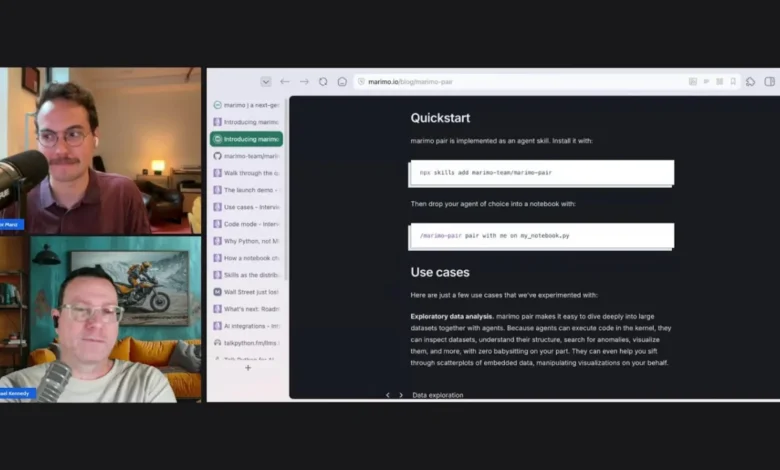
The landscape of artificial intelligence in software development has shifted from simple code completion to the deployment of autonomous coding agents capable of scoping features, editing files, and executing tests. However, a significant technological barrier has persisted between these agents and the specific requirements of data science: the divide between static files on a disk and the live, in-memory state of a running program. While traditional software engineering revolves around source code saved to a filesystem, data work is inherently exploratory, relying on the immediate feedback of variables, data frames, and visualizations held in a computer’s RAM. Marimo, the developer of a reactive Python notebook architecture, has addressed this gap with the release of Marimo Pair, a new agent "skill" that allows AI entities to operate within a live execution environment.
The Evolution of the Reactive Notebook Environment
To understand the impact of Marimo Pair, it is necessary to examine the evolution of the computational notebook. For over a decade, the Jupyter ecosystem has dominated data science, providing a "scratchpad" where code and output coexist. However, traditional notebooks often suffer from the "hidden state" problem, where cells can be run out of order, leading to a kernel state that does not match the visible code on the screen. This inconsistency creates a high cognitive overhead for human developers and renders the environment nearly impossible for AI agents to navigate reliably.
Marimo entered the market as a solution to these structural flaws. Unlike traditional notebooks that save to the proprietary .ipynb JSON format, Marimo notebooks are stored as pure Python files. More importantly, Marimo is reactive. It tracks the dependencies between variables across different cells. If a variable is updated in one cell, all descendant cells are automatically re-executed. This deterministic execution order ensures that the notebook’s state is always synchronized with its code. By establishing this rigorous framework, Marimo created the necessary foundation for an AI agent to "understand" the relationship between different parts of a program in real-time.
Bridging Disk and Memory with Marimo Pair
Current coding agents, such as Anthropic’s Claude Code or OpenAI’s Codex, primarily interact with a project by reading and writing files. While effective for building web applications or CLI tools, this approach fails in data science because the "truth" of the work often resides in a loaded data frame or a plot rather than the script that generated it. Marimo Pair changes this dynamic by dropping the agent directly into the active Python kernel.
Technically, Marimo Pair is distributed as an agent skill—a package of instructions and tools that teaches an LLM how to interact with a specific environment. Once installed via package managers like npm or uv, the skill equips the agent with a "run Python" tool. This tool allows the agent to execute code within the Marimo kernel, enabling it to inspect live variables, query data frame schemas, and trigger UI updates.
Instead of the agent guessing the contents of a CSV file based on a read_csv command in a script, it can now execute a command to see the first five rows, check for null values, and verify the data types of every column. This live inspection allows the agent to course-correct in real-time. If an agent attempts to plot a column that contains strings instead of integers, it immediately receives the traceback from the kernel and can fix the code before the user even intervenes.
The Shift Toward Agentic Data Exploration
The introduction of Marimo Pair marks a transition from "vibe coding"—where developers rely on the LLM to guess the correct logic—to verified agentic exploration. Trevor Manz, a lead developer at Marimo, highlights that this integration allows the notebook to become a "shared canvas." In this workflow, the human and the AI act as true pair programmers. A user might circle a cluster of points on an interactive chart, and the agent, seeing the indices of those points in the kernel’s memory, can immediately answer questions about why those specific data points are outliers.
This capability significantly lowers the barrier to entry for complex data tasks. For example, loading data from legacy formats like Excel often requires bespoke parsers and specific library knowledge (such as openpyxl or pandas sheet arguments). With Marimo Pair, a user can simply drag an Excel file into the environment and instruct the agent to "load the third sheet and create a pair plot of the quantitative axes." The agent queries the live state to identify which columns are quantitative, writes the necessary code, and the chart updates instantly in the Marimo UI.
Token Economics and Context Efficiency
One of the most critical challenges in AI development is managing the "context window"—the limited amount of information a model can process at one time. Traditional agents often "pollute" their context window by reading thousands of lines of irrelevant file data or terminal logs to find a single variable value.
Marimo Pair introduces a more efficient form of "token economics." By allowing the agent to ask targeted questions of the kernel (e.g., print(df.columns)), the agent only brings the most relevant information back into its context. It no longer needs to see the entire 10,000-line notebook file to understand what is happening in the current cell. It can focus its attention on the specific variables and logic currently under discussion. This targeted approach not only makes the agent more accurate but also reduces the cost and latency associated with high-token-usage prompts.
Market Context and the "SaaSpocalypse"
The release of Marimo Pair arrives at a time of intense competition among AI tool providers. Recent industry data from 2026 suggests a highly fragmented market where Claude Code has taken a significant lead among terminal-based agents, followed by Microsoft’s GitHub Copilot, Cursor, and Codex.
The industry is also reacting to the "SaaSpocalypse"—a term coined after Anthropic released a series of markdown-based "skills" that demonstrated how simple, reusable instruction sets could replace complex, expensive proprietary integrations. By choosing to distribute Marimo Pair as a markdown-based skill rather than a locked-in proprietary plugin, the Marimo team has ensured that their tool remains interoperable. Whether a developer uses the Claude terminal, the Cursor editor, or an open-source model through OpenCode, they can utilize the same Marimo Pair skill to drive their data analysis.
Official Responses and Industry Implications
Industry analysts view the move as a direct challenge to the "walled garden" approach of larger tech giants. By decoupling the agent harness from the execution environment, Marimo is betting on a future where developers move fluidly between different AI models while maintaining a consistent workspace.
"We want Marimo to be a useful tool to any agent," Manz stated during the launch. "If we would have tried to build only for one model a year ago, it would have been wasted effort given how fast these platforms change. Our priority is making sure that regardless of what agent you use, you have notebooks as a useful tool for producing reproducible artifacts."
This approach has broad implications for reproducibility in science and finance. Because the agent is forced to build the notebook cell-by-cell within Marimo’s reactive constraints, the resulting artifact is guaranteed to run for other users. This eliminates the common frustration of "one-shot" AI-generated scripts that work once in a specific terminal session but fail when saved to a file.
Future Roadmap: Remote Kernels and GPU Integration
The roadmap for Marimo Pair includes deeper integration with high-performance computing infrastructure. The team recently announced Molab, a cloud-hosted version of Marimo running on CoreWeave infrastructure. This allows users to connect their local AI agents to remote kernels equipped with powerful GPUs.
In this scenario, a developer could run a lightweight agent on their laptop while the actual data processing and model training occur on a remote server. The agent maintains the same "live state" access to the remote GPU memory as it would on a local machine. Furthermore, Marimo is working on real-time collaboration features that would allow multiple human users and multiple AI agents to interact with the same kernel simultaneously, creating a multi-agent environment for complex data modeling.
Conclusion
Marimo Pair represents a significant step toward making AI agents viable for the nuances of data science and exploratory programming. By breaking down the wall between the filesystem and the live kernel, it allows agents to "see" the data as it exists in memory, leading to more accurate, efficient, and reproducible results. As the industry moves toward more autonomous workflows, the ability for AI to interact with live state—rather than just static code—will likely become the standard for all technical computing environments. For now, Marimo has positioned itself at the forefront of this shift, offering a glimpse into a future where the notebook is not just a document, but a living, shared canvas for human and machine intelligence.