AWS Introduces Amazon Bedrock AgentCore Consent Portal to Streamline OAuth Session Binding and Secure AI Agent Integrations

The rapid proliferation of enterprise artificial intelligence agents has fundamentally transformed how organizations interact with third-party software services. As these autonomous agents increasingly require delegated access to vital developer and communication platforms—including GitHub, Slack, Jira, and various cloud utilities—on behalf of human operators, the underlying security architecture governing these interactions has faced unprecedented demands. Historically, when an AI agent required authorization to invoke tools on a user’s behalf, the implementing organization was forced to construct and maintain custom session binding infrastructure. This cumbersome process demanded the deployment of public HTTPS callback endpoints, manual management of complex browser states, custom handling of authorization Universal Resource Locators (URLs), and explicit calls to token completion APIs.
To alleviate this administrative burden and establish a standardized, highly secure paradigm for identity federation, Amazon Web Services (AWS) has officially announced the launch of the Consent portal for AgentCore Identity, an advanced capability embedded within Amazon Bedrock AgentCore. This fully managed web experience and session binding endpoint drastically simplifies the three-legged OAuth (3LO)—also known as the OAuth 2.0 authorization code flow—between corporate identity providers (IdPs), managed agent gateways, and external service providers. By centralizing session binding within a native AWS construct, enterprise administrators can effortlessly deploy secure consent interfaces, delegate granular tool access to developers, and ensure that per-user tokens are securely isolated within the AgentCore Identity token vault.
Background Context and the Evolution of Agentic Security
The emergence of Model Context Protocol (MCP) clients and advanced integrated development environment (IDE) assistants—such as Kiro, Claude Code, Cursor, and Visual Studio Code—has accelerated the adoption of multi-tool AI workflows. Developers routinely rely on autonomous coding assistants to inspect repositories, commit code, review pull requests, and communicate status updates across team channels. However, these capabilities introduce significant security challenges, chief among them being the principle of least privilege and user accountability.
In traditional enterprise environments, sharing a single service account token across an entire engineering team creates a massive security vulnerability, obscuring audit trails and violating compliance mandates. Conversely, implementing per-user OAuth flows natively within custom applications historically required hundreds of lines of boilerplate code, intricate session management logic, and continuous maintenance to protect sensitive client secrets and authorization codes. Furthermore, companies utilizing robust enterprise identity providers like Okta, Microsoft Entra ID, Auth0, or Ping Identity needed a seamless bridge to connect corporate single sign-on (SSO) credentials with outward-facing developer tools without compromising user experience or security posture.
The introduction of the AgentCore Identity Consent portal directly addresses these structural friction points. By decoupling the consent and session binding mechanics from the application codebase, AWS enables organizations to establish a unified, auditable security baseline for all AI agent interactions across cloud environments.
Architecture and Technical Mechanics of the Consent Portal
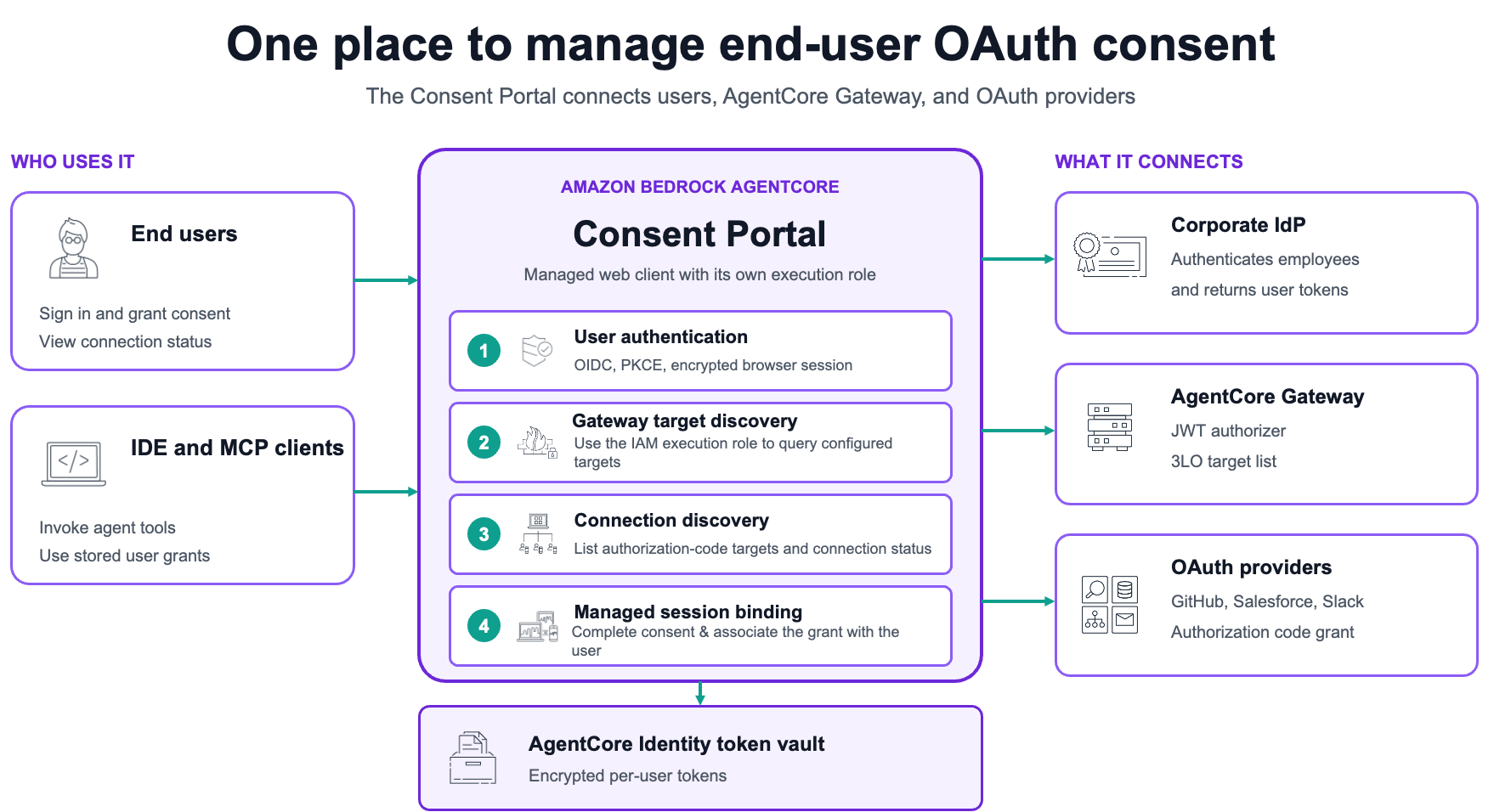
The newly introduced Consent portal operates as an integrated nexus within the Amazon Bedrock AgentCore ecosystem. When an administrator provisions a Consent portal for a specific AgentCore Gateway, the platform generates a dedicated, secure endpoint following a structured regional naming convention. The architectural workflow is designed to enforce strict security boundaries at every stage of the authentication and authorization lifecycle.
The process initiates when an administrator configures the corporate identity provider and defines the gateway targets—such as independent connections to GitHub and Slack—associating each with its respective outbound OAuth provider. Once the administrator shares the generated Consent portal URL with end users, the user journey begins with corporate authentication.
- Corporate Authentication: The user navigates to the Consent portal URL and is immediately redirected to the organization’s corporate IdP (e.g., Okta or Microsoft Entra ID). Upon successful authentication, the IdP issues a signed JSON Web Token (JWT) access token, verifying the user’s corporate identity.
- Target Discovery and Presentation: Utilizing an assigned AWS Identity and Access Management (IAM) execution role, the portal queries the AgentCore Gateway to discover configured targets. It then presents a clean, centralized web dashboard displaying the available provider connections—such as GitHub or Slack—alongside their current authorization status.
- Independent Provider Consent: The user can review the granular scopes requested by each application and choose to grant consent independently. For instance, a developer can authorize GitHub access for code repository inspection while leaving Slack disconnected, or vice versa. Clicking "Connect" initiates the standard OAuth 2.0 authorization code flow with the external provider.
- Session Binding and Token Vault Storage: Once the external provider returns the authorization code, the managed session binding endpoint intercepts the response. AgentCore Identity securely maps this OAuth grant directly to the authenticated user’s identity, completing the session binding process without exposing sensitive tokens to the client application. The resulting per-user tokens are then securely archived within the AgentCore Identity token vault.
Subsequent tool invocations initiated by the AI agent within the developer’s IDE automatically leverage the pre-stored, user-specific token. This eliminates the need for repeated authorization prompts, balancing rigorous security compliance with frictionless developer productivity.
Step-by-Step Implementation Scenario: Equipping a Development Assistant
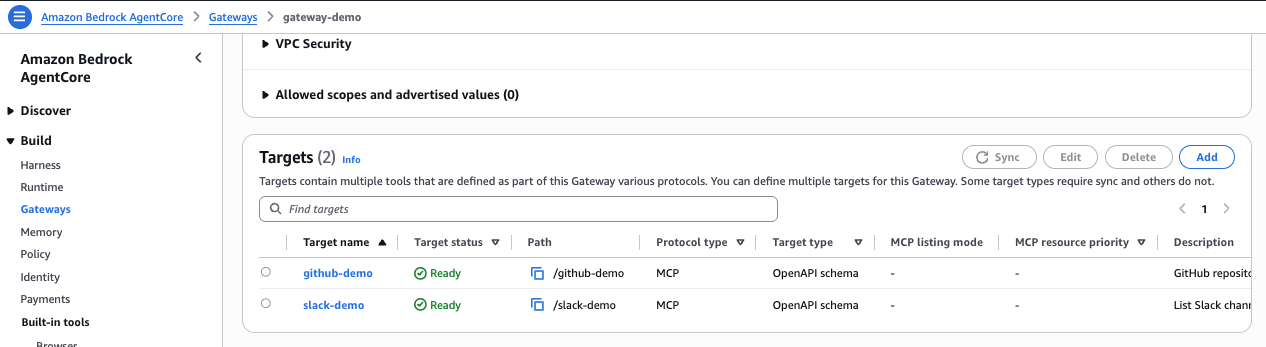
To illustrate the practical deployment and user experience of the Consent portal, industry analysts and AWS practitioners point to a standard enterprise implementation scenario involving a fictitious software development firm, Example Corp.
Example Corp seeks to provide its engineering workforce with an advanced AI coding assistant managed via an AgentCore Gateway. The assistant requires secure, audited access to two primary external services: a GitHub organization for repository management and a Slack workspace for team collaboration. The corporate architecture relies on a centralized IdP for employee credential management, and compliance mandates dictate that all outbound OAuth grants must remain strictly bound to the individual employee who approved them.
Administrative Configuration Walkthrough
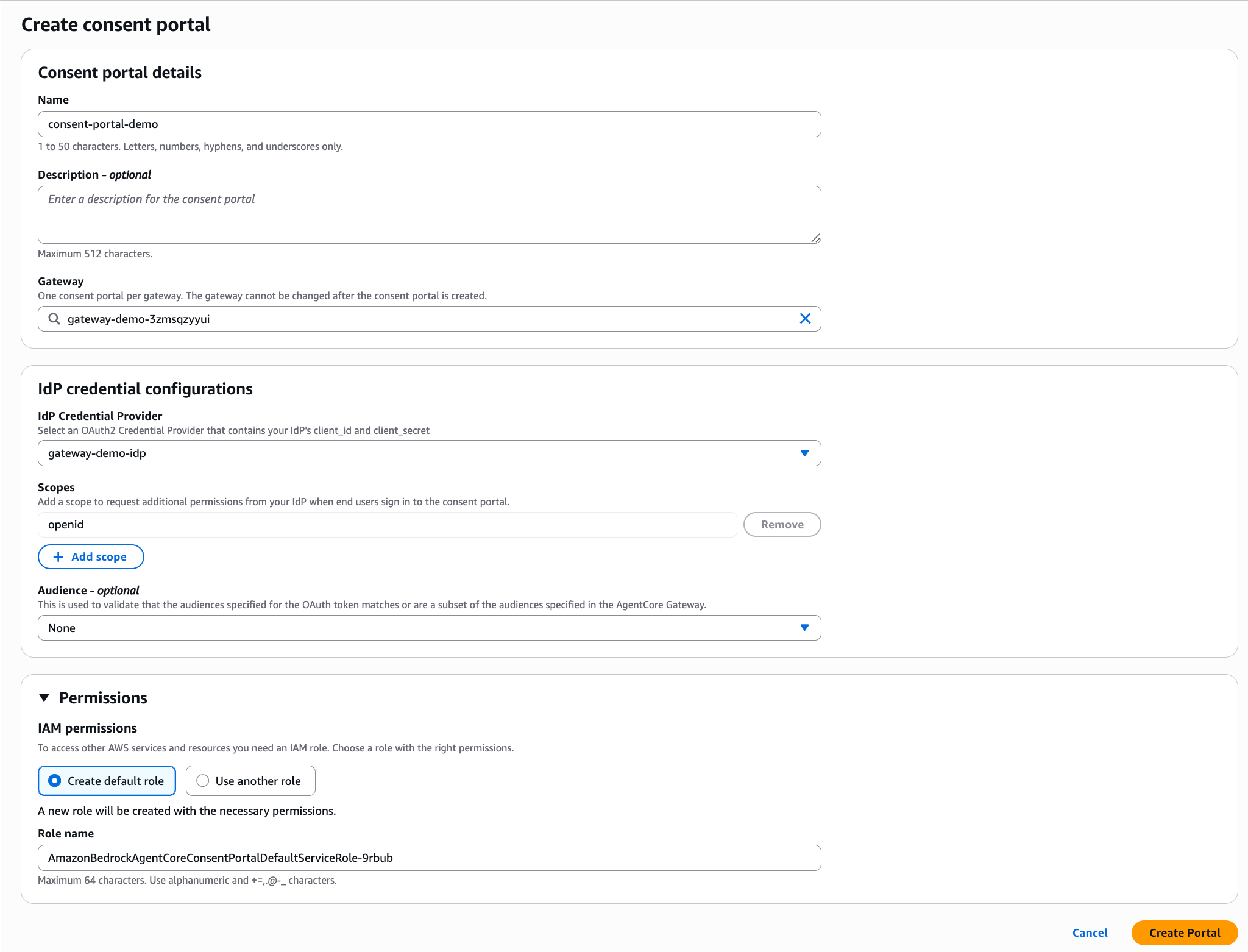
Deploying the Consent portal requires a sequence of precise administrative configurations across the AWS Management Console and the corporate IdP.
Step 1: Administrator Permissions and Execution Role
The administrator must possess an IAM policy granting comprehensive permissions to manage Consent portals, OAuth2 credential providers, gateways, and gateway targets. Additionally, the policy must permit the creation and passing of the default service role (AmazonBedrockAgentCoreConsentPortalDefaultServiceRole-<suffix>).
Step 2: Corporate IdP Application Registration
The administrator registers a new application within the corporate IdP, configuring the primary redirect callback URL to point directly to the portal’s callback endpoint (<portal-url>/callback). The IdP must be configured to issue a signed JWT access token—utilizing custom authorization servers or specific audience parameters in platforms like Okta or Auth0—to ensure the portal can accurately validate incoming user sessions.
Step 3: Creating the IdP and Outbound Credential Providers
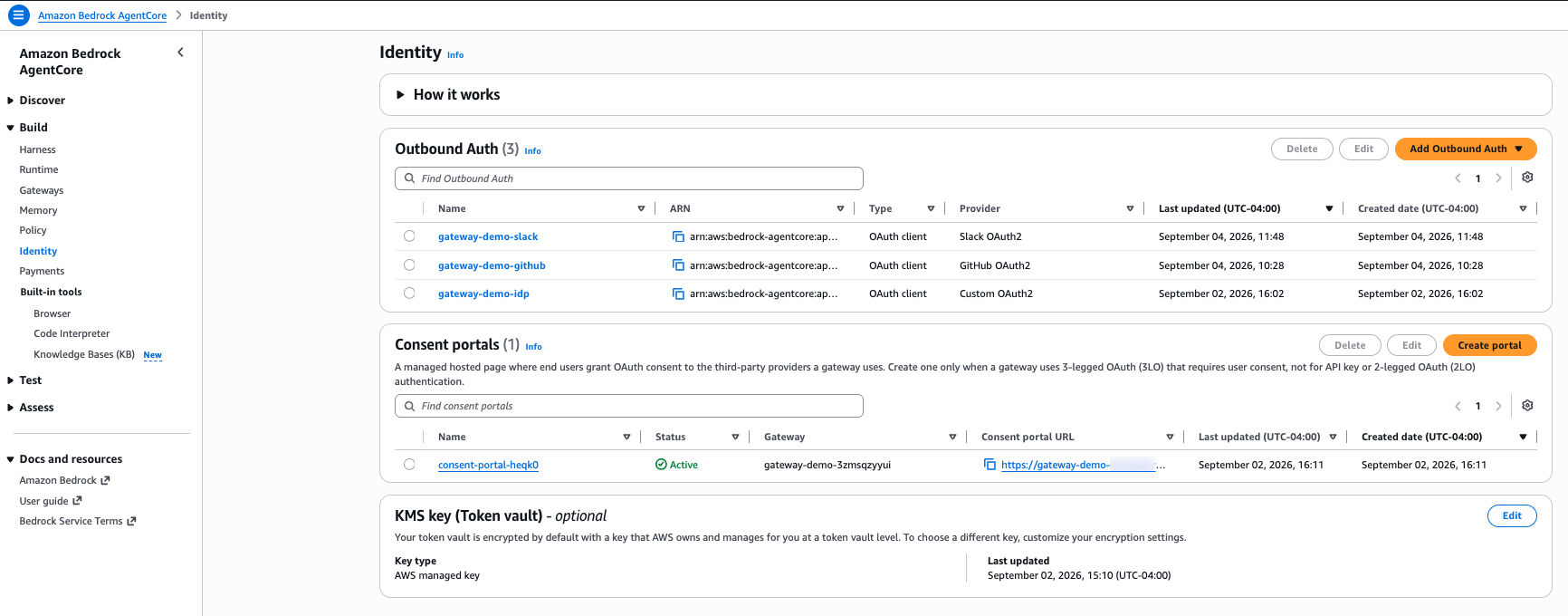
Within the AWS Management Console under the AgentCore Identity page, the administrator creates an OAuth2 credential provider for the corporate IdP sign-in, supplying the necessary client ID and client secret. Separate outbound credential providers are then established for GitHub and Slack, mapping their respective client configurations and requested OAuth scopes (e.g., read:user, repo for GitHub).
Step 4: Gateway Target Integration
The administrator associates each gateway target with its corresponding outbound OAuth provider and configures the default return URL to point to the managed session binding endpoint (<portal-url>/connect/callback).
Step 5: Portal Provisioning
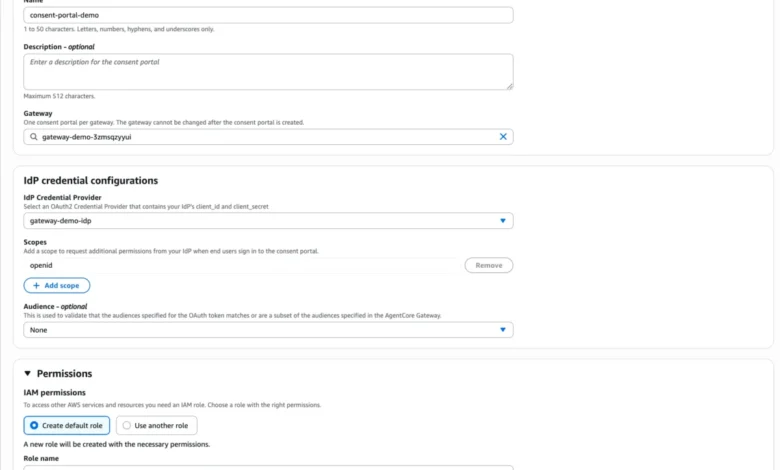
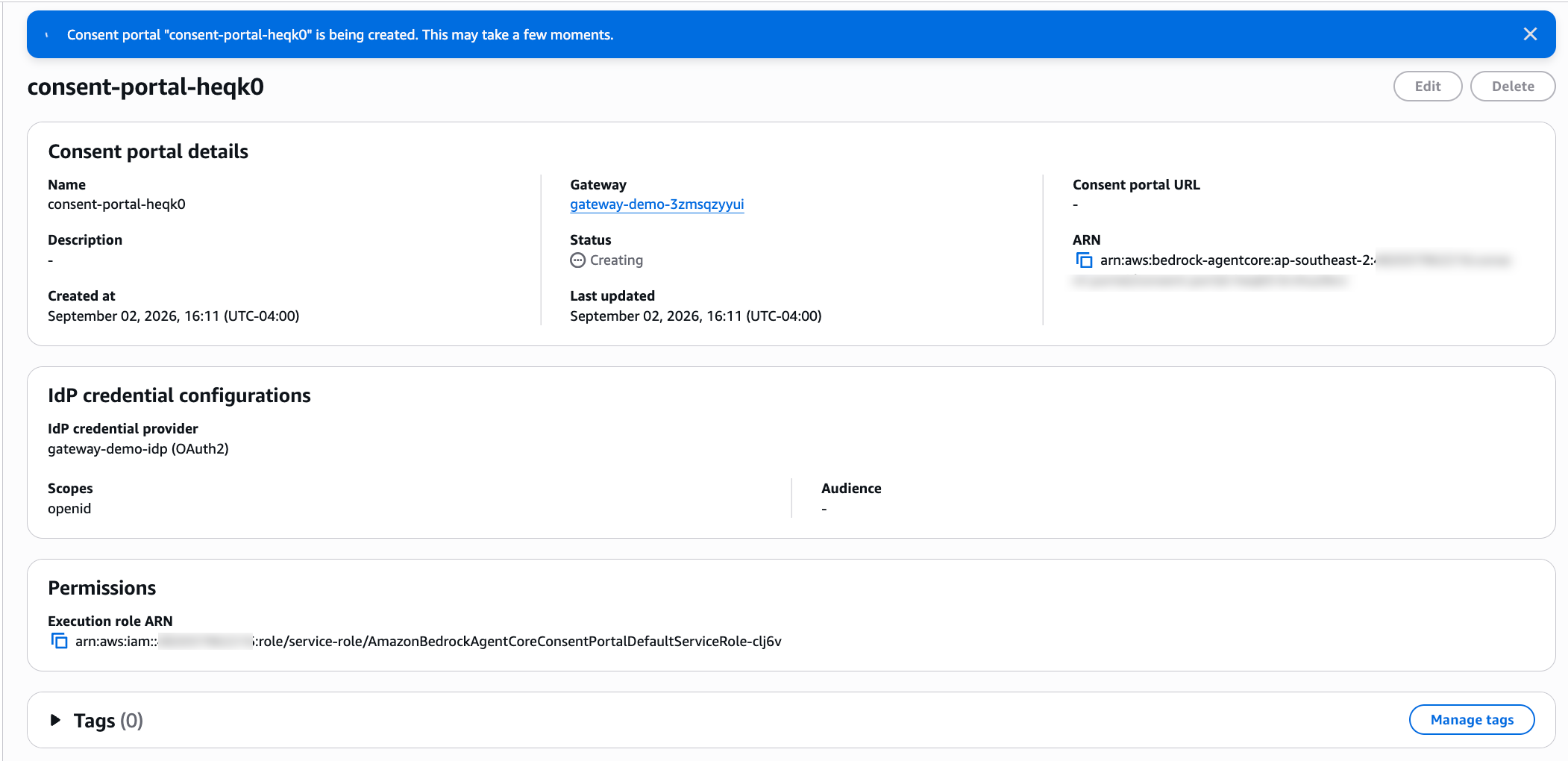
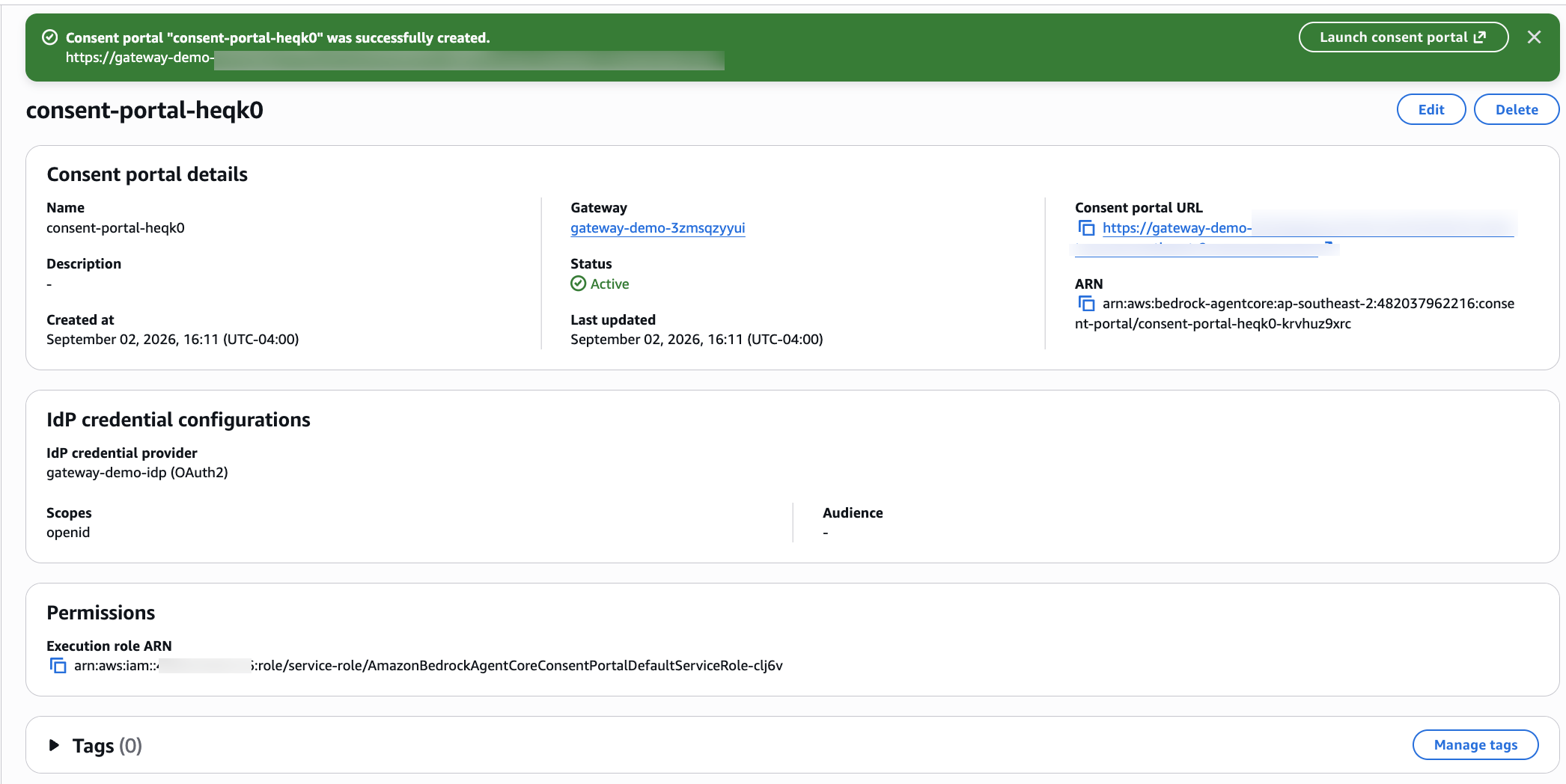
The administrator navigates to the Consent portals section within the AgentCore Identity console and initiates the creation wizard. After selecting the appropriate gateway, execution role, and sign-in credential provider, the provisioning status transitions from "Creating" to "Active," generating the unique Consent portal URL.
Step 6: Finalizing Callbacks and Distribution
The administrator registers the final callback URLs within the respective external provider applications and distributes the portal URL to the engineering team.
End-User Experience and OAuth State Verification
Upon receiving the portal URL, a developer at Example Corp accesses the web interface and signs in using corporate SSO credentials. The landing page displays the discovered GitHub and Slack integrations, both initially marked as "Not connected."
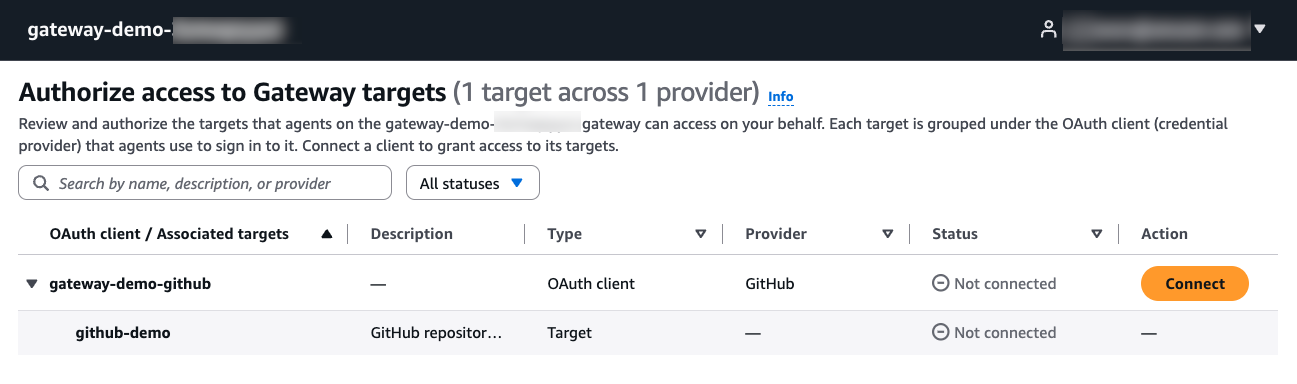
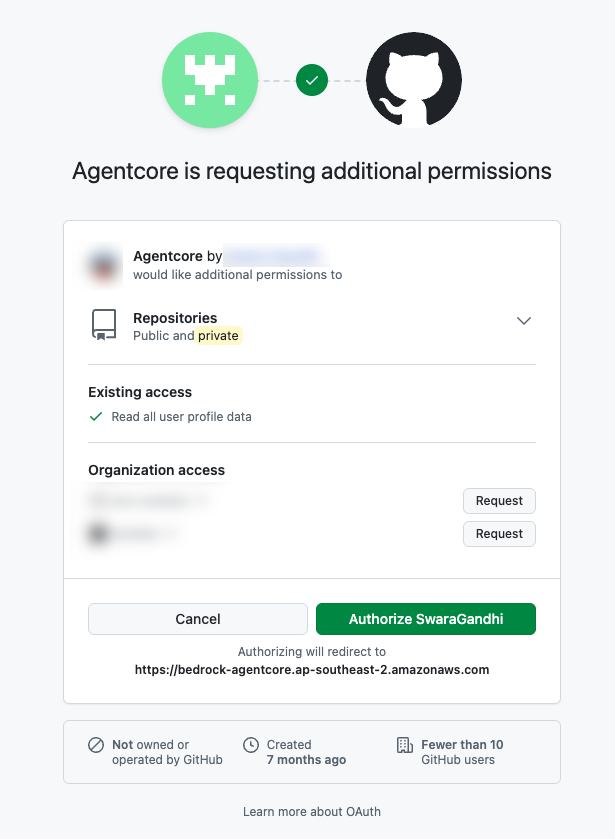
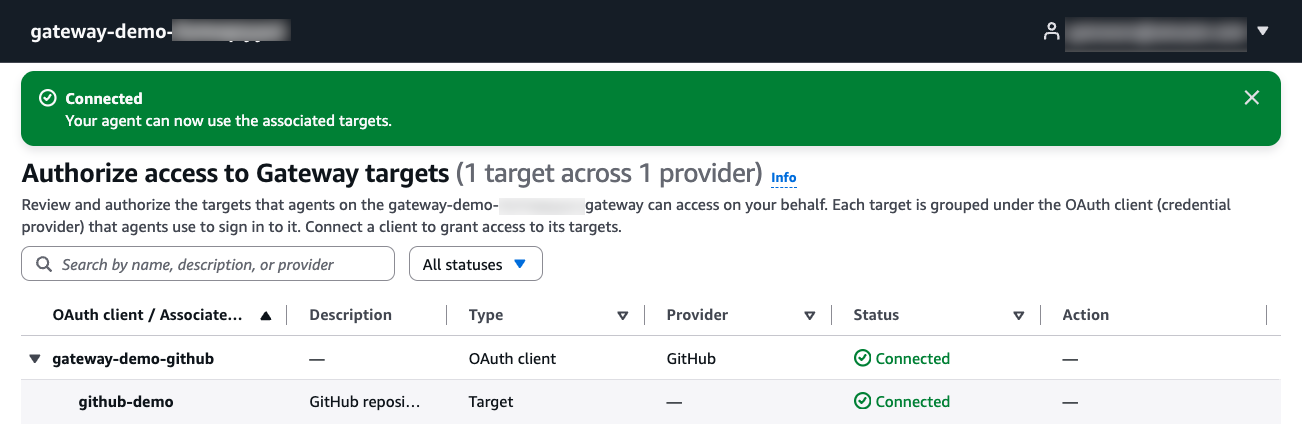
When the developer clicks "Connect" next to GitHub, the browser redirects to the GitHub OAuth authorization page, explicitly detailing the requested organization access and permission scopes. Upon approval, GitHub redirects the request back to the managed session binding endpoint. The portal instantly updates the UI to reflect a "Connected" status for GitHub, while Slack remains unlinked. This modular capability proves essential for teams requiring fine-grained control over external service integrations.
Comprehensive Auditability and Compliance via AWS CloudTrail
In enterprise deployments, maintaining verifiable audit trails for AI agent activity is a strict regulatory requirement. Amazon Bedrock AgentCore integrates natively with AWS CloudTrail to record all consent-related operations, ensuring complete visibility into token generation and access requests.
Security and compliance officers can filter CloudTrail event histories by the event source bedrock-agentcore.amazonaws.com to inspect critical management events, including:
CreateConsentPortaland configuration modifications.CreateOauth2CredentialProviderand credential lifecycle updates.GetResourceOauth2Token, which captures vital telemetry when an agent retrieves a user-specific token.
Analysis of a typical GetResourceOauth2Token event reveals precise metadata—such as the AWS Region, assumed role ARN, resource credential provider name, and requested scopes—while automatically redacting sensitive token strings and state values to maintain cryptographic security. In the event of an authentication failure, administrators can leverage the accompanying errorCode and errorMessage parameters, paired with exact timestamps and region markers, to rapidly diagnose and remediate misconfigurations.
Implications and Future Outlook for Agentic AI Infrastructure
The introduction of the Amazon Bedrock AgentCore Consent portal marks a significant maturation point in enterprise generative AI governance. By shifting the operational burden of session binding, callback routing, and token vault management from custom application code to a fully managed AWS service, enterprises can accelerate the deployment of secure AI assistants without cutting corners on compliance.
Industry analysts note that as Model Context Protocol clients and sophisticated IDE assistants become standard fixtures in software engineering, finance, and healthcare, the demand for bulletproof identity federation will only escalate. Solutions that gracefully bridge the gap between corporate identity management and external API authorization protocols will ultimately dictate the speed and scale at which organizations can safely adopt autonomous agents. With AgentCore Identity, AWS has established a robust template for secure, user-centric agent delegation, setting a new benchmark for enterprise cloud architecture.