The landscape of Large Language Model (LLM) deployment has undergone a radical transformation over the past eighteen months. As of 2026, the once-yawning chasm between the capabilities of open-weight models and proprietary, closed-source APIs has narrowed to a negligible gap for the vast majority of commercial applications. For organizations, the decision-making process has shifted away from the pursuit of raw benchmark dominance toward a nuanced calculation of data sovereignty, operational overhead, and total cost of ownership. This transition marks the maturation of the generative AI sector, where model selection is no longer a philosophical stance but a pragmatic engineering necessity.
The current market is defined by a clear divergence: proprietary models, such as those in the OpenAI GPT-5, Anthropic Claude, and Google Gemini families, remain the gold standard for high-complexity reasoning and rapid, frictionless integration. Conversely, open-weight ecosystems—spearheaded by Meta’s Llama 4, DeepSeek’s reasoning-optimized architectures, and Alibaba’s Qwen 3.5—have democratized access to frontier-level performance, allowing enterprises to maintain control over their infrastructure and sensitive data.
The Chronology of Convergence
To understand the current market state, one must look at the rapid evolution of the ecosystem. In 2023, the industry was characterized by a "frontier-first" mentality, where proprietary models held a decisive lead in reasoning, coding, and instruction-following. At that time, open-weight alternatives were largely experimental, often trailing proprietary benchmarks by significant margins and lacking the necessary infrastructure support for large-scale production.
By late 2024, the release of high-performance, smaller-parameter models began to shift the economics. The emergence of efficient quantization techniques and optimized serving engines like vLLM allowed organizations to run powerful models on commodity hardware. By 2025, the entry of DeepSeek and Qwen into the high-end leaderboard space forced a price war in the API market. Data from industry analysts suggests that LLM API pricing has plummeted by approximately 80% since early 2023, as cloud providers and model labs raced to capture market share amidst the commoditization of base-model intelligence.
A Data-Driven Decision Framework
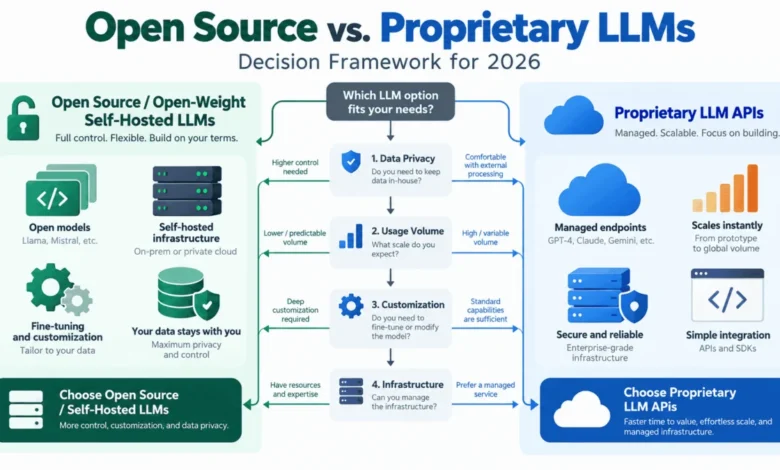
For engineering leads and Chief Data Officers, the decision between open and proprietary architectures now rests on a structured, four-pillar framework. This framework moves beyond the hype of leaderboard scores to focus on the operational reality of the enterprise.
1. Data Sensitivity and Regulatory Compliance
For sectors governed by stringent data protection laws—such as healthcare (HIPAA), finance (PII/GDPR), and defense—the decision is often predetermined. When data cannot legally or contractually traverse third-party APIs, self-hosted open-weight models are the only viable solution. The ability to deploy a model within a "private cloud" or air-gapped environment provides a level of security that proprietary API providers, despite their rigorous enterprise agreements, cannot always satisfy for every regulatory jurisdiction.
2. Usage Volume and Economic Scaling
The cost-benefit analysis of LLM usage is highly non-linear. At low volumes—typically defined as under one million tokens per month—the overhead of managing a self-hosted model, including the costs of GPU procurement, security hardening, and MLOps personnel, far outweighs the simplicity of a pay-as-you-go API.
However, as usage scales to the 10-million-token-per-month threshold, the economics invert. High-volume enterprises that utilize hosted inference platforms like Together AI, Groq, or Replicate can realize a 4x to 10x reduction in costs compared to frontier proprietary APIs. At the highest tiers, where usage exceeds 500,000 requests per day, full self-hosting on reserved GPU infrastructure becomes the industry-standard path for maximizing long-term cost predictability.
3. Customization and Model Ownership
Proprietary APIs are optimized for general-purpose utility. While some providers offer fine-tuning capabilities, these are often constrained by "walled garden" limitations—users do not own the resulting model weights and are restricted by the provider’s data usage policies. Open-weight models offer a structural advantage here: they allow for deep, domain-specific fine-tuning on proprietary datasets. For companies operating in specialized niches—such as legal document analysis or clinical genomics—this capability to "own" the model and its specialized weights is a significant competitive moat.
4. Infrastructure and Operational Capacity
The "hidden" cost of open-source adoption is infrastructure expertise. Maintaining a production-grade LLM stack requires specialized knowledge of model serving, performance monitoring, and disaster recovery. For teams lacking a dedicated MLOps function, the "middle path"—utilizing hosted open-model APIs—has become the preferred strategy. This approach grants the cost and licensing benefits of open-weight models while offloading the heavy lifting of infrastructure maintenance to specialized third-party providers.
The Performance Reality: Bridging the Gap
Recent testing indicates that for roughly 80% of enterprise tasks—including text classification, summarization, and retrieval-augmented generation (RAG)—current open-weight models are functionally equivalent to their proprietary counterparts. The remaining 20% of use cases, which require advanced multi-step logical reasoning or ultra-long-context synthesis, still favor frontier proprietary models.
However, the "capability gap" is becoming increasingly irrelevant as model-distillation techniques allow smaller, open models to mimic the reasoning patterns of larger, proprietary frontier models. This trend suggests that the future of enterprise AI will be increasingly hybrid: simple, repetitive tasks will be offloaded to low-cost, self-hosted open models, while complex, high-value queries will be routed to proprietary frontier APIs.
Implications for Future Strategy
The rapid decline in API pricing and the proliferation of high-quality open-weight models present a significant risk of vendor lock-in. As organizations build deeper integrations—leveraging custom assistant APIs or specialized structured output formats—they increase their "exit costs." Industry experts advise keeping the LLM layer as a modular, pluggable component of the software architecture. By utilizing model-agnostic prompt templates and standardized integration patterns, companies can maintain the flexibility to switch providers as the market continues to evolve.
Moreover, the regulatory landscape is catching up to these technical shifts. European data governance frameworks, for instance, are increasingly viewing self-hosted, open-weight models as a more compliant path for domestic AI development. As more nations pursue "AI sovereignty," the demand for open-weight models that can be audited, inspected, and controlled will likely accelerate.
Conclusion: A New Era of Pragmatism
The debate between open-source and proprietary models is no longer a binary choice between "free" and "premium." It is a sophisticated calculation of resource allocation. The 2026 landscape is defined by a shift toward pragmatism: if your infrastructure can support it, open-weight models offer unmatched control and long-term cost efficiency; if your priority is time-to-market and operational simplicity, proprietary APIs remain the most efficient conduit to production.
The winners in this market will not be those who choose one side of the divide, but those who build flexible systems capable of leveraging both. As the capability gap continues to close, the differentiator for enterprises will move away from which model they use, and toward how effectively they integrate these models into their core business workflows to drive verifiable, scalable value. The era of blind reliance on frontier models is over; the era of architectural precision has begun.