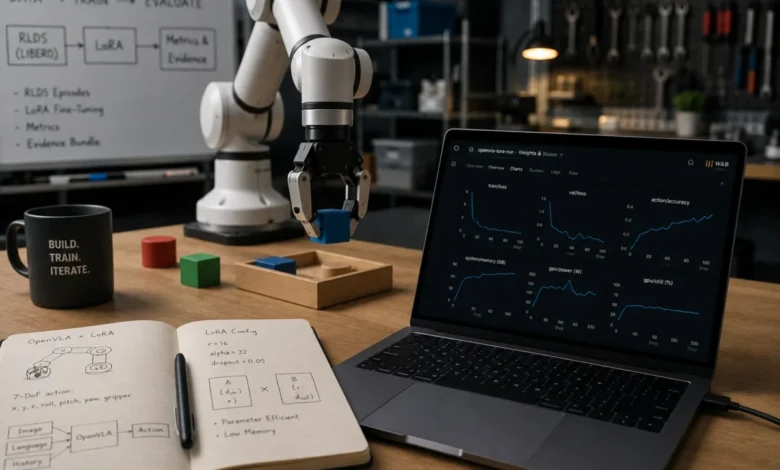
The burgeoning field of embodied AI is rapidly advancing, driven by models capable of understanding complex visual and linguistic cues to execute physical actions. Among these, Vision-Language-Action (VLA) models stand out as a promising frontier for robotic control. However, the sheer scale and complexity of these models, such as the 7-billion-parameter OpenVLA, often present significant barriers to entry for researchers and developers. A recent demonstration addresses this challenge by providing a compact, verifiable pathway for fine-tuning OpenVLA using Low-Rank Adaptation (LoRA) within a Google Colab environment, offering a crucial "smoke test" before committing to larger, more resource-intensive experiments.
The Rise of Vision-Language-Action Models in Robotics
OpenVLA, introduced in a paper published on June 12, 2024, by Chen et al., represents a significant leap forward in open-source VLA models. Trained on an extensive dataset of 970,000 real-world robot demonstrations, it aims to bridge the gap between human instruction and robotic execution. A VLA model fundamentally processes two primary inputs: a camera image from the robot’s workspace, providing visual context, and a natural-language instruction, such as "put the cup on the plate," defining the task. Its output is a prediction of the next action the robot should take, effectively translating abstract human commands into concrete robot movements.
This capability is transformative for robotics, moving beyond pre-programmed routines to enable more adaptive and general-purpose robots. However, deploying such a sophisticated model requires careful adaptation to specific robot hardware, environments, and task variations—a process known as fine-tuning.

Addressing the "Cost Barrier": The Need for Approachable Fine-tuning
The scale of OpenVLA, with its 7 billion parameters, immediately raises concerns about computational cost, fragility in deployment, and the difficulty of verifying training outcomes. For many research groups or individual practitioners, running full-scale fine-tuning experiments can be prohibitive due to GPU memory limitations, prolonged training times, and complex setup procedures. This demonstration directly tackles these issues by offering a small, reproducible, and inspectable path.
The core objective is to demystify OpenVLA fine-tuning, providing a clear understanding of:
- What aspects of the OpenVLA model are altered during fine-tuning.
- The specific advantages offered by a LoRA adapter.
- How to execute the official training pipeline in an accessible Colab environment.
- Methods to definitively verify that the training process was legitimate and not merely a script that completed without error.
By offering this foundational understanding and a concrete, verifiable example, the initiative aims to empower researchers to confidently approach OpenVLA adaptation without the initial overhead of large-scale resource commitment.
Understanding OpenVLA: A Deep Dive into Robot Control

At its heart, OpenVLA is designed for robust robot control. When a robot is tasked with a manipulation objective, OpenVLA serves as the policy engine. It ingests the current visual state of the workspace via camera imagery and the human-provided instruction. From these inputs, it predicts a sequence of "action tokens." These tokens are discrete vocabulary entries that correspond to specific robot control values.
For the released OpenVLA model, these action tokens are decoded into a normalized seven-degree-of-freedom (7-DoF) end-effector command. The end-effector, typically a gripper or tool, is the part of the robot arm that interacts with the environment. The seven values typically represent:
- x, y, z: Positional coordinates in a 3D space.
- Roll, Pitch, Yaw: Rotational orientations (Euler angles) of the end-effector.
- Gripper: A scalar value controlling the gripper’s opening or closing.
Before actual execution, these normalized values must be scaled and converted to the specific action space and control parameters of the target robot system and its corresponding dataset. This translation layer is crucial for successful real-world deployment.
The Mechanism of Adaptation: Fine-tuning with LoRA
Fine-tuning is a standard practice in large language and vision models, involving the further training of a pre-trained model on a specific, often smaller, dataset. In the context of OpenVLA, this involves feeding the model robot demonstrations—sequences of observed states, corresponding instructions, and the actions taken by the robot. The goal is to enhance the model’s predictive accuracy for actions within a particular family of tasks relevant to the new deployment.

This specific demonstration leverages the openvla/openvla-7b checkpoint, the official 7-billion-parameter base model. Crucially, it employs Low-Rank Adaptation (LoRA) instead of a full fine-tuning approach. LoRA is a parameter-efficient fine-tuning (PEFT) technique that significantly reduces computational demands. Instead of updating all 7 billion parameters, LoRA introduces small, trainable "adapter weights" into the existing model architecture. The vast majority of the original model’s weights remain frozen, while only these new, low-rank matrices are updated during training.
The benefits of LoRA are substantial:
- Reduced Memory Footprint: Training fewer parameters requires significantly less GPU memory, making it feasible on hardware like a Colab A100.
- Faster Training: Fewer parameters to update translate to quicker iteration cycles.
- Smaller Checkpoints: The resulting adapter checkpoint is much smaller than a fully fine-tuned model, simplifying storage and deployment.
- Mitigation of Embodiment Shift: Fine-tuning, especially with efficient methods like LoRA, is invaluable when a pre-trained policy, while capable, doesn’t perfectly match a new robot setup. This "embodiment shift" can arise from changes in camera angles, gripper designs, action scales, environmental objects, or task language not adequately covered in the original training data. LoRA allows for rapid adaptation to these specific discrepancies.
The OpenVLA project itself has reported that LoRA can achieve performance comparable to full fine-tuning while training only approximately 1.4% of the total parameters, underscoring its efficacy for practical applications. This makes LoRA an ideal choice for initial experiments and validation runs, providing a "smoke test" with tangible evidence of real training without the overhead of full model updates.
The LIBERO Dataset: Fueling Robot Learning
For this fine-tuning run, the chosen dataset is libero_spatial_no_noops from the Robot Learning Dataset Standard (RLDS). LIBERO (LIfeLong BEnchmark for ROobots) is a widely recognized benchmark for language-conditioned robot manipulation tasks. The spatial split specifically focuses on tasks requiring robots to understand and execute actions based on spatial relationships between objects, for example, "place the red block next to the blue cylinder."

The RLDS format is a standardized way to store robot demonstrations as discrete episodes. Each episode is a complete sequence of interactions, containing:
- Observations: Raw sensor data, primarily camera images, capturing the robot’s visual perception at each timestep.
- Language Instructions: The natural-language command guiding the robot’s actions for that episode.
- Actions: The 7-DoF robot commands executed at each timestep.
- Step Information: Additional metadata relevant to each timestep.
The no_noops suffix indicates that "no-operation" actions—timesteps where the robot performed no significant state change—have been filtered out. This ensures that the training data focuses exclusively on meaningful actions that advance the task, optimizing learning efficiency. The notebook automates the download and local storage of this dataset within the Colab runtime.
An example episode, "pick up the black bowl on the ramekin and place it on the plate," vividly illustrates the dataset’s content. It provides a sequence of camera frames, showing the robot’s progression through the task, alongside the corresponding 7-DoF action values for each step. This rich, structured data allows OpenVLA to learn directly from expert demonstrations.
It is important to note the licensing for the dataset. The libero_spatial_no_noops split, distributed by the OpenVLA project, falls under the Creative Commons Attribution 4.0 International (CC BY 4.0) license. This permits commercial use with attribution, fostering broader adoption and research. The underlying LIBERO and OpenVLA codebases are released under the more permissive MIT License.
Reproducibility and Accessibility: The Colab Environment

To maximize accessibility and reproducibility, the entire fine-tuning process is orchestrated within a Google Colab notebook. This choice democratizes access to powerful GPU hardware, typically an A100 High-RAM instance, which is essential for handling large models like OpenVLA. The notebook is meticulously designed for a single, sequential run: configure the runtime, securely add a Weights & Biases (W&B) API key via Colab Secrets, and execute cells from top to bottom.
A distinctive feature of this setup is the use of two distinct Python environments:
/content/openvla_venv: Dedicated to running the OpenVLA training script, it maintains the specific (and often older) machine learning dependencies required by OpenVLA./content/wandb_sync_venv: This environment, with a more current W&B client, is activated after training to upload the offline-logged run data to W&B.
This dual-environment strategy circumvents potential dependency conflicts, ensuring the stability of the OpenVLA training stack while still supporting modern experiment tracking. The notebook’s integration with W&B is robust; it automatically detects the user’s default W&B entity via the API key, ensuring the run is logged to the correct account.
Executing the Fine-tuning Process: The Training Command
The core of the fine-tuning operation is executed via the official OpenVLA LoRA entry point, vla-scripts/finetune.py. The torchrun command orchestrates the distributed training (though in this case, it’s a single-node, single-process setup for simplicity):

torchrun --standalone --nnodes 1 --nproc-per-node 1 vla-scripts/finetune.py
  --vla_path openvla/openvla-7b
  --data_root_dir /content/data/rlds/modified_libero_rlds
  --dataset_name libero_spatial_no_noops
  --run_root_dir /content/openvla_runs
  --adapter_tmp_dir /content/openvla_adapter_tmp
  --lora_rank 32
  --batch_size 2
  --grad_accumulation_steps 8
  --learning_rate 0.0005
  --image_aug True
  --wandb_project openvla-lora-finetune
  --wandb_entity "$WANDB_ENTITY"
  --max_steps 100
Key hyperparameters and their rationale:
--lora_rank 32: This value, defining the rank of the low-rank matrices in LoRA, is chosen to balance adaptation capability with parameter efficiency, aligning with OpenVLA’s own LoRA examples.--batch_size 2: A small physical batch size keeps GPU memory usage manageable on a single A100, preventing out-of-memory errors.--grad_accumulation_steps 8: To compensate for the small physical batch size, gradient accumulation is employed. This means gradients are computed over 8 mini-batches before a single optimizer step is performed, resulting in an effective batch size of 2 8 1 (processes) = 16. This helps stabilize training while keeping memory consumption low.--learning_rate 0.0005: A conservative learning rate, typical for fine-tuning large models, prevents aggressive updates that could destabilize the pre-trained weights.--image_aug True: Image augmentation is enabled to enhance the model’s robustness to visual variations in the environment, a common practice in vision-based robotics.--max_steps 100: The training is limited to 100 steps. This duration is sufficient to validate the entire pipeline—dataset loading, LoRA adapter training, metric logging, and W&B synchronization—without requiring extensive computational resources. It serves as a proof-of-concept rather than a performance benchmark.
Verifying the Learning Signal: Metrics and System Telemetry
Despite its short duration, the 100-step run provides clear evidence of a learning signal. Several key metrics, tracked and logged to W&B, confirm the training process:
train_loss: This measures the supervised training error. A decrease in this value indicates that the model is learning to predict the demonstrated actions more accurately.l1_loss: Represents the L1 absolute error between the predicted continuous action values (x, y, z, roll, pitch, yaw, gripper) and the demonstrated values. Lowerl1_losssignifies that the robot’s predicted movements are closer to the expert demonstrations.action_accuracy: This metric quantifies how often the model’s predicted discrete action tokens precisely match the demonstrated action tokens. An increase in accuracy suggests improved token-level prediction.
The run observed train_loss falling sharply from an initial high to stabilize around 3.2-3.6, ending at 3.42928. l1_loss decreased from approximately 0.46 to fluctuate between 0.18 and 0.29, concluding at 0.2222. action_accuracy notably increased from around 0.09 to a peak near 0.35, finishing at 0.28571. The consistent movement of all three metrics in the expected direction—loss decreasing, accuracy increasing—confirms that the LoRA adapter was actively learning and updating the model’s behavior.
Beyond these learning metrics, system telemetry, also logged by W&B, provides crucial evidence of hardware activity:

system/memory: Shows the host system’s memory usage, stabilizing after initial setup.Process GPU Power Usage (W)andProcess GPU Power Usage (%): These metrics confirm that the Colab A100 GPU was actively engaged. During much of the training, GPU power usage hovered between 170-190 watts, representing approximately 40% utilization of the available power range. This sustained activity unequivocally demonstrates that the notebook performed real, computationally intensive GPU training.
The Importance of Audit Trails: Weights & Biases Integration
A critical aspect of this demonstration is its commitment to transparency and verifiability through experiment tracking. For any robotics tutorial, particularly one involving large models, the experiment tracker serves as an indispensable audit trail. It links every claim made in the article to verifiable logged metrics, system telemetry, configuration files, and metadata from the exact training job.
The integration with Weights & Biases (W&B) ensures that:
- Metrics are persistent: Training loss, action accuracy, and L1 loss are recorded over time.
- System health is monitored: GPU utilization, memory usage, and power consumption are logged, proving active computation.
- Configuration is traceable: The exact training command and hyperparameters are saved.
- Artifacts are accessible: Any generated adapter weights or other output files could be logged (though not a primary focus of this specific smoke test).
- Reproducibility is enhanced: A unique, stable W&B run URL provides a complete record that anyone can inspect.
The notebook’s strategy of performing offline W&B logging during training and then syncing the completed run is particularly robust. This ensures that even if there are intermittent network issues or dependency conflicts during the training phase, the results are preserved locally and can be uploaded once the environment is stable, culminating in a dynamic, shareable W&B page. The provided W&B run link (https://wandb.ai/wb-authors/openvla-lora-finetune/runs/zwo162re) serves as concrete, inspectable evidence.
Beyond the Smoke Test: Implications for Robotics Research

While a 100-step LoRA run is not intended to evaluate the final performance of a robot policy, its value lies in validating the training pipeline itself. It confirms that:
- The correct dataset (
libero_spatial_no_noops) can be successfully loaded and processed. - The official OpenVLA fine-tuning script executes without error.
- The LoRA adapter receives and processes updates, demonstrating actual learning.
- The allocated GPU hardware performs real computational work.
- All training metrics are accurately logged and persist outside the immediate notebook environment, syncing to a robust experiment tracker.
This accessible baseline holds significant implications for the broader robotics research community. It lowers the entry barrier for experimenting with advanced VLA models, enabling smaller labs or individual researchers to prototype and validate ideas more rapidly. By providing a clear, reproducible, and inspectable foundation, it accelerates the transition from theoretical models to practical, adaptable robot policies. This approach encourages a culture of verifiable research, where the integrity of the training process is established before embarking on resource-intensive evaluations involving longer training, simulation rollouts, or real-robot testing.
Reproducing the Experiment: A Step-by-Step Guide
To replicate this foundational OpenVLA fine-tuning experiment, users can follow these straightforward steps:
- Navigate to the companion Colab notebook: https://colab.research.google.com/drive/1AiiJuFvNUTyQ-eksm9Mj7wAGtvH_V4zQ
- Configure the Colab runtime: Select "Python 3" as the runtime type, "A100 GPU" as the hardware accelerator, and ensure "High-RAM" is enabled.
- Add your Weights & Biases API key: In Colab Secrets, create a new secret named
WANDB_API_KEYand paste your API key. - Execute the notebook: From the Colab menu, choose "Runtime" -> "Run all".
The notebook will then automatically proceed through the entire sequence: installing necessary dependencies, cloning the OpenVLA repository, staging the modified LIBERO RLDS dataset, setting up the dedicated OpenVLA Python environment, executing the LoRA fine-tuning run, syncing the offline W&B run, verifying the W&B run URL, and zipping all generated evidence files. Upon completion, users can access the W&B link provided by the notebook to thoroughly inspect the run’s history, charts, files, and metadata, validating every aspect of the training process.

Conclusion: A Foundation for Future Robotics Development
In an era where large-scale AI models are becoming central to advanced robotics, the ability to conduct small, verifiable experiments is paramount. This demonstration of OpenVLA LoRA fine-tuning in Colab provides more than just a tutorial; it offers a critical methodology. It proves that the entire training pipeline—from data loading and model adaptation to GPU utilization and metric logging—is correctly wired and functional. This establishes a trustworthy baseline, allowing researchers to proceed with confidence to more ambitious experiments, knowing that their underlying training process is sound, reproducible, and fully inspectable. This approach not only makes advanced robotics research more accessible but also fosters greater rigor and transparency in the development of intelligent, embodied agents.
Sources
- OpenVLA paper: https://arxiv.org/abs/2406.09246
- OpenVLA modified LIBERO RLDS dataset: https://huggingface.co/datasets/openvla/modified_libero_rlds
- LIBERO dataset source: https://github.com/Lifelong-Robot-Learning/LIBERO (Liu et al., 2023)
- Creative Commons Attribution 4.0 International (CC BY 4.0) license: https://creativecommons.org/licenses/by/4.0/
- Colab notebook: https://colab.research.google.com/drive/1AiiJuFvNUTyQ-eksm9Mj7wAGtvH_V4zQ
- W&B run: https://wandb.ai/wb-authors/openvla-lora-finetune/runs/zwo162re