The Evolution of Model Integration
The history of machine learning integration has moved from specialized, localized models to broad, API-based generative services. Initially, data scientists utilized libraries like Scikit-Learn to build pipelines that handled everything from feature extraction to hyperparameter tuning. These pipelines were highly prized for their ability to be saved, shared, and reproduced. However, the introduction of proprietary LLMs presented a logistical hurdle. Developers were forced to choose between the simplicity of an API call—often wrapped in manual error handling—and the structured, modular nature of Scikit-Learn.
Scikit-LLM addresses this by wrapping LLMs directly into the Scikit-Learn estimator API. This design decision allows developers to incorporate state-of-the-art language models into existing workflows, including cross-validation loops, pipelines, and grid searches. By treating an LLM as a standard estimator, the library allows for a seamless transition from traditional algorithms like Logistic Regression or Random Forests to advanced LLM-based classifiers without requiring a total overhaul of the existing codebase.
Core Estimators and Functional Components
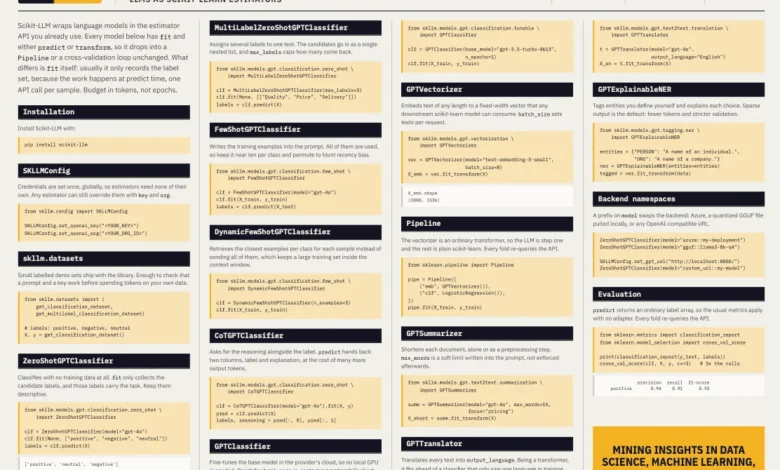
The utility of Scikit-LLM is best understood through its primary estimators, which simplify complex prompt engineering tasks into standardized API methods.
- ZeroShotGPTClassifier: This tool serves as the entry point for most users. In this framework, the classification task is defined by the labels themselves. Unlike traditional supervised learning, where a model "learns" from a dataset, the ZeroShotGPTClassifier uses labels as descriptive prompts to classify text. Users must shift their perspective to treat labels as semantic definitions rather than mere category IDs.
- DynamicFewShotGPTClassifier: When zero-shot performance is insufficient, this classifier provides a more nuanced approach. Instead of feeding the entire training dataset into a prompt—which could hit token limits or degrade performance—the dynamic few-shot model retrieves the most relevant examples for each specific input, ensuring higher accuracy and better utilization of the context window.
- GPTVectorizer: This component allows for the conversion of text data into fixed-width vectors. By acting as the initial stage in a pipeline, it enables the integration of LLMs with classical machine learning models. A developer can use an LLM to generate high-quality text embeddings and subsequently pass those embeddings to a standard Scikit-Learn classifier, effectively combining the semantic intelligence of an LLM with the computational efficiency of traditional models.
- GPTTranslator: This tool functions as a transformer module. It can be placed at the beginning of a pipeline to normalize multilingual input into a single language before it reaches a classifier. This eliminates the need for expensive retraining of existing models on multilingual datasets.
Supporting Data and Operational Costs
While the convenience of Scikit-LLM is significant, the operational costs associated with API-based machine learning models cannot be ignored. In a traditional Scikit-Learn environment, running a cross-validation score with cv=5 is computationally intensive but rarely carries a direct monetary cost per execution. In contrast, every fit or predict call made through Scikit-LLM involves an API request to a provider, typically measured in tokens.
Data from current industry benchmarks suggest that for large-scale datasets, the cost of calling an LLM API for every sample can scale linearly with the dataset size. For instance, performing a grid search over multiple parameters multiplies the number of API calls by the number of parameter combinations. If a developer runs a grid search on a dataset of 1,000 samples with 10 parameter combinations, they are looking at 10,000 API calls. Organizations must weigh the precision of LLM-based classification against the budgetary implications of token consumption. Developers are encouraged to implement rigorous caching mechanisms and monitor token usage closely to avoid unexpected costs.
Chronology of Implementation
The rise of library-level wrappers like Scikit-LLM represents a significant shift in the AI engineering timeline. In 2022 and early 2023, the industry saw a "gold rush" phase where companies were manually connecting their internal systems to LLM APIs via bespoke code. By late 2023, the focus shifted toward "AI Engineering"—the practice of building reliable, repeatable systems around these models.
The release of the Scikit-LLM cheat sheet serves as a formalization of this engineering shift. It provides a standardized reference guide for practitioners who are transitioning from ad-hoc scripting to structured MLOps. This documentation aids in the adoption of best practices, such as treating labels as descriptive prompts and leveraging vectorization for downstream model training.
Implications for the Data Science Community
The broader implication of this library is the democratization of advanced AI workflows. By wrapping complex prompt engineering inside a familiar interface, Scikit-LLM allows data scientists who have spent years mastering the Scikit-Learn ecosystem to pivot toward generative AI without experiencing a "knowledge gap."
Furthermore, this tool encourages a modular approach to model architecture. By treating an LLM as a "step" in a pipeline, developers can easily swap out models as technology evolves. If a superior model becomes available, the underlying pipeline logic remains intact, requiring only a change in the estimator configuration. This modularity is a core tenet of maintainable software engineering and is crucial for companies looking to future-proof their AI applications.
Strategic Recommendations for Implementation
For organizations planning to integrate Scikit-LLM, the following strategies are recommended:
- Iterative Development: Start with the
ZeroShotGPTClassifierto establish a baseline. Use the cheat sheet to refine label descriptions, as the quality of the classification is directly tied to the clarity of the label provided. - Cost Management: Before scaling to full-dataset cross-validation, conduct testing on a small, stratified sample. Calculate the per-call cost to ensure that the budget remains within acceptable limits for the given project scope.
- Hybrid Modeling: Utilize the
GPTVectorizerto keep LLMs as a component rather than the entire solution. By combining LLM-generated embeddings with classical classifiers like SVM or Gradient Boosting, developers can often achieve high performance with significantly lower latency and cost. - Monitoring: Since Scikit-LLM relies on external APIs, it is vital to implement robust logging and error handling. Even though the library wraps these processes in a consistent API, the underlying provider availability and rate limits remain external dependencies.
As the industry matures, the value of libraries that provide abstraction without sacrificing control will only increase. Scikit-LLM stands as a testament to this, proving that the future of machine learning is not in choosing between "traditional" and "generative," but in finding ways to integrate the best of both worlds. The release of this documentation marks an essential milestone in that integration, providing the necessary reference material for practitioners to build more sophisticated, efficient, and maintainable AI systems. Whether used for rapid prototyping or as part of a complex production pipeline, the library enables a level of consistency that was previously missing in the LLM landscape.