Unlocking the Future: A Comprehensive Guide to Five Free, Industry-Validated AI Courses for Aspiring Practitioners

The landscape of artificial intelligence education is undergoing a profound transformation, characterized by an unprecedented accessibility of high-quality learning resources that defy traditional financial barriers. While the burgeoning interest in AI has spawned a multitude of costly bootcamps and certifications, often promising rapid mastery for steep fees, a significant shift has occurred: the most impactful and respected AI education available in 2026 is, remarkably, entirely free. Leading organizations at the forefront of AI innovation, responsible for developing foundational models and frameworks, have progressively open-sourced their educational materials, creating an unparalleled opportunity for aspiring practitioners. For individuals possessing a foundational understanding of Python and a drive to transition into an AI practitioner role, an expensive academic degree is no longer a prerequisite; rather, strategic engagement with the right curriculum is paramount.
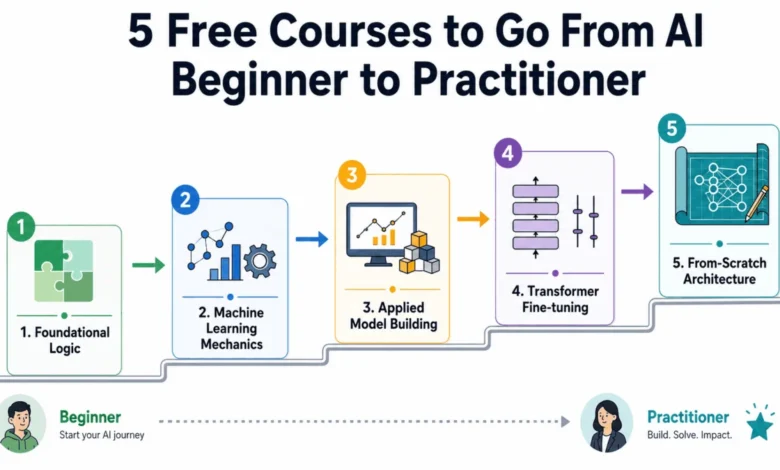
This article delineates a meticulously curated, sequential five-course roadmap designed to guide learners from fundamental AI algorithms to the sophisticated construction of modern large language models (LLMs) from first principles. Each course within this progression has been independently verified as free, offers highly practical application, and garners significant respect from hiring managers across the technology industry. The outlined pathway addresses a critical need in the rapidly evolving AI sector, providing a structured, no-cost alternative to expensive educational programs, thereby democratizing access to highly sought-after skills.
The Democratization of Artificial Intelligence Skills
The demand for skilled AI professionals has surged dramatically in recent years, reflecting the pervasive integration of AI across virtually every industry sector. Reports from institutions such as the World Economic Forum and PwC consistently highlight artificial intelligence as a top-tier skill for future workforces, with projections indicating millions of new jobs requiring AI proficiency. However, the traditional pathways to acquiring these skills, often involving multi-year university degrees or expensive specialized bootcamps, have historically presented significant barriers to entry, particularly for individuals from underserved communities or those seeking career transitions without substantial financial outlay.
The emergence of high-quality, free online courses from reputable institutions and industry giants like Harvard, Google, fast.ai, Hugging Face, and renowned AI researchers such as Andrej Karpathy, marks a pivotal moment in educational accessibility. This trend is not merely a philanthropic gesture but a strategic move by industry leaders to cultivate a broader talent pool, foster innovation, and accelerate the adoption of their respective technologies and frameworks. By making core educational content freely available, these organizations contribute to a more inclusive and dynamic AI ecosystem. Industry analysts suggest that this shift empowers a diverse range of learners to acquire cutting-edge skills, effectively bypassing the financial and logistical constraints of traditional education. This democratization is crucial for addressing the global AI talent gap and ensuring that the benefits of AI development are broadly distributed.
A Strategic Roadmap for AI Proficiency: From Fundamentals to Frontier Models
The journey to becoming a proficient AI practitioner is best approached systematically. The initial phase of any serious AI education transcends merely installing libraries or calling APIs; it necessitates the development of a robust mental model for how AI systems conceptualize and solve problems. The first two courses in this comprehensive list are specifically designed to establish this critical foundation, progressing from classical AI logic to the core mathematical underpinnings of machine learning. Skipping this foundational layer is a common pitfall for self-taught practitioners, a deficiency that frequently becomes evident in technical interviews and practical problem-solving scenarios.
Once a solid theoretical framework is in place, the focus transitions decisively towards practical application and building. The subsequent two courses in this roadmap (courses number 3 and 4) are where many learners experience their most significant leaps forward. These courses are engineered to compel participants to develop and deploy functional models, moving beyond theoretical understanding to tangible creation. By the culmination of this practical layer, learners are expected to possess the capability to train, rigorously evaluate, and successfully deploy an AI model on a dataset of their own choosing, demonstrating a robust command of the AI development lifecycle.
The final layer is where competent practitioners evolve into true engineers. While proficiently utilizing existing AI frameworks is a valuable skill, a deeper understanding of the underlying mechanisms and architectures of these frameworks represents an entirely different echelon of expertise. The final course in this sequence meticulously strips away layers of abstraction, challenging learners to reconstruct complex AI architectures from first principles. This segment, while arguably the most demanding in the roadmap, is also the most illuminating, providing profound insights into the foundational mechanics of advanced AI systems.
Layer 1: Establishing Foundational Principles and Mathematical Acumen
1. Harvard’s CS50: Introduction to AI with Python
Before delving into the complexities of massive neural networks and sophisticated AI models, a fundamental grasp of artificial intelligence’s core logic is indispensable. Harvard’s CS50: Introduction to AI with Python serves as an expertly constructed bridge, seamlessly connecting standard software engineering principles with the intricacies of machine learning. This course places a significant emphasis on deciphering how AI systems genuinely "think," reason, and arrive at decisions, offering a crucial conceptual framework.
The CS50 AI course distinguishes itself through several key attributes. It meticulously covers foundational AI concepts, including search algorithms, knowledge representation, logical inference, machine learning, and neural networks, all within a practical Python programming context. Taught by David J. Malan and Brian Yu, renowned educators, the course is celebrated for its clear explanations and engaging problem sets that challenge learners to implement AI algorithms from scratch. This hands-on approach is vital for building an intuitive understanding of AI’s operational mechanisms. Furthermore, it grounds learners in classical AI paradigms before transitioning to modern statistical methods, providing a holistic perspective on the field’s evolution. This initial exposure to the logical underpinnings of AI is crucial for developing the "mental model" that Vinod Chugani and other experts identify as essential, preventing common misconceptions about how AI systems process information and make choices. The course effectively demystifies the decision-making processes within AI, moving beyond the "black box" perception. Learners can audit CS50’s Introduction to AI with Python for free via edX or directly through Harvard’s OpenCourseWare platform, making it accessible globally.
2. Google’s Machine Learning Crash Course
Following a solid understanding of basic AI logic, the next crucial step is to comprehend the mechanics of how machines learn from data. Google’s Machine Learning Crash Course (MLCC) stands out as an exceptionally fast and efficient pathway to mastering the core mathematics and practical mechanics underpinning modern machine learning. Notably, this is the identical course Google utilizes to upskill its internal engineering teams, vouching for its practical relevance and high quality.
The MLCC is designed for engineers with a basic understanding of Python and algebra. It delves into essential machine learning concepts such as feature engineering, training and validation, classification, regression, and neural networks. What makes this course particularly effective is its blend of theoretical explanations with practical exercises, often utilizing TensorFlow and Google Colaboratory notebooks. Learners gain exposure to critical metrics for evaluating model performance, understand the pitfalls of overfitting and underfitting, and learn strategies for optimizing model accuracy and efficiency. The course’s concise modules and interactive nature ensure that complex mathematical concepts are presented in an digestible manner, directly applicable to real-world problems. This course is indispensable for solidifying the mathematical and algorithmic foundations necessary for practical machine learning development, providing the ‘mechanics’ that complement the ‘logic’ learned in CS50. Access to the Google Machine Learning Crash Course is direct and unencumbered on their developer portal, requiring no sign-up for its interactive modules and Colab notebooks, highlighting Google’s commitment to open education.
Layer 2: Practical Application and Model Deployment
3. fast.ai’s Practical Deep Learning for Coders
Many traditional machine learning courses adopt a bottom-up approach, focusing on mathematical theory for weeks before transitioning to practical model building. fast.ai’s Practical Deep Learning for Coders, co-founded by Jeremy Howard, radically inverts this pedagogical model. This course is renowned for its top-down methodology, empowering learners to train a state-of-the-art deep learning model in the very first lesson, subsequently dedicating the remainder of the course to meticulously explaining the underlying principles and mechanisms.
fast.ai is widely regarded as the ultimate practitioner’s course due to its immediate hands-on emphasis. It covers crucial deep learning applications, including computer vision, natural language processing, and tabular data analysis, all implemented using the PyTorch framework. The course is distinguished by its focus on practical tips, tricks, and best practices that are often overlooked in more academic settings, enabling learners to achieve competitive results with minimal code. By prioritizing practical implementation, fast.ai cultivates a "builder’s mindset," encouraging rapid prototyping and iterative development. This approach not only accelerates the learning curve but also instills confidence in learners to tackle complex deep learning challenges head-on. It transforms theoretical knowledge into deployable skills, a crucial step for aspiring AI practitioners. All lectures and Jupyter notebooks for Practical Deep Learning for Coders are freely available on the fast.ai website, reflecting its open-source ethos.
4. The Hugging Face NLP Course
In the contemporary landscape of generative AI, a deep understanding of Transformer architectures is indispensable. Hugging Face, having established itself as the central repository and community for open-source AI, particularly in natural language processing (NLP), offers an official NLP course that serves as the definitive guide to navigating and leveraging its expansive ecosystem. This course efficiently bridges the gap from a working comprehension of NLP fundamentals to the advanced techniques of fine-tuning the sophisticated models that power today’s cutting-edge AI applications.
The Hugging Face NLP Course provides comprehensive training on leveraging the Hugging Face Transformers library, an industry standard for working with state-of-the-art NLP models. It covers essential topics such as tokenization, using pre-trained models, fine-tuning for specific tasks (e.g., text classification, question answering, summarization), and deploying models at scale. The course is highly interactive, featuring hands-on coding exercises and direct engagement with the Hugging Face ecosystem, including its vast model hub and datasets. By mastering this course, learners gain proficiency in handling large language models, a skill critical for roles in generative AI, content creation, and intelligent automation. This mastery positions practitioners to work with the very tools and models that are shaping the future of AI. The completely free and interactive Hugging Face NLP Course is readily accessible directly on their platform, requiring no subscription, underscoring its commitment to fostering an open and collaborative AI community.
Layer 3: Deconstructing Advanced Architectures and First Principles
5. Andrej Karpathy’s Neural Networks: Zero to Hero
To truly transcend the label of a beginner and emerge as a high-level AI practitioner and engineer, it becomes essential to peel back the layers of abstraction provided by high-level frameworks and construct AI architectures from first principles. Andrej Karpathy, a towering figure in the AI community—former Director of AI at Tesla and a founding member of OpenAI—developed the "Neural Networks: Zero to Hero" series precisely for this purpose. This groundbreaking series guides learners through the intricate process of building a neural network, and subsequently a Generative Pre-trained Transformer (GPT)-level large language model, entirely from scratch using only fundamental mathematical operations.
This series stands apart due to its rigorous, bottom-up approach. Karpathy meticulously breaks down complex concepts such as backpropagation, gradient descent, and the internal workings of self-attention mechanisms in Transformers, demonstrating their implementation using basic Python and PyTorch. By reconstructing these architectures from the ground up, learners gain an unparalleled depth of understanding into how and why modern AI models function as they do, rather than simply what they do. This deep dive into the foundational mathematics and engineering challenges of neural networks is crucial for anyone aspiring to contribute to advanced AI research and development or to build highly optimized custom solutions. It cultivates an engineer’s intuition, enabling practitioners to diagnose problems, innovate, and contribute at a fundamental level. While demanding, the clarity and insight provided by this series are arguably among the most valuable free AI educational content available today. Dedicating a few weekends to the Neural Networks: Zero to Hero playlist on YouTube is an investment that yields profound returns in AI understanding.
Broader Implications: The Impact of Accessible AI Education
The availability of such a robust and free curriculum has far-reaching implications beyond individual skill acquisition. It represents a significant disruption to traditional educational models, challenging the perceived necessity of expensive university degrees for entry into high-tech fields. This democratization of knowledge fosters a more meritocratic environment where talent and dedication can supersede financial privilege.
Economically, this trend contributes to a more dynamic and competitive global talent pool. Nations and regions that actively promote and integrate these free resources into their educational frameworks stand to gain a competitive edge in AI innovation. Furthermore, it accelerates the pace of AI research and development by ensuring that a broader base of individuals, regardless of their socio-economic background, can contribute to cutting-edge advancements. Analysts suggest that this proliferation of accessible, high-quality AI education is a critical factor in mitigating the widening skills gap reported by numerous industries globally. It supports the growth of agile startups and small businesses by providing them with access to skilled personnel who might otherwise be cost-prohibitive. Educators and industry leaders increasingly emphasize that such practical, open-source resources are not just supplementary but are becoming core components of effective AI learning pathways, fostering a culture of continuous learning and adaptation essential in a rapidly evolving technological landscape.
Expert Perspective: Vinod Chugani’s Vision
Vinod Chugani, an AI and data science educator and the original curator of this free course roadmap, embodies the philosophy of bridging the gap between emerging AI technologies and practical application for working professionals. His focus areas, including agentic AI, machine learning applications, and automation workflows, underscore the real-world relevance of the chosen courses. Through his extensive work as a technical mentor and instructor, Chugani has consistently supported data professionals in skill development and career transitions, drawing analytical expertise from quantitative finance to inform his hands-on teaching approach. His advocacy for accessible, actionable strategies and frameworks is directly reflected in the structured, sequential nature of this recommended learning path, designed for immediate applicability by professionals. Chugani’s insights reinforce the notion that true AI proficiency stems not from theoretical memorization but from a deep, practical understanding gained through building and deconstructing systems.
Conclusion: A Pathway to AI Mastery Without Financial Burden
The journey to becoming a proficient AI engineer does not necessitate an expenditure of thousands of dollars. The five-course sequence meticulously outlined here is specifically designed for sequential progression, with each subsequent layer strategically building upon the knowledge and skills acquired in the preceding one. Harvard’s CS50 lays the crucial logical foundation, equipping learners with a fundamental understanding of AI’s reasoning paradigms. Google’s Machine Learning Crash Course then imparts the essential mathematical mechanics and practical algorithmic knowledge. fast.ai propels learners into the realm of active building and shipping of functional models, fostering a hands-on approach. Hugging Face integrates practitioners into the vibrant open-source ecosystem, enabling them to leverage and fine-tune modern generative AI tools. Finally, Andrej Karpathy’s series strips away abstractions, offering a profound, engineering-level understanding of the underlying architectures.
This comprehensive sequence, requiring approximately three to five months for a part-time student, promises a depth of understanding that is both robust and enduring. Many paid programs offer outcomes of similar scope, yet few achieve the thoroughness or practical applicability of the resources linked here, all provided entirely free of charge. Aspiring AI practitioners are encouraged to commence with Harvard’s CS50, progressing through the material at a self-determined pace, ensuring a solid assimilation of foundational concepts. This deliberate approach to establishing a strong base will significantly enhance the comprehension and utility of the subsequent stages of this transformative roadmap. The era of democratized AI education is here, offering an unparalleled opportunity for anyone committed to mastering this pivotal technology.