3 Ways to Optimize Small Language Models for Narrow Automation: Reusing the Prompt Prefix with a Key-Value Cache

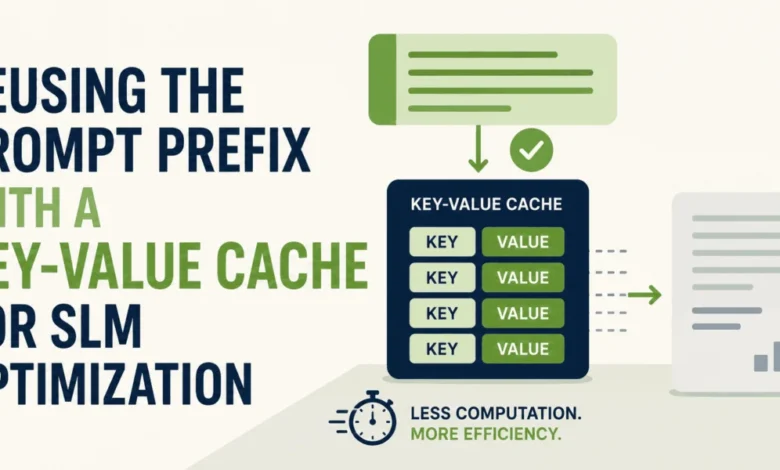
The shift toward deploying Small Language Models (SLMs) in production environments has fundamentally altered the landscape of narrow automation. While large language models (LLMs) have dominated the headlines, the practical, low-latency, and cost-effective nature of SLMs—such as the Qwen2.5-0.5B-Instruct model—offers a compelling alternative for enterprise-grade automation tasks. A critical strategy for maximizing the utility of these models is the optimization of the inference pipeline, specifically through the implementation of prompt prefix caching. By treating static instruction blocks as reusable computational assets, developers can achieve significant performance gains, often exceeding 50% in runtime efficiency.
The Evolution of SLM Deployment
The move toward "narrow automation"—tasks such as customer support ticket classification, sentiment analysis, or automated data extraction—requires a departure from the "one-size-fits-all" approach typical of general-purpose LLMs. In previous technical assessments, it was established that constraining the output space is a primary lever for optimization. However, the pre-fill phase of the transformer architecture, where the model processes the input prompt, remains a significant bottleneck.
In a standard deployment scenario, every incoming ticket or user request triggers a full re-encoding of the entire prompt, including the system instructions, taxonomy definitions, and few-shot examples. In most narrow automation contexts, these static elements account for the overwhelming majority of the token count. For instance, a system prompt spanning 150 tokens paired with a 20-token dynamic ticket input means that approximately 88% of the data processed by the model is identical for every transaction. Recomputing these tokens across every layer of the transformer on every request is inherently redundant and computationally taxing.
The Mechanics of Prefix Caching
The transformer architecture functions by calculating key and value vectors for each token at every layer of the network. Because these vectors are dependent only on the preceding tokens, they remain constant if the prefix—the instruction block—remains static. By computing these key-value (KV) pairs once and storing them in a cache, developers can effectively bypass the redundant pre-fill stage for the instruction portion of the prompt.
When a new ticket arrives, the model only needs to perform a "partial" pre-fill, processing only the dynamic input while injecting the cached KV states from the preceding static layers. This technique, known as KV-caching or prefix caching, effectively transforms the inference cycle. In benchmarks conducted on an M2 MacBook Air with 24GB of RAM, the use of a DynamicCache object allowed the model to maintain the integrity of its predictions while significantly reducing the overhead associated with the system instruction block.
Benchmarking Performance Gains
To validate the efficacy of prefix caching, a controlled benchmark was established using 600 representative support tickets. The baseline measurement involved the traditional approach of re-encoding the full prompt for every ticket. The system utilized the Qwen2.5-0.5B-Instruct model, specifically leveraging the Hugging Face Transformers library in float16 precision.
The baseline results indicated an average processing time of approximately 308.1 milliseconds per ticket. In contrast, the implementation of prefix caching yielded an average processing time of 133.5 milliseconds per ticket. This represents a total runtime reduction of approximately 57%. Importantly, the accuracy of the model remained identical between the baseline and the cached versions. This confirms that the optimization is a purely computational efficiency measure, preserving the model’s logical output while drastically lowering the cost per inference.
Technical Implementation and Considerations
For organizations looking to integrate this strategy, the implementation requires a rigorous approach to tokenization. The split between the static prefix and the dynamic suffix must be "token-clean." This means that the concatenation of the encoded prefix and the encoded suffix must yield the exact same token IDs as encoding the full prompt as a single unit.
In the provided architecture, developers utilize the DynamicCache class to manage the KV states. By populating the cache with the instruction block once, the inference loop for subsequent tickets becomes significantly leaner. The cache_position parameter in the model’s forward pass is then adjusted to account for the offset, ensuring the model correctly identifies that the new input follows the pre-existing, cached prefix.
Broader Implications for Enterprise AI
The implications of these optimization strategies extend far beyond minor runtime improvements. For enterprises managing high-volume, repetitive tasks—such as processing thousands of support tickets per hour—the cumulative savings in GPU or NPU cycles translate directly into lower operational costs and enhanced scalability.
Moreover, this shift encourages the use of more detailed and nuanced instruction sets. Traditionally, developers might hesitate to provide extensive context or long lists of examples to an SLM due to the latency penalties associated with larger prompts. With prefix caching, the "cost" of a prompt is essentially decoupled from its length, provided the instruction block is static. This allows for more robust, descriptive prompts that can improve the quality of narrow automation without sacrificing system performance.
The Future of Narrow Automation
As the industry moves toward specialized AI agents, the ability to fine-tune the inference lifecycle will distinguish high-performance applications from less efficient counterparts. The transition from treating every model call as an isolated event to viewing the interaction as a persistent, stateful process is a hallmark of mature AI engineering.
Industry analysts observe that as models become smaller and more efficient, the focus of development will increasingly shift from model training to infrastructure optimization. Techniques such as prefix caching, constrained output spaces, and quantized model weights are becoming the standard toolkit for engineers tasked with deploying AI at scale.
Ultimately, the optimization of SLMs for narrow automation is not merely about making code run faster; it is about making these tools practical for the vast majority of business use cases where latency and reliability are paramount. When the infrastructure around an SLM is properly optimized, the small model is no longer a compromise—it becomes the superior choice.
Conclusion
The data demonstrates a clear path forward for organizations utilizing small language models. By minimizing redundant compute through prefix caching, businesses can achieve a significant competitive advantage in terms of both cost and speed. As demonstrated by the 57% reduction in runtime during recent benchmarking, the combination of static instruction reuse and efficient cache management is a foundational strategy for the next generation of automated enterprise systems. Developers and data scientists are encouraged to audit their current inference pipelines, identify static components of their prompts, and implement caching mechanisms to realize these substantial performance gains.