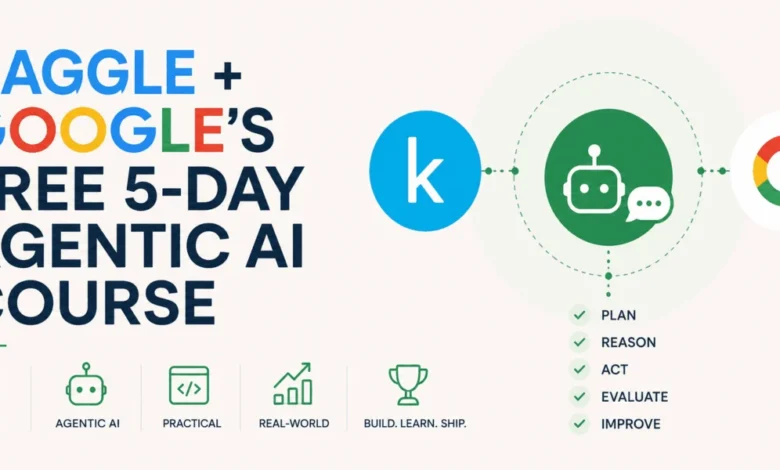
Kaggle and Google’s Free 5-Day Agentic AI Course Sets Unprecedented Benchmark in Developer Education

The landscape of artificial intelligence development has witnessed a transformative milestone with the "AI Agents Intensive," a free, five-day course jointly offered by Google and Kaggle. This ambitious educational initiative, which launched its live run in November 2025, captivated a global audience, drawing an astounding 1.5 million registrants—a figure that underscores the burgeoning interest and critical demand for skills in the rapidly evolving field of agentic AI. Far from being a mere registration metric, the course demonstrated profound engagement, culminating in over 11,000 capstone project submissions, firmly establishing it as one of the largest and most impactful technical courses ever conducted by attendance.
This extraordinary success is not an isolated event but rather a continuation of Google and Kaggle’s strategic commitment to democratizing advanced AI education. Following in the footsteps of their highly successful 2024 Generative AI Intensive, which attracted over 140,000 developers and secured a Guinness World Record for its rerun as the largest virtual AI conference, the 2025 program pivoted to a more specialized, yet equally critical, domain: AI agents. This strategic narrowing of focus reflected a clear understanding of the industry’s need for clarity and expertise in a sub-field often shrouded in conceptual ambiguity.
The Strategic Imperative of Agentic AI
Agentic AI represents a significant leap beyond traditional large language models (LLMs), endowing AI systems with the capacity for autonomy, planning, and interaction with their environment. Unlike static LLMs that respond to single prompts, AI agents can decompose complex tasks, utilize external tools, maintain conversational state, learn from experience, and even collaborate with other agents or human users to achieve predefined goals. This paradigm shift holds immense promise for automating intricate workflows, developing more sophisticated virtual assistants, and creating intelligent systems capable of navigating real-world complexities.
Google’s heavy investment in agentic AI, evident through its Gemini models, the Agent Development Kit, and Vertex AI Agent Engine, signals a clear strategic direction. By equipping a massive global developer community with the skills to build and deploy these advanced systems, Google is not only fostering an ecosystem around its technologies but also addressing a looming skills gap that could impede the broader adoption and innovation of AI. Industry analysts frequently highlight the exponential growth in demand for AI engineers capable of designing, developing, and deploying intelligent agents, positioning such courses as vital conduits for talent development.
A Chronology of Educational Excellence: From GenAI to Agentic Mastery
The journey towards the AI Agents Intensive began with the resounding success of the 2024 GenAI Intensive. This precursor event served as a critical foundation, introducing developers to the fundamentals of generative AI, its applications, and the tools available within Google’s ecosystem. Its record-breaking attendance validated the immense global appetite for practical AI training, demonstrating the effectiveness of the Kaggle platform combined with Google’s deep technical expertise. The success of the GenAI Intensive provided invaluable insights into scalable online education, community engagement, and curriculum design, all of which informed the subsequent Agentic AI program.
Building upon this foundation, the November 2025 AI Agents Intensive represented a targeted evolution. Recognising the growing confusion surrounding the definition and practical application of AI agents, the course was meticulously designed to demystify the concept and provide hands-on experience. The live, five-day format created a dynamic, interactive learning environment, fostering a sense of community among participants. The sheer volume of capstone submissions—over 11,000—is a testament to the course’s efficacy in translating complex theoretical knowledge into tangible, practical skills, resulting in real-world projects that developers could showcase.
For those who missed the live event, Google and Kaggle swiftly transitioned the entire curriculum into a self-paced Kaggle Learn Guide, making the valuable content permanently accessible to a global audience. This strategic move ensures that the knowledge is not confined to a single cohort but becomes a persistent resource for ongoing learning. Furthermore, in June 2026, a refreshed run, themed around "vibe coding," was offered, catering to developers who prefer the structured, cohort-based experience and the interactive elements of a live event, demonstrating a flexible approach to cater to diverse learning preferences.
Unpacking the Curriculum: A Deep Dive into Agentic AI Development
The core of the AI Agents Intensive lies in its meticulously structured five-day curriculum, each day pairing a foundational technical whitepaper with two hands-on codelabs. This blended learning approach ensures that participants grasp the theoretical underpinnings before immediately applying them through practical coding exercises using Google’s Gemini models and the Agent Development Kit.
-
Day 1: Introduction to Agents – Foundations of Agentic Systems: The inaugural day establishes the fundamental concepts of agent architectures. Participants delve into understanding what constitutes an AI agent, distinguishing it from simpler scripts or direct LLM calls. Key architectural patterns, such as ReAct (Reasoning and Acting) or Plan-and-Execute frameworks, are introduced, providing a blueprint for designing intelligent systems. The day culminates in participants building their very first AI agent and subsequently, a multi-agent system, offering immediate practical application of the concepts learned. This foundational understanding is crucial for appreciating the complexity and utility of autonomous AI.
-
Day 2: Tools and Interoperability with MCP – Empowering Agents: This day explores how agents extend their capabilities by interacting with external tools and systems. The concept of tool-use in AI agents is critical, allowing them to perform actions beyond their core reasoning capabilities, such as fetching real-time data from APIs, interacting with databases, or executing code. Participants learn to write custom tools tailored to specific tasks and understand the Model Context Protocol (MCP), which facilitates seamless communication between agents and external systems. Crucially, Day 2 also introduces the vital concept of human-in-the-loop approval for long-running or critical operations. This aspect is paramount for ensuring safety, accountability, and ethical deployment, transforming a potentially dangerous autonomous system into a useful and controllable one.
-
Day 3: Context Engineering: Sessions and Memory – Crafting Intelligent Memory: A common pitfall for nascent AI agents is their inability to retain information across interactions or sessions. Day 3 addresses this challenge by focusing on building stateful agents that remember past conversations and actions. The curriculum delves into session management and strategies for endowing agents with long-term memory that persists across multiple interactions. This involves techniques like embedding past conversations, utilizing vector databases for semantic search, and structured knowledge representation. Mastering context engineering is often the differentiator between a rudimentary agent and a truly intelligent, adaptive system, and the course rightly emphasizes slowing down at this critical juncture.
-
Day 4: Agent Quality – Ensuring Reliability and Performance: Widely regarded as one of the most critical modules, Day 4 shifts focus to the rigorous evaluation and quality assurance of AI agents. Participants learn essential MLOps practices tailored for agentic systems, including robust logging, tracing mechanisms for understanding agent decision-making, and defining appropriate metrics. The curriculum covers methods for evaluating both an agent’s responses and the effectiveness of its tool usage, which are distinct yet interconnected challenges. This day equips developers with the skills to objectively measure agent performance, identify failure points, and iteratively improve their systems—a skill frequently overlooked in introductory courses but indispensable for production-ready AI. Industry experts consistently highlight that the ability to measure and assure the quality of AI systems is a core competency for any serious AI practitioner.
-
Day 5: Prototype to Production – Deployment and Scalability: The final day bridges the gap between a functional prototype and a robust, deployable system. Participants explore the agent-to-agent protocol, enabling complex workflows where multiple agents collaborate to achieve a larger objective. The module then delves into deploying agents to managed runtimes, such as Google’s Vertex AI Agent Engine. This covers considerations for scalability, reliability, monitoring, and integration into existing enterprise infrastructures. This practical guide to the "last mile" ensures that developers can transition their innovative agent designs from impressive notebook demos to real-world applications that can serve actual users at scale.
Democratizing Advanced AI Skills: Accessibility and Impact
The course’s prerequisites are intentionally accessible: a working knowledge of Python and familiarity with calling an LLM API. This thoughtful design ensures that a broad spectrum of developers, from aspiring AI engineers to seasoned practitioners looking to upskill, can participate without needing prior agent-specific expertise. This approach democratizes access to cutting-edge AI knowledge, fostering a more inclusive and diverse AI talent pool globally.
The advice offered by the course creators, specifically to delve deeply into the whitepapers and not rush solely to the code, underscores the pedagogical philosophy. The conceptual understanding derived from the evaluation and context-engineering material (Days 3 and 4) provides the "durable understanding" that differentiates a skilled agent builder from someone merely copying code. This emphasis on fundamental principles ensures that participants gain not just how to build, but also why their agents might fail and how to diagnose and fix issues, promoting true problem-solving capabilities.
The Broader Implications: Shaping the Future AI Workforce
The monumental success of the AI Agents Intensive holds significant implications for the global AI landscape and the future workforce.
-
Addressing the AI Skills Gap: The overwhelming registration numbers and completion rates highlight a critical global demand for specialized AI skills. By offering high-quality, free education, Google and Kaggle are directly addressing the skills gap, enabling millions to participate in the AI revolution. This initiative helps cultivate a workforce ready to tackle complex challenges and innovate across various industries.
-
Google’s Ecosystem Strategy: These intensives are a clear component of Google’s broader strategy to establish its AI platforms and tools (Gemini, Vertex AI, Agent Development Kit) as industry standards. By training a massive developer base on its technologies, Google strengthens its position in the competitive AI market and ensures a vibrant developer community dedicated to its ecosystem.
-
Empowering Global Innovation: The self-paced nature and free accessibility mean that developers from every corner of the globe, regardless of economic background or geographical location, can access world-class AI education. This empowerment has the potential to spark innovation in regions previously underserved by advanced technical training, fostering localized solutions and diverse perspectives in AI development.
-
Practical Portfolio Building: The capstone project, a core component of the course, provides participants with a tangible, real-world project to showcase their newfound skills. In a competitive job market, such practical demonstrations of ability are invaluable for career advancement, allowing participants to "point at something real" when seeking employment or entrepreneurial opportunities. The 11,000+ submissions signify a substantial influx of newly skilled individuals ready to contribute to the agentic AI domain.
Industry analysts suggest that such large-scale, free educational initiatives are crucial for accelerating the adoption of new technologies. "The democratization of advanced AI knowledge, particularly in areas like agentic AI, is not just about upskilling individuals; it’s about catalyzing widespread innovation and ensuring that the benefits of AI are broadly distributed," notes a prominent tech education expert. Educational leaders also emphasize the importance of blending theoretical understanding with practical application, a methodology at the heart of the Kaggle/Google intensives.
In conclusion, the AI Agents Intensive stands as a testament to the power of collaborative, accessible education in shaping the technological future. By equipping 1.5 million individuals with the critical skills to build intelligent agents, Google and Kaggle have not only run one of the largest technical courses in history but have also made a profound contribution to the global AI talent pool, paving the way for the next generation of autonomous and intelligent systems. The investment of five days, as a million and a half people discovered, is undoubtedly a worthwhile one, offering a pathway to mastering a frontier technology that promises to redefine industries and daily life.