For the past decade, the JavaScript ecosystem has operated on a comfortable assumption: developers write the code, frameworks organize it, and browsers render it. React, Vue, Angular, and their ecosystems were all designed with a human at the keyboard. This foundational paradigm is currently undergoing a radical shift as autonomous coding agents—such as Anthropic’s Claude Code, GitHub Copilot, and Cursor—begin to assume responsibility for significant portions of production-grade code. As these AI agents become integral to software engineering workflows, a growing tension has emerged: frameworks designed to maximize human productivity often introduce syntactic and structural complexities that baffle artificial intelligence models.
The release of ArrowJS 1.0 in early 2026 marks a watershed moment in this transition, positioning itself as the first UI framework built explicitly for the "agentic era." By prioritizing minimal abstraction and native web platform primitives, ArrowJS seeks to solve the hallucination and syntax errors that plague AI models when forced to interact with the rigid, rule-heavy conventions of traditional frameworks.
The Conflict Between Traditional Frameworks and AI Agents
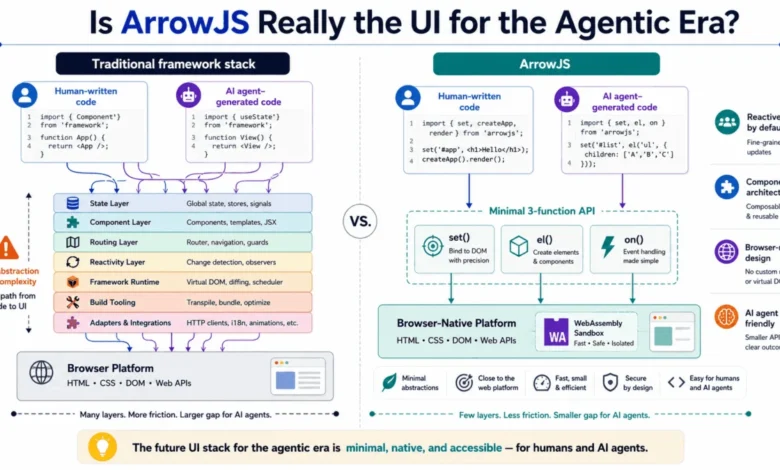
To understand the necessity of a framework like ArrowJS, one must analyze the failure modes inherent in modern web development architectures. React, the dominant player in the JavaScript space with a market share exceeding 39%, relies on a set of deeply ingrained conventions. These include strict hook ordering, the dichotomy between controlled and uncontrolled components, and the necessity of JSX compilation. While human developers learn these patterns through years of practice, AI agents treat them as statistical probabilities.
When an AI model generates code, it draws upon vast training datasets. However, because React’s abstractions are implicit rather than explicit, models frequently violate subtle "rules of the road," such as calling hooks conditionally. This results in code that appears syntactically correct to the agent but fails at runtime. Similarly, Vue.js and Svelte, while offering more readable syntax or superior performance, introduce their own framework-specific compilers and reactivity systems. These layers of abstraction create a "semantic gap"—a distance between what the agent intends to build and how the framework requires the browser to interpret that intent. For an AI operating on token-based pattern recognition, these framework-specific layers often function as noise, leading to higher error rates in complex UI generation.
The Chronology of Agentic UI Integration
The movement toward agent-native development did not occur in a vacuum. The following timeline outlines the evolution of AI-driven coding:
- 2021-2022: The emergence of LLM-based coding assistants (Copilot) focuses on autocomplete and boilerplate generation, primarily serving human-in-the-loop workflows.
- 2023-2024: The rise of autonomous coding agents (Cursor, Devin, Claude Code) shifts the goalpost. These agents are tasked with building entire features or components from natural language prompts.
- 2025: Industry reports highlight a growing "framework tax," where developers spend more time fixing code generated by AI for complex frameworks like React than they would writing it themselves.
- Early 2026: ArrowJS 1.0 launches with a design philosophy centered on "platform-first" development, specifically targeting the agentic workflow.
Technical Architecture of ArrowJS: Minimizing the Agentic Friction
ArrowJS distinguishes itself through a radical reduction of the API surface. By limiting the framework to three core functions—reactive, html, and component—the creators have ensured that the entire documentation set is compact enough to fit comfortably within the context window of most modern large language models. This allows an AI to hold the entire framework’s logic in its "working memory" during the generation process, significantly reducing the likelihood of misapplied patterns.
Furthermore, the framework eliminates the build step entirely. By leveraging native tagged template literals, ArrowJS allows for immediate rendering without the need for complex transpilation or configuration files—common failure points for automated agents. Perhaps most innovatively, ArrowJS includes a WebAssembly-based sandbox. This feature allows AI-generated code to execute in an isolated environment, mitigating the security risks traditionally associated with eval() while avoiding the performance and styling constraints of iframes. This capability is critical for applications that require dynamic, user-generated interfaces or adaptive dashboards that evolve in real-time based on agentic logic.
Supporting Data and Industry Analysis
The current adoption of AI in software development is characterized by a "React-first" strategy, largely because React possesses the largest training corpus of any UI framework. Platforms like V0 and Lovable have capitalized on this, training models heavily on React patterns to ensure high-fidelity outputs. However, analysts point out that this is a temporary state of affairs.
"The reliance on React for AI generation is currently a function of data availability, not necessarily architectural superiority," notes one industry researcher. "As models become more capable of reasoning, the need for ‘agent-friendly’ architectures—frameworks that are logically transparent and conceptually simple—will outweigh the benefit of having a larger training dataset."
While ArrowJS currently boasts approximately 3,500 GitHub stars, its relevance is not measured by its current install base in legacy enterprises, but by its utility in the growing sector of "generative UI" applications. For data scientists and machine learning engineers, the shift is particularly relevant. As these professionals build increasingly sophisticated AI-powered applications, the ability to have an agent create, test, and render a UI component on the fly—without requiring a human to manually debug a React hook mismatch—represents a significant leap in productivity.
Official Responses and Strategic Implications
The developer community remains divided on the long-term prospects of "agent-native" frameworks. Proponents argue that the cost of maintaining legacy-style abstractions will become untenable as AI agents take on more architectural roles. Critics, however, point to the vast ecosystem of libraries and design systems—such as Material UI or Tailwind CSS—that are deeply integrated with current standards.
"The question for any team today is not just about the framework’s ease of use for an AI, but about the long-term support, hiring, and tooling ecosystem," says technical consultant Vinod Chugani. "ArrowJS offers a compelling vision for a future where the machine is a first-class developer, but that future must coexist with the reality of current enterprise infrastructure. For projects that require high-velocity, generative interface updates, the trade-off is increasingly leaning toward architectures that prioritize simplicity over ecosystem breadth."
The Road Ahead: Agent-Friendly as a Moving Target
The definition of "agent-friendly" is inherently fluid. As foundational models evolve, their ability to navigate complex framework-specific rules improves. If future iterations of models like GPT-5 or Claude 4 demonstrate an inherent mastery of complex hooks and build pipelines, the "agent-hostile" nature of React may diminish, rendering the need for specialized frameworks like ArrowJS less urgent.
However, the core argument of ArrowJS—that software should be built with primitives that are logically consistent and easy to reason about—remains a fundamental tenet of good engineering. Whether the industry moves toward adopting specialized agent-centric tools or whether existing frameworks adopt "agent-friendly" patterns remains to be seen.
For now, ArrowJS stands as a concrete, data-driven answer to a problem that many development teams are only just beginning to encounter. For data scientists and practitioners building adaptive, AI-integrated dashboards and applications, it offers a blueprint for how to structure software in a world where the primary developer may not be human. The evolution of this framework will serve as a key indicator of whether the future of web development will be defined by legacy standards or by a new generation of agent-centric tools designed specifically for the era of machine intelligence.