GraphEval: A Knowledge Graph-Based Framework Revolutionizes the Detection and Localization of Large Language Model Hallucinations

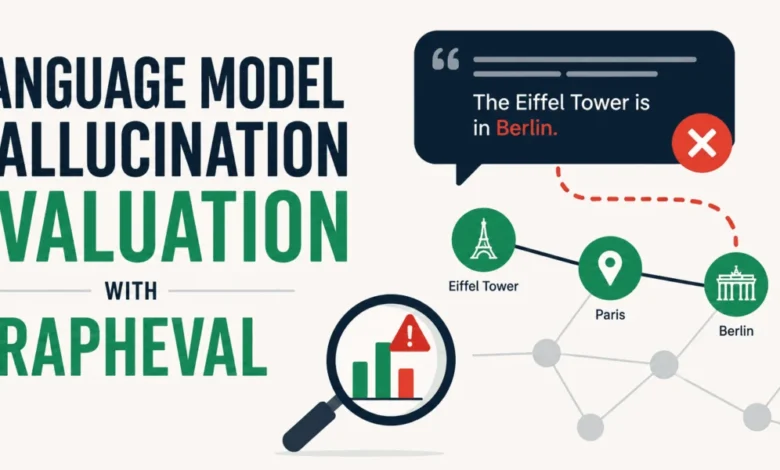
The pervasive issue of hallucinations in Large Language Models (LLMs) has presented a significant hurdle to their widespread adoption and reliability across critical applications. Hallucinations, defined as instances where an LLM generates factually incorrect, nonsensical, or entirely fabricated information, stem primarily from the model’s inherent lack of internal, verifiable knowledge regarding the query at hand. While the rapid advancements in LLM technology have spurred numerous efforts to mitigate these errors during content generation, the development of robust, methodological frameworks for internally diagnosing and pinpointing the exact location of such inaccuracies has received comparatively less attention. Addressing this crucial gap, a recent landmark study by Amazon researchers introduced GraphEval, an innovative evaluation framework that harnesses the power of knowledge graphs to analyze, detect, and explain hallucinations within LLM-generated outputs, marking a significant step towards more trustworthy artificial intelligence systems.
The Pervasive Challenge of LLM Hallucinations
The meteoric rise of LLMs, exemplified by models like GPT-4, LLaMA, and Mistral, has transformed industries ranging from customer service and content creation to scientific research and education. These powerful models excel at generating human-like text, translating languages, summarizing complex documents, and answering diverse queries with remarkable fluency. However, their capacity for generating plausible-sounding but factually incorrect information – colloquially termed "hallucinations" – remains a critical impediment. This problem is not merely an inconvenience; it carries substantial risks, potentially leading to misinformation, erroneous decision-making, legal liabilities, and a fundamental erosion of user trust in AI systems. Industry reports consistently highlight hallucination rates as a top concern for businesses deploying LLMs, with some studies indicating that users encounter factual errors in a significant percentage of AI-generated responses, necessitating extensive human oversight and verification. The economic and reputational costs associated with these errors underscore the urgent need for sophisticated detection and mitigation strategies. Current methods often rely on external fact-checking mechanisms or human review, which are time-consuming, expensive, and difficult to scale effectively, particularly in dynamic, high-volume operational environments.
GraphEval Emerges: A Novel Approach from Amazon Research
In response to this pressing need, Amazon researchers developed GraphEval, a framework designed to offer a more explainable and precise method for identifying and localizing LLM hallucinations. Unlike traditional performance metrics that often provide aggregated, single-score evaluations of aspects like accuracy or certainty, GraphEval emphasizes diagnostic insight. Its core innovation lies in its two-stage evaluation process, which leverages knowledge graphs (KGs) to represent information structurally and then employs Natural Language Inference (NLI) models to verify the factual consistency of each piece of information against a reliable ground-truth context. This structured approach allows GraphEval to move beyond merely flagging an output as "incorrect" to specifically identifying which parts of the output are hallucinatory, thereby offering actionable insights for model refinement and error correction. The framework’s genesis reflects a growing industry-wide recognition that simply improving LLM output quality isn’t enough; understanding why and where models err is equally vital for building robust and responsible AI. The decision by Amazon, a leader in cloud computing and AI services, to invest in such a framework underscores the strategic importance of trustworthy AI for enterprise applications.
Deconstructing GraphEval: A Two-Stage Evaluation Paradigm
GraphEval’s methodology is built upon a two-stage process that systematically dissects LLM outputs for factual accuracy. This structured approach is fundamental to its ability to provide granular insights into hallucination occurrences.
-
Stage 1: Knowledge Graph Extraction for Semantic Representation
The initial phase involves transforming the LLM-generated text into a structured knowledge graph. A knowledge graph is a semantic network that represents entities (nodes) and their relationships (edges) in a machine-readable format, typically as subject-predicate-object triples (e.g., "GraphEval – uses – Knowledge Graphs"). This transformation is crucial because it breaks down complex natural language into atomic, verifiable facts. To accomplish this, GraphEval employs an auxiliary LLM or a specialized information extraction model. This model is tasked with parsing the generated response and identifying the key entities and the relationships connecting them, subsequently formatting these as a list of triples. For instance, if an LLM responds, "GraphEval is an evaluation framework that uses Knowledge Graphs. It requires a highly expensive, enterprise-level server farm to operate," the extraction process would yield triples such as('GraphEval', 'is', 'evaluation framework'),('GraphEval', 'uses', 'Knowledge Graphs'), and('GraphEval', 'requires', 'expensive enterprise server farm'). The accuracy and completeness of this extraction stage are paramount, as any errors here could propagate through the subsequent evaluation. While the conceptual example simplifies this, in a production environment, the extraction model would need to be highly robust to variations in language, sentence structure, and potential ambiguities within the LLM’s output. -
Stage 2: Natural Language Inference for Factual Verification
Once the LLM’s output has been meticulously converted into a set of knowledge graph triples, the second stage of GraphEval commences: factual verification using Natural Language Inference (NLI). NLI is a task in natural language processing where a model determines the logical relationship between two text fragments, typically a "premise" (the ground-truth context) and a "hypothesis" (each extracted triple). The NLI model classifies this relationship into one of three categories:- Entailment: The hypothesis is logically implied by the premise.
- Contradiction: The hypothesis directly contradicts the premise.
- Neutral: The premise neither entails nor contradicts the hypothesis; there’s insufficient information to determine the relationship.
GraphEval leverages a pre-trained NLI model, such as those available on platforms like Hugging Face (e.g.,cross-encoder/nli-deberta-v3-small), to compare each extracted triple against a designated ground-truth knowledge base. This ground-truth context is assumed to contain verified, factual information relevant to the LLM’s query. For each triple, the NLI model assesses whether the ground-truth context entails that triple. If the NLI model predicts ‘entailment,’ the triple is considered grounded and factually correct. However, if the model outputs ‘neutral’ or ‘contradiction,’ that specific triple is flagged as a hallucination. This precise identification of non-entailing triples provides the explainability that sets GraphEval apart, allowing developers to pinpoint exactly which pieces of information within an LLM’s response are problematic.
Bridging Theory to Practice: A Simulated Walkthrough
To demystify GraphEval’s operational mechanics, a practical simulation helps illustrate its core principles, even while abstracting away the heavy computational demands of a real-world implementation. The conceptual walkthrough mirrors the two stages, demonstrating how hallucinations are systematically identified.
-
Establishing the Ground Truth: The Role of Retrieval-Augmented Generation (RAG)
In a practical setting, the "ground-truth context" is not simply a hardcoded string but a dynamically retrieved set of verified facts. This is where Retrieval-Augmented Generation (RAG) systems play a pivotal role. RAG architectures first retrieve relevant documents or data snippets from an authoritative knowledge base (often stored in a vector database for efficient semantic search) before an LLM generates its response. This process grounds the LLM in up-to-date, factual information, reducing the likelihood of hallucinations. GraphEval operates by comparing the LLM’s generated output not just to the retrieved context, but to a source of truth that could be the RAG’s retrieved documents or an independent, verified knowledge base. For the simulation, asource_contextstring serves as this factual bedrock: "GraphEval is a hallucination evaluation framework based on representing information in Knowledge Graph (KG) structures. It acts as a pre-processing step and utilizes out-of-the-box NLI models to detect factual inconsistencies." This represents the verified information against which the LLM’s claims will be checked. -
From Text to Triples: The Extraction Process
Following the establishment of ground truth, the LLM’s generated response is subjected to information extraction. Consider an LLM output generated in response to a prompt like "explain succinctly what GraphEval is": "GraphEval is an evaluation framework that uses Knowledge Graphs. It requires a highly expensive, enterprise-level server farm to operate." An auxiliary LLM, perhaps a more compact or locally hosted model like Mistral-7B, would then be prompted to extract knowledge graph triples from this text. The prompt would explicitly instruct the LLM to return the output as a Python list of(Subject, Relationship, Object)tuples. In the simulation, this computationally intensive step is bypassed by directly presenting theextracted_triples:[('GraphEval', 'is', 'evaluation framework'), ('GraphEval', 'uses', 'Knowledge Graphs'), ('GraphEval', 'requires', 'expensive enterprise server farm')]. Crucially, one of these triples—('GraphEval', 'requires', 'expensive enterprise server farm')—is deliberately introduced as a hallucination, serving as the target for detection in the subsequent NLI stage.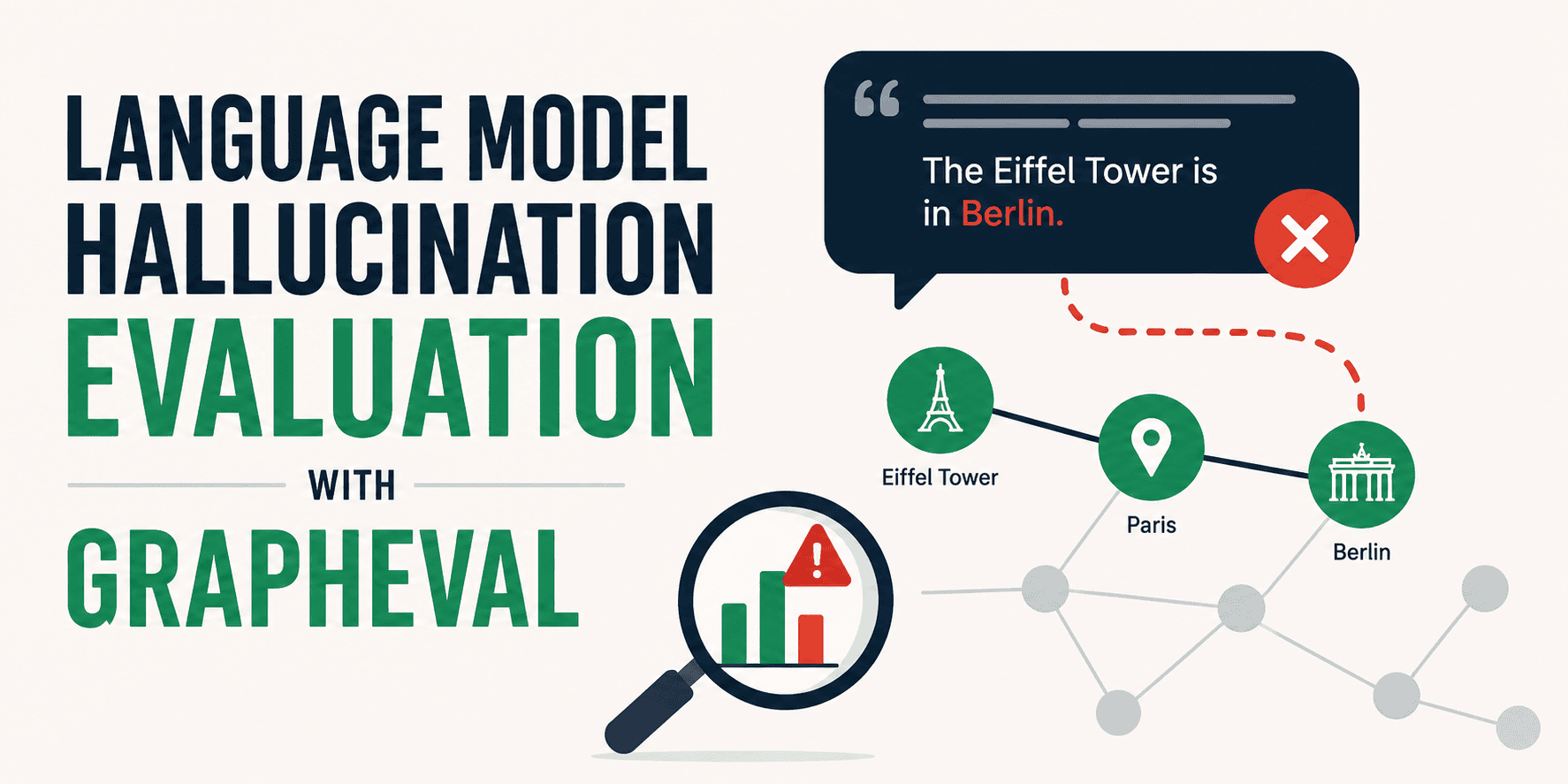
-
Verifying Factual Consistency: The NLI Engine at Work
The core of GraphEval’s diagnostic power lies in the NLI process. Utilizing a publicly available, open-source NLI model (e.g.,cross-encoder/nli-deberta-v3-small), each extracted triple is systematically evaluated against thesource_context. For each triple, a "hypothesis" is constructed (e.g., "GraphEval requires expensive enterprise server farm") and fed to the NLI model alongside thesource_contextas the "premise." The NLI model then outputs its classification: ‘entailment’, ‘neutral’, or ‘contradiction’. GraphEval interprets any result other than ‘entailment’ as a signal of hallucination. The simulation clearly demonstrates this:('GraphEval', 'is', 'evaluation framework')-> NLI Output:entailment(Grounded)('GraphEval', 'uses', 'Knowledge Graphs')-> NLI Output:entailment(Grounded)('GraphEval', 'requires', 'expensive enterprise server farm')-> NLI Output:neutral(HALLUCINATION)
This outcome precisely identifies the fabricated claim about server farm requirements, showcasing GraphEval’s ability to localize the hallucination. The final visualization, presenting the knowledge graph with color-coded edges (green for grounded, red for hallucinatory), provides an intuitive "hallucination map," further enhancing explainability and making the diagnostic process visually clear.
Key Advantages and Explainability: Beyond Simple Metrics
GraphEval’s primary strength lies in its ability to offer explainable insights into LLM hallucinations, a feature often lacking in conventional evaluation metrics. While metrics like ROUGE, BLEU, or perplexity assess linguistic quality or fluency, they provide little to no information about factual accuracy or the specific points of divergence from truth. GraphEval, by contrast, transforms the black-box nature of hallucination detection into a transparent, diagnostic process. By breaking down LLM outputs into discrete, verifiable facts represented as knowledge graph triples, it allows developers and researchers to pinpoint exactly which statements are incorrect. This granular feedback is invaluable for several reasons:
- Targeted Model Improvement: Instead of knowing an LLM generally hallucinates, GraphEval identifies what specific facts are wrong. This allows for targeted fine-tuning, retrieval system adjustments, or knowledge base enhancements to address the root causes of errors more effectively.
- Enhanced Trust and Transparency: Providing a clear "hallucination map" builds greater trust in AI systems. Users and developers can understand the reliability of different parts of an LLM’s output, fostering more informed interaction and deployment decisions.
- Auditability and Compliance: In regulated industries, the ability to audit and explain AI decisions is paramount. GraphEval offers a structured way to demonstrate that AI outputs have been rigorously checked for factual integrity, supporting compliance efforts.
- Developer Efficiency: Automated and explainable detection reduces the reliance on costly and time-consuming manual review, freeing up human experts to focus on more complex tasks.
Addressing the Limitations and Future Directions
While GraphEval represents a significant advancement, it is not without its inherent limitations and areas for future development. The framework’s effectiveness is heavily reliant on several factors:
- Quality of KG Extraction: The initial step of converting text into knowledge graph triples is critical. Errors or omissions by the auxiliary LLM during extraction can lead to false positives or negatives in hallucination detection. Improving the robustness and accuracy of information extraction models remains an ongoing challenge.
- Accuracy of NLI Models: While NLI models like DeBERTa are powerful, they are not infallible. They can sometimes misclassify the relationship between premise and hypothesis, especially with complex sentences, nuanced language, or when the ground truth is incomplete or ambiguous. Continuous improvement in NLI model performance is essential.
- Completeness of Ground-Truth Knowledge Base: GraphEval’s ability to detect hallucinations is directly tied to the completeness and accuracy of the ground-truth context it uses for verification. If the ground truth itself is incomplete or contains errors, the evaluation will be compromised. Maintaining and expanding comprehensive, up-to-date knowledge bases is a significant operational challenge.
- Computational Overhead: In a real-world production setting, generating knowledge graphs from every LLM output and then running NLI inference on potentially hundreds or thousands of triples per response can be computationally expensive and introduce latency. Optimizing the efficiency of both extraction and NLI processes is crucial for scalability.
Future directions for GraphEval could include exploring multi-modal knowledge graphs to verify information across different data types (text, images, video), integrating uncertainty quantification into NLI predictions, and developing adaptive ground-truth contexts that can evolve with new information.
Industry Implications and the Drive for Trustworthy AI
The introduction of frameworks like GraphEval carries profound implications for the broader AI industry. As LLMs become increasingly integrated into enterprise solutions, their trustworthiness becomes a non-negotiable requirement. GraphEval contributes directly to the growing field of "Responsible AI" by providing a concrete mechanism for validating factual accuracy. For businesses, this translates into:
- Reduced Risk: Minimizing the generation of false information lowers the risk of legal challenges, financial losses, and reputational damage.
- Improved Product Quality: Higher quality, factually accurate AI outputs lead to better user experiences and more effective applications.
- Accelerated Development: Developers can iterate on LLM models more rapidly by receiving precise feedback on where hallucinations occur, streamlining the debugging and fine-tuning process.
- Competitive Advantage: Companies that can reliably demonstrate the factual integrity of their AI offerings will gain a significant edge in a market increasingly sensitive to AI risks.
This move aligns with broader industry trends focusing on AI safety, explainability, and ethical deployment, signaling a maturation of the AI landscape from pure capability to robust reliability.
Expert Perspectives on Hallucination Mitigation
Leading figures in AI research and ethics consistently highlight the critical importance of tools like GraphEval. Dr. Anya Sharma, a senior researcher specializing in AI ethics at a prominent tech think tank, commented, "The problem of LLM hallucination isn’t just a technical glitch; it’s a fundamental challenge to the societal acceptance of AI. Frameworks like GraphEval, which provide transparent, explainable diagnostics, are indispensable. They empower developers to build more reliable systems and foster public trust, moving us closer to truly beneficial AI." Similarly, John Davies, head of AI product development at a global software firm, stated, "Our enterprise clients demand absolute accuracy, especially when LLMs are deployed in sensitive areas like financial analysis or healthcare. GraphEval’s ability to pinpoint the exact hallucinatory elements is a game-changer for our development workflow, allowing us to deliver verifiable and trustworthy AI solutions." These statements underscore the practical and ethical imperatives driving the adoption and development of such advanced evaluation methodologies.
Conclusion: Paving the Way for More Reliable LLMs
GraphEval stands as a testament to the ongoing innovation aimed at making Large Language Models not only more powerful but also more reliable and transparent. By translating the complex task of hallucination detection into a structured, two-stage process involving knowledge graphs and Natural Language Inference, it offers a diagnostic capability that far surpasses traditional aggregate metrics. This explainable approach allows developers to pinpoint the root cause of factual errors, enabling targeted improvements and fostering greater trust in AI systems. As LLMs continue their trajectory towards ubiquitous integration, frameworks like GraphEval will be instrumental in ensuring that this powerful technology can be deployed responsibly and effectively, paving the way for a future where AI-generated content is synonymous with factual integrity. The continuous evolution of such methodologies is paramount to unlocking the full, trustworthy potential of artificial intelligence.