The Comma-Separated Values (CSV) file format remains the universal language of data exchange in the modern digital economy. Despite the rise of sophisticated cloud-based data warehouses and complex API-driven architectures, the simplicity of the CSV file ensures its continued dominance in database exports, legacy system migrations, and routine business reporting. However, this ubiquity masks a persistent technical challenge: the frequency of data quality degradation. Inconsistent delimiters, character encoding mismatches, schema drift, and duplicate entries are commonplace, often forcing data professionals into repetitive, manual cleanup workflows that are both time-consuming and prone to human error.
The evolution of data pipelines over the past decade has highlighted a significant gap in tooling. While large-scale data engineering frameworks like Apache Spark or cloud-native ETL services are excellent for terabyte-scale processing, they are often overkill for the small-to-medium datasets encountered in daily business operations. The need for lightweight, portable, and dependency-free utilities has never been higher. By leveraging the Python standard library, developers can now deploy robust, automated scripts that address the five most common pain points in CSV management without the overhead of external package management.
The Anatomy of CSV Data Quality Issues
Data practitioners frequently report that the "last mile" of data preparation—cleaning up incoming CSV files—consumes a disproportionate amount of their time. According to industry surveys, data professionals spend approximately 80% of their time on data preparation and only 20% on actual analysis. This imbalance is largely attributed to the lack of standardization in how systems export data.
Historical context reveals that the CSV format, while governed by RFC 4180, is rarely implemented with strict adherence. Legacy financial systems often output files using semicolons or tabs rather than commas, while modern global applications frequently encounter encoding errors when handling non-ASCII characters, such as those found in international names or currency symbols. These inconsistencies, when left unaddressed, ripple through downstream applications, leading to broken database imports, failed dashboard visualizations, and skewed analytical results.
A Chronology of Automated Validation
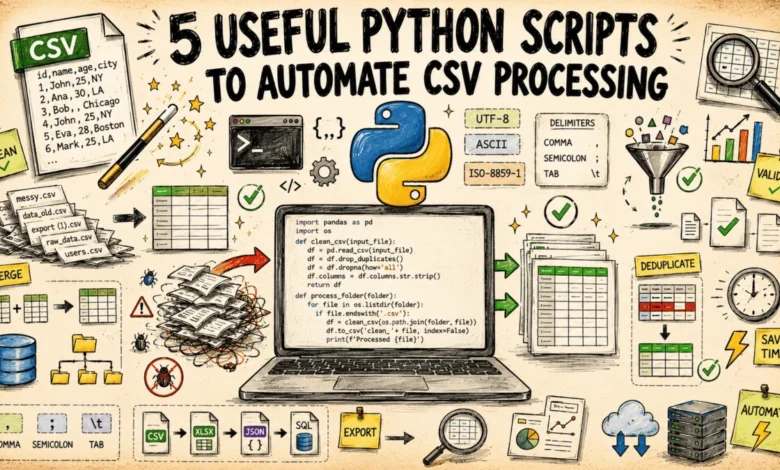
The shift toward "data-as-code" has prompted a move away from manual spreadsheet manipulation toward automated, script-based validation. The following five-stage approach represents the current standard for robust CSV handling:
- Schema Validation: Ensuring the structural integrity of the data before it enters the ingestion pipeline.
- Row-Level Diffing: Tracking changes between file versions to maintain audit trails.
- Format Normalization: Standardizing encoding and delimiters to prevent ingestion failures.
- Column Transformation: Reshaping data structures to meet specific interface requirements.
- Data Anonymization: Protecting sensitive information during the sharing or testing phase.
Technical Deep Dive: Validating Data at the Gate
The first line of defense in any data pipeline is a schema validator. A CSV file that passes a basic syntax check may still be semantically invalid—containing, for example, a string in a column expected to be an integer. By utilizing the csv.DictReader class, developers can stream data row-by-row, validating each entry against a predefined JSON schema. This approach is highly efficient, as it maintains a constant memory footprint, allowing for the validation of multi-gigabyte files that would otherwise trigger memory overflow errors in standard desktop spreadsheet software.
Industry experts emphasize that "failing fast" is critical to pipeline health. By producing a granular error report that highlights the specific row number, column name, and the nature of the violation, developers can provide immediate feedback to upstream data providers. This process significantly reduces the "debugging cycle" associated with identifying why a particular import failed.
Auditing Changes with Row-Level Diffing
The ability to compare two iterations of a dataset is essential for change management. In large-scale operations, identifying which rows were added, removed, or modified is often an exercise in frustration if performed manually. By implementing a dictionary-based hashing strategy—where each row is indexed by a unique key (such as an ID or primary key)—developers can automate the detection of changes.
This methodology provides a clear audit trail. Instead of comparing whole files, the script isolates the specific records that have changed and records the delta in a dedicated CSV report. This level of transparency is increasingly required by data governance policies, which demand that every modification to a dataset be documented and traceable to a specific source or update cycle.
Standardizing the Chaos of Encoding
One of the most persistent issues in data engineering is the "encoding hell" associated with files generated across different operating systems. A file created on a legacy Windows system using CP1252 encoding will inevitably cause issues when processed by a Linux-based server expecting UTF-8.
The use of Python’s csv.Sniffer utility allows scripts to programmatically detect delimiters—differentiating between commas, tabs, and semicolons—and, combined with character encoding detection, provides a mechanism for full file normalization. By converting all incoming data to a standard UTF-8 format with consistent line endings, organizations can eliminate the common "mojibake" or character corruption issues that plague global data systems.
The Role of Transformation and Anonymization
Data transformation often involves renaming headers or deriving new fields based on existing data. By using a configuration-driven approach—where transformation rules are stored in a separate JSON file—organizations can ensure that data reshaping is consistent and reproducible. This avoids the dangers of "hard-coding" logic, which often leads to technical debt.
Furthermore, with the introduction of stricter data privacy regulations such as the GDPR and CCPA, the ability to anonymize data before it leaves a secure environment has become a legal requirement rather than a best practice. By utilizing keyed hashing, a script can replace personally identifiable information (PII) with consistent tokens. This allows data scientists to test models or share samples with external partners while preserving the underlying statistical relationships, all without exposing the actual identity of the subjects.
Broader Implications for Data Governance
The shift toward these lightweight, automated scripts represents a broader trend toward "decentralized data engineering." As organizations move away from monolithic, black-box ETL tools, the preference for modular, transparent, and version-controlled scripts is growing.
The implications for businesses are significant:
- Cost Reduction: Automating manual tasks saves thousands of engineering hours annually.
- Improved Data Quality: Reducing human interaction with raw data minimizes the risk of accidental modification.
- Operational Resilience: By gating data at the point of ingestion, organizations prevent "data swamp" scenarios where corrupted data becomes deeply embedded in the reporting layer.
Conclusion
The tools outlined here—schema validation, diffing, normalization, transformation, and anonymization—form a comprehensive toolkit for any data practitioner. By relying on the Python standard library, these scripts offer a level of reliability and portability that proprietary tools often struggle to match. As data volumes continue to grow and the complexity of regulatory environments increases, the ability to rapidly deploy, audit, and clean data through automated, script-based processes will remain a foundational skill for the modern data professional.
Ultimately, the goal of these scripts is not just to perform a task, but to create a repeatable, auditable process that transforms CSV management from a chaotic, manual chore into a stable, automated component of the organizational data architecture. Whether a team is dealing with a handful of files or thousands of automated exports, these strategies provide a pathway toward cleaner, more reliable, and more secure data pipelines.