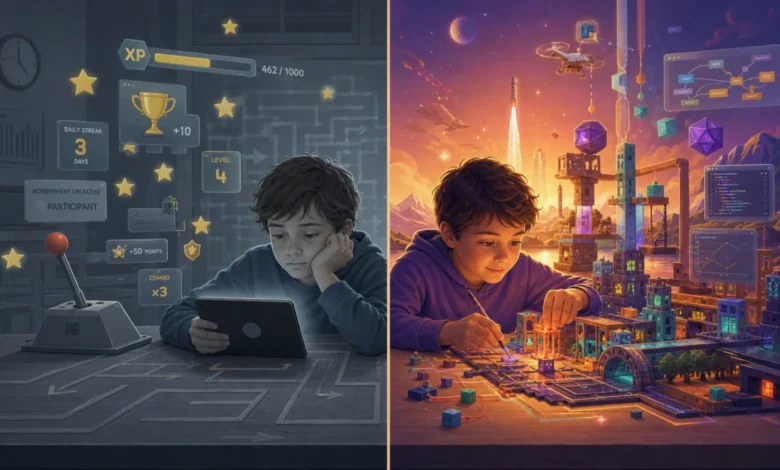
The disconnect between modern educational software and the actual gaming habits of children has reached a critical inflection point. For the past decade, the EdTech industry has operated under the assumption that "gamification"—the integration of game-like mechanics such as experience points (XP), leaderboards, and digital badges—is the silver bullet for student engagement. However, as Gen Alpha and late Gen Z students reach school age, educators and developers are finding that these surface-level mechanics are increasingly ineffective. Students who spend their leisure hours navigating the complex, creative, and social ecosystems of platforms like Minecraft, Roblox, and Fortnite are finding traditional "gamified" learning tools patronizing and intellectually hollow.
The Evolution of the Digital Student
To understand this friction, one must examine the environment in which today’s students were raised. Unlike previous generations, for whom gaming was a secondary activity, current students are "digital natives" who have interacted with complex, interactive simulations since early childhood. By age eight, the average student has accumulated hundreds, if not thousands, of hours of gameplay. This is not merely time spent looking at a screen; it is time spent mastering mechanics, negotiating social hierarchies in multiplayer servers, and learning the fundamentals of logic through block-based programming.
According to industry reports from platforms like Roblox, over 50% of their daily active users are under the age of 13. These children are not just consumers; they are builders. They participate in an economy of creation where they define their own goals and solve problems through iterative failure. When these same children encounter an educational platform that relies on "digital worksheets"—where the only interaction is clicking a correct answer to receive a virtual "gold star"—the disparity in quality becomes glaring. They do not perceive this as a game; they perceive it as an attempt to disguise rote memorization with superficial rewards.
A Chronology of the Gamification Fallacy
The trend of gamification in education gained mainstream momentum around 2010, influenced by the broader corporate trend of using behavioral psychology to drive productivity.
- 2010–2014: The "Gamification Era" begins. Software developers, largely non-gamers, begin applying the "Points-Badges-Leaderboards" (PBL) framework to educational tools, believing that extrinsic rewards would naturally mirror the engagement found in popular video games.
- 2015–2018: Rapid adoption of EdTech in K-12 classrooms. Schools heavily invest in adaptive learning software that tracks progress via progress bars and streaks.
- 2019–2022: The "Minecraft Generation" enters middle school. Teachers report increasing apathy toward traditional gamified apps, noting that students often find ways to "game the system" rather than engaging with the educational content.
- 2023–Present: A shift in industry perspective. Developers and educational psychologists begin questioning whether extrinsic reward systems are actually detrimental to intrinsic motivation, leading to a movement toward "game-based learning" rather than mere "gamification."
Supporting Data and Behavioral Analysis
The failure of "bad gamification" can be traced back to Self-Determination Theory (SDT), which posits that human motivation relies on three psychological needs: autonomy, competence, and relatedness.
Research published in the Journal of Educational Psychology suggests that when a task is inherently interesting, the introduction of extrinsic rewards—like a digital badge for finishing a math problem—can actually decrease the student’s intrinsic interest in the subject matter. This phenomenon, known as the "overjustification effect," suggests that once the reward is removed, the student no longer sees a reason to engage with the material.
Furthermore, data from student surveys indicates that "meaningless progression" is the primary driver of app churn. When students are asked to compare a commercial sandbox game to an educational tool, they consistently identify "agency" as the deciding factor. In a sandbox game, the user chooses their path. In poorly designed EdTech, the user is restricted to a linear path with no ability to experiment. By removing the possibility of meaningful failure, developers effectively strip the activity of its "game-ness," leaving behind only the drudgery of the worksheet.
Official Responses and Industry Shifts
While the EdTech sector has been slow to pivot, some industry leaders are beginning to acknowledge the "intelligence gap." Companies specializing in game-based learning, such as those integrating coding into immersive environments, are now prioritizing "agency-first" design.
A spokesperson for an educational game design firm noted during a recent industry conference: "We spent years trying to make education look like a game. We should have spent that time making the learning process function like a game. The difference is the difference between putting a coat of paint on a house and building the house from the foundation up."
Critics within the gaming industry argue that the problem is a fundamental lack of literacy among developers. Many EdTech designers lack experience in professional game design, leading to the creation of systems that focus on metrics—such as time-on-app or completion rates—rather than the player experience. By prioritizing these metrics, companies create "Skinner boxes" designed to trap students rather than environments designed to inspire them.
Broader Impact and Future Implications
The implications of this disconnect are significant. If students associate "gamification" with manipulation, they will become increasingly cynical toward digital learning tools. This creates a barrier for future educational technologies; as users grow more sophisticated, they will be less susceptible to basic psychological manipulation tactics like notification streaks and meaningless XP.
To survive, the EdTech industry must undergo a paradigm shift. Developers must move away from the "Points, Badges, and Leaderboards" (PBL) model and toward a genre-based framework:
- RPG Principles: Instead of XP for tasks, allow students to unlock deeper, more complex roles or abilities as they master foundational concepts.
- Strategy Principles: Provide students with a set of tools and a goal, but allow them to determine the method of success.
- Puzzle Principles: Focus on the "Aha!" moment of discovery rather than the quantitative completion of a sequence.
The path forward is not to abandon games in the classroom, but to respect the intelligence of the student. Young users have been trained by some of the most sophisticated interaction designers in the world. They recognize the difference between a tool that empowers them to explore and a tool that attempts to bribe them for their attention. As the market matures, the winners will be those who stop treating education as a series of chores to be completed and start treating it as a challenge to be conquered. The era of "homework with points" is coming to an end; in its place, the next generation of educational tools must prioritize the agency, creativity, and complexity that define the modern gaming landscape. If the industry fails to adapt, it risks losing the most important demographic in education: the students themselves.