The Evolution of Digital Interaction: Moving Beyond Menus and Forms Toward Intent-Driven AI Experiences

The global digital landscape is undergoing a profound paradigm shift, moving rapidly away from the traditional mechanics of menus, drop-down selections, forms, and endless browser tabs toward experiences shaped directly around human intent. For user experience (UX) designers, developers, and product architects alike, understanding this fundamental evolution requires a rigorous re-evaluation of their core responsibilities. Professionals are transitioning from designing visible, static interfaces to guiding transparent, intent-driven artificial intelligence systems that prioritize efficiency and seamless execution over high engagement metrics.

Main Facts and the Architectural Shift of the Web
Since the commercialization of the Graphical User Interface (GUI), pioneered by landmark systems such as the Xerox Star and later popularized by the original Apple Macintosh in the 1980s, software has relied overwhelmingly on point-and-click interactions. For decades, if a user wanted to complete a multi-faceted task—such as booking international travel, comparing financial assets, purchasing consumer goods, or researching complex health symptoms—they were forced to navigate a labyrinth of manual user interfaces. This legacy model dictated that users click through layered menus, adjust granular range sliders, fill out tedious multi-step forms, dismiss intrusive cookie pop-ups, and juggle dozens of open browser tabs simply to cross-reference basic information.
Over time, digital consumers became accustomed to spending the vast majority of their digital interaction time managing software mechanics rather than actually achieving their underlying personal or professional goals. However, this foundational contract between human and computer is officially changing. Propelled by rapid breakthroughs in artificial intelligence, machine learning, and large language models, a new generation of web tools is pioneering a radical philosophy: Intent-Driven Design. Rather than expecting users to learn complex site navigation paths, master specialized software, or click through elaborate sales funnels, these modern platforms operate by capturing high-level human goals and silently executing the heavy lifting in the background.
This emerging vision builds directly upon long-standing Human-Computer Interaction (HCI) concepts, most notably Golden Krishna’s seminal thesis “The Best Interface Is No Interface” and Don Norman’s foundational principles of human-centered design. The ultimate objective of modern web architecture is no longer to construct prettier buttons, incorporate flashy animations, or maximize superficial engagement metrics; rather, it is to minimize user friction to the point of eliminating the traditional interface entirely.
Historical Chronology: From Mechanical Inputs to Autonomous Execution
To contextualize the current revolution in web design, it is necessary to examine the friction that the digital industry has accepted as standard operating procedure for over forty years.
- The 1980s–1990s (The GUI Revolution): The introduction of the Graphical User Interface established the mouse, windows, icons, and pull-down menus as the gold standard of computing. While revolutionary for its time, it established the human-as-operator paradigm, where users had to manually manipulate digital objects to achieve results.
- The 2000s–2010s (The Web and Mobile App Boom): As the internet scaled globally, websites and mobile applications focused heavily on conversion rates, multi-step checkout processes, and interactive dashboards. Interaction volume, click-through rates, and page views per session became the primary KPIs for software success, inadvertently increasing user cognitive load.
- The Early 2020s (The Rise of Conversational AI): Early large language models introduced chat-based interfaces, allowing users to type prompts rather than navigate complex directories. However, chat windows often introduced a new form of friction—forcing users to write extensive conversational prompts and manually parse large blocks of text.
- The Present Era (Intent-Driven and Generative UI): The contemporary landscape moves past simple chat boxes toward autonomous execution. Systems now capture high-intent natural language inputs, generate custom user interfaces on the fly, and execute complex multi-step digital workflows autonomously in the background.
Comparative Analysis: The 10-Click Process Versus Intent Flows
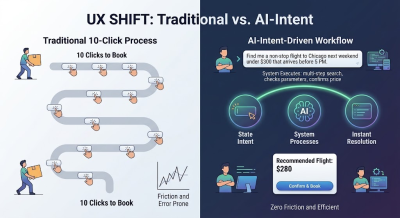
To understand the practical impact of this transition, consider the traditional workflow of booking a flight online. In a legacy point-and-click UI paradigm, the computer acts as a passive container of data, while the human acts as the exhaustive orchestrator. The user must manually input departure and arrival airports, select dates via a calendar widget, filter by preferred airlines, adjust time sliders, review baggage fees, input passenger details, and complete payment verification across multiple screens.
Intent-driven design flips this dynamic entirely. Instead of forcing the user to navigate the mechanical steps of how to find a flight, the modern platform asks a single overarching question: What are you trying to accomplish?
When a user expresses a comprehensive goal—such as requesting a non-stop flight to Chicago for the upcoming weekend under $300 that arrives before 5 PM—the software reads the intent, executes the multi-step search query behind the scenes, compares available options across providers, and presents a single actionable resolution. Ten distinct clicks dissolve into one clear intent outcome.
Platform Implementations Reshaping the Digital Ecosystem
This philosophical shift is no longer a theoretical exercise confined to academic laboratories; it is actively transforming mainstream digital platforms across various sectors.
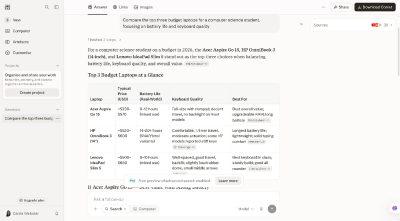
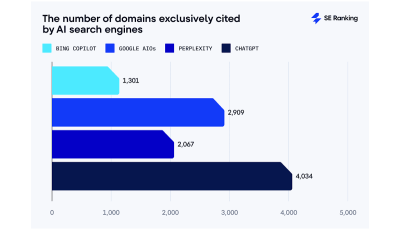
- Perplexity AI (Search Without Open Tabs): Traditional search engines were built as directories that rewarded users with lists of blue links, leaving the cognitive labor of opening multiple tabs, skimming long articles, and synthesizing information to the user. Platforms like Perplexity AI allow users to perform instant intent-based searches, immediately synthesizing contextual, verified answers and bypassing traditional link navigation entirely.
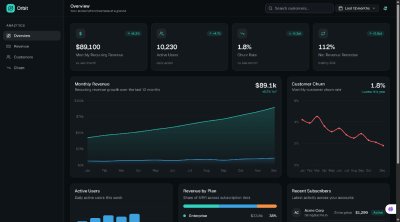
- Vercel v0 (Web Design Without Manual Layouts): Historically, creating a digital interface required manual wireframing, dragging and dropping elements in visual builders, selecting hexadecimal color codes, and writing CSS. Generative interface builders allow users to input natural language prompts to instantly generate functional code components and responsive UI layouts on demand.
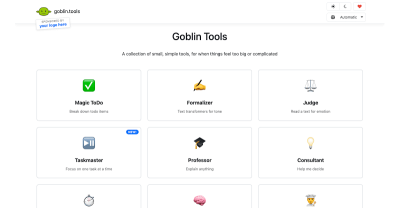
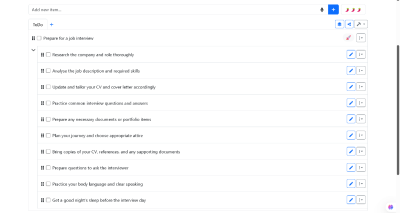
- Goblin.tools (Task Breakdown and Productivity): Traditional productivity suites require users to manually construct task lists, assign deadlines, and organize Kanban boards. Single-page AI productivity tools automatically decompose overwhelming, complex projects into structured, manageable micro-tasks tailored to neurodivergent individuals or anyone experiencing cognitive overload, requiring zero configuration.
Core Pillars of Intent-Driven Web Design
Industry analysts and UX researchers note that removing traditional menus and sidebars requires a new framework for maintaining usability. Designers pioneering this space rely on three core pillars:
- High-Level Goal Input: Rather than waiting for micro-actions like clicks and dropdown selections, modern systems leverage contextual metadata—such as device state, physical location, and historical interaction patterns—to anticipate needs and accept natural language inputs.
- Generative UI: Computing is shifting from command-based interaction to outcome-specification. Generative UI renders layouts dynamically on the fly based on the user’s immediate objective, dissolving when the task is complete.
- Autonomous Execution by AI Agents: Traditional interfaces rely heavily on prevention, interrupting users with frequent confirmation modals. Intent-driven systems prioritize frictionless rollback mechanisms, utilizing prominent "Undo" buttons, simple revision prompts, and transparent audit logs instead of intrusive warnings.
Industry Implications and the Hidden Risks of Automation
While stripping away interface friction offers unprecedented user liberation, it introduces significant ethical and technical challenges that product designers must carefully navigate.
When software acts on inferred intent rather than explicit point-and-click commands, users risk experiencing the "illusion of control." According to insights from human-computer interaction research groups, automation must maintain strict boundaries to prevent user frustration and algorithmic paternalism. Designers must balance convenience with safety by explicitly prompting users for high-stakes confirmations regarding financial transactions, public data publishing, or critical privacy alterations.
Furthermore, the "black box problem" remains a notable hurdle. In traditional user interfaces, troubleshooting an unexpected result is straightforward; users can inspect filters or verify dates. In intent-driven systems, opaque AI logic can obscure why a specific outcome was generated. To combat this, usability guidelines from major research bodies advocate for transparent feedback loops, wherein systems explicitly state their interpretations—such as displaying the exact parameters being searched—allowing users to calibrate trust and correct misinterpretations instantly.
Conclusion and Future Outlook
For decades, the digital economy evaluated software success through engagement metrics centered around time spent in-app, click-through rates, and session page views. Websites were deliberately engineered to maximize visual interaction volume.
The widespread adoption of intent-driven design turns these legacy metrics upside down. Aligning with the broader movement toward mindful technology and digital well-being, the ultimate test of a modern digital product is no longer how visually captivating its buttons are, but rather how effectively the software solves the user’s problem and gets completely out of their way. As the web evolves beyond screens and static layouts, the future of digital architecture will be defined not by more interaction, but by seamless, invisible completion.