The Death of the Button: Why the Future of Web Design is Intent-Driven and Interface-Free

The contemporary digital landscape is undergoing a profound paradigm shift, moving rapidly away from traditional menus, multi-step forms, and endless point-and-click interactions toward fluid experiences shaped entirely by human intent. For decades, software has relied heavily on visual interfaces pioneered during the dawn of the Graphical User Interface (GUI) era by systems like the Xerox Star and popularized by the Apple Macintosh. To accomplish routine digital tasks—such as booking travel, purchasing retail goods, or researching medical symptoms—users have long been forced to navigate complex labyrinths of drop-down menus, filter sliders, cookie banners, and dozens of open browser tabs. Industry analysts note that contemporary web users frequently spend more time managing software mechanics than actually achieving their underlying objectives.
This foundational contract between human and machine is now officially being rewritten. Propelled by significant leaps in artificial intelligence, machine learning, and large language models (LLMs), a new generation of digital products is pioneering Intent-Driven Design. Rather than expecting users to learn proprietary navigation structures and complex sales funnels, these modern platforms capture high-level human goals and autonomously execute the necessary groundwork in the background. This evolution represents a realization of long-standing Human-Computer Interaction (HCI) theories, echoing principles from Don Norman’s human-centered design frameworks and Golden Krishna’s widely cited thesis that "the best interface is no interface." Consequently, UX designers are being forced to re-evaluate their professional roles, shifting their core competencies away from crafting static visual layouts toward guiding transparent, intent-driven AI experiences.

The Evolution of Interaction: From the 10-Click Paradigm to Ambient Computing
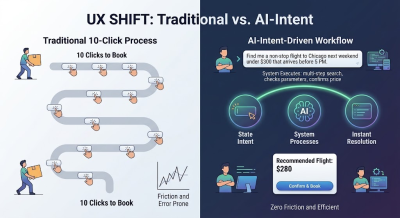
To fully grasp the magnitude of this transition, one must examine the friction that the digital industry has accepted as standard operating procedure for decades. Consider the conventional workflow for purchasing a commercial airline ticket online. The user experience is intentionally hyper-interactive and fragmented: a customer must open a browser, navigate to a travel aggregator, input departure and arrival cities using calendar pickers, select specific dates, filter by preferred airlines, adjust departure time windows, sort through tiered pricing options, manually enter passenger details, bypass targeted upsells for baggage and seat selection, and finally input payment credentials across multiple verification screens.
This workflow exemplifies the traditional point-and-click UI paradigm. In this model, the computer acts as a passive, static container of raw data, while the human acts as the active orchestrator—manually inputting parameters, interpreting raw outputs, and executing each micro-step sequentially.
Intent-driven design completely reverses this dynamic. Instead of compelling the user to navigate the mechanical steps required to find a flight, an intent-driven interface poses a singular, high-level question: What are you trying to accomplish? When a user articulates a specific goal—such as requesting a non-stop flight to Chicago for the upcoming weekend under $300 that arrives prior to 5:00 PM—the software parses the underlying intent, executes the multi-step search queries across disparate databases behind the scenes, cross-references options, and presents a single, actionable resolution. The traditional ten-click process dissolves into a solitary, seamless outcome.
Real-World Pioneers: Platforms Replacing Buttons with Intent
This transformation is not a theoretical forecast of a distant future; it is actively reshaping the web today. Several accessible platforms are already demonstrating how traditional buttons and menus can be successfully supplanted by intent-capturing systems.
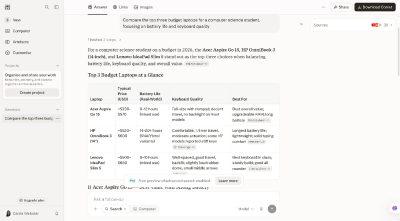
Perplexity AI has fundamentally altered how users approach digital information retrieval. Traditional search engines functioned primarily as directories, rewarding queries with static lists of blue links while leaving the arduous labor of opening tabs, skimming text, and synthesizing answers to the human user. Perplexity and comparable AI-native search tools allow users to perform instant intent-based searches, immediately synthesizing contextual answers and eliminating the need for sprawling tab management.
Similarly, Vercel v0 has transformed web development and interface design. Historically, creating a digital product required manually drawing rectangles, selecting hex codes, adjusting padding values, and writing cascading style sheets (CSS) within drag-and-drop builders or vector graphics tools like Figma. Generative interface builders now allow users to articulate layout and functional requirements in natural language, instantly rendering production-ready code components on the fly without manual layout construction.
Productivity suites are experiencing an identical evolution. Platforms like Goblin.tools provide single-page, AI-driven task management that deconstructs overwhelming human objectives into granular, actionable checklists without requiring user sign-ups, configuration, or manual Kanban board maintenance.
Core Pillars of Intent-Driven Web Design
When traditional sidebars, persistent navigation menus, and form fields are stripped away, designers must rely on entirely new architectural pillars to maintain software usability and trust:
- High-Level Goals via Natural Language and Context: Invisible interfaces do not merely wait for explicit commands; they leverage contextual metadata—such as device state, location, and historical behavioral patterns—to anticipate needs and trigger proactive assistance.
- Generative User Interfaces: Moving away from static layouts where every visitor views identical pages, modern computing is shifting toward outcome-specification. Generative UI dynamically renders layouts on demand, creating customized widgets or calculators specifically tailored to the user’s immediate context before gracefully dissolving once the task is complete.
- Autonomous Execution and Reversibility: Traditional software relies heavily on intrusive confirmation pop-ups to prevent user error. Intent-driven systems adapt established usability heuristics by shifting safety nets from prevention to frictionless reversibility. Autonomous agents execute tasks directly, backed by prominent "undo" mechanisms, revision prompts, and transparent audit logs rather than warning modals.
The Hidden Risks: Managing Control and the Black Box Problem
While eliminating interface friction offers profound liberation, stripping away conventional visual controls introduces significant product design and ethical challenges. When software acts on inferred intent rather than explicit commands, designers must navigate critical technical pitfalls.
The primary concern involves the illusion of control. When digital platforms make decisions autonomously on behalf of a user, the experience can quickly cross the line from helpful to patronizing or invasive. According to insights from academic institutions like the Stanford Human-Computer Interaction Group, automation must maintain strict operational boundaries to prevent user frustration. Industry watchdogs, including the Center for Humane Technology, emphasize that digital architects must actively guard against manipulative defaults and dark patterns. Consequently, modern design systems dictate that routine execution should be fully automated, while high-stakes actions—such as financial transactions, public data publishing, or privacy modifications—must explicitly require human confirmation.
Furthermore, the "black box problem" remains a persistent hurdle. In a legacy graphical user interface, unexpected results are easily diagnosed by reviewing checked filter boxes or incorrect date inputs. In contrast, intent-driven interfaces obscure the operational mechanics. To mitigate this lack of transparency, human-AI interaction frameworks advocate for explicit feedback loops. Systems must clearly state their operational interpretation—such as displaying an active confirmation message stating it is searching for specific budget parameters—allowing users to accurately calibrate trust and correct misinterpretations instantly.
Implications for the UX Industry and Digital Metrics
For the user experience design community, this technological wave requires a fundamental reimagining of professional responsibilities. Industry practitioners must transition from designing static buttons and rigid form fields to mapping and presenting dynamic, generative UI components that adapt fluidly to shifting human intent. Mastering emerging patterns—such as ambient feedback, inline prompts, and transparent status indicators—is now critical to ensuring that agent-driven tools remain intuitive, ethical, and deeply human-centered.
For decades, the digital economy measured software success through engagement metrics rooted in friction: time spent in-app, click-through rates, page views per session, and ad impressions. Websites were intentionally engineered to maximize visual engagement and interaction volume. The philosophy championed by advocates of intent-driven design effectively inverts these legacy metrics. The ultimate test of a modern digital product is no longer how captivating its buttons are, but how efficiently the software solves the user’s problem and gets completely out of the way.
As the web continues its evolution beyond menus and forms, digital applications will increasingly be judged not by the complexity or beauty of their interfaces, but by their ability to render those very interfaces obsolete. The future of the digital realm is not characterized by increased user interaction, but by seamless, invisible completion.