Building a Senior AI Data Analyst: Transitioning from Intuitive Chatbots to Disciplined Analytical Frameworks

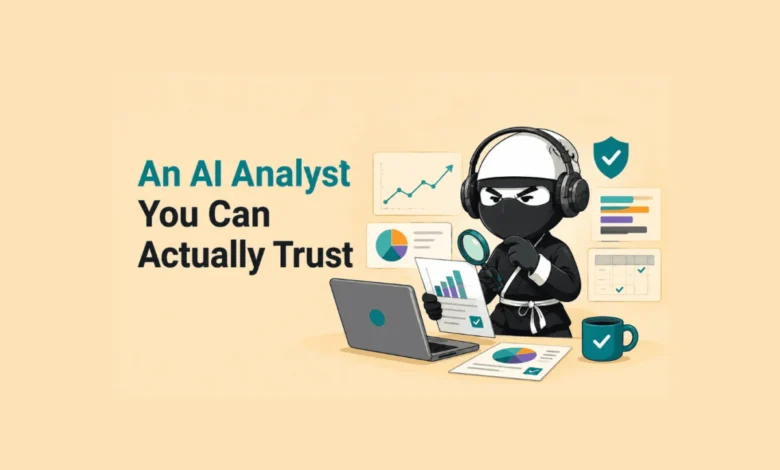
The rapid adoption of Large Language Models (LLMs) in corporate environments has introduced a significant paradox in business intelligence: while chatbots provide instantaneous responses to complex queries, they often lack the critical skepticism required for rigorous data analysis. When asked to identify the most effective promotional strategy, a standard AI model might identify a top-performing promotion based on limited, statistically insignificant samples. This creates a "confidence trap," where AI presents a bold, numerically sound conclusion that is fundamentally disconnected from the underlying data’s reliability. To bridge this gap, developers and data scientists are increasingly moving away from single-prompt interactions toward structured, multi-stage analytical toolkits that emulate the cautious, hypothesis-driven methodology of a senior human analyst.
The Problem of Premature Inference
In traditional data analysis, a senior practitioner follows a deliberate, multi-step process: they define the business objective, formulate a testable hypothesis, query the data, validate the sample size, and only then offer an executive summary. In contrast, standard generative AI prompts often skip these intermediate checkpoints. By focusing solely on the "best-looking" number, models frequently fail to account for the volume of data supporting that result.
For example, a promotion that performs well across 1,000 orders provides a robust foundation for strategic decision-making. Conversely, a promotion that appears to be the most successful based on only 10 orders—or even a single order—is statistically unreliable. When an LLM ignores this distinction, it risks providing recommendations that could lead to significant financial misallocation. The objective of building a "Senior AI Data Analyst" is not to replace the human element, but to codify the necessary skepticism of a veteran analyst into a deterministic Python-based workflow.
Developing the Analytical Pipeline
The proposed solution involves a modular Python toolkit designed to process queries through six distinct stages: business understanding, hypothesis generation, SQL planning, validation, executive summarization, and recommendation. This architecture ensures that the LLM operates within a rigid framework, preventing the "one-breath" answer syndrome that characterizes many consumer-grade chatbots.
By utilizing a common interface that supports both Anthropic and OpenAI APIs, this toolkit provides flexibility while maintaining a consistent analytical standard. The process begins with the ingestion of data, such as an order-level dataset containing product identifiers, promotion codes, costs, and units sold. Utilizing tools like Pandas for data manipulation and DuckDB for lightweight SQL execution, the pipeline ensures that the data is inspected for schema integrity—such as data types and missing values—before any LLM interaction occurs.

Chronology of the Six-Stage Analytical Workflow
The framework operates as a linear pipeline, ensuring that each stage informs the next while maintaining a clear audit trail of the reasoning process.
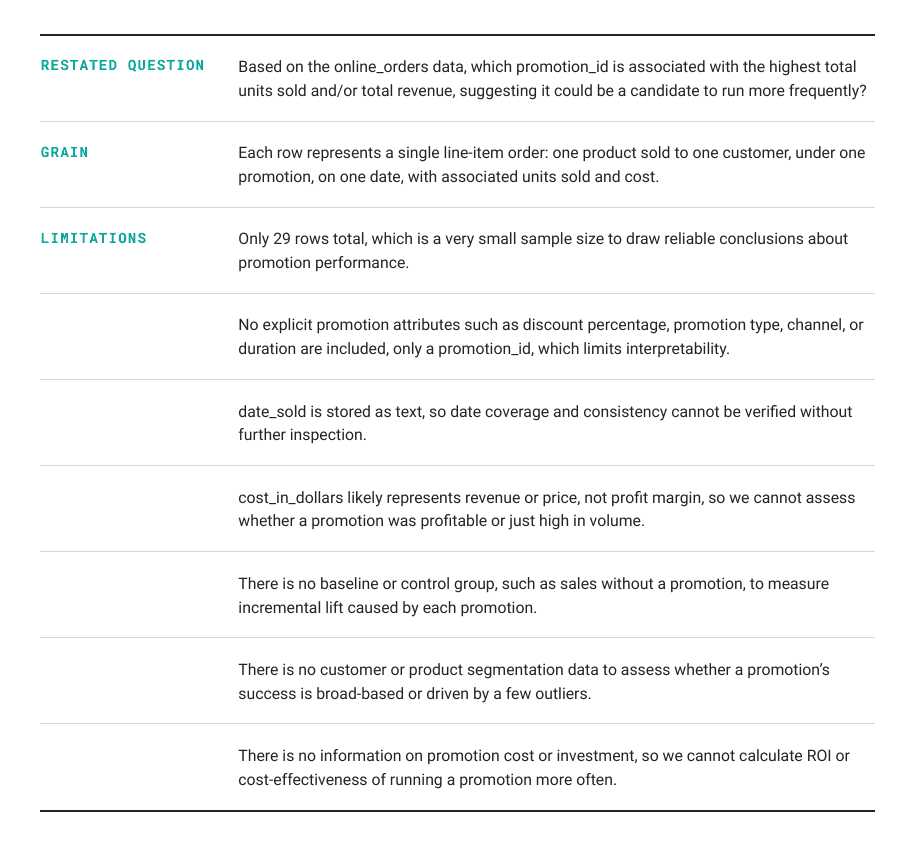
- Business Understanding: The model first restates the stakeholder’s query, identifies the data grain—defining exactly what an individual row represents—and lists limitations such as date coverage or missing dimensions. This forces the model to confront the quality of the dataset before making any claims.
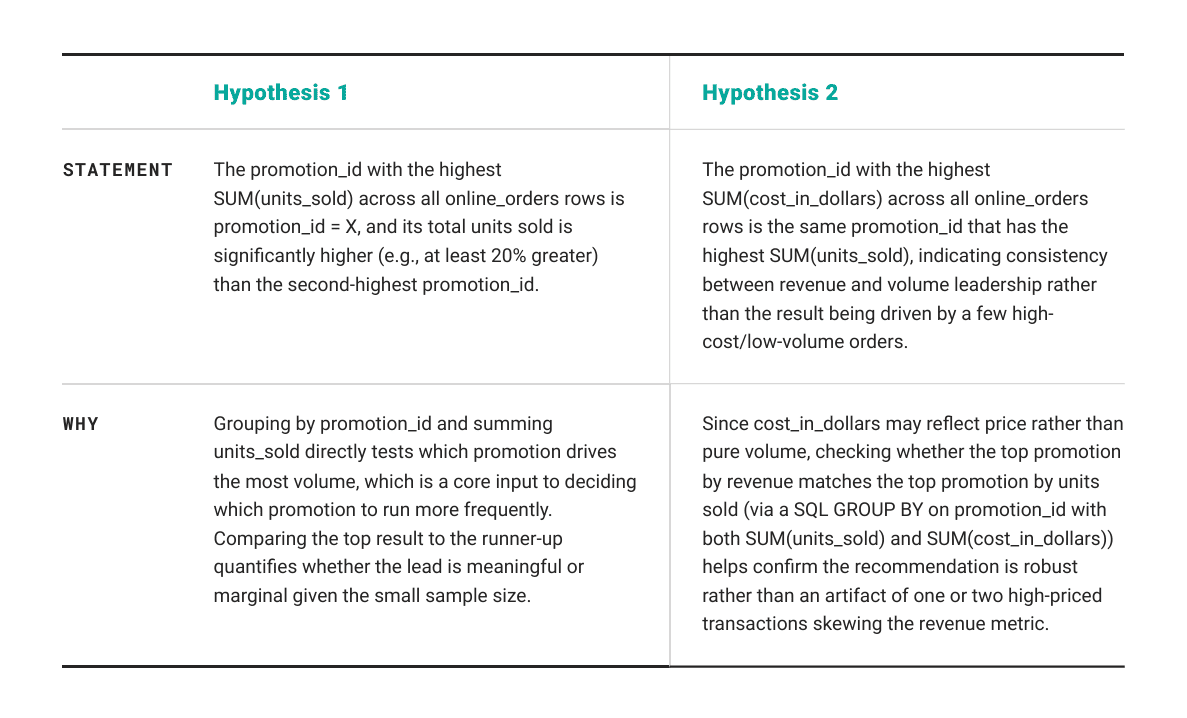
- Hypothesis Generation: Instead of jumping to an answer, the system proposes specific, testable hypotheses based on the available columns. This stage converts vague business questions into quantifiable problems.
- SQL Planning: The model generates SQL queries designed to test the chosen hypothesis. A crucial requirement here is the inclusion of sample size metrics, such as
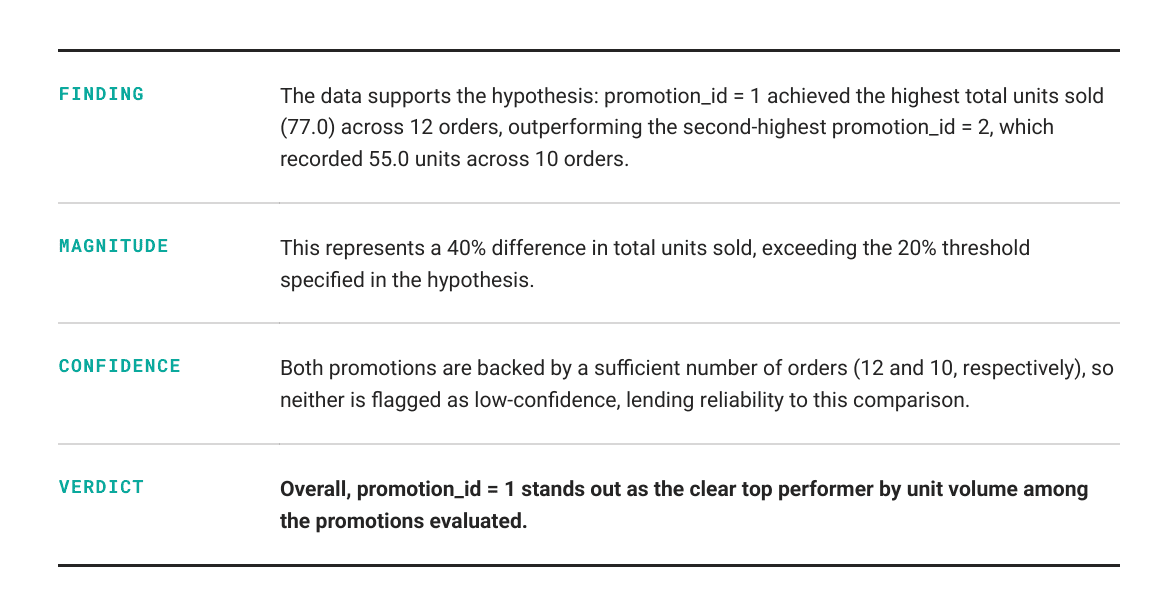
COUNT(*), which allows the system to verify the statistical significance of the results later. - Validation: This is the critical "gatekeeper" phase. The pipeline executes the SQL query and automatically flags results that fall below a pre-defined threshold of orders. By moving this logic out of the LLM’s generative domain and into deterministic code, the system enforces a strict rule: if the sample size is insufficient, the result is disqualified from being used as the basis for a recommendation.
- Executive Summary: The model is instructed to draft a summary that explicitly excludes any low-confidence data points. It is forbidden from using flagged rows as the basis for headline claims.
- Recommendations: The final stage proposes actionable business steps. Like the summary, these must be derived exclusively from the supported evidence. If the data is insufficient to make a recommendation, the model is directed to suggest further analysis rather than inventing a false certainty.
Supporting Data and Statistical Rigor
The necessity for this framework is illustrated by examining a sample dataset of 29 orders. When queried via a simple SQL GROUP BY operation, a promotion with a single order might emerge as the leader by average units sold. A naive AI might seize upon this as the "best" promotion. However, the validation stage of the senior analyst pipeline would immediately flag this as low-confidence data, effectively suppressing it. By requiring a minimum number of orders—such as three—the system ensures that the recommendation is not skewed by outliers or anecdotal data points.
Official Responses and Industry Perspectives
The shift toward "Chain-of-Thought" (CoT) prompting and agentic workflows has been a primary topic of discussion within the machine learning community. Industry experts note that as LLMs become more integrated into business operations, the focus is shifting from "model performance" (how well the model predicts the next token) to "process performance" (how well the model executes a series of logical operations).
By constraining the model to return JSON-formatted outputs at each stage, the pipeline ensures that the output is programmatically consumable. This standardization allows for the creation of audit logs, where a manager can review the exact hypothesis, SQL query, and validation logic used to reach a recommendation. This transparency is vital for corporate governance, as it replaces "black box" decision-making with a traceable, verifiable trail of logic.
Broader Implications and Future Trends
The move toward disciplined, multi-stage AI analysis carries significant implications for the future of business intelligence. First, it reduces the risk of "hallucinated" business strategies, which are common when models are encouraged to provide definitive answers without sufficient context. Second, it democratizes the senior analytical process, allowing junior staff to produce work that adheres to the standards of a seasoned analyst by leveraging the pre-built pipeline.
However, the effectiveness of this system relies heavily on the quality of the underlying data and the strictness of the validation parameters. As organizations continue to integrate these tools, the focus will likely shift toward refining these thresholds and creating more sophisticated validation checks, such as automated drift detection or anomaly identification, to further harden the output against errors.
In conclusion, the transition from simple chatbot queries to structured, multi-stage analytical toolkits represents a maturation of AI in the workplace. By building systems that mirror the cautious, evidence-based habits of experienced human analysts, companies can harness the speed of AI while maintaining the rigor required for high-stakes decision-making. The "Senior AI Data Analyst" is not defined by the speed of its response, but by its capacity to pause, validate, and verify before reaching a conclusion.