The contemporary labor market is currently defined by a profound linguistic disconnect between corporate hiring mandates and the technical realities of the workforce. As organizations across the globe scramble to integrate generative models and machine learning frameworks into their operational architectures, the term "AI experience" has emerged as a ubiquitous, albeit poorly defined, requirement in job postings for data analysts, statisticians, and researchers. While the inclusion of this phrase suggests a standardized technical benchmark, analysis of current recruitment trends reveals that the term functions less as a measurable competency and more as a malleable marketing signal. Consequently, job seekers equipped with traditional statistical backgrounds often find themselves misreading the intent of hiring managers, leading to a significant friction point in the professional transition toward AI-augmented roles.
The rise of this terminology coincides with the post-2022 explosion of generative AI interest following the public release of advanced large language models. Historically, technical job descriptions relied on specific, verifiable markers—such as proficiency in R, Python, SQL, or specific econometric methodologies. However, the current "AI gold rush" has seen human resources departments and technical hiring managers adopt "AI experience" as a catch-all phrase to signify a company’s commitment to modernity. This shift represents a departure from the precision that historically governed quantitative hiring. According to recent surveys of hiring managers, the term is frequently used as a broad filter to identify candidates who possess "AI literacy," yet the actual expectations behind the phrase vary wildly depending on whether the hiring entity is a retail conglomerate, a high-stakes biotech startup, or a financial services firm.
The Categorization of AI Expectations
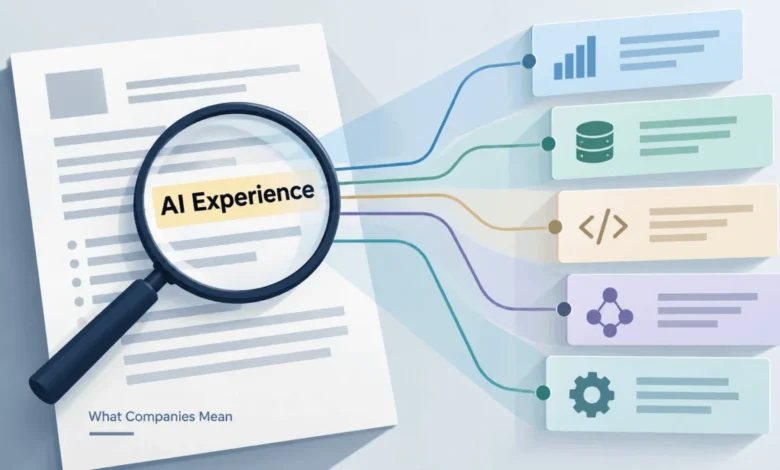
To navigate this landscape, it is essential to categorize the varying interpretations of "AI experience" into distinct operational frameworks. While the terminology remains fluid, professional assessments suggest that most job postings fall into one of four primary categories.
The first category, "AI Tool Proficiency," focuses on the ability to utilize existing platforms, such as ChatGPT, Claude, or proprietary internal API-based tools, to augment day-to-day productivity. In this context, the employer is not looking for a model architect, but rather a professional capable of prompt engineering and workflow automation. The second category, "Conceptual AI Awareness," requires an understanding of how machine learning models function at a high level—specifically, the ability to explain the risks, biases, and hallucinations inherent in AI-generated outputs. This is increasingly common in governance, risk, and compliance (GRC) roles.
The third category, "Applied Machine Learning," is the most technical, requiring the candidate to possess hands-on experience in training, tuning, or deploying predictive models using frameworks like Scikit-Learn, PyTorch, or TensorFlow. Finally, the fourth category, "Domain-Specific AI Implementation," refers to roles where the candidate must bridge the gap between niche subject matter expertise and AI infrastructure—for instance, a medical researcher tasked with fine-tuning a model specifically for genomic sequencing. By identifying which category a job posting occupies, candidates can align their statistical resumes with the company’s specific business needs rather than guessing at an amorphous requirement.
Bridging the Gap: Statistics as the Foundation of AI
A persistent misconception among mid-career professionals is that their established statistical training is becoming obsolete in the face of machine learning. In reality, the technical chasm between a classical statistician and an AI practitioner is frequently overstated. Machine learning is, at its core, an extension of statistical inference; the fundamental principles of regression, probability theory, hypothesis testing, and error minimization remain the bedrock of modern AI.
The transition from a traditional analytical role to an AI-focused one is less about learning entirely new mathematical paradigms and more about a shift in vocabulary and toolsets. For example, a data analyst who has spent years building predictive regression models to forecast quarterly revenue is already performing the core tasks of supervised learning. When translating this to an "AI experience" resume, the focus must shift from the specific tool used—such as a legacy spreadsheet or basic statistical software—to the methodology of model evaluation and validation. Framing experience around the reasoning process, such as "evaluating model drift" or "mitigating bias in predictive outcomes," aligns the candidate’s history with the contemporary language of machine learning.
Analytical Implications and Market Trends
The proliferation of "AI experience" as a hiring requirement has created an inefficient feedback loop. Data indicates that when companies list "AI experience" without further clarification, they often receive a deluge of applications from candidates who overestimate their technical requirements, or conversely, drive away qualified statisticians who fear they lack the necessary "coding" background.
Research from talent acquisition firms suggests that job postings containing the term "AI" often correlate with higher salary bands, yet the technical assessment during the interview phase frequently ignores the high-level "AI" buzzwords in favor of basic data hygiene and problem-solving logic. For the candidate, this implies that the job posting should be treated as a dataset to be decoded. If a description emphasizes "hands-on modeling," the expectation is for technical proficiency in code. If it emphasizes "strategic collaboration," the expectation is for the ability to translate technical AI outcomes into business decisions.
The Seniority Signal and Professional Judgment
The weight of the "AI experience" requirement is heavily influenced by the seniority level of the role. For entry-level positions, companies are primarily looking for adaptability—the willingness to adopt new tools and the comfort level required to work in an environment where the output is probabilistic rather than deterministic. For mid-level roles, the expectation shifts toward "Informed Collaboration," where the individual must act as an interface between pure data science teams and non-technical stakeholders.
At the senior level, the requirement for "AI experience" is largely a proxy for "Strategic Judgment." Executives and senior leaders are expected to understand the cost-benefit analysis of AI deployment. This includes identifying when an AI solution is an expensive, unnecessary complexity compared to a simpler, more robust statistical heuristic. This critical perspective—the ability to identify the limitations of a system—is arguably the most sought-after skill in the current market, yet it is rarely articulated as a requirement in formal job postings.
Clearing the Path for Career Transition
Candidates often succumb to the "certification trap," assuming that an online course or a micro-credential in artificial intelligence is a mandatory prerequisite for application. However, industry evidence suggests that hiring managers are far more interested in an applicant’s ability to demonstrate critical thinking. When faced with a potential AI failure, a candidate who can explain the statistical root cause—such as data leakage or training-serving skew—will consistently outperform a candidate who merely lists a certification on their resume.
Furthermore, the practice of listing every AI tool one has touched is often counterproductive. Modern recruitment software and human hiring managers prioritize depth of reasoning over breadth of familiarity. A candidate who can articulate the specific business problem solved by a machine learning model is more valuable than one who lists a dozen tools without context.
Conclusion: Decoding the Future of Work
Ultimately, the emergence of "AI experience" as a cornerstone of recruitment is a reflection of a rapidly evolving digital economy. It is not a static technical hurdle, but a dynamic, multifaceted demand that requires the applicant to act as a translator of their own experience. By viewing the job posting as an imperfect communication of the company’s internal anxieties and strategic goals, professionals can effectively map their existing statistical expertise onto the requirements of the modern firm. The future of the data profession lies not in abandoning the rigorous foundations of statistics, but in applying them with the agility and critical judgment required to navigate an AI-augmented workspace. As the hype surrounding artificial intelligence matures, the ability to provide substantive, evidence-based reasoning will remain the most enduring "experience" any professional can offer to the market.