The Myth of Neutral Data: Why Statisticians and Researchers Must Embrace Perspective Over Passivity

The ongoing debate surrounding the intersection of statistical analysis and narrative communication has reached a critical juncture across academic, corporate, and governmental research institutions. At a recent data literacy workshop hosted for quantitative analysts, a participant raised a foundational question that has sparked broader discussions across the analytics sector: Does the practice of "telling a story" with data inherently introduce bias by forcing a predetermined perspective, and is true objectivity better served by simply presenting raw metrics and allowing audiences to draw their own conclusions?
This inquiry reflects a deep-seated tension within the scientific and analytical communities. For decades, researchers, data scientists, and statisticians have been trained to prize neutrality above all else, often viewing rhetorical framing or narrative structures with skepticism. However, industry experts, communications specialists, and senior data practitioners argue that this instinct, while well-intentioned, relies on a fundamental misconception of how data is collected, curated, and interpreted. Rather than protecting neutrality, the practice of merely showing the data often creates a vacuum of interpretation, leaving complex findings vulnerable to misinterpretation, manipulation, or irrelevance.
The Evolution of the Data Storytelling Debate
The friction between quantitative rigor and qualitative communication is not new. In 2014, thought leaders in data visualization began advocating for the concept of "leading with story," suggesting that analysts who spend weeks or months examining a dataset hold a unique responsibility to interpret its meaning for stakeholders. Subsequent frameworks published in 2017 further emphasized the "so what?" factor—the professional obligation to move beyond descriptive statistics and articulate the real-world implications of empirical findings.
Despite these developments, resistance persists among technical specialists. Many practitioners express concern that adopting narrative techniques requires embellishing facts, manufacturing dramatic arcs, or cherry-picking evidence to support a preferred thesis. This apprehension has led to a defensive reliance on the phrase "storytelling doesn’t work in my situation," a sentiment that communication consultants suggest is frequently used as an excuse to avoid the difficult work of synthesis and translation.
Industry surveys on corporate data culture consistently indicate that while organizations invest heavily in data collection and advanced analytics, decision-makers frequently struggle to derive actionable insights from standard dashboards and raw reports. A 2023 study by enterprise analytics firms revealed that over 60 percent of executive decision-makers report feeling overwhelmed by uninterpreted data presentations, highlighting a persistent communication gap between technical analysts and business leaders.
Distinguishing Between Bias and Perspective
To resolve the discomfort surrounding data narratives, analysts must first establish a clear distinction between bias and perspective.
Bias refers to systematic errors or distortions in data collection, sampling, or analysis that compromise the validity of research findings. Eliminating such biases is a core tenet of the scientific method and must remain a priority in any analytical workflow.
Perspective, on the other hand, is the unavoidable viewpoint shaped by the decisions made throughout the research process. Long before a dataset is visualized for an audience, a cascade of subjective choices has already occurred:
- Determining the core research questions
- Selecting specific variables to measure and defining the methodologies for measurement
- Choosing which data points to include or exclude during cleaning and normalization
- Deciding which comparisons to prioritize and which statistical models to apply
- Selecting a single summary graph out of dozens of possible visualizations
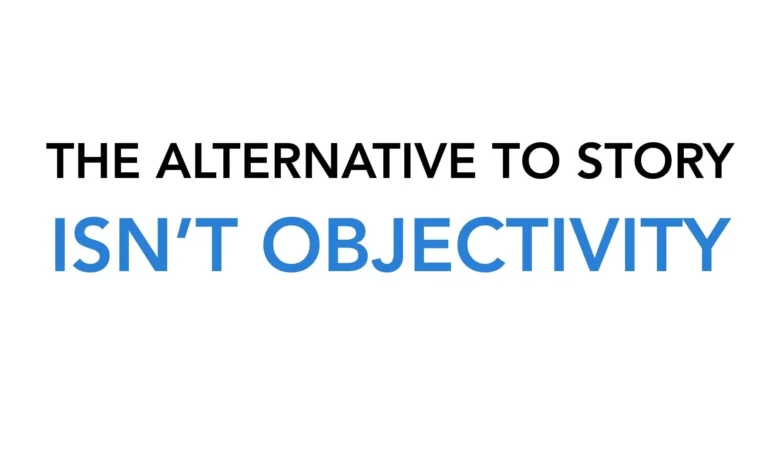
Because these foundational choices inherently influence what an audience ultimately sees, the concept of a completely neutral, uninfluenced presentation of data is mathematically and practically impossible. As analytics veterans point out, the alternative to a structured narrative is not pure objectivity; it is unguided subjectivity on the part of the audience.
The Risks of Passive Data Presentation
When researchers adopt a passive stance—refusing to offer an interpretation or a guiding narrative—they do not eliminate interpretation from the communication process; they merely outsource it.
When stakeholders are presented with complex datasets devoid of expert context, several negative outcomes frequently occur:
- Misinterpretation: Audiences lacking technical expertise may draw causal conclusions from purely correlational data.
- Selective Exploitation: Unframed data provides fertile ground for bad actors or biased stakeholders to cherry-pick metrics that support predetermined agendas, shielded by the credibility of the original research.
- Decision Paralysis: Without a clear synthesis of what the findings mean for operations or policy, decision-makers may fail to act, rendering months of rigorous research functionally useless.
Statistics and research ethics committees note that passive communication can inadvertently amplify misinformation. When the author of a study declines to explain the limitations, context, and primary takeaways of their work, the data is left open to whatever narrative the loudest voice in the room chooses to project.
Adapting Narrative Frameworks for Technical Fields
Recognizing that traditional storytelling terminology can alienate mathematically minded professionals, industry experts recommend reframing the concept entirely. For those who remain uncomfortable with the term "story," the process can simply begin with establishing a clear, evidence-based perspective.
This approach requires analysts to answer foundational questions before presenting their findings:
- Given the depth of the data, what key trends or anomalies deserve immediate attention?
- What are the most reasonable conclusions that can be drawn from the evidence?
- What plausible alternative explanations or limitations must be communicated alongside the primary findings?
In academic or exploratory research settings, this perspective does not need to manifest as a single, absolute recommendation. Instead, analysts can present a spectrum of interpretations: outlining multiple plausible hypotheses, detailing the evidence supporting each, and framing the discussion around the specific questions the data raises. This methodology maintains intellectual rigor while providing the audience with a structured, digestible starting point for debate.
Furthermore, bringing a perspective to data analysis does not mean overstating certainty. Responsible communicators actively highlight uncertainty, methodological caveats, and the boundaries of their conclusions. The goal is to ensure that the impact of the research matches the strength of the underlying evidence—neither exaggerating findings nor hiding behind excessive caution.
Implications for the Future of Research and Analytics
As organizations across all sectors grapple with exponential growth in data generation, the demand for effective data communication has never been higher. The traditional model of the isolated statistician handing off raw numbers to decision-makers is increasingly recognized as inefficient and professionally irresponsible.
Experts emphasize that rigor and narrative clarity are not mutually exclusive. An analyst can maintain the highest standards of mathematical and scientific precision while simultaneously constructing a compelling, responsible narrative that guides an audience toward understanding.
Refusing to engage in this synthesis under the banner of absolute objectivity ultimately abdicates the communicator’s core responsibility. By embracing perspective, acknowledging uncertainty, and actively structuring how data is received, researchers ensure that their work informs, rather than overwhelms, the public discourse. In the modern data landscape, the most objective path forward is not silence, but clarity.