Optimizing AI Agent Performance Through Markdown Data Serialization: A Strategic Approach to Token Efficiency

The rapid proliferation of autonomous AI agents has fundamentally shifted the operational requirements of modern software development, placing an unprecedented premium on context window management and token consumption. As these agents increasingly rely on search results, file retrieval, and complex data parsing to execute tasks, developers are encountering a significant economic bottleneck: the high cost of token-heavy data formats. Traditional data structures, particularly JavaScript Object Notation (JSON), were designed for machine-to-machine communication, emphasizing structural precision over token economy. When fed into Large Language Models (LLMs), these formats often include substantial metadata, tracking strings, and nested hierarchies that inflate token counts without contributing to the model’s reasoning capabilities.
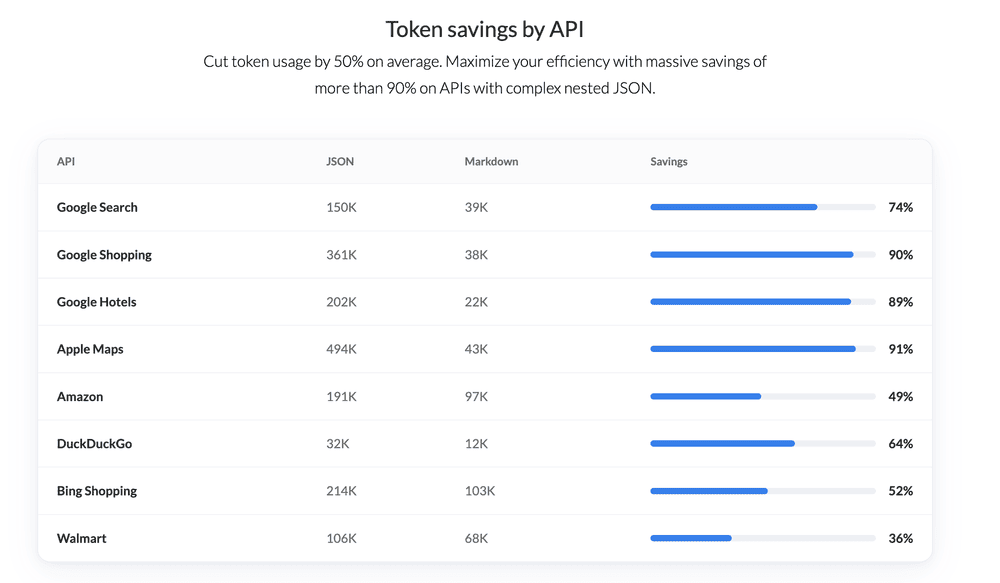
A recent shift in industry standards has emerged, with data providers like SerpApi introducing native Markdown output as a viable alternative to JSON for LLM-integrated workflows. This transition represents a critical evolution in how developers manage data ingestion for generative AI, potentially reducing token overhead by up to 74% in specific use cases.
The Economic Reality of Token Bloat
In the current ecosystem, every token processed by an LLM incurs a direct cost, whether through API fees or computational resources. AI agents, by their nature, are iterative; they often perform recursive queries, search multiple sources, and digest lengthy logs to reach a conclusion. When a simple search query triggers a response containing extensive JSON payloads—packed with tracking links, internal metadata, and repetitive schema definitions—the AI model is forced to consume tokens simply to "read" the formatting, not the intelligence.
For developers, this creates a "tax" on agentic systems. If an agent retrieves ten search results, and each result is wrapped in a verbose JSON object, the cumulative token count can exceed the context window of smaller models or significantly spike the operational costs of larger ones. By replacing these verbose structures with Markdown, developers can strip away the structural noise that AI models are inherently capable of parsing through natural language processing rather than strict schema enforcement.
Chronology and the Evolution of Data Serialization
The reliance on JSON as the de facto standard for web APIs has been a cornerstone of the modern web since the mid-2000s, providing a robust way to exchange data between servers and web browsers. However, the rise of LLMs from 2022 to the present has created a "mismatch" in utility. While JSON remains essential for traditional backend systems where numeric precision and strict typing are required for database operations, it has proven suboptimal for AI agents that act as semantic processors.
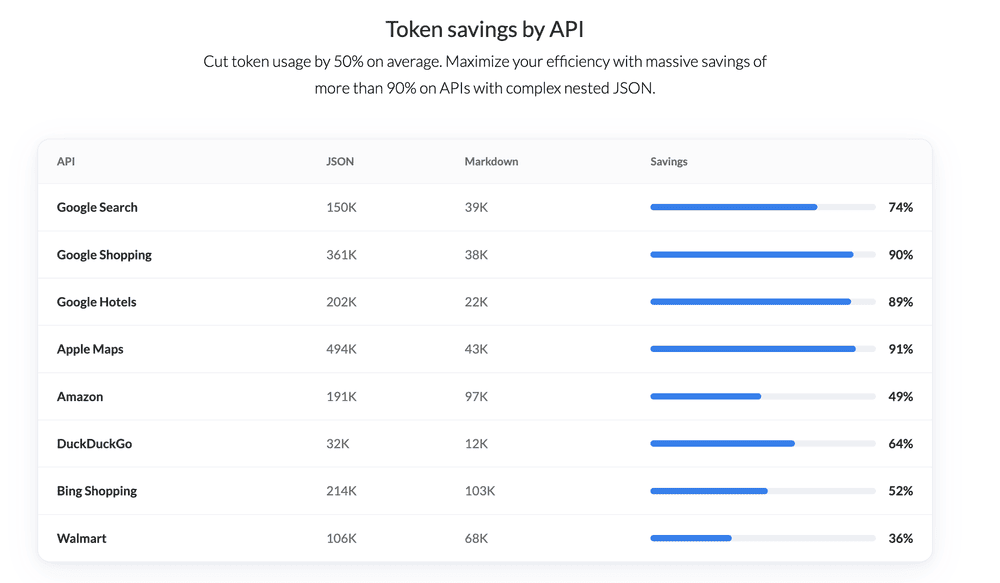
Recognizing this, data providers have begun a phased rollout of LLM-optimized outputs. Throughout the last twelve months, developers have experimented with manual "stripping" scripts—custom-built software designed to clean up API responses before feeding them into models like GPT-4 or Claude. The introduction of native Markdown support by platforms like SerpApi signifies a maturation of this trend, moving from ad-hoc, client-side cleaning to server-side, optimized serialization. This shift suggests a broader industry move toward providing "model-ready" data rather than just "machine-readable" data.
Comparative Analysis: JSON vs. Markdown Efficiency
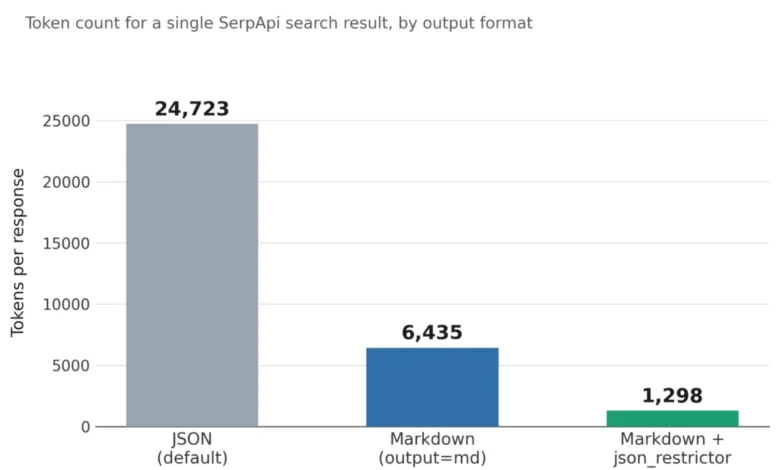
To understand the tangible benefits of this shift, one must look at the empirical data regarding token reduction. In a controlled test comparing search results for a common query, a standard JSON response required 24,723 tokens to represent the data fully. Upon switching to a Markdown-optimized output, the same dataset was rendered using only 6,435 tokens. A further restriction of specific fields brought that count down to 1,298 tokens.
This represents a reduction of approximately 95% from the original JSON payload. The implications for this are twofold:
- Cost Efficiency: Direct reduction in API costs is the most immediate impact. For high-volume agents performing thousands of queries per day, this reduction translates to significant annual savings.
- Context Window Preservation: By reducing the "filler" text, developers can fit more high-value information into a single context window. This allows agents to perform more complex multi-step reasoning tasks without hitting the model’s memory limits, which often lead to truncation or degradation in performance.
Technical Implementation and Strategic Considerations
The implementation of Markdown output is designed to be non-disruptive, typically requiring a minor adjustment to API call parameters. By appending a query parameter or utilizing a header-based request, developers can instruct the server to reformat the data before it crosses the network.
However, the technical community maintains a nuanced view on when to use this approach. The primary consideration is the requirement for "downstream data integrity." JSON remains the gold standard when:
- Numeric Precision is Mandatory: Systems requiring exact floats for prices, currency conversions, or coordinate data for geospatial mapping should maintain JSON serialization to avoid the risk of Markdown parsing errors or loss of significant digits.
- Complex Schema Validation: In environments where strict type-checking is enforced, the loose structure of Markdown may cause integration failures.
For developers, the strategy is increasingly becoming "hybrid." A developer might use Markdown-formatted search results to feed an agent that is summarizing findings or conducting research, but retain JSON-formatted data for the specific backend logic that handles e-commerce transactions or database updates.
Broader Implications for AI Infrastructure
The move toward Markdown serialization is emblematic of a larger trend in AI engineering: the shift from "brute force" AI integration toward "precision" AI engineering. Early AI adoption was characterized by simply throwing as much data as possible at a model to see what it could infer. Today, the focus has shifted toward high-fidelity data pipelines where the signal-to-noise ratio is meticulously managed.
This trend is expected to influence how APIs are designed in the future. We are likely to see the emergence of "AI-first APIs" that provide tiered output formats:
- Machine-Optimized (JSON/Protobuf): For transactional systems.
- Model-Optimized (Markdown/Structured Text): For generative reasoning engines.
- Human-Optimized (HTML/Rendered Content): For user interfaces.
Furthermore, the automation of field restriction—such as the json_restrictor feature—allows for dynamic, on-the-fly pruning of data. This enables developers to create "context-aware" API calls, where the amount of data returned is scaled based on the specific intent of the agent, rather than a one-size-fits-all approach.
Future Outlook and Industry Adoption
As the market for AI agents continues to mature, the demand for token-efficient data structures will likely grow. The industry is currently in a phase of optimization where the winners will be those who can reduce the "hidden costs" of AI operations. By offloading the burden of data transformation from the model to the API provider, developers can improve the latency and intelligence of their agents.
The adoption of Markdown is not merely a stylistic preference; it is a tactical response to the physical constraints of current LLM architectures. While Markdown is not a "magic bullet" that replaces the need for robust data architecture, it provides a crucial layer of efficiency that bridges the gap between massive web datasets and the finite, costly memory of modern AI models.
In summary, the transition toward Markdown and other lightweight serialization formats marks a significant milestone in the maturity of AI engineering. It signals that the developer community is moving past the experimental phase and into a period of infrastructure refinement, where the focus is on performance, cost-effectiveness, and the sustainable scaling of agentic systems. As these standards become more common, the barrier to entry for building complex, agent-driven applications will continue to lower, ultimately accelerating the pace of AI innovation across the enterprise landscape.