Mastering Production AI Agent Evaluation: A Comprehensive Guide to Amazon Bedrock AgentCore

The deployment of autonomous artificial intelligence agents into production environments has shifted the primary engineering challenge from basic operational execution to rigorous behavioral verification. As enterprises scale their reliance on multi
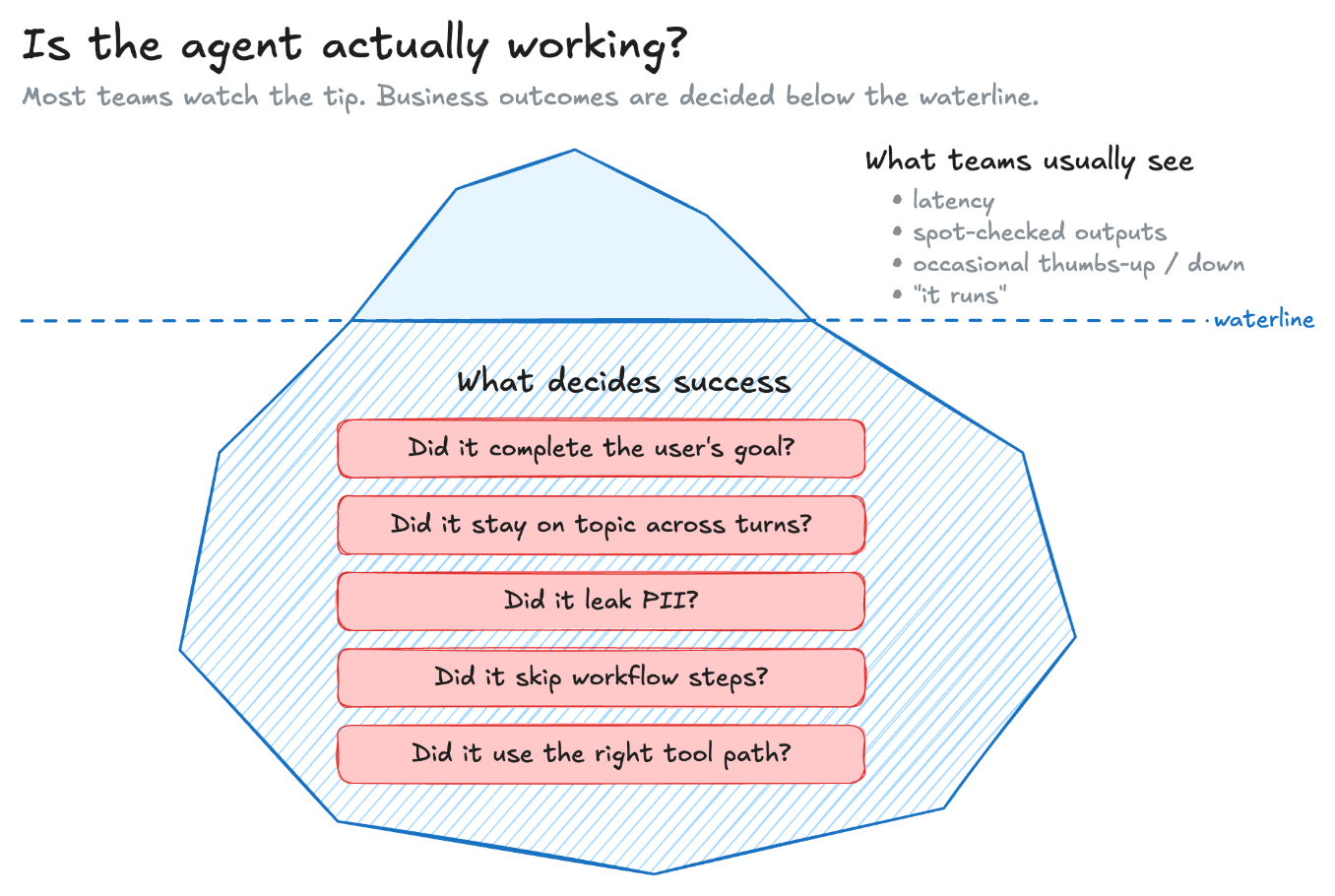
-step agents for customer service, complex data research, and domain-specific advisory tasks, the fundamental question facing engineering leadership is no longer whether an agent can execute code, but whether it consistently delivers the desired business outcomes at scale. Traditional monitoring methodologies—such as random output spot-checking, latency tracking, and sporadic user feedback collection—fail to capture the granular realities of long-session agentic workflows. These surface-level metrics often obscure critical systemic failures, including context drift, unauthorized data exfiltration, unaddressed user sub-requests, and the silent omission of mandatory procedural steps.
To bridge this operational visibility gap, modern artificial intelligence infrastructure has increasingly embraced structured agent evaluation. However, evaluating autonomous systems presents unique architectural complexities. A high aggregate performance score on one metric can easily mask a catastrophic failure in another. For instance, a customer support agent may successfully resolve a high volume of tickets while simultaneously violating compliance protocols by leaking personally identifiable information (PII) in its responses. Consequently, organizations must implement multi-layered evaluation frameworks that measure specific, observable agent behaviors at the appropriate level of granularity. Amazon Bedrock AgentCore addresses this industry-wide challenge by providing a unified evaluation ecosystem that combines native AWS built-in evaluators with managed open-source frameworks such as DeepEval and AutoEval.
Background Context and the Evolution of Agentic Monitoring
The rapid adoption of foundation models over the past several years initially focused on single-turn request-response accuracy, often measured through static benchmarks or superficial human preference ratings. As enterprises transitioned from static text generation to autonomous agents capable of tool usage, multi-turn reasoning, and persistent memory retention, these legacy metrics proved entirely inadequate. An agent operating over a twenty-step session requires continuous oversight of its trajectory, state management, and policy adherence.
Recognizing this market shift, cloud providers and developer tooling ecosystems have raced to develop native observability layers. Amazon Bedrock AgentCore emerged from the necessity to standardize agent telemetry and evaluation across disparate enterprise applications. By integrating managed third-party evaluation libraries directly into its core architecture, AWS has sought to eliminate the friction associated with stitching together disjointed observability pipelines. This architectural convergence allows engineering teams to evaluate agent trajectories against business logic without exporting sensitive operational data outside secure cloud boundaries.
Translating Business Outcomes into Measured Behaviors
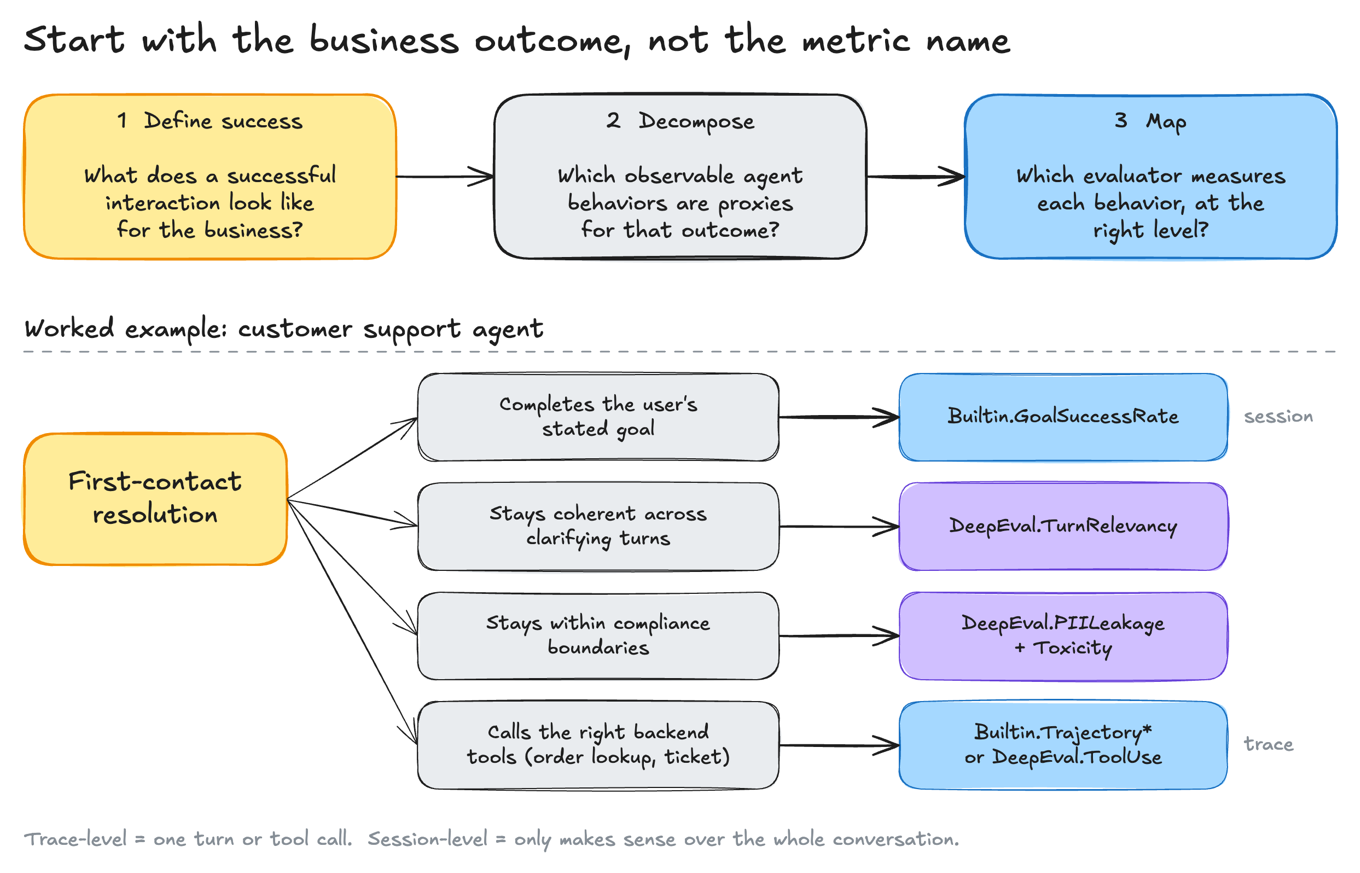
A pervasive pitfall in early agent evaluation strategies is the random selection of generic metric labels based on semantic appeal rather than operational utility. Terms such as helpfulness or task completion are frequently implemented without a clear mapping to underlying business drivers, resulting in dashboards filled with numbers that yield zero actionable insight. To establish a robust evaluation framework, engineering teams must transition through a disciplined three-step methodology: defining the precise business outcome, identifying the observable behaviors within agent traces that signify success or failure, and mapping those behaviors to specific, targeted evaluators.
This methodology shifts the evaluation paradigm from reactive debugging to proactive quality assurance. For example, in a financial advisory agent, the primary business outcome is the delivery of accurate, unbiased, and secure guidance. The observable behavior required to verify this outcome involves tracking whether the agent adhered strictly to regulatory disclosures while querying internal databases. By systematically decomposing high-level business goals into granular trace-level metrics, organizations can construct evaluation pipelines that reflect real-world operational risks.
The Comprehensive Evaluator Catalog on Amazon Bedrock AgentCore
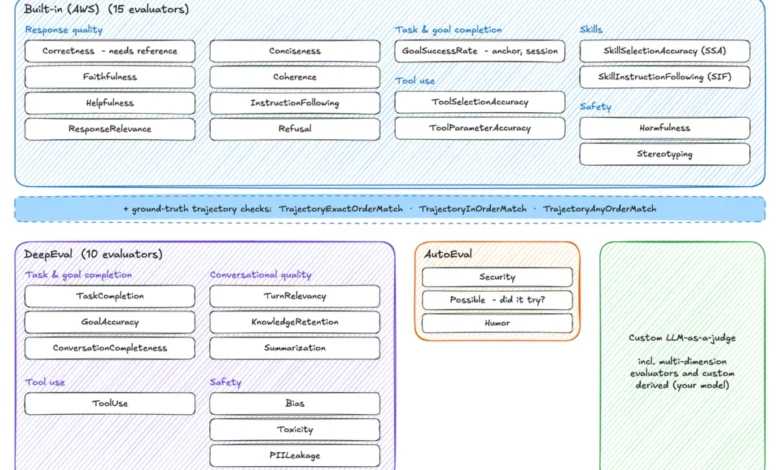
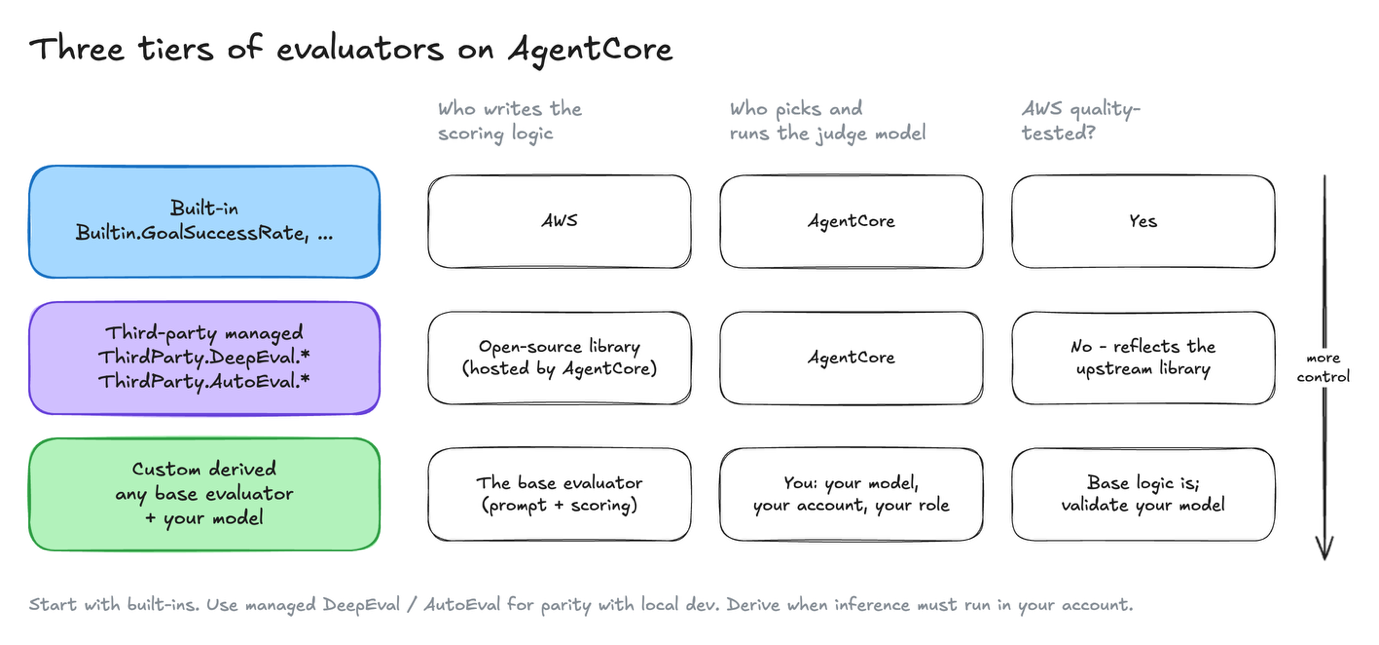
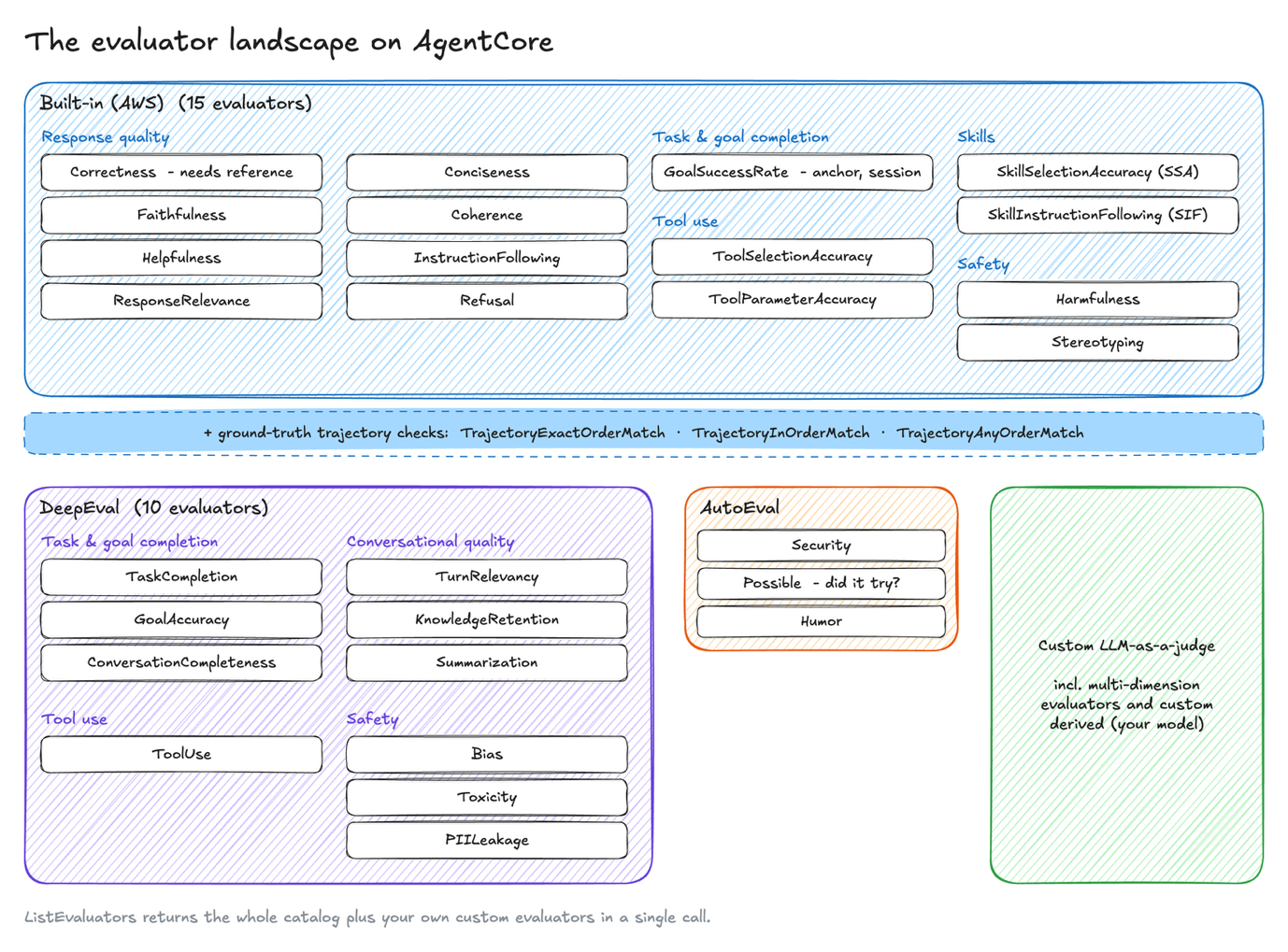
Amazon Bedrock AgentCore provides a diverse catalog of evaluators categorized by their source and underlying scoring logic. This breadth ensures that developers rarely need to construct evaluation metrics from scratch. The ecosystem is divided into three primary tiers: built-in AWS evaluators, managed third-party open-source integrations, and custom derived evaluators.
Built-in AWS evaluators offer out-of-the-box validation across multiple operational dimensions. These include core semantic metrics such as correctness, relevance, and helpfulness, alongside specialized safety checks. Furthermore, AgentCore features ground-truth trajectory checks—namely TrajectoryExactOrderMatch, TrajectoryInOrderMatch, and TrajectoryAnyOrderMatch—which evaluate whether an agent executed the expected sequence of tool calls during a complex workflow. These trajectory checks are indispensable when the methodology of task execution is equally as important as the final output.
Complementing the native AWS suite, the integration of DeepEval provides managed open-source metrics categorized into semantic, safety, task-completion, and conversational groups. Metrics such as ConversationCompleteness and KnowledgeRetention are engineered specifically to address the vulnerabilities inherent in multi-turn interactions. While a traditional single-turn evaluator might award a high score to an agent’s immediate response, ConversationCompleteness specifically flags agents that successfully answer a recent prompt while quietly dropping unresolved inquiries from earlier in the session. Similarly, KnowledgeRetention detects degradation in contextual memory over extended dialogue histories.
AutoEval further enriches this ecosystem by supplying specialized signals focused on security vulnerabilities and conditional feasibility. When standard catalog offerings fail to capture an organization’s unique compliance requirements, developers can deploy custom LLM-as-a-judge evaluators. These custom evaluators utilize designated foundation models to score agent traces against tailored prompt templates, balancing deep customization with enterprise governance.
Addressing Complexity Through Multi-Dimension Evaluators
Standard single-dimension evaluators return a single numeric score per trace or session, a methodology that proves insufficient when assessing complex interactions governed by multiple, independent criteria. In enterprise customer support, for instance, a single response must simultaneously resolve the user’s technical issue, comply with data privacy policies, and maintain a professional tone. If a single judge returns a blended composite score for such an interaction, engineering teams remain blind to the specific driver of failure.
To resolve this limitation, AgentCore supports multi-dimension evaluators. These advanced custom LLM-as-a-judge implementations evaluate a single trace against a structured list of discrete dimensions within one execution call. Each dimension possesses its own distinct instruction set, evaluation criteria, and scoring scale. The underlying judge model processes the trace data once and returns granular results for every specified dimension without computing a misleading composite score.
This architectural approach enables organizations to enforce strict quality gates. If a software release improves conversational tone but causes a regression in security policy compliance, a multi-dimension evaluator immediately isolates the policy violation. However, best practices dictate that multi-dimension evaluators should be utilized only when criteria can be judged from identical evidence; established single-dimension metrics, such as built-in correctness or third-party PII leakage detection, should remain isolated to preserve model-level modularity and governance flexibility.
Tailoring Evaluation Stacks Across Different Agent Categories
Different use cases demand distinct evaluation architectures. Tailored evaluator stacks ensure that monitoring resources are directed toward the most critical risk vectors associated with a specific agent type.
For customer support agents, where the primary business objective is rapid problem resolution free of downstream liability, evaluation stacks should anchor on Builtin.GoalSuccessRate, supplemented by ThirdParty.DeepEval.ConversationCompleteness and ThirdParty.DeepEval.PIILeakage. As operational maturity increases, teams frequently layer in toxicity checks and security evaluations to safeguard sensitive consumer data.
For multi-step research agents operating across extensive autonomous workflows, the risk profile shifts toward procedural integrity and context preservation. These agents require evaluation stacks centered on ground-truth trajectory matching, such as Builtin.TrajectoryAnyOrderMatch, alongside deep conversation metrics like KnowledgeRetention and GoalAccuracy. Ensuring that the agent follows the correct tool path is vital to preventing silent logic failures during extended research tasks.
In high-stakes domain-specific applications—including medical, legal, and financial advisory agents—the tolerance for error is virtually nonexistent. Within these sectors, an incorrect output carries severe real-world consequences that outweigh the utility of no answer at all. Consequently, deployment stacks prioritize rigorous correctness validation, security compliance, and bias mitigation, frequently leveraging custom derived evaluators to ensure that all judge inferences remain strictly within the enterprise’s governed cloud account.
Operationalizing Evaluation: The Three Execution Modes
Amazon Bedrock AgentCore operationalizes evaluation through three distinct execution modes, providing flexibility across the software development lifecycle from initial local debugging to continuous production monitoring.
On-demand evaluation serves as the primary feedback loop during active development. Developers can pass live session logs directly to the evaluation client using standard application programming interfaces during local testing.
import boto3

client = boto3.client('bedrock-agentcore')

response = client.evaluate(
    evaluatorId="ThirdParty.DeepEval.TaskCompletion",
    evaluationInput="sessionSpans": session_span_logs
)

for result in response["evaluationResults"]:
    print(f"Value: result.get('value')")
    print(f"Explanation: result.get('explanation', '')")
This on-demand capability supports the entire evaluator catalog, allowing developers to rapidly test custom prompts and tool integrations against standardized metrics without waiting for batch processing cycles.
Online evaluation shifts the monitoring paradigm to production runtime environments by sampling live user traffic at configurable rates. This mode serves as the primary health signal for deployed agents, seamlessly combining native AWS evaluators and third-party metrics within a unified configuration. Simultaneously, batch evaluation provides regression testing capabilities by executing defined evaluator stacks against static golden datasets of historical sessions. This ensures that prompt engineering updates, model version upgrades, and infrastructure changes do not inadvertently degrade performance across critical business dimensions.
Implications for Enterprise AI Governance
The integration of comprehensive evaluation frameworks into enterprise artificial intelligence infrastructure marks a maturation point for the generative AI industry. As autonomous agents assume greater operational autonomy in corporate workflows, the ability to continuously audit their behavior is no longer an optional engineering luxury; it is a fundamental regulatory and business necessity.
By unifying native cloud evaluators with managed open-source frameworks, platforms like Amazon Bedrock AgentCore lower the technical barrier to sophisticated observability. Organizations that successfully implement outcome-driven evaluation stacks are better positioned to mitigate compliance risks, detect silent functional regressions, and build scalable, reliable agentic systems that deliver measurable enterprise value. The future of autonomous agent deployment will ultimately belong to organizations that treat evaluation not as an afterthought, but as the foundational architecture governing production AI behavior.