In the rapidly evolving landscape of artificial intelligence, organizations are increasingly tasked with customizing large language models (LLMs) to suit specific domain requirements. As the demand for bespoke AI solutions grows, practitioners face a critical architectural decision: whether to engage in computationally expensive fine-tuning or to utilize the model as a static feature extractor paired with traditional machine learning classifiers. This decision carries significant implications for operational costs, latency, and the ultimate accuracy of the deployed application.
The Shift Toward Efficient Adaptation
Historically, the standard procedure for domain adaptation involved full-parameter fine-tuning, a process where every weight within a neural network is updated based on new, domain-specific data. While effective, this approach is prohibitively expensive for most enterprises, requiring massive GPU clusters and significant power consumption. The introduction of Parameter-Efficient Fine-Tuning (PEFT) methods, such as Low-Rank Adaptation (LoRA), revolutionized this space by freezing the primary weights and training only a small fraction of the model’s parameters.
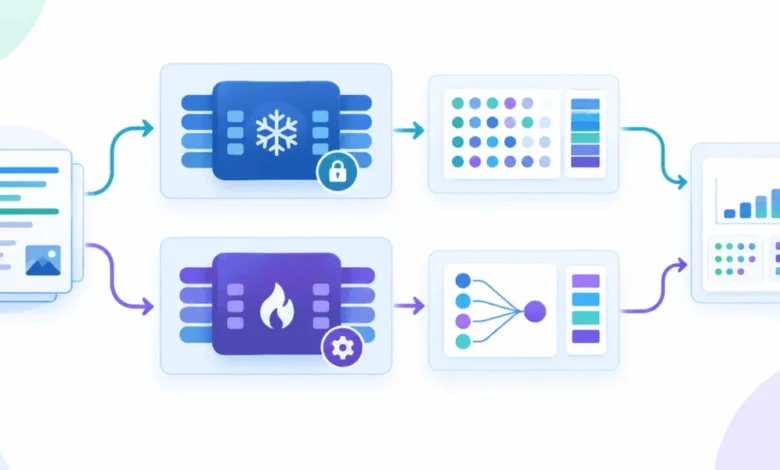
Simultaneously, a more conservative strategy has gained traction: using LLMs as frozen embedding generators. In this paradigm, the model acts as a fixed encoder, transforming raw text into high-dimensional vectors—embeddings—that capture semantic meaning. These embeddings are then fed into lightweight, traditional algorithms like Random Forests or Support Vector Machines (SVMs). This dual-track approach—LoRA fine-tuning versus frozen embedding classification—now defines the primary debate in deployment strategy for production-grade AI.
Comparative Chronology and Methodology
The methodology for comparing these two approaches typically begins with the selection of a robust base model, such as the Qwen or Llama series, and a standardized dataset, such as AG News, which categorizes text into distinct classes.
In the frozen embedding workflow, the model operates in an evaluation-only mode. By passing text through the transformer layers and extracting the last hidden state, researchers obtain a numerical representation of the input. Because the LLM weights remain locked, the computational burden is restricted to the forward pass. Once these embeddings are generated, the training of a scikit-learn classifier occurs almost instantaneously, often requiring mere seconds of CPU or light GPU time.
Conversely, the LoRA approach involves injecting trainable rank-decomposition matrices into the transformer layers. During the training phase, the model updates these adapters to optimize for the specific task at hand. While this process is more resource-intensive than training a scikit-learn model, it allows the LLM to adjust its internal representations, theoretically leading to a more nuanced understanding of the domain.
Quantitative Performance Analysis
Empirical testing reveals a clear performance trade-off between the two methodologies. In controlled environments using subsets of the AG News dataset, the frozen embedding approach consistently yields respectable accuracy—often exceeding 80%—with significantly lower latency during the training phase. The extraction of these features acts as the primary bottleneck, yet the downstream training of the classifier is negligible.
However, fine-tuning via LoRA frequently pushes accuracy metrics into the high 80th or 90th percentile. This performance gain is the result of the model’s ability to refine its internal weights to better capture the subtle linguistic patterns and semantic relationships unique to the specific dataset. For applications where every percentage point of accuracy translates into significant business value, such as legal document review or medical diagnostics, the extra training time associated with LoRA is often viewed as a necessary investment.
Technical Implications and Resource Management
The broader impact of these strategies hinges on the concept of "compute-constrained deployment." For developers operating on limited hardware—such as a single NVIDIA T4 GPU—the resource overhead of fine-tuning can be a barrier.
- Memory Footprint: Fine-tuning, even with QLoRA (quantized LoRA), requires enough VRAM to hold optimizer states and gradient information. Frozen embeddings, by contrast, only require enough memory to perform a single forward pass of the model.
- Inference Latency: Once deployed, an LLM with LoRA adapters might introduce slightly more latency compared to a frozen model, though this can be mitigated through techniques like adapter merging.
- Overfitting Risks: Using a traditional classifier on top of frozen embeddings often acts as a regularization mechanism, preventing the model from over-learning the noise present in small, specialized datasets. Fine-tuning, if not carefully monitored, risks overfitting the LLM to the training set, potentially degrading performance on out-of-distribution data.
Expert Perspectives on Deployment
Industry analysts and machine learning engineers emphasize that there is no "one-size-fits-all" solution. The choice between strategies should be governed by the specific constraints of the project.
"For rapid prototyping or when the domain dataset is limited in size, frozen embeddings are often the superior choice," notes one senior AI researcher. "They provide a baseline of performance that is surprisingly difficult to beat without significant effort. However, when the task requires a deep understanding of domain-specific jargon, such as in scientific literature or highly regulated financial contexts, fine-tuning remains the gold standard."
Furthermore, there is a growing consensus that for generative tasks—where the goal is to produce novel text rather than classify existing content—fine-tuning is essentially non-negotiable. While a classifier can determine if a news article belongs in the ‘Sports’ or ‘Finance’ category, it cannot assist in the generation of synthetic, domain-aligned text. In such cases, the architectural decision is made for the developer: the LLM must be adapted.
Broader Impact on AI Democratization
The accessibility of these techniques has profound implications for the democratization of AI. By offering a path to high-performance domain adaptation without the need for massive data centers, researchers are enabling smaller firms and academic institutions to compete with large technology conglomerates.
The widespread adoption of LoRA and other PEFT techniques has effectively lowered the barrier to entry for fine-tuning. Simultaneously, the success of the frozen embedding strategy underscores the enduring relevance of classical machine learning algorithms. Scikit-learn’s ensemble methods, which have been refined over decades, remain highly effective when paired with the sophisticated feature extraction capabilities of modern transformers.
Conclusion and Future Outlook
As the field continues to mature, we can expect to see hybrid architectures emerge. These systems might use frozen embeddings to perform initial, high-speed filtering, followed by a fine-tuned "expert" model to handle complex cases that require deeper reasoning.
Ultimately, the choice between fine-tuning and frozen embeddings is a reflection of the fundamental engineering challenge: balancing performance, cost, and complexity. As organizations continue to integrate AI into their core operations, the ability to discern which strategy is appropriate for a given task will remain a vital skill for practitioners. Whether the goal is to save on compute costs or to squeeze out maximum classification accuracy, the path forward is clear: start with the simplest, most efficient method—frozen embeddings—and reserve the complexity of fine-tuning for when the data and the task truly demand it.