Amazon Announces Web Search API on Amazon Bedrock AgentCore to Streamline Real-Time Data Access for AI Applications


Amazon Web Services (AWS) has officially announced the launch of the Web Search API on Amazon Bedrock AgentCore, marking a significant evolution in how artificial intelligence agents, automated workflows, and enterprise applications retrieve up-to-the-minute information. Designed to bridge the critical gap between static model training data and real-world dynamic events, the new standalone interface allows developers to programmatically access fresh web indices using single-line API calls. This release targets the growing demand for low-latency, highly secure search capabilities that can be directly integrated into custom orchestration loops, data pipelines, and application backends without the infrastructural overhead previously required by proxy gateways.
Background Context and Industry Evolution
For years, generative artificial intelligence models and large language models (LLMs) have faced inherent limitations tied to their static training datasets. While foundational models excel at reasoning, synthesis, and creative generation, they struggle inherently with real-time queries concerning breaking news, recent regulatory updates, fluctuating market prices, or newly released software packages. To mitigate this phenomenon—often referred to as knowledge cutoff obsolescence—developers have traditionally relied on complex Retrieval-Augmented Generation (RAG) architectures or third-party search engine APIs that require extensive API key management, custom scraping infrastructure, and complex rate-limiting architectures.
Amazon’s initial iteration of live search integration for AI applications relied on the AgentCore Gateway, a feature designed for platform teams seeking to centralize search policies across sprawling multi-agent ecosystems. While the gateway model successfully provides secure, unified Model Context Protocol (MCP) endpoints for complex enterprise deployments, software engineers repeatedly noted that it introduced unnecessary friction for isolated applications, background data pipelines, and self-contained coding scripts. Recognizing this operational bottleneck, AWS engineered the Web Search API to expose the enterprise-grade search engine infrastructure that already powers mainstream Amazon products—including Alexa+, Kiro, and Quick—directly to developer code through standard cloud infrastructure.
Operational Architecture and Mechanism
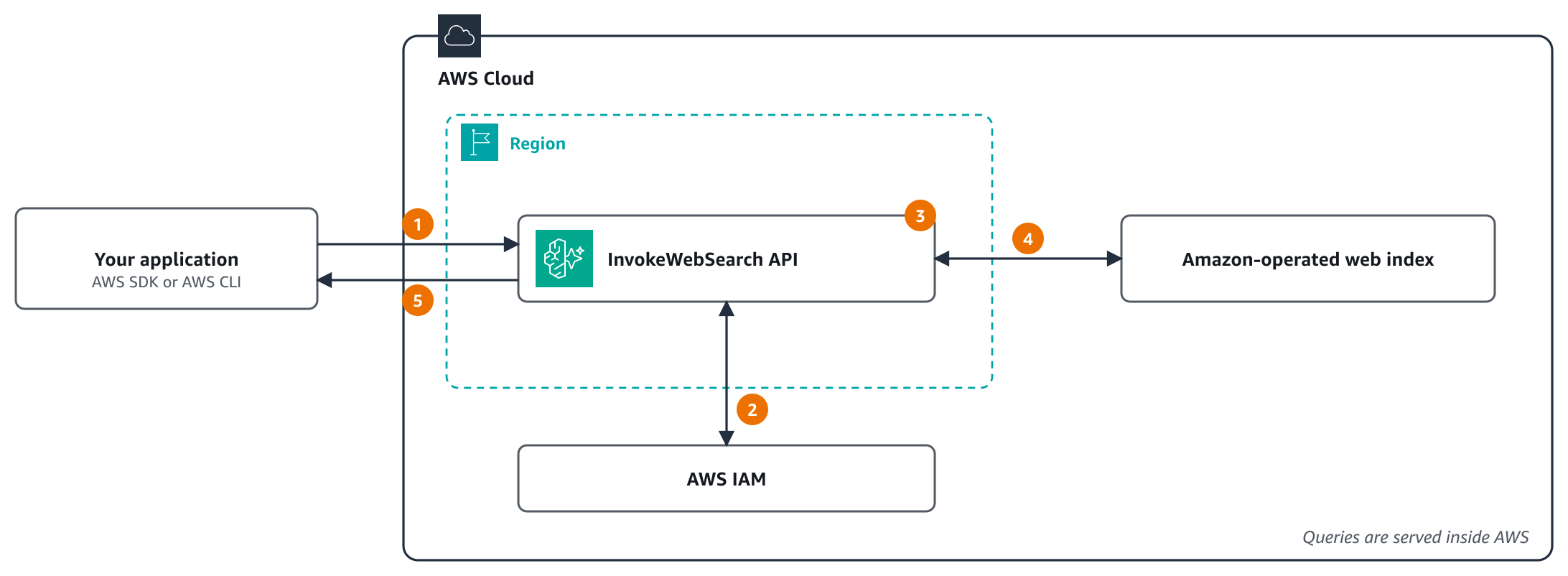
The Web Search API operates via the InvokeWebSearch data plane action housed within the bedrock-agentcore service endpoint. By leveraging standard AWS Signature Version 4 (SigV4) cryptographic signing protocols, the API eliminates the administrative burden of handling external API keys, secrets, or third-party token rotations. Instead, applications authenticate using the same AWS Identity and Access Management (IAM) credentials and roles already established across the developer’s cloud environment.
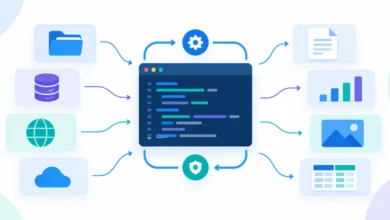
When an application invokes a search query, the request travels securely through AWS infrastructure, where it is evaluated against granular IAM policies and optional domain filters. The backend queries an enterprise-grade web index operated directly by Amazon, returning a structured payload containing ranked search results. Each result provides a precise text extract alongside supplementary metadata, including page titles, source URLs, and exact publication timestamps when available. This deterministic output structure allows developer code to programmatically verify freshness and relevance before feeding information into context windows or downstream analytical pipelines.
Integration Flexibility and Framework Compatibility
To maximize utility across diverse engineering environments, AWS has rolled out native integration support for popular AI development frameworks, alongside robust compatibility with core AWS compute primitives.
For developers utilizing LangChain and LangGraph, the integration is streamlined through updated libraries such as langchain-aws (version 1.9.3 and later) and the AgentCore Python SDK (version 1.26.0). These libraries allow engineers to instantiate web search toolkits with minimal configuration, embedding search capabilities directly into complex agentic loops. For instance, multi-agent supply chain monitoring systems can now execute parallel queries across multiple package repositories, validating every retrieved data point against verified source URLs before generating final analytical reports.
For teams operating outside formal agent frameworks, direct invocation via the AWS Command Line Interface (CLI) or standard AWS SDKs—such as Boto3 for Python—enables seamless integration into existing serverless functions and containerized workloads. Code running on AWS Lambda, Amazon Elastic Container Service (Amazon ECS), Amazon Elastic Compute Cloud (Amazon EC2), or Amazon Elastic Kubernetes Service (Amazon EKS) inherits execution roles automatically, requiring only a single IAM policy update to gain search capabilities without altering underlying deployment scripts.
Enterprise Security and Private Connectivity
Security and data governance remain paramount in enterprise AI deployments, particularly for financial institutions, healthcare providers, and government contractors handling sensitive internal data. The Web Search API addresses these compliance mandates through native support for AWS PrivateLink.
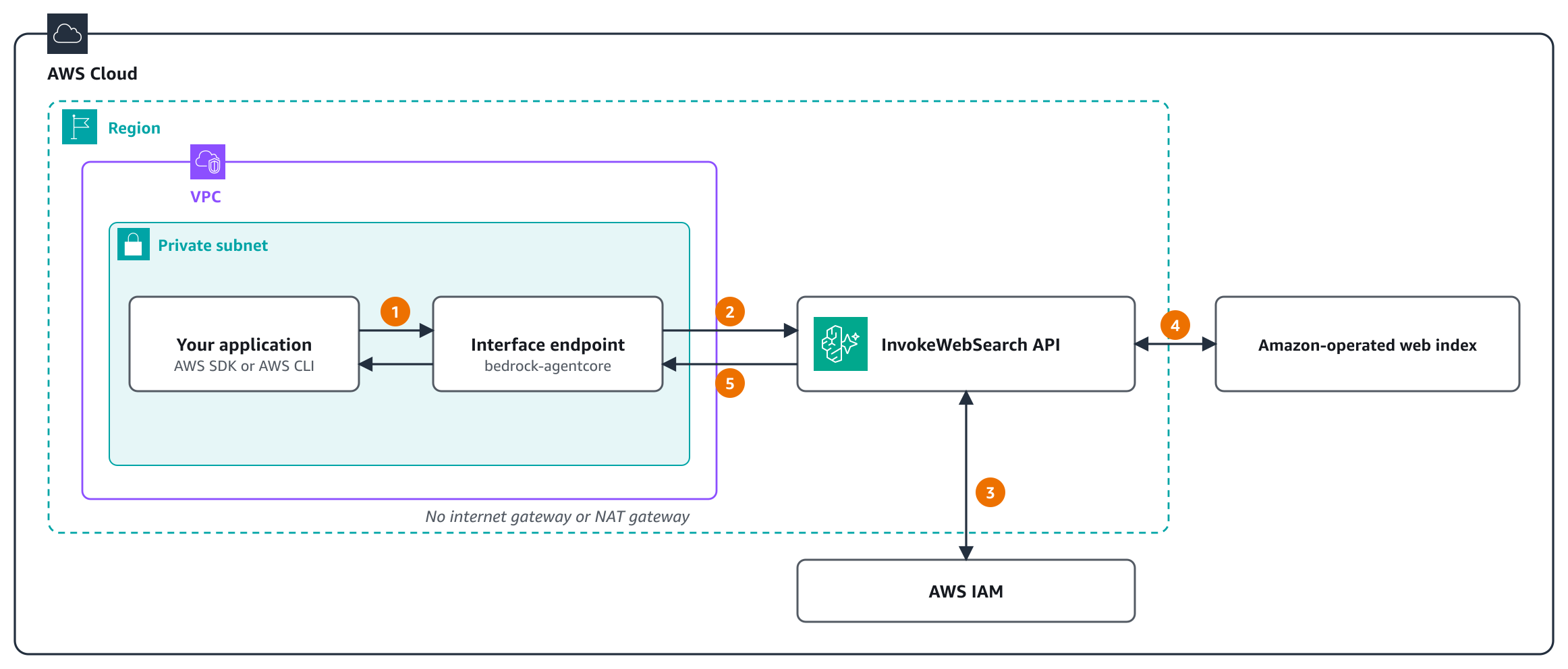
By establishing an interface VPC endpoint (com.amazonaws..bedrock-agentcore) within a Virtual Private Cloud (VPC), organizations can route search traffic entirely within the secure AWS backbone network. This architectural pattern ensures that queries originating from private subnets never traverse the public internet, eliminating the requirement for internet gateways, NAT gateways, or external proxies. Furthermore, administrators can enforce strict network access control lists (ACLs) and resource policies to govern precisely which workloads possess authorization to query the web index.
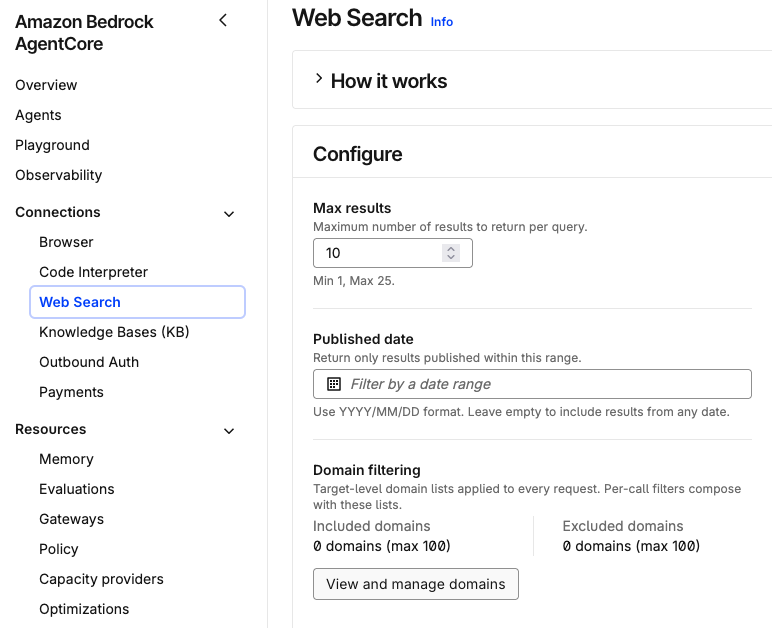
Granular access controls extend to query-level parameters as well. Developers can programmatically restrict searches to designated trusted domains, apply strict temporal filters to filter out outdated content, and manage execution budgets to prevent unexpected consumption spikes. Default service quotas permit up to 10 requests per second per AWS Region per account, with provisions for higher limits available through standard AWS support channels upon request.
Comparative Analysis: API Versus Gateway Architecture
To assist technical leadership in selecting the optimal integration pattern for their workloads, AWS has delineated clear operational boundaries between the standalone Web Search API and the established AgentCore Gateway.
The AgentCore Gateway remains the recommended architectural choice for platform engineering teams managing large fleets of multi-tenant agents. It excels in environments where multiple AI tools must be exposed through a single secure MCP endpoint, where inbound and outbound authentication requires JSON Web Tokens (JWT), or where centralized administrators wish to enforce immutable search policies and domain restrictions globally across all downstream agents without individual developer intervention.
Conversely, the Web Search API is purpose-built for scenarios demanding custom orchestration, non-agent data pipelines, automated dashboards, or direct developer control over caching and retry logic. Unlike the gateway, which abstracts tool execution behind protocol-specific layers, the API offers direct, programmatic interaction, allowing engineers to handle payloads with maximum flexibility and minimal abstraction overhead.
Pricing, Availability, and Economic Impact
The economic model of the Web Search API aligns closely with existing Amazon Bedrock pricing structures. Billed at a rate of $7 per 1,000 queries, the service meters usage identically to the gateway connector’s web search rate. Crucially, because the standalone API operates without an intervening gateway infrastructure, organizations incur zero gateway resource charges, lowering the total cost of ownership for high-volume automated data pipelines and background research agents.
At launch, the Web Search API is available across several major global AWS Regions, including US East (N. Virginia), US East (Ohio), US West (Oregon), Europe (Ireland), Asia Pacific (Tokyo), and Asia Pacific (Sydney). This multi-region deployment strategy ensures that global enterprises can minimize network latency by executing search queries geographically close to their core processing workloads.
Broader Implications for the AI Ecosystem
The introduction of the Web Search API on Amazon Bedrock AgentCore signifies a maturing operational landscape for generative AI deployment. As enterprises transition from experimental proof-of-concept models to mission-critical production systems, the demand for deterministic, auditable, and secure external data retrieval has intensified. By decoupling web search functionality from rigid agent frameworks and exposing it as a low-level, IAM-secured primitive, AWS has provided developers with the foundational building blocks required to construct robust, self-correcting, and strictly governed AI applications capable of interacting seamlessly with the live internet.
Related posts: