The rapid proliferation of Large Language Models (LLMs) has shifted the primary challenge of AI development from model accessibility to model reliability. While industry-standard benchmarks such as MMLU (Massive Multitask Language Understanding) and GSM8K (Grade School Math 8K) provide a baseline for general reasoning, they are increasingly insufficient for specialized enterprise applications. As organizations move toward deploying custom RAG (Retrieval-Augmented Generation) pipelines and domain-specific agents, the need for bespoke evaluation frameworks has become a critical engineering priority. Building a custom evaluation harness in Python—a modular, repeatable system for testing model performance against proprietary criteria—allows developers to bridge the gap between general intelligence and operational compliance.
The Evolution of Model Evaluation
The necessity for custom evaluation architectures emerged as a response to the "black box" nature of proprietary LLMs. In early 2023, the industry largely relied on human-in-the-loop testing, which proved non-scalable as deployment velocity increased. By late 2023, the transition toward automated "LLM-as-a-judge" frameworks began, allowing for the rapid iteration of prompts and system configurations.
In a professional software engineering context, a test harness functions as the scaffolding that orchestrates inputs, monitors outputs, and validates them against a predetermined baseline. When applied to LLMs, this architecture must account for the non-deterministic nature of generative AI. Unlike unit testing in traditional software, where the output is binary and predictable, LLM evaluation requires a nuanced approach that measures latency, cost, semantic accuracy, and adherence to safety guidelines.
Core Architecture: The Four Modular Pillars
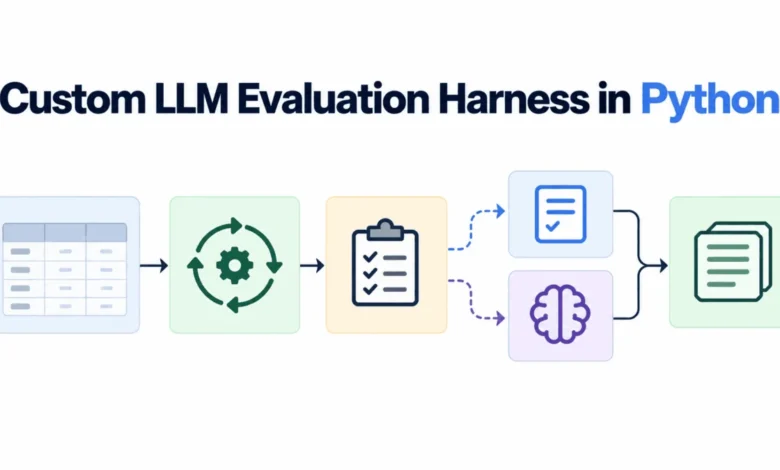
To build a robust, production-grade evaluation harness, developers must decouple the system into four distinct, modular components. This modularity ensures that the system remains maintainable as the complexity of the test suite grows.
- The Golden Dataset: This represents the foundation of the evaluation. Unlike synthetic data, which often fails to capture the "long tail" of real-world edge cases, a golden dataset should be composed of 20 to 50 high-quality samples derived from production logs. These samples should reflect the actual messiness of user inputs—including ambiguity, typos, and adversarial prompts—that a model is expected to handle.
- The Inference Runner: This component manages the execution of model calls. By leveraging libraries such as LiteLLM, developers can maintain a unified interface across diverse backends, including OpenAI’s GPT-4, Anthropic’s Claude, or open-source alternatives like Llama 3. The runner must incorporate robust error handling, including exponential backoff and timeout logic, to ensure that network fluctuations do not compromise the integrity of the evaluation run.
- The Judge Layer: This is the analytical engine that determines whether a model’s output is acceptable. This layer can be implemented as a deterministic check—verifying the presence of specific keywords or formats—or as an intelligent "LLM-as-a-judge" that evaluates semantic correctness. Integrating Pydantic models at this stage is essential; it forces the judge to return structured, typed data, eliminating the ambiguity inherent in free-text responses.
- The Logger: Evaluation results must be recorded in an immutable format, such as JSONL (JSON Lines). By logging both the prompt, the raw model output, and the evaluation score, developers create an audit trail that allows for the retroactive re-scoring of past runs if the evaluation rubric is updated.
Technical Implementation and Concurrency
Effective evaluation requires speed. Running hundreds of prompts sequentially against a remote API is inefficient and cost-prohibitive. Utilizing Python’s asyncio library is standard practice for modern evaluation harnesses. By deploying concurrent asynchronous calls, developers can reduce the total runtime of a test suite by orders of magnitude.
For instance, when utilizing litellm.acompletion within an asyncio.gather loop, a suite of 100 test cases can be processed in parallel. This concurrency, coupled with a strict retry policy—such as three retries with a 30-second timeout—transforms a sluggish, unreliable test process into a high-performance continuous integration asset.
Fact-Based Analysis: Why Generic Benchmarks Fail
The primary limitation of public benchmarks is their lack of alignment with business-specific constraints. A model may score in the 99th percentile on MMLU but fail to adhere to a company’s internal refusal policy regarding unauthorized financial advice.
Data from recent enterprise deployments suggests that "domain drift" is a significant factor in model failure. When a model is tasked with interpreting specific technical documentation or proprietary codebases, its performance often deviates from its general capability. A custom harness allows teams to create "Regression Test Suites," where specific failure modes identified in production are converted into golden test cases. This creates a defensive moat around the application, ensuring that model updates or prompt engineering adjustments do not inadvertently introduce regressions.
The Role of Pydantic in Structured Evaluation
A common point of failure in automated evaluation is the lack of output control from the judge model. Without enforcing structure, an LLM acting as a judge might return a response like, "The model seems to have done a good job." This is unparseable for automated reporting systems. By integrating Pydantic, developers define a schema—such as a JudgeScore object—that forces the judge to return a boolean passed field and a string reason field. This rigor is what elevates a script to an enterprise-grade testing framework.
Broader Impact and Industry Implications
The adoption of custom evaluation harnesses is fundamentally changing the lifecycle of AI products. Companies are moving away from "vibes-based" development—where performance is judged by ad-hoc human observation—toward a quantitative, evidence-based development cycle. This transition has several implications for the industry:
- Continuous Integration (CI/CD): Evaluation harnesses are increasingly being integrated into CI/CD pipelines. Every time a prompt is modified or a new model version is tested, the harness triggers automatically, providing a "green/red" status on the system’s performance.
- Cost Optimization: By logging raw outputs, developers can perform "what-if" analysis. If a new, cheaper model is released, they can re-run their existing golden dataset through the judge layer without needing to re-gather user feedback, significantly reducing the cost of model migration.
- Safety and Compliance: For industries such as finance, healthcare, and law, the ability to document exactly how a model was tested is not merely a best practice—it is a regulatory requirement. A well-maintained evaluation log serves as a record of due diligence.
Future Directions
While the current approach to building evaluation harnesses is largely manual, the ecosystem is rapidly evolving. We are seeing a move toward more sophisticated grading rubrics, where judges assign scores on a sliding scale rather than a binary pass/fail. Additionally, as multi-modal models gain prominence, the next generation of harnesses will need to integrate visual and audio evaluation, extending the concepts of the golden dataset and the judge layer into new sensory domains.
In conclusion, building a custom evaluation harness is a foundational task for any organization serious about the reliability of their AI systems. By focusing on modularity, leveraging asynchronous Python, and ensuring that every evaluation result is captured in a structured log, developers can move beyond the limitations of public benchmarks. This disciplined approach provides the transparency and control necessary to move LLMs from experimental prototypes to robust, production-ready systems that can be trusted to handle complex, real-world tasks. As the technology continues to mature, the ability to build and maintain these internal evaluation systems will likely distinguish successful AI-driven enterprises from those that struggle to maintain consistent quality in their deployments.
Related posts: