Enhancing Web Data Ingestion for Amazon Bedrock Knowledge Bases Using Crawl4AI and AWS Fargate

The quality of answers generated by Retrieval-Augmented Generation (RAG) applications is inextricably linked to the integrity, cleanliness, and structure of the underlying data ingested into the system. As organizations increasingly adopt generative artificial intelligence to streamline operations and derive insights from vast corpuses of external information, managing data pipelines has emerged as a critical engineering challenge. To address this, developers frequently leverage Amazon Bedrock Knowledge Bases, a fully managed RAG capability provided by Amazon Web Services (AWS) that orchestrates document ingestion, storage, indexing, and retrieval without requiring manual vector store provisioning. While built-in tools such as the Amazon Bedrock Web Crawler offer seamless synchronization for standard public websites, enterprise applications often demand granular control over web content extraction. Scenarios requiring the removal of navigation boilerplate, the isolation of specific content regions, or the attachment of bespoke metadata attributes necessitate advanced pre-processing solutions. To bridge this gap, engineers can integrate Crawl4AI—an open-source Python-based web crawler—with AWS Fargate and Amazon Simple Storage Service (Amazon S3) to build a robust, customized web ingestion pipeline for Amazon Bedrock Knowledge Bases.
Background Context and Evolution of Managed RAG Workflows
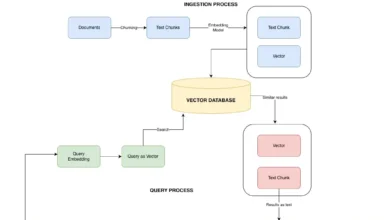
Retrieval-Augmented Generation has rapidly evolved from a novel experimental architecture into an enterprise standard for grounding large language models in verifiable, domain-specific data. Traditionally, building a RAG pipeline required deep expertise in vector database management, embedding model selection, chunking strategy optimization, and synchronization scheduling. Platforms like Amazon Bedrock revolutionized this space by abstracting away the heavy lifting of infrastructure management. Through Amazon Bedrock Managed Knowledge Bases, users can connect diverse data sources while the service automatically handles text parsing, vector generation, and semantic indexing.
Despite these advancements, ingestion bottlenecks remain a primary pain point for developers dealing with messy, unstructured web data. Public web pages are notoriously heterogeneous, cluttered with advertisements, navigation menus, footers, and scripts that can degrade the semantic quality of vector embeddings. When irrelevant boilerplate text is ingested alongside core information, semantic search algorithms may retrieve suboptimal context, ultimately leading to hallucinations or imprecise answers from the generative AI model.
While the native Amazon Bedrock Web Crawler handles basic crawling requirements—respecting robots.txt directives and tracking incremental modifications—it operates as a general-purpose ingestion tool. Organizations seeking to enforce strict data hygiene, attach contextual metadata such as expiration timestamps or categorization tags, and convert raw HTML into cleanly formatted Markdown prior to vectorization require a programmatic pre-processing layer. The integration of Crawl4AI into an automated AWS Fargate workflow provides developers with the precise programmatic control needed to curate web datasets before they ever reach the embedding phase.
Architecture and Technical Workflow of the Crawl4AI Integration
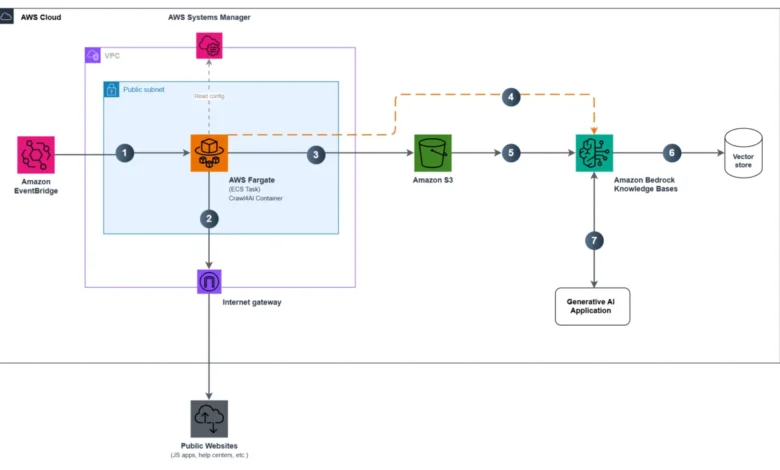
The deployed architecture relies on a serverless containerized pattern orchestrated via the AWS Cloud Development Kit (AWS CDK). The core workflow begins with an Amazon EventBridge schedule that periodically triggers an AWS Fargate task executing within a secure container environment. This container runs a Python application utilizing Crawl4AI to execute bounded, scoped web scraping operations across designated seed URLs.
During the execution phase, the crawler navigates authorized websites using a Breadth-First Search (BFS) deep crawling strategy, guided by strict domain filters and maximum depth parameters. As the crawler processes each page, it evaluates content against CSS selectors and pruning filters designed to strip away extraneous HTML elements. The extracted text is then converted into Markdown format, which preserves hierarchical structures such as headings, lists, and tables without embedding the massive syntax overhead of raw HTML markup.
Concurrently, the task generates a metadata sidecar file for each Markdown document. Adhering to the strict formatting requirements of Amazon Bedrock Knowledge Bases, these sidecars encapsulate structured attributes—such as source URLs, epoch timestamps, and content classifications—within a JSON structure capped at a 10 KB limit. The Fargate task uploads both the Markdown documents and their corresponding sidecar files to a designated Amazon S3 bucket under a configured prefix. Once the files reside in S3, the application programmatically initiates an Amazon Bedrock Knowledge Base ingestion job via the Boto3 SDK, prompting the knowledge base to parse, chunk, embed, and index the newly prepared data.
Deployment and Operational Implementation
Deploying the solution requires a configured workstation with Docker, Python, and the AWS CDK installed. Administrators begin by cloning the sample repository, establishing a virtual environment, and installing the necessary deployment dependencies. Because the deployment process provisions container images and cloud infrastructure, setting the correct AWS region via environment variables is essential to ensure resources are deployed in close proximity to the existing knowledge base.
git clone https://github.com/aws-samples/sample-crawl4ai-bedrock-knowledge-base.git
cd sample-crawl4ai-bedrock-knowledge-base/deploy
python -m venv .venv
source .venv/bin/activate  # Windows PowerShell: .venvScriptsActivate.ps1
python -m pip install -r requirements.txt
Following environment configuration, the AWS CDK bootstrap process prepares the target account and region. The core deployment command utilizes context parameters to pass essential configuration variables, including the target knowledge base identifier, data source ID, S3 bucket name, and authorized seed URLs.
export AWS_DEFAULT_REGION=us-east-1  # Windows PowerShell: $env:AWS_DEFAULT_REGION = "us-east-1"
cdk bootstrap aws://ACCOUNT_ID/REGION

cdk deploy
  -c knowledgeBaseId=ABCDEFGHIJ
  -c dataSourceId=KLMNOPQRST
  -c s3Bucket=amzn-s3-demo-bucket
  -c 'seedUrls=["https://www.example.com/services"]'
  -c maxDepth=1
  -c maxPages=25
Engineers can adjust parameters such as maxDepth and maxPages to constrain initial ingestion runs during testing phases. Furthermore, container architectures can be tailored to match workstation capabilities, allowing compilation for either ARM64 or x86_64 CPU environments. Networking considerations—such as managing VPC block public access configurations or implementing NAT gateways via egressMode=nat—ensure that container tasks maintain secure, reliable internet connectivity when traversing external websites.
Data Preparation and Metadata Enrichment Logic
A key innovation of the Crawl4AI preparation pipeline is its ability to sanitize content and inject structured metadata prior to S3 upload. The core crawling script asynchronously manages browser instances, executes JavaScript-rendered content, and filters responses to prevent scope leakage following HTTP redirects.
    written, seen = [], set()
    pages_crawled = 0
    browser_config = BrowserConfig(headless=True, java_script_enabled=True)

    async with AsyncWebCrawler(config=browser_config) as crawler:
        for seed in config.seed_urls:
            remaining = config.crawl.max_pages - pages_crawled
            if remaining <= 0:
                break

            strategy = BFSDeepCrawlStrategy(
                max_depth=config.crawl.max_depth,
                max_pages=remaining,
                filter_chain=FilterChain([
                    SeedScopeFilter(seed, config.crawl.scope),
                ]),
            )
            run_config = CrawlerRunConfig(
                deep_crawl_strategy=strategy,
                markdown_generator=DefaultMarkdownGenerator(
                    content_filter=PruningContentFilter()
                ),
                css_selector=config.crawl.css_selector,
                check_robots_txt=config.crawl.check_robots_txt,
                mean_delay=config.crawl.request_delay_seconds,
                max_range=0,
                semaphore_count=1,
            )

            results = await crawler.arun(url=seed, config=run_config)
            for result in results:
                if pages_crawled >= config.crawl.max_pages:
                    break
                pages_crawled += 1
                requested_url = result.url
                source_url = getattr(result, "redirected_url", None) or requested_url
                if not SeedScopeFilter(seed, config.crawl.scope).apply(source_url):
                    continue
                canonical = _canonical_url(source_url)
                if canonical in seen:
                    continue
                seen.add(canonical)
                if not result.success or not result.markdown:
                    continue

                md_result = result.markdown
                markdown = (
                    getattr(md_result, "fit_markdown", None)
                    or getattr(md_result, "raw_markdown", None)
                    or (md_result if isinstance(md_result, str) else "")
                )
                if not markdown:
                    continue

                written.extend(
                    _write_document(
                        output_dir,
                        _base_name(source_url),
                        markdown,
                        "source_url": source_url,
                    )
                )
    return written
To complement the generated Markdown documents, metadata sidecar files are structured to satisfy strict AWS schema validations. By associating typed key-value pairs with each document, the pipeline enables downstream hybrid search operations to filter results based on temporal constraints or content categorization.
  "metadataAttributes":
    "source_url":
      "value": "type": "STRING", "stringValue": "https://www.example.com/services/permits"
    ,
    "crawled_at_epoch":
      "value": "type": "NUMBER", "numberValue": 1790640000
    ,
    "content_category":
      "value": "type": "STRING", "stringValue": "web"
Validation, Retrieval Quality, and Search Optimization
Following successful ingestion, validating retrieval quality is a mandatory step before deploying generative components into production. Amazon Bedrock Knowledge Bases utilizing managed search configurations execute hybrid retrieval, combining semantic vector search with keyword matching, followed by service-managed reranking to maximize result relevance.
Developers can programmatically test retrieval accuracy using the Boto3 SDK, applying complex filters to narrow search scopes based on metadata attributes such as ingestion timestamps or content categories.
import time
import boto3

client = boto3.client("bedrock-agent-runtime", region_name="us-east-1")
week_ago = int(time.time()) - 7 * 24 * 60 * 60

response = client.retrieve(
    knowledgeBaseId="ABCDEFGHIJ",
    retrievalQuery="text": "How do I apply for a building permit?",
    retrievalConfiguration=
        "managedSearchConfiguration":
            "numberOfResults": 5,
            "filter":
                "andAll": [
                    "equals": "key": "content_category", "value": "web",
                    "greaterThan": "key": "crawled_at_epoch", "value": week_ago,
                ]
            ,

    ,
)

for result in response["retrievalResults"]:
    print(result.get("metadata", ).get("source_url"), result["content"]["text"][:200])
This targeted filtering mechanism ensures that applications surface fresh, highly contextual information while mitigating the risk of outdated data persistence. Furthermore, utilizing agentic retrieval operations enables applications to generate fully cited responses, automatically mapping answers back to their exact source URLs.
Security, Compliance, and Operational Governance
Operating automated web crawling and ingestion pipelines at scale introduces significant security and compliance responsibilities. Because the Fargate tasks operate on public networks to fetch external web content, organizations must institute strict egress filtering, monitor VPC flow logs, and ensure that KMS encryption keys are properly managed across S3 storage buckets.
Additionally, administrators must account for data lifecycle management. Because S3 uploads are strictly additive, removing a source URL from a target website does not automatically purge the corresponding objects from the storage bucket. Operators must implement secondary synchronization or deletion scripts to prune obsolete documents, ensuring compliance with data privacy mandates and corporate governance policies. Safeguards such as deletion protection thresholds on managed knowledge bases further prevent catastrophic data loss during synchronization anomalies.
Conclusion and Future Outlook
The integration of Crawl4AI with AWS Fargate and Amazon Bedrock Knowledge Bases represents a powerful architectural pattern for organizations seeking granular control over web data ingestion. By programmatically cleaning, formatting, and enriching web content prior to vectorization, development teams can dramatically improve the precision, reliability, and contextual grounding of enterprise RAG applications. While native crawlers remain suitable for straightforward public websites, the extensible Crawl4AI preparation pipeline provides the necessary flexibility for complex web properties requiring specialized parsing and metadata attachment. Through careful deployment, rigorous retrieval validation, and robust operational monitoring, enterprises can successfully scale their generative AI initiatives atop clean, authoritative, and securely managed knowledge repositories.