In the rapidly evolving landscape of artificial intelligence, autonomous agents capable of writing and executing their own code have transitioned from experimental research projects to functional enterprise tools. However, this capability introduces a significant security paradox: providing an AI agent with the power to execute arbitrary code is fundamentally equivalent to granting a remote user shell access to your infrastructure. As organizations rush to integrate these agents into production workflows, the necessity for robust, multi-layered sandboxing architectures has become the primary bottleneck for safe deployment. Achieving security in this context requires a delicate balance between isolation, resource constraints, and operational latency.
The Evolution of Execution Isolation
The fundamental challenge of agentic code execution lies in the shared nature of modern computing environments. Historically, developers relied on basic process-level isolation. However, as AI agents become more sophisticated, they are increasingly prone to "hallucinated" or malicious code execution that can exhaust system resources, exfiltrate sensitive environment variables, or attempt to break out of the host environment.
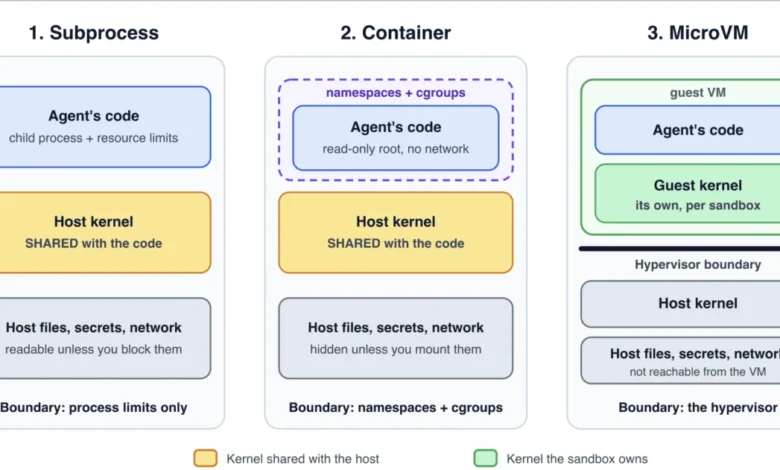
The current industry standard for mitigating these risks involves three distinct tiers of isolation, each offering a different trade-off between speed and security. At the foundational level, developers use limited subprocesses—a method that leverages Linux kernel features such as resource limits (cgroups) and namespace isolation (unshare). While this approach provides the lowest latency, it remains inherently vulnerable because the agentic process and the host operating system share the same kernel.
The middle tier utilizes containerization, most notably through platforms like Docker. Containers add layers of abstraction through namespaces and cgroups, allowing for more granular control over CPU, memory, and networking. Yet, the history of container security is marked by persistent vulnerabilities, such as the high-profile runc exploits observed in late 2025. These incidents underscored the reality that container boundaries are logical, not physical; a kernel-level exploit within a container can potentially compromise the entire host.
The third and most robust tier involves the use of microVMs, specifically those powered by Firecracker technology. Unlike containers, which share a kernel with the host, a microVM runs a dedicated, lightweight guest kernel. This creates a hardware-level boundary, ensuring that even if an agent executes code that triggers a kernel panic or an exploit, the impact is strictly confined to the isolated virtual machine.
Benchmarking Safety and Latency: A Comparative Analysis
To understand the practical implications of these tiers, security engineers often subject them to a standardized battery of "hostile" code snippets. A typical test suite includes resource-exhaustion attacks, such as CPU loops and memory allocation floods, as well as privilege-escalation attempts, such as unauthorized file access or attempts to scan internal network ports.
In controlled benchmarks, the subprocess tier often fails to prevent "fork bombs" or read-access to host-level configuration files because the environment is too tightly coupled with the host. Conversely, a hardened Docker container—configured with the --read-only flag, no network access, and restricted capabilities—effectively blocks these common vectors. However, the overhead of spinning up a container, even a "slim" image, introduces a latency penalty.
MicroVMs represent the peak of current security architecture. By utilizing platforms like E2B, which provides an API-first approach to Firecracker environments, developers can spin up a dedicated kernel for a single execution block. While this incurs a higher latency—typically ranging from 150ms to 300ms—it provides a level of forensic cleanliness that is impossible to achieve with shared-kernel methods. For many enterprise applications, this marginal increase in latency is considered a necessary trade-off for the near-total elimination of cross-session contamination.
Chronology of Infrastructure Hardening
The trajectory of sandboxing technology has accelerated significantly between 2024 and 2026. In early 2024, most AI developers relied on simple Python exec() wrappers, which were essentially unprotected. By mid-2025, the industry saw a shift toward "jail-like" environments using Docker as the default. The turning point occurred in November 2025, following the disclosure of major vulnerabilities in the runc runtime, which forced security teams to re-evaluate the assumption that containers were "secure enough."
By April 2026, the market shifted definitively toward microVMs. Docker’s official launch of "Docker Sandboxes" explicitly integrated Firecracker-based technology, signaling that even the most prominent containerization platforms recognized that containers alone were no longer sufficient for the unique security requirements of autonomous AI agents. This development mirrors the shift in serverless computing, where AWS Lambda pioneered the use of Firecracker to ensure that distinct customer functions never share the same underlying kernel.
Operational Considerations for AI Engineers
Implementing these safeguards requires more than just picking a technology; it requires a fundamental change in how agents interact with their environment. Infrastructure teams should adopt a "policy-as-code" approach, where the boundaries for file access, network connectivity, and secret management are defined at the infrastructure layer, rather than being managed by the agent itself.
A critical best practice involves the principle of "fail-closed" networking. Whether using a subprocess or a microVM, the environment should be configured with no external network access by default. If an agent requires access to a specific API, it should be mediated through a secure proxy or a restricted outbound gateway. This prevents the "callback" attacks common in malicious code, where a compromised agent attempts to signal a remote command-and-control server.
Furthermore, developers must account for state persistence. One of the primary advantages of the microVM approach is its ephemeral nature. Because the virtual machine is destroyed after the code execution completes, there is no risk of residual state (such as temporary files or cached credentials) affecting the next turn of the agent. This "clean-slate" architecture is a vital component of building stateless, predictable AI systems.
Broader Implications and Future Outlook
The industry trend points toward a future where "agentic runtime security" becomes a distinct category of cybersecurity. As AI agents gain the ability to perform more complex tasks—such as automated web scraping, database administration, and software deployment—the threat surface will expand exponentially.
Experts anticipate that within the next two years, we will see the emergence of specialized hardware-backed execution environments specifically designed for LLMs. These environments will likely feature even faster boot times, possibly dropping below 50ms, while maintaining the strong isolation properties of current microVMs. Additionally, as the use of "Agentic Workflows" becomes standard in Fortune 500 companies, the demand for third-party auditing of these sandbox environments will increase. Organizations will need to prove not only that their agents are smart, but that their execution environments are impenetrable.
In conclusion, the choice of sandboxing technology should be dictated by the sensitivity of the data the agent interacts with and the level of trust placed in the underlying model. For low-stakes development environments, a limited subprocess may suffice. However, for any system interacting with production APIs, customer data, or internal secrets, the microVM is rapidly becoming the non-negotiable standard. By isolating the kernel, enforcing strict resource constraints, and maintaining ephemeral execution states, engineers can harness the immense power of AI agents while keeping their digital infrastructure secure from the unintended consequences of autonomous code. The era of "blind execution" is over; the future of AI is secure, isolated, and highly performant.