Navigating the Future of Artificial Intelligence: A Comprehensive Guide to the AWS re:Invent 2026 AI and Machine Learning Track

Amazon Web Services is set to host its premier annual learning conference, AWS re:Invent, from November 30 through December 4, bringing together tens of thousands of cloud architects, developers, enterprise leaders, and machine learning practitioners from around the globe. As artificial intelligence transitions from experimental implementations to core enterprise infrastructure, this year’s conference schedule reflects an industry-wide pivot toward production-grade systems, autonomous multi-agent frameworks, and specialized silicon. With more than 2,000 total technical sessions scheduled across the multi-day event, the dedicated Artificial Intelligence and Machine Learning (AIM) track alone features over 140 unique sessions designed to guide attendees through every layer of the modern cloud intelligence stack.
For industry professionals unable to make the trip to Las Vegas, AWS has structured a hybrid engagement model, offering live broadcasts of foundational keynotes alongside on-demand access to breakout sessions via the official AWS Events YouTube channel. However, the in-person experience offers unmatched value through interactive chalk talks, immersive builder sessions, hands-on workshops, and collaborative code talks led by top-tier AWS engineers and industry pioneers. Navigating this vast catalog of technical education requires a systematic understanding of the AWS AI portfolio, which spans from underlying hardware infrastructure up to fully managed agentic business solutions.
The Evolution of the AWS AI Stack
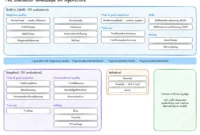
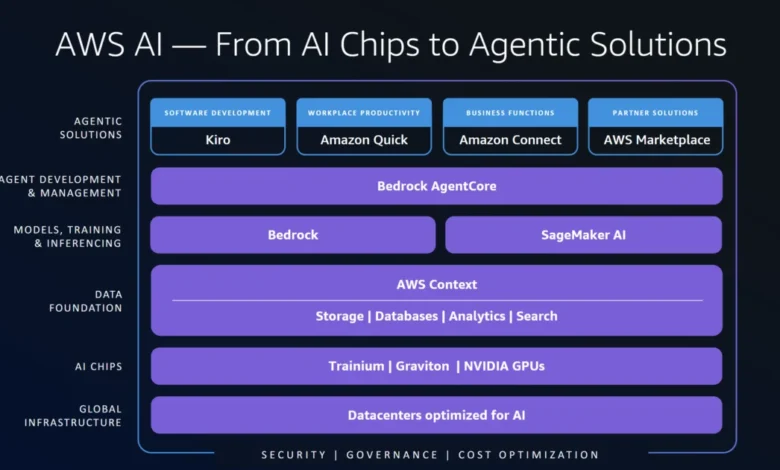
To make sense of the overwhelming array of choices at re:Invent, enterprise technologists often rely on the conceptual framework of the AWS AI stack. This multi-layered architecture begins at the foundational level with purpose-built global infrastructure. AWS data centers are engineered from the ground up to accommodate the extreme power density, advanced liquid and air cooling, and high-bandwidth, low-latency networking required to train and run massive large language models.
Sitting directly within these optimized facilities are advanced compute options tailored for high-performance deep learning. AWS offers customers a strategic choice between industry-standard NVIDIA graphics processing units and its own purpose-built AWS Trainium chips. While NVIDIA GPUs provide robust, highly flexible acceleration for diverse machine learning workloads, AWS Trainium is engineered specifically to maximize price performance for deep learning training and high-throughput inference, utilizing the proprietary AWS Neuron software stack to integrate seamlessly with frameworks like PyTorch without requiring complex code rewrites.
Moving up the architectural stack, the data foundation layer addresses a critical bottleneck in enterprise AI adoption: context. Through AWS Context, organizations can unify disparate data silos spanning relational databases, analytical data stores, object storage, and enterprise search platforms. This seamless connectivity ensures that models and autonomous agents can dynamically access verified, real-time data at the exact moment it is needed.
At the model, training, and inference tier, developers are given dual pathways through Amazon Bedrock and Amazon SageMaker AI. Amazon Bedrock provides managed, serverless access to hundreds of foundational models from leading providers via a single, unified API, removing the operational overhead of managing underlying infrastructure. Conversely, Amazon SageMaker AI gives engineering teams granular, end-to-end control to build, fine-tune, and deploy custom proprietary or open-weight models on dedicated clusters, such as those powered by SageMaker HyperPod.
Above the model tier lies the rapidly expanding domain of agent development and management, anchored by Amazon Bedrock AgentCore. This capability allows engineering teams to design, orchestrate, and deploy autonomous AI agents that can seamlessly utilize any model or tool provider without vendor lock-in. Finally, at the apex of the stack sit ready-to-use agentic solutions—such as specialized tools for software development, enterprise knowledge management, customer experience, and supply chain orchestration—while robust security, governance, and cost optimization mechanisms remain embedded continuously across every single layer.
Structuring the Learning Experience: Session Formats and Core Tracks
AWS re:Invent 2026 has structured its learning catalog into distinct formats tailored to different learning styles and organizational roles. Breakout sessions offer broad strategic insights and architectural overviews, with recordings made publicly available shortly after delivery. Chalk talks provide intimate, whiteboard-driven discussions led by AWS experts, encouraging deep technical dialogue and real-time problem solving. For practitioners seeking hands-on mastery, builder sessions and workshops provide guided, practical environments to write code, configure infrastructure, and deploy production-ready pipelines. Code talks cater specifically to advanced developers and performance engineers diving deep into underlying software kernels and APIs.
The extensive AIM track focuses heavily on three foundational layers: custom AI chips, model development and inference pipelines, and autonomous agent architectures, with security and governance principles woven into every session. Newcomers to the ecosystem are encouraged to begin with foundational overviews like AIM204, which provides a comprehensive walk-through of the entire AWS AI stack, before progressing toward advanced 300- and 400-level deep dives into distributed training, multi-tenant agent scaling, and kernel optimization.
Silicon Innovations: NVIDIA GPUs Versus AWS Trainium
As organizations grapple with escalating infrastructure costs, hardware selection has emerged as a primary strategic imperative. The conference agenda reflects this reality by offering extensive, parallel tracks dedicated to both NVIDIA GPU optimization and AWS Trainium advancements.
Sessions dedicated to NVIDIA GPUs—such as AIM2210 and AIM3301—focus on maximizing cluster utilization, refining GPU scheduling algorithms, and deploying high-performance instances like the EC2 G7 and G7e families. Data processing optimization is a major theme, highlighted by sessions demonstrating how Amazon EMR integrated with the NVIDIA cuDF plugin can accelerate Apache Spark workloads by up to 3.7 times on G7 instances without requiring application modifications.
Simultaneously, the AWS Trainium track showcases the cost-efficiency and raw computational power of Amazon’s custom silicon. Sessions such as AIM310 introduce the latest architectural iterations, including Trainium3 and the Trn3 UltraServer, designed to maintain exceptional performance when running complex mixture-of-experts models. Researchers and data scientists deeply embedded in PyTorch can engage in specialized nanochat code talks and distributed-training workshops, while infrastructure engineers can explore resilient Kubernetes deployments capable of orchestrating tens of thousands of accelerators simultaneously. Furthermore, specialized sessions like AIM323 explore emerging frontiers such as world models and physical AI, demonstrating how native PyTorch frameworks and agentic Neuron workflows can power advanced simulation for robotics and autonomous driving.
Customization and Production Scale with Amazon SageMaker AI
For organizations requiring deep model customization, domain-specific adaptation, or proprietary model training, Amazon SageMaker AI serves as the core orchestration platform. Sessions at re:Invent 2026 emphasize the entire model lifecycle, from initial dataset preparation and hyperparameter tuning to serverless deployment and large-scale distributed training on SageMaker HyperPod.
Notable enterprise case studies feature prominently in the agenda. Salesforce, for instance, details the architectural journey behind building and serving its open-weight Koa models, while Intuit and Tencent Games share invaluable production insights on scaling training workloads across thousands of accelerators. For platform teams and ML engineers, workshops such as AIM406, AIM403, and AIM456 provide hands-on environments to construct foundation model pipelines using Amazon EKS, tune distributed jobs with Ray, and implement advanced policy distillation techniques to train efficient, compact models from larger counterparts.
Building Autonomous Capabilities with Amazon Bedrock
The transition from static generative AI chat interfaces to autonomous, action-oriented agents represents one of the most significant technological shifts in enterprise software. The Amazon Bedrock and AgentCore sessions at re:Invent 2026 are specifically curated to help developers navigate this transition safely and effectively.
Introductory sessions establish core competencies in model evaluation, prompt caching, and batch inference routing, ensuring that organizations can maintain cost predictability as user adoption scales. More advanced sessions, such as AIM439 and AIM407, provide step-by-step methodologies for constructing production-grade agents equipped with persistent memory, secure identity management, robust tool access, and multi-agent coordination using frameworks like Strands Agents. Enterprise architecture teams can also examine real-world deployments, such as PepsiCo’s conversational ordering workflow, gaining practical knowledge on how to balance agent autonomy with strict business logic and error-handling protocols.
Trust, Governance, and Responsible AI in the Enterprise
As AI agents assume greater operational autonomy—ranging from automated claims processing and financial approvals to customer data management—establishing institutional trust is paramount. AWS addresses this challenge through its comprehensive "Trust in Depth" paradigm, which combines responsible AI frameworks with automated reasoning and formal verification techniques.
Conference sessions highlight how leading enterprises are replacing periodic manual audits with continuous automated governance. For example, case studies from organizations like John Deere demonstrate how AI Risk Intelligence tools can reduce compliance assessment times by over 30 percent while ensuring strict adherence to internal policies and regulatory standards. Technical workshops guide developers through the process of auditing multi-agent systems for bias, implementing fairness metrics, and translating complex legal and regulatory policies into machine-checkable rules within Amazon Bedrock Guardrails.
Broader Horizons: Sustainability and Hybrid Infrastructure
Rounding out the comprehensive re:Invent curriculum are specialized tracks addressing environmental sustainability and hybrid cloud deployment models. As computational demands surge, AWS continues to optimize its data center infrastructure through energy-efficient custom silicon, machine learning-tuned environmental controls, and hardware designed with low embodied carbon. Sessions such as AIM320 and AIM412 demonstrate how organizations can leverage generative AI and knowledge graphs to track, measure, and actively reduce the carbon footprint of their cloud workloads.
Additionally, for enterprises bound by strict data sovereignty, low-latency requirements, or data gravity constraints, sessions exploring AWS Local Zones, Dedicated Local Zones, and AWS AI Factories provide critical architectural guidance. Presentations detail how organizations like Netflix and T-Mobile utilize localized compute infrastructure to run demanding visual effects pipelines and latency-sensitive distributed inference, while emerging hybrid architectures allow companies to operate advanced AI factories directly on-premises with full AWS management and support.
Conclusion and Planning for Attendees
With an expansive catalog spanning foundational silicon, custom model training, multi-agent orchestration, and rigorous governance frameworks, AWS re:Invent 2026 offers a definitive roadmap for enterprise artificial intelligence adoption. Attendees are strongly encouraged to utilize the official event catalog to reserve seats in advance, while leveraging walk-up queues and on-demand streaming to maximize their educational engagement. As artificial intelligence solidifies its position as the bedrock of modern digital enterprise, the insights, technical depth, and architectural patterns shared in Las Vegas will undoubtedly shape the trajectory of cloud technology for years to come.