Python Ecosystem Sees a Paradigm Shift as Rust Integrates Deeply into Core Tooling and Libraries

The intersection of Python and Rust has transitioned from an experimental niche into a dominant architectural trend across the software development industry. Over the past several years, the Python ecosystem has increasingly leaned on Rust to overcome inherent performance bottlenecks, modernizing foundational tools, standard libraries, and web application servers. This shift is not merely about raw execution speed; it represents a fundamental philosophical evolution in how developers approach memory management, type safety, and deployment pipelines.
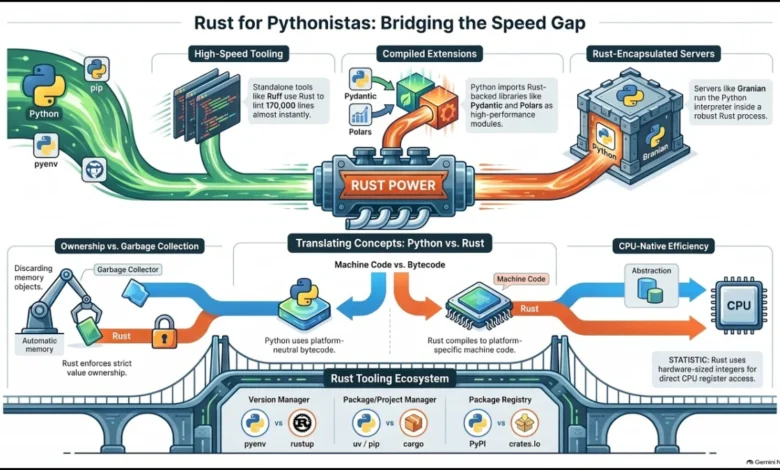
The integration of Rust into Python environments has become particularly apparent through high-profile utilities such as Ruff, the ultra-fast linter capable of scanning the entire CPython codebase from scratch in a mere 0.3 seconds. Alongside Ruff, critical libraries and deployment frameworks like Pydantic, Polars, uv, and Granian leverage Rust under the hood to deliver performance metrics that traditional, pure-Python solutions cannot match. As developer expectations shift toward near-instantaneous feedback loops in continuous integration and local development, Rust-based tooling has established a new performance baseline for the Python community.
Understanding the Rust-Python Synergy
To understand why Rust has found such a receptive audience among Python developers, one must examine the distinct ways the two languages interact. Industry observers generally categorize Rust’s presence in the Python ecosystem into three distinct tiers: external tools that happen to be written in Rust, underlying libraries imported and utilized by Python applications, and high-performance servers that embed the Python interpreter directly within a Rust-managed runtime environment.
The first tier encompasses standalone command-line utilities and development tools like Ruff or uv. In these instances, Rust is utilized purely to compile high-efficiency binaries that execute independently of Python’s runtime overhead. Because these tools process text, parse syntax trees, and manage dependency resolutions entirely in compiled machine code, they operate at speeds bounded only by hardware limits.
The second tier involves libraries like Pydantic for data validation and Polars for data manipulation. These packages expose a clean, idiomatic Python API on the surface while executing core computations within a high-performance Rust engine. Python’s historical strength lies in its dynamic nature, ease of use, and readability, but these qualities introduce computational overhead due to dynamic typing, garbage collection, and heap allocation. By offloading heavy data transformations and validation logic to a compiled Rust core, developers retain Python’s ergonomic benefits while achieving speeds comparable to native C or C++ extensions.
The third tier inverts the traditional relationship by embedding the Python interpreter inside a Rust-based application server, such as Granian. In this architecture, Rust handles the high-concurrency network I/O, connection management, and system resource oversight, passing execution to the embedded Python interpreter only when handling specific application logic. This model offers robust concurrency handling and superior resource efficiency for modern web applications.
The Core Philosophical Divide: Ownership and Memory Management
Despite the growing synergy between the two languages, adopting Rust requires developers to cross a significant conceptual chasm, particularly regarding memory management and the strict rules enforced by Rust’s compiler. In Python, memory management is entirely automated. Developers pass objects, lists, and variables freely across functions and modules without manual intervention, relying on reference counting and the garbage collector to clean up unused memory.
Rust approaches memory safety through a radically different paradigm governed by its strict ownership model and the legendary borrow checker. The foundational rule of Rust is that any given value or variable can have only one owner at a time. When a value is assigned or passed to another variable or function, ownership is transferred—or moved—unless explicit borrowing mechanisms are implemented. Attempting to pass variables around with the casual abandon common in Python will result in immediate compilation errors in Rust.
While this restriction initially frustrates developers transitioning from dynamic languages, it eliminates an entire class of runtime bugs common in languages like C and C++, such as null-pointer dereferencing, buffer overflows, and double-free vulnerabilities. Furthermore, Rust’s compiler is renowned for providing exceptionally detailed, instructive error messages that often diagnose the precise structural flaw and suggest corrective code modifications.
Hardware Proximity and Performance Implications
The performance delta between Python and Rust stems largely from how each language interacts with underlying hardware and CPU architectures. Python handles numbers and data structures through generalized abstractions. For instance, integers in Python are boundless, dynamically resizing objects stored on the heap with significant metadata overhead, allowing developers to perform mathematical operations on massive numbers without truncation fears.
Rust, conversely, is explicitly engineered for close proximity to the machine. It maps its data types directly to CPU primitives, requiring developers to explicitly declare variable sizes and characteristics, such as whether an integer is signed or unsigned, and whether it occupies 8, 16, 32, or 64 bits. While this demands upfront architectural decisions from the programmer, it eliminates the computational overhead of dynamic dispatch and memory translation layers.
Furthermore, data structures in Rust are typically stored contiguously in memory—either on the stack or in well-managed heap allocations—allowing modern CPU caches to prefetch and process data with maximum efficiency. In contrast, Python’s reliance on pointer-heavy heap references creates fragmented memory access patterns that reduce cache locality benefits.
Tooling Evolution and Ecosystem Maturation
The maturation of packaging and interface frameworks has dramatically smoothed the transition from Python to Rust. Projects utilizing PyO3, a prominent Rust crate for binding Python and Rust code, allow developers to map Rust structs and functions directly to Python-compatible equivalents with minimal boilerplate. By leveraging procedural macros provided by PyO3, developers can expose Rust functions and classes that integrate seamlessly into standard Python import statements.
Complementary packaging utilities like Maturin further streamline this process by automating the compilation of Rust extensions into platform-specific wheels, bridging the gap between cargo, Rust’s build system and package manager, and PyPI distribution standards. This allows development teams to incrementally optimize performance bottlenecks in existing Python applications without rewriting entire codebases from scratch.
Industry Implications and Future Outlook
The integration of Rust into the Python landscape reflects a broader industry-wide movement toward memory-safe systems programming and high-efficiency tooling. Major technology companies, operating systems, and hardware manufacturers have increasingly mandated memory-safe languages for critical device drivers and infrastructure components.
For the Python community, the rise of Rust does not signal a replacement of Python as a high-level orchestration and scripting language. Instead, it fortifies Python’s position as a dominant force in data science, artificial intelligence, and web backend development by shoring up its performance foundations. As profiling tools improve and cross-language integration frameworks continue to mature, developers will find it increasingly straightforward to blend Python’s expressive syntax with Rust’s unyielding computational speed, setting a new standard for modern software engineering efficiency.
Related posts: