The landscape of software development has been profoundly altered by the advent of artificial intelligence coding agents. Over the past few years, developers have grown accustomed to orchestrating complex features, editing source files on disk, executing test suites, and shipping code with minimal manual intervention. However, a significant disconnect has long persisted between traditional software engineering workflows and data-centric work. While standard coding agents excel at managing static files within a repository, data science and exploratory programming operate fundamentally on live, in-memory states. Data practitioners rely heavily on loading datasets, inspecting intermediate representations, executing interactive cells, observing runtime behaviors, and determining subsequent moves based on live data sitting in system memory. Until recently, artificial intelligence agents remained entirely blind to this dynamic environment, restricted exclusively to static files on disk rather than the live computational state.
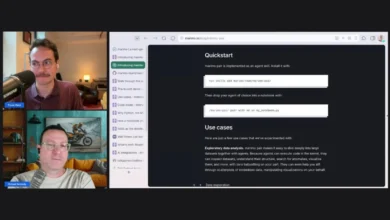
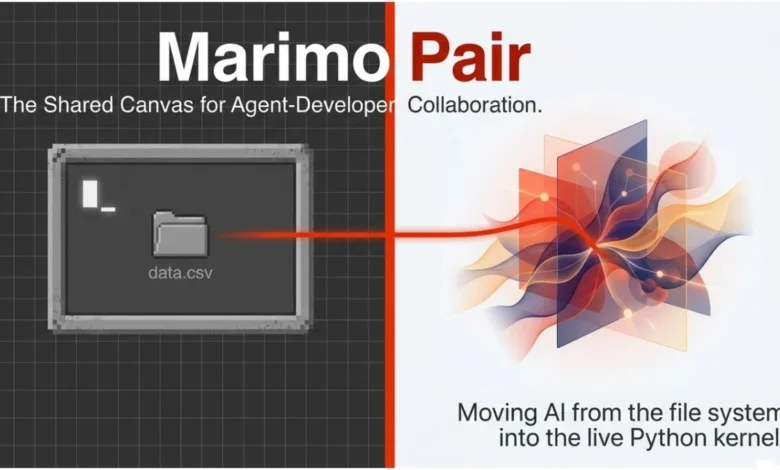
This paradigm shifted significantly during episode 555 of the Talk Python To Me podcast, recorded on June 30, 2026, where host Michael Kennedy welcomed back Trevor Manz to discuss the launch of Marimo Pair. This innovative tool effectively dismantles the long-standing wall between static code repositories and live notebook execution. By integrating an intelligent coding agent directly inside a running Marimo reactive notebook, Marimo Pair grants the agent full, unhindered access to every variable, data frame, and object that the Python runtime holds in memory. The computational notebook instantly transforms into a shared collaborative canvas where users can point to specific elements, direct the agent to execute code dynamically, and watch visual representations update in real time without the need to configure complex Model Context Protocol (MCP) tools or manually describe rigid database and data schemas.
The Architectural Limitations of Traditional Notebooks for AI
To understand the magnitude of this advancement, one must examine why traditional computational notebooks, such as standard Jupyter implementations, have historically presented immense challenges for artificial intelligence integration. In a conventional Jupyter workflow, notebooks are saved as .ipynb files structured in JSON format. Crucially, these files contain not only the Python source code and markdown cells but also the complete execution outputs, ranging from simple text logs to massive embedded datasets and high-resolution base64-encoded charts.
When a standard coding agent—such as Claude Code, Codex, or various open-source alternatives—attempts to parse a traditional notebook, it must ingest this sprawling JSON structure. The agent is forced to sift through thousands of lines of irrelevant historical output, stale execution logs, and out-of-order state definitions. Furthermore, traditional notebooks suffer from hidden state anomalies, where cells can be executed out of sequence, rendering the stored outputs fundamentally stale and untrustworthy. For an artificial intelligence agent trying to reason about a codebase, these file-based limitations introduce severe cognitive overhead, token inefficiency, and a high probability of compounding errors.
Marimo was engineered from the ground up to solve these exact structural flaws in the Python data ecosystem. Unlike traditional notebooks, Marimo operates as a reactive Python notebook where the execution order is determined entirely by data flow and variable dependencies rather than the physical placement of cells on the screen. Marimo files are stored as clean, standard .py Python scripts rather than proprietary JSON artifacts. This hyper-focus on the native Python ecosystem established a robust foundation, making the eventual integration of state-aware coding agents a natural evolutionary step.
Introducing Marimo Pair and Code Mode Architecture
Marimo Pair introduces a streamlined approach to agentic data workflows by embedding an agent directly into an active Marimo kernel through a specialized agent skill and a semi-private internal API known as "Code Mode." Rather than treating the notebook as a static text file on disk, Marimo Pair equips the coding agent with a powerful, singular capability: the ability to execute arbitrary Python code directly within the running kernel environment.
Through Code Mode, the connected agent gains instantaneous visibility into the live notebook session. It can query the kernel to list active variables, inspect cell declarations, check data types and schemas, and examine live metrics without cluttering its context window with gigabytes of raw historical JSON data. The agent can invoke mutation APIs to create new cells, modify existing logic, run execution cycles, and handle package installations on the fly.
Crucially, because Marimo Pair exposes Python as the primary interface rather than a restrictive JSON-based tool schema, agents can compose complex operations natively. An agent can loop through multiple cell creation requests, execute diagnostic queries against active Polars or Pandas data frames, and immediately ingest the resulting runtime feedback into its decision loop. This establishes a tight feedback cycle identical to the iterative, exploratory workflows that human data scientists have used for decades.
Distribution Models and Ecosystem Interoperability
The distribution model chosen for Marimo Pair reflects a modern philosophy of flexibility and developer-first tooling. Rather than forcing users into a proprietary chat interface or locking them into a single vendor’s ecosystem, the Marimo team packaged Marimo Pair as a portable agent skill distributed via standard markdown definitions.
Developers can easily install the Marimo Pair skill across a wide array of agent harnesses. For users of Claude Code, the skill is accessible directly from official marketplaces. For developers utilizing alternative environments or command-line toolchains, installation is supported via standard package runners such as npx skills add or through modern runtimes like Deno using uvx dino. This decoupled architecture ensures that as AI harnesses, model providers, and developer environments rapidly evolve, the core integration between Marimo and the underlying agent remains resilient and immune to out-of-sync versioning issues.
By supporting popular agentic ecosystems—including Claude Code, Codex, and OpenCode—Marimo Pair meets developers precisely where they already write code. Whether a developer is operating within a terminal-based CLI environment, utilizing Cursor, or working inside native integrated development environments like Visual Studio Code, Marimo Pair acts as a universal bridge to live computational state.
Transforming Exploratory Data Analysis and Human-AI Collaboration
The implications of Marimo Pair extend far beyond mere convenience; they fundamentally redefine how exploratory data analysis (EDA) and data-driven software engineering are conducted. In a traditional software engineering task, coding agents operate asynchronously—a developer scopes a feature, points an agent at a repository, and lets it run tests in a stateless manner. Data work, however, requires continuous visual and numerical validation.
With Marimo Pair, the agent acts as an authentic pair-programming partner. A data practitioner can ingest complex, messy datasets—such as multi-sheet Excel files or unstructured CSVs—and direct the agent to handle the tedious initial parsing, schema detection, and null-value auditing. Because the agent can inspect the live data frame in memory, it no longer has to guess about column types or dimensions.
Furthermore, when visual feedback is required, the agent can generate interactive charts and plots directly within the reactive Marimo canvas. If an anomaly appears in a visualization, the developer can highlight the specific section or point to the rendered graphic, allowing the multimodal agent to analyze the visual output alongside the underlying memory state. This eliminates the tedious friction of translating visual observations into textual descriptions, allowing data teams to reach insights with unprecedented speed.
Future Outlook and Broader Implications
As artificial intelligence coding agents continue to mature, the boundary between static application development and dynamic data science will continue to blur. Tools like Marimo Pair represent a vital step toward bridging this divide, proving that agents are most effective when given access not just to files on disk, but to the living, breathing runtime state of the applications they help build.
By prioritizing native Python integration, reactive data-flow guarantees, and universal agent compatibility, the Marimo team has established a powerful template for future developer tooling. As upcoming integrations bring deeper native support to IDE extensions and cloud-hosted GPU sandboxes like Molab, the ability to collaborate seamlessly with artificial intelligence inside a shared computational canvas will likely become an industry standard. For data scientists, engineers, and analysts alike, the era of flying blind with static notebook files has officially drawn to a close.