Marimo Pair Integrates AI Agents with Reactive Python Notebooks to Bridge Live Memory and Computational Workflows

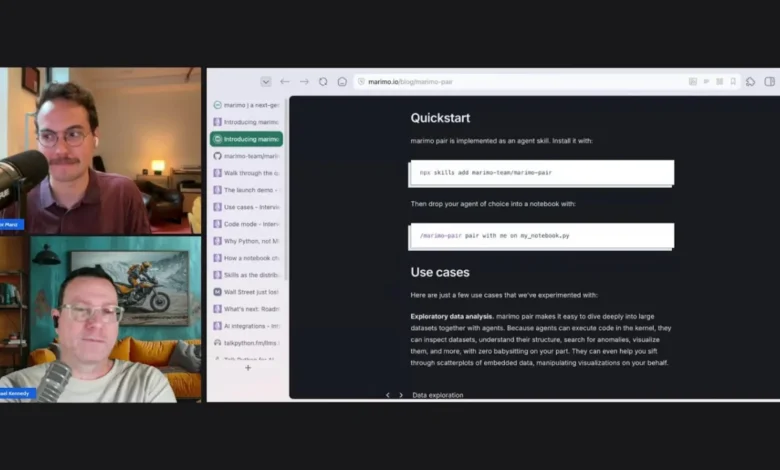
The landscape of artificial intelligence in software development has shifted from simple code completion to autonomous agentic workflows, yet a significant barrier has persisted between static code on disk and the dynamic state of data science. In a recent technical reveal, the team behind Marimo, a reactive Python notebook platform, introduced Marimo Pair. This new agent skill allows AI models to move beyond reading and writing flat files, granting them direct access to the live variables, data frames, and execution states held within a running Python kernel. By collapsing the wall between the agent and the runtime environment, Marimo Pair transforms the computational notebook into a shared canvas where humans and AI can interact with data in real time.
The Technological Gap in Data Science Automation
For several years, coding agents have demonstrated high proficiency in traditional software engineering tasks. These workflows typically involve scoping a feature, editing source files, running tests, and deploying code—all of which occur on the file system. However, data science and exploratory data analysis (EDA) operate under a different set of heuristics. In a data-centric environment, the practitioner loads a dataset, inspects its distributions, runs a specific cell, observes the response, and determines the next logical step based on the state currently held in the computer’s RAM.
Until the release of Marimo Pair, most AI agents were "blind" to this live state. While an agent could read a script that loads a CSV file, it could not "see" the resulting data frame unless the user manually copied the output into the chat window. This lack of situational awareness often led to hallucinations, where agents suggested operations on columns that did not exist or failed to account for data cleaning steps performed in memory but not yet committed to a script. Marimo Pair addresses this by dropping the agent directly into the active Marimo kernel, providing a bridge between the model’s reasoning capabilities and the live Python environment.
The Evolution of Computational Notebooks: From Jupyter to Marimo
To understand the impact of Marimo Pair, it is necessary to examine the evolution of the environment it inhabits. For over a decade, the Jupyter Notebook has been the industry standard for interactive computing. However, Jupyter notebooks are notorious for "hidden state" issues, where cells can be run out of order, leading to a kernel state that does not match the code visible on the screen. This inconsistency is a primary hurdle for AI agents, which struggle to navigate the non-linear history of a standard notebook session.
Marimo, a reactive alternative to Jupyter, was designed to solve this by treating the notebook as a directed acyclic graph (DAG). In Marimo, if a variable is updated in one cell, all descendant cells that rely on that variable are automatically re-executed. This ensures that the code on the screen always reflects the state in memory. For an AI agent, this deterministic environment provides a "single source of truth." When an agent using Marimo Pair interacts with the notebook, it does so within a framework that guarantees reproducibility, a feature that Trevor Manz, a lead developer at Marimo, describes as essential for effective human-AI collaboration.
Technical Architecture of the Marimo Pair Skill
Marimo Pair is distributed as an "agent skill," a standardized package of instructions that teaches a model how to use specific tools. In this case, the skill is defined by a skill.md file that can be integrated into popular agent harnesses such as Claude Code, Codex, and OpenCode. Unlike traditional integrations that require complex Model Context Protocol (MCP) wiring or rigid JSON schemas, Marimo Pair utilizes a semi-private "code mode" API within the Marimo environment.
The core of the interaction is a single tool call: execute_python. When the agent invokes this tool, it sends a string of Python code to the running Marimo kernel. Because the agent is operating within the same process as the user’s analysis, it can perform complex runtime inspections. For example, instead of guessing the schema of a dataset, the agent can run df.info() or df.describe() and use the actual results to inform its next code block.
Furthermore, Marimo Pair enables the agent to drive the UI. It can create new cells, edit existing ones, and even trigger "toast" notifications to alert the user of its progress. This creates a multimodal feedback loop. If a user makes a selection on an interactive plot in the Marimo UI, the agent can detect that change in the index and provide an immediate summary of the selected data points.
Chronology of the Agentic Shift
The development of Marimo Pair occurs during a period of intense competition in the AI tooling market, often referred to in developer circles as the "SaaSpocalypse." This era was catalyzed in late 2024 and early 2025 by the release of high-performance coding models like Anthropic’s Claude 3.5 Sonnet and the subsequent launch of agentic interfaces like Claude Code.
- Mid-2024: Traditional "autocomplete" AI (like early GitHub Copilot) began losing ground to "agentic" tools that could execute terminal commands and manage entire file structures.
- December 2024: The Marimo team began observing a shift in user behavior, with developers asking for ways to use Claude Code and Cursor to drive reactive notebooks.
- Early 2025: The "Skill" specification gained traction, allowing developers to package complex toolsets for agents without needing to rebuild the underlying LLM.
- June 2025: Marimo Pair is officially introduced, providing the first deep integration between agentic CLIs and reactive notebook kernels.
Supporting data from industry newsletters, such as The Pragmatic Engineer, indicates that Claude Code has rapidly become the preferred tool for software engineers, followed by Cursor and GitHub Copilot. By positioning Marimo Pair as a skill that works across these platforms, Marimo has avoided the "platform lock-in" that often plagues new developer tools.
Token Economics and Operational Efficiency
One of the most significant advantages of the Marimo Pair approach is the optimization of "token economics." In the context of LLMs, a "token" is a unit of text, and every interaction has a cost and a limit (the context window). When an agent attempts to understand a data project by reading files from a disk, it must often ingest thousands of lines of raw data or metadata to orient itself. This consumes the context window and increases the likelihood of the model losing track of the primary objective.
Marimo Pair allows the agent to offload this context to the Python kernel. Instead of the agent "holding" the entire dataset in its memory, it simply knows that the dataset is available in the kernel as variable df. The agent can then query specific information—such as the names of the columns or the mean of a specific series—returning only the necessary information to the LLM. This "lazy loading" of context makes the agent significantly more efficient and allows it to handle much larger datasets than would be possible through file-based reading alone.
Broad Impact on Data Science and Professional Workflows
The implications of Marimo Pair extend beyond simple convenience. For professional data scientists, it lowers the "activation energy" required for complex tasks. Trevor Manz highlights a use case involving legacy data formats, such as Excel files with multiple nested tables. Traditionally, a developer would spend an hour writing a bespoke parser using libraries like openpyxl or pandas. With Marimo Pair, a user can simply drag the file into the notebook and instruct the agent to "load these three tables and create a pair plot of the quantitative variables." The agent performs the tedious API lookups and data mangling in seconds, allowing the human to focus on the high-level analysis.
For the broader industry, Marimo Pair represents a step toward "headless" data science. Users are now spinning up remote Marimo sessions on infrastructure like CoreWeave (via Marimo’s MoLab), connecting their local agent via a URL, and allowing the AI to build out entire reproducible analysis pipelines autonomously. This "headless" mode ensures that even if the agent is driving the process, the final result is a well-formed, reactive Python program that can be handed off to another human for verification.
Conclusion and Future Outlook
The launch of Marimo Pair marks a transition from AI as a spectator of code to AI as a participant in the live computational state. By leveraging the reactive nature of the Marimo platform, the tool provides a level of safety and reliability that is missing from traditional notebook integrations.
Looking forward, the Marimo team has indicated that the roadmap for Marimo Pair includes tighter integration with VS Code’s native notebook editor and expanded multimodal capabilities. As models become more adept at processing visual information, the expectation is that agents will soon be able to "watch" the plots they generate and self-correct their analysis based on visual anomalies. For now, Marimo Pair stands as a significant bridge, enabling a more fluid, state-aware collaboration between human intuition and machine intelligence in the data science domain.