Automating Amazon Redshift Patch Testing to Ensure Workload Stability and Performance Consistency

Amazon Web Services (AWS) has introduced a sophisticated, event-driven framework designed to automate the validation of Amazon Redshift clusters, addressing a critical need for enterprises to maintain high availability and performance standards amidst frequent cloud infrastructure updates. As Amazon Redshift continues to evolve with frequent patches and feature releases, the burden of ensuring that these updates do not disrupt production environments has become a primary concern for data engineers and system administrators. The new automated test suite provides a robust mechanism to verify cluster health, client tool compatibility, and query performance, effectively creating a "verified gate" that prevents untested changes from impacting mission-critical workloads.
The Strategic Context of Cloud Data Warehouse Maintenance
Amazon Redshift serves as a cornerstone for data-driven organizations, offering petabyte-scale data warehousing that supports complex analytical queries and business intelligence operations. However, the continuous delivery model of modern cloud services means that Amazon Redshift clusters are frequently updated with performance enhancements, security patches, and new features. While these updates are generally beneficial, they can occasionally introduce behavior changes—adjustments in how the database engine processes specific SQL commands or manages metadata—that may conflict with existing application logic or third-party client tools.
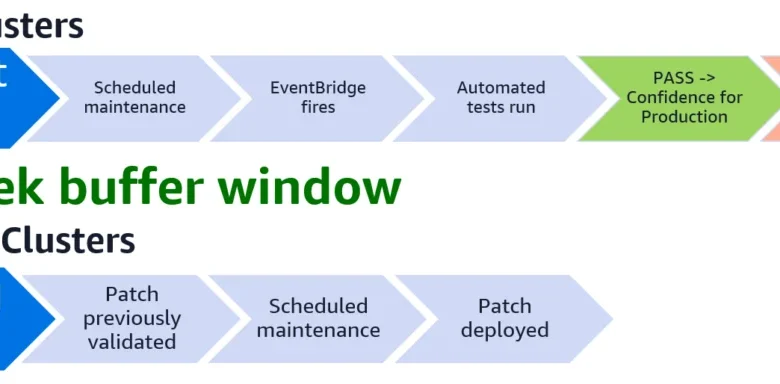
To mitigate the risk of service level agreement (SLA) violations, AWS has long advocated for a tiered patching strategy. Under this best practice, organizations maintain development and quality assurance (Dev/QA) clusters on the "Current" patch track, while production clusters remain on the "Trailing" track. This discrepancy creates a strategic buffer, typically lasting between one and six weeks, during which the Dev/QA environment receives the latest updates before they are deployed to production. The newly detailed automated suite is designed to maximize the utility of this window by providing rigorous, hands-off testing the moment a patch lands.
Architectural Overview of the Automated Validation Pipeline
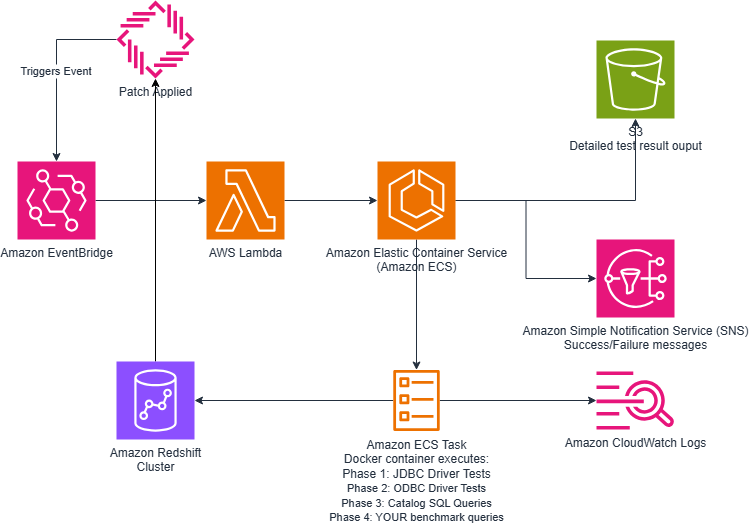
The solution leverages a serverless, event-driven architecture that integrates several native AWS services, including Amazon EventBridge, AWS Lambda, and AWS Fargate. The orchestration begins with Amazon EventBridge, which monitors the Redshift environment for specific events such as cluster reboots, modifications, or the application of a patch. Once an event is detected, EventBridge triggers an AWS Lambda function that serves as the pipeline’s orchestrator.
The Lambda function initiates an AWS Fargate task, which runs within a containerized environment. This Fargate task executes the core testing logic, utilizing standard JDBC and ODBC drivers to interact with the Redshift cluster. By using Fargate, the system ensures that the testing environment is ephemeral and scalable, consuming resources only when a test is actively running. Upon completion, the results are synthesized into a report and delivered via Amazon Simple Notification Service (SNS) to the relevant engineering teams, while a detailed log of the performance data is stored in an Amazon S3 bucket for historical analysis.
A Chronology of the Automated Testing Process
The lifecycle of a single validation run follows a precise four-stage sequence:
- Event Detection: The system remains dormant until Amazon EventBridge identifies a trigger event, such as an "AWS_RISK_NOTIF" or a "Redshift-Event-0002" (indicating a successful patch).
- Orchestration: The Lambda function retrieves cluster credentials from AWS Secrets Manager and configures the environment variables required for the Fargate task.
- Test Execution: The Fargate container executes a series of SQL queries designed to stress-test the cluster’s compatibility and speed.
- Reporting and Analysis: The system compares the results against a stored baseline. If anomalies are detected—such as a query taking significantly longer than its historical average—the system flags a regression and alerts the administrator.
For teams requiring immediate feedback, the architecture also supports manual invocation via the AWS Command Line Interface (CLI), allowing engineers to trigger the suite on-demand during maintenance windows.
Deep Dive: Client Compatibility and Metadata Integrity
A significant portion of the test suite is dedicated to client tool compatibility. In many enterprise environments, users connect to Redshift through various SQL clients such as DBeaver, SQL Workbench/J, or RStudio. These tools often rely on complex metadata API calls to enumerate schemas, tables, and columns. Even a minor change in how Redshift returns metadata can cause these tools to fail, leading to developer frustration and lost productivity.
The automated suite replicates the exact connection behavior of these popular tools. It executes specific queries that mimic the catalog traversal and object discovery processes used by JDBC and ODBC drivers. By testing getTables(), getColumns(), and getPrimaryKeys() equivalents, the suite ensures that the underlying database remains accessible to all end-user applications. This is particularly vital for organizations using custom views or complex schemas that might be sensitive to changes in the database catalog.
Performance Regression Detection and Benchmarking
Beyond mere connectivity, the suite addresses the more insidious issue of performance regression. A patch might not "break" a query in the sense of causing an error, but it could alter the query execution plan in a way that increases latency. In a high-concurrency production environment, a query that slows down from two seconds to fifteen seconds can cause a massive backlog, impacting downstream dashboards and reporting tools.
The benchmarking phase of the suite utilizes a "known good" state methodology. On its initial run, the suite captures baseline execution times for a set of performance-critical queries defined by the user. On all subsequent runs—following patches or reboots—the system compares current timings against this baseline. This data-driven approach allows organizations to quantify the impact of a patch with high precision. If the variance exceeds a predefined threshold, the system provides immediate notification, allowing the team to investigate or roll back changes before the patch hits the production cluster.
Operational Implications and DataOps Integration
The introduction of this automated framework represents a significant shift toward "DataOps"—the application of DevOps principles to data pipelines and infrastructure. By automating the validation process, organizations can reduce the manual effort required for regression testing by an estimated 70% to 90%, depending on the complexity of their workloads.
Furthermore, the solution addresses a common pain point in cloud management: the lack of visibility into "minor" infrastructure changes. By keeping AWS Secrets Manager and Amazon SNS traffic off the public internet through VPC endpoints, the architecture maintains a high security posture while ensuring that the testing process itself does not introduce new vulnerabilities.
Industry Impact and Future Outlook
Industry analysts suggest that as the volume of enterprise data grows, the cost of downtime or performance degradation becomes increasingly prohibitive. For a global enterprise, even an hour of reduced performance in a core data warehouse can result in thousands of dollars in lost productivity and delayed decision-making. The ability to proactively validate patches in a Dev/QA environment before they reach production is no longer a luxury but a requirement for modern data strategy.
Experts at AWS emphasize that this solution is not a static tool but a customizable framework. Organizations are encouraged to "clone and customize" the repository, adding their own performance-critical queries and specific client catalog checks. This flexibility ensures that the testing suite evolves alongside the organization’s data architecture.
Conclusion: Strengthening the Data Value Chain
The automation of Amazon Redshift patch testing is a major step forward in infrastructure reliability. By bridging the gap between continuous cloud innovation and the need for enterprise stability, this suite allows organizations to embrace the latest database features with confidence. As organizations continue to migrate their most sensitive and demanding workloads to the cloud, tools that provide automated, event-driven validation will be essential in maintaining the integrity of the data value chain.
The full solution, including CloudFormation templates and Docker build scripts, is currently available through AWS’s official GitHub samples, providing a clear path for organizations to implement these best practices immediately. Through the combination of serverless orchestration and rigorous performance benchmarking, AWS is providing its customers with the tools necessary to ensure that their data platforms remain both cutting-edge and rock-solid.