Amazon SageMaker AI Expands Enterprise Generative AI Inference Capabilities With 13 Major 2026 Architectural Updates

The enterprise deployment of generative artificial intelligence has long been stymied by a fundamental infrastructure paradox: while foundational models grow increasingly massive—spanning tens to hundreds of gigabytes—the operational constraints governing their real-time deployment have become radically intolerant of delay. Latency requirements are no longer evaluated in seconds, but in tokens per second. Cold-start sequences regularly stretch past the multi-minute mark as bulky containers and parameter weights traverse network boundaries. Simultaneously, global graphics processing unit (GPU) capacity remains heavily constrained, and legacy monitoring suites fail to capture the granular, token-level telemetry necessary to maintain production stability.
In response to these industry-wide bottlenecks, Amazon Web Services (AWS) has rolled out a comprehensive suite of 13 major feature additions to Amazon SageMaker AI. Deployed across the platform’s dual operational pathways—fully managed endpoints and Kubernetes-native Amazon SageMaker HyperPod Inference—these updates seek to re-engineer how startups, enterprises, and public sector organizations scale instance-based model consumption. By decoupling the economics of AI deployment from token-consumption billing models and tying them instead to underlying instance utilization, AWS aims to provide predictable cost structures alongside high-throughput performance.
Architectural Divergence: Managed Endpoints Versus HyperPod Inference
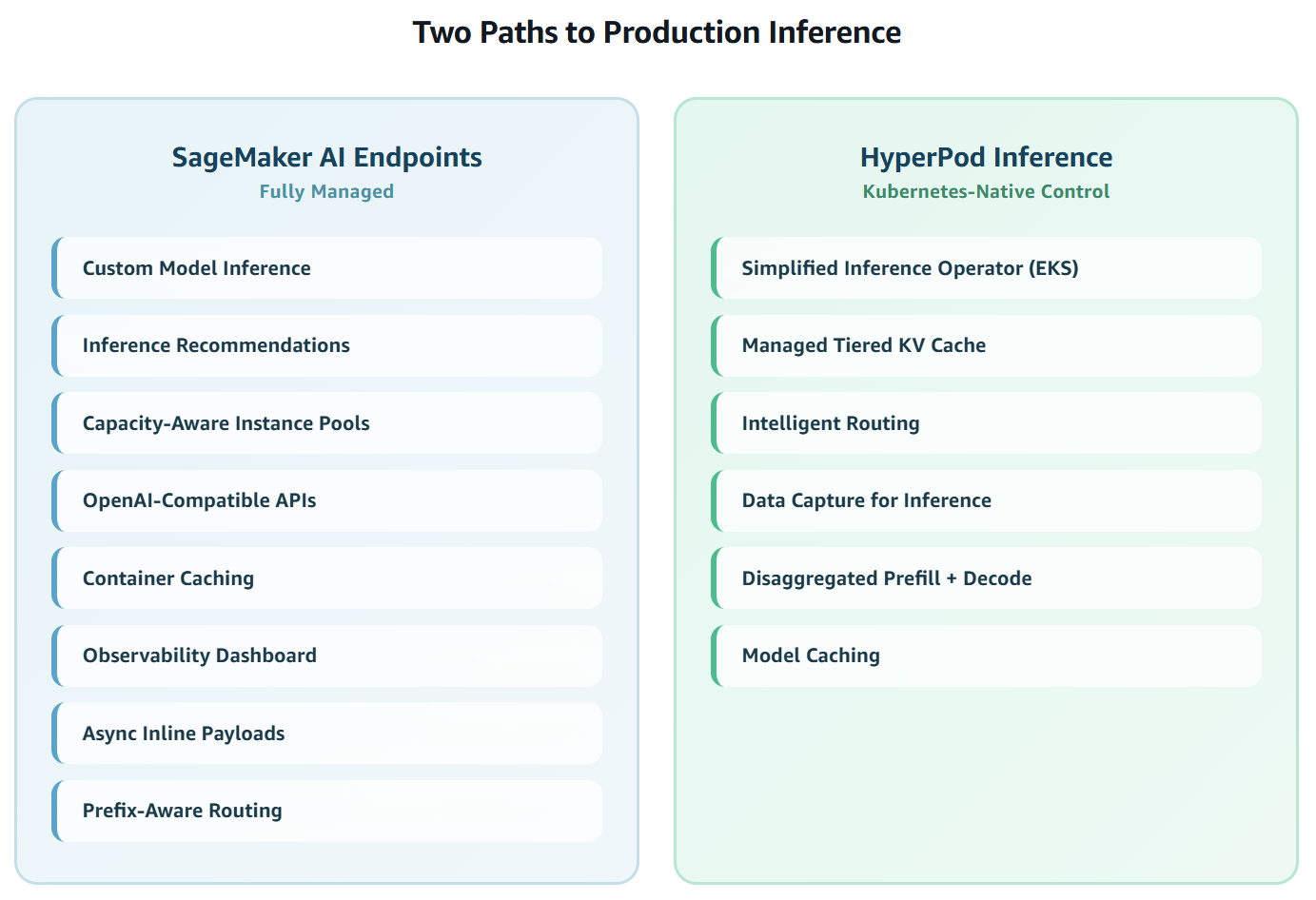
Modern AI workloads demand disparate operational philosophies depending on an organization’s internal engineering maturity. To accommodate this, SageMaker AI maintains two distinct deployment paths, each tailored to specific operational requirements.
Managed SageMaker endpoints are engineered for product teams seeking to minimize operational overhead. In this paradigm, AWS absorbs the complexities of GPU provisioning, horizontal auto-scaling, and foundational infrastructure monitoring. Organizations simply supply their model artifact and a designated performance objective, allowing the platform to manage the underlying mechanics.
Conversely, Amazon SageMaker HyperPod Inference is architected for enterprises and deep-tech startups requiring granular, Kubernetes-native control over dedicated GPU clusters. Operating via the Amazon Elastic Kubernetes Service (EKS), HyperPod bridges the gap between large-scale cluster training and production inference serving. It offers deep stack customizability, giving platform engineers node-level access, custom Amazon Machine Images (AMIs), and multi-cloud or hybrid-cloud deployment flexibility.
| Dimension | Managed Endpoints | HyperPod Inference |
|---|---|---|
| Infrastructure Management | Fully managed by AWS | Managed Kubernetes stack (EKS) |
| Deployment Interface | AWS Console, SDK, CLI | kubectl, Terraform, Console, CLI, SDK |
| Scaling Mechanisms | Managed auto scaling via Amazon CloudWatch | Auto scaling via Karpenter, KEDA, CloudWatch |
| Layer Customization | Container and model layers | Node-level access, custom frameworks, and AMIs |
| API Protocols | OpenAI-compatible native endpoint | HTTP, gRPC, custom load balancer integrations |
| Primary Use Case | Rapid deployment with minimal operational friction | Kubernetes-based, train-to-serve hybrid environments |
Streamlining Managed Endpoints: From Conception to Production
The first half of 2026 introduced seven distinct enhancements to SageMaker AI managed endpoints, targeting the friction points of benchmarking, capacity provisioning, protocol compatibility, scaling latency, observability, and asynchronous payload management.
Automated Inference Recommendations and Benchmarking
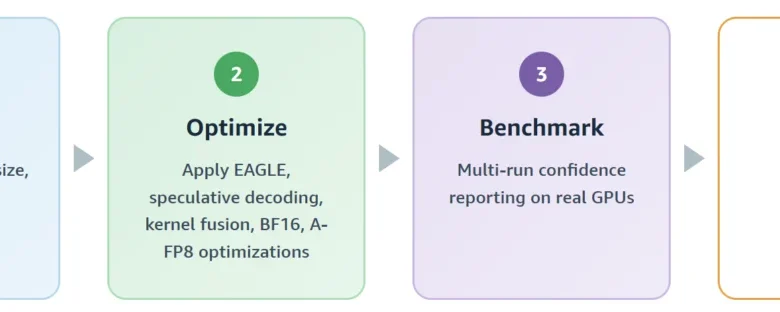
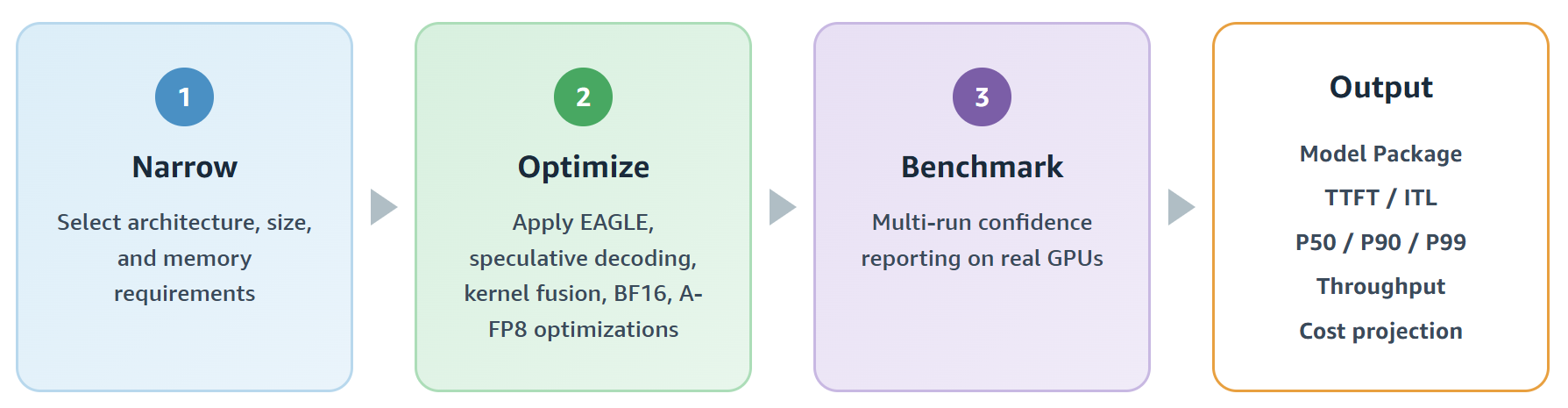
Historically, configuring a newly acquired open-weights or proprietary model required two to three weeks of manual experimentation across more than a thousand potential hardware, container, and optimization permutations. In April 2026, SageMaker introduced automated inference recommendations.
By defining a target model and core performance metric—such as cost minimization, latency reduction, or throughput maximization—engineers trigger an automated three-stage evaluation pipeline. The system narrows feasible instance choices, applies optimal compilation techniques, and runs rigorous empirical benchmarking. The output is a deployable Model Package containing validated performance indicators, including time to first token (TTFT), inter-token latency (ITL), P50, P90, and P99 latency percentiles, alongside direct cost projections. Benchmarks on a 20-billion parameter open-weights model demonstrated a twofold increase in tokens per second without increasing request latency.
Capacity-Aware Instance Pools and Fallback Logic
A persistent vulnerability in automated scaling architectures has been the hard dependency on a single designated instance type. When sudden demand spikes coincided with regional GPU shortages, endpoints would experience catastrophic failure before serving a single request.
Deployed in May 2026, capacity-aware instance pools eradicate this single point of failure. Organizations can configure a prioritized hierarchy of up to five distinct instance types. During initial provisioning, scale-out events, or fleet contraction, SageMaker systematically iterates through the preference list. If primary hardware capacity is constrained, the endpoint seamlessly falls back to alternative hardware classes, dynamically applying hardware-specific optimizations such as speculative decoding or quantization on the fly.
OpenAI-Compatible API Integration
The friction of migrating existing applications built around the OpenAI ecosystem to custom-hosted infrastructure has long represented a significant engineering tax. May 2026 saw the introduction of native OpenAI-compatible API support on SageMaker endpoints.
By exposing an /openai/v1 path complete with streaming chat completions, SageMaker allows engineering teams to migrate production applications simply by altering the endpoint URL. All underlying SDK calls, prompt schemas, and response handling logic remain untouched. Authentication is handled via standard bearer tokens derived from native AWS credentials, bypassing the complexity of SigV4 request signing and lowering the barrier for agentic workloads running on dedicated enterprise GPUs.
Container Caching and Accelerated Cold Starts
Scaling events previously suffered from substantial latency penalties as newly spawned instances were forced to pull multi-gigabyte container images from the Amazon Elastic Container Registry (ECR) in real time. For large serving containers exceeding 10 gigabytes, this added minutes of dead time to scale-out operations.
Container caching, launched in June 2026, pre-pulls container images onto target nodes automatically. Operating with zero required configuration, the feature halves end-to-end startup latency. Benchmarks using an 8-billion parameter model on a standard GPU instance demonstrated a reduction in startup time from 525 seconds to 258 seconds—a 51 percent acceleration.
Advanced Observability and Token-Level Telemetry
Traditional cloud monitoring tools capture basic infrastructure health metrics such as CPU and memory utilization, but remain blind to the application-specific indicators that dictate generative AI performance.
To bridge this visibility gap, SageMaker introduced native OpenTelemetry metrics paired with a pre-configured Amazon CloudWatch Insights dashboard. The system automatically surfaces over 100 granular metrics—including KV cache pressure, GPU memory fragmentation, and token generation velocities—within two minutes of an endpoint entering service. Furthermore, a PromQL-compatible endpoint enables direct integration with managed Grafana dashboards via secure AWS authentication.
Asynchronous Payload Enhancements and Prefix-Aware Routing
Rounding out the managed endpoint updates, asynchronous inference capabilities were upgraded to support inline payloads up to 128,000 bytes directly within the InvokeEndpointAsync API, eliminating the previous requirement to pre-stage JSON prompts in Amazon S3.
Simultaneously, the introduction of prefix-aware routing fundamentally transformed multi-turn conversational and retrieval-augmented generation (RAG) workloads. By utilizing the initial tokens of a prompt as a deterministic fingerprint, the routing engine directs requests sharing common system instructions or document context to the same underlying GPU instance. This maximizes key-value (KV) cache reuse, dropping P50 time-to-first-token latency by up to 77 percent on long-context benchmarks while minimizing redundant GPU compute cycles.
HyperPod Inference: Bringing Cluster Control to Kubernetes
For organizations with specialized infrastructure teams requiring direct oversight of their compute clusters, Amazon SageMaker HyperPod Inference received six major updates through mid-2026, bridging the operational gap between large-scale model training and production serving.
The Simplified Inference Operator on EKS
Deploying complex large language models on Kubernetes has traditionally required the meticulous authoring of disparate resource manifests, including deployments, services, horizontal pod autoscalers, and custom health checks.
The Simplified Inference Operator, released in April 2026, abstracts this operational complexity into a native EKS add-on. Platform engineers can deploy and manage complex serving stacks by submitting a single Custom Resource Definition (CRD), unifying lifecycle management across diverse model families.
Disaggregated Prefill and Decode Architecture
Under traditional unified serving architectures, the computational phases of prompt processing (prefill) and token generation (decode) compete for the same GPU resources. Consequently, a massive, complex prompt submitted by a single user can block token generation for all other concurrent users sharing that hardware instance.
Deployed in July 2026 via Inference Operator v3.2, Disaggregated Prefill and Decode (DPD) physically separates these two phases onto distinct, independently scalable GPU pools. When a request arrives, prefill GPUs process the prompt context. The resulting KV cache is then transferred instantaneously to the decode pool via Elastic Fabric Adapter (EFA) utilizing GPU-Direct RDMA, bypassing the host CPU entirely. This architecture ensures that incoming heavy prompts never disrupt ongoing token generation for active users, yielding highly predictable latency distributions at scale.
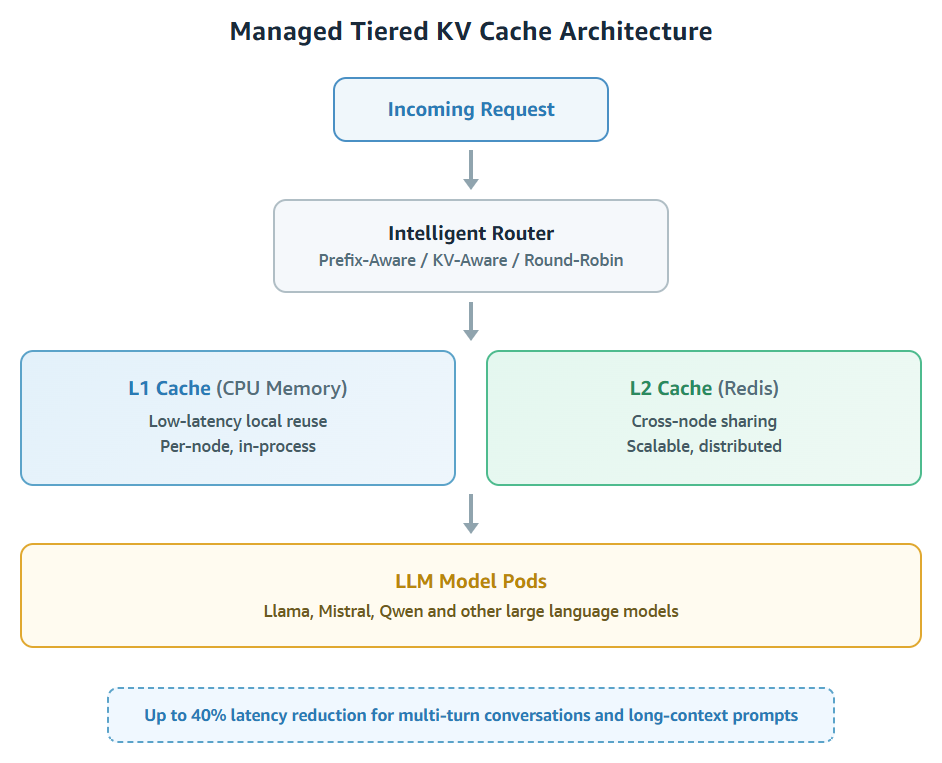
Managed Tiered KV Caching, Data Capture, and Model Caching
To further suppress compute overhead, HyperPod introduced a managed two-tier KV cache architecture. An L1 tier leverages node-local CPU memory for rapid low-latency retrieval, while an L2 tier utilizes Redis to facilitate cross-node cache sharing across the broader cluster fleet.
Complementing this, new data capture capabilities allow regulated enterprises to automatically stream tamper-evident inference logs from the application boundary, load balancer, and container layers directly to Amazon S3 without custom sidecar instrumentation. Finally, HyperPod model caching pre-downloads model weights onto node-local NVMe storage, achieving local read speeds of approximately 7 gigabytes per second and neutralizing cold-start penalties during rapid cluster auto-scaling events.
Market Implications and Strategic Outlook
Industry analysts note that as foundational model commoditization accelerates, enterprise differentiation is shifting rapidly from model selection to operational execution efficiency. By integrating 13 distinct infrastructure advancements into a unified platform throughout 2026, AWS has positioned SageMaker AI to capture complex enterprise workloads that require rigorous compliance, low latency, and predictable unit economics.
The introduction of these capabilities lowers the barrier to entry for organizations lacking dedicated AI infrastructure research teams. Through programs such as AWS Experience-Based Acceleration, enterprises and startups alike are increasingly equipped to deploy, monitor, and scale instance-based AI architectures with production-grade reliability. As AWS outlines its roadmap for the remainder of 2026 and beyond, continued investment in multi-region networking, hybrid-cloud federation, and advanced routing strategies suggests that the optimization of the generative AI inference stack will remain a primary battleground for cloud providers.