BMW Group Automates FinOps at Terabyte Scale by Processing 14,000 Cloud Accounts Daily for Fifty Dollars

Managing a sprawling multi-cloud estate spanning more than 14,000 accounts presents unprecedented operational hurdles for modern enterprises. For the BMW Group, maintaining visibility over this massive infrastructure required moving past traditional, reactive reporting tools. In collaboration with Reply, BMW developed Cloud Efficiency Analytics (CLEA), an in-house FinOps system built on Amazon Web Services (AWS) that successfully shifts cloud financial management from manual dashboard checks to automated, daily anomaly detection. By leveraging a serverless architecture orchestrated by AWS Step Functions and AWS Lambda, alongside forecasting capabilities powered by Meta’s open-source Prophet library, the automotive giant processes billions of billing rows daily with remarkable cost-efficiency.
The Evolution from Passive Dashboards to Proactive FinOps
Historically, enterprise cloud financial management relied heavily on static reporting. CLEA initially began as a series of Amazon QuickSight dashboards designed to grant internal BMW employees visibility into their respective cloud expenditures. However, leadership recognized a fundamental limitation inherent to dashboards: they only display past events, and they require someone to actively open them to glean insights.
In a massive enterprise cloud footprint, waiting for an employee to notice an unexpected financial spike on a monthly or weekly report often results in runaway costs that are difficult to mitigate after the fact. To bridge this critical visibility gap, BMW and Data Reply engineers reimagined CLEA. The system was transformed into an automated engine that executes daily anomaly detection algorithms. Instead of waiting for human intervention, the system analyzes yesterday’s billing data and proactively dispatches targeted email alerts directly to account owners when expenditures diverge significantly from established historical patterns.
Architecture of a Terabyte-Scale Pipeline
The scale of BMW Group’s cloud environment is staggering. Processing billing data requires ingesting information from AWS Cost and Usage Reports (CUR), alongside equivalent billing exports from other cloud providers within the corporate ecosystem. Raw data volumes regularly touch approximately 3 billion rows across 500 columns every single month.
To make sense of this massive influx of information, CLEA aggregates the raw data into a consistent, unified grain: daily cost per account per service. Because data arrives with a standard one-day lag (T-1), yesterday’s financial footprint is systematically analyzed and evaluated on the current day. The data transformation pipeline is deliberately scheduled to execute only after AWS CUR delivery is formally confirmed as complete, thereby preventing discrepancies caused by partial-day data processing.
To handle computational workloads efficiently without maintaining idle infrastructure, the engineering team adopted a fully serverless paradigm. AWS Step Functions orchestrates the daily workflow operating in Distributed Map mode with a concurrency cap of 500. A preparation Lambda function dynamically discovers active accounts, writing the list to Amazon S3 as JSON. Subsequently, the workload is fanned out across concurrent Lambda functions, enabling the system to evaluate hundreds of thousands of account-service combinations—spanning services like Amazon EC2, Amazon S3, AWS Lambda, and Amazon RDS—in roughly 20 minutes. Remarkably, the total compute cost for processing all 14,000 accounts hovers around $50 per month, translating to less than half a cent per account monthly.
Forecasting Baselines and Algorithmic Precision
At the heart of CLEA’s detection engine is a robust predictive modeling framework built around Prophet, Meta’s open-source forecasting library. Selected for its reliability and consistent performance with cost time series data, the Prophet model trains continuously on 365 days of historical daily costs for every unique account-service pair, incorporating additive seasonality.
The forecasting engine generates two primary outputs: a 12-month rolling forecast and per-day predicted values that serve as the expected cost baseline. Crucially, the forecasting layer is treated as a modular, pluggable component. By strictly standardizing inputs and outputs, the engineering team ensures that the core forecasting algorithm can be swapped out in the future without disrupting downstream detection and alerting layers that internal teams rely upon.
Establishing effective baselines in an enterprise of this magnitude requires moving away from rigid, static rules. Setting a flat financial threshold—such as alerting whenever daily spending exceeds a specific dollar amount—fails in dynamic environments where accounts organically grow, adopt new services, and scale workloads intentionally. A threshold high enough to prevent false alarms on massive production accounts would leave smaller accounts completely unmonitored. By deploying a model that learns the specific trajectory of each account-service pair, CLEA compares actual spending against what that specific pair has historically demonstrated.
Filtering Noise and Mitigating False Positives
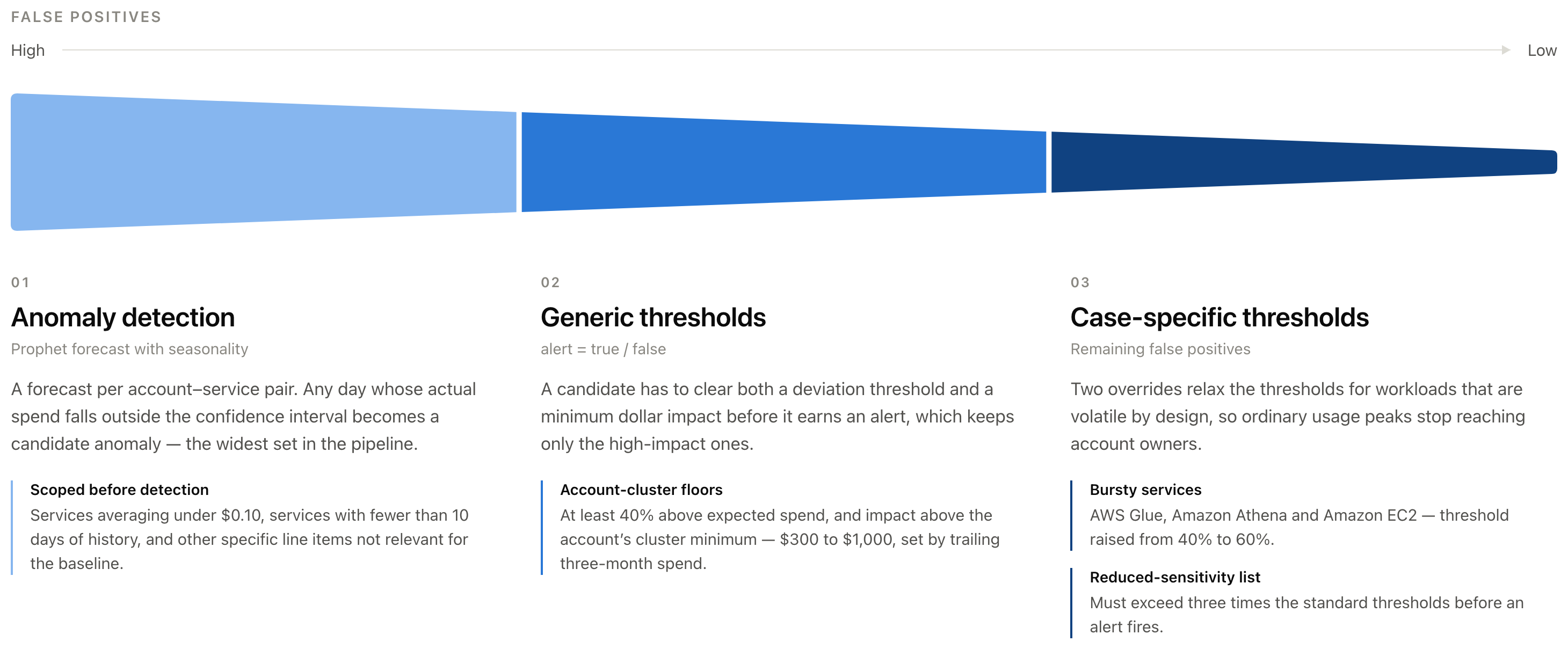
Even with sophisticated forecasting models, raw detections frequently generate noise. To ensure that account owners receive only actionable insights, CLEA applies a rigorous, multi-layered filtering framework designed to separate genuine anomalies from routine operational fluctuations.
The reduction process begins by eliminating low-spend services—specifically those averaging under $10.10 over a three-day window—alongside services with fewer than ten days of history and non-relevant line items. Surviving candidates must clear a baseline deviation threshold of at least 40 percent above expected spend.
To account for organizational diversity, CLEA implements account-cluster filtering. Accounts are categorized into four distinct tiers based on their trailing three-month average spend, each paired with a mandatory minimum dollar impact required to trigger an alert:
- Cluster 1 (Less than $100k trailing spend): Minimum impact of $300
- Cluster 2 ($100k to $250k trailing spend): Minimum impact of $500
- Cluster 3 ($250k to $500k trailing spend): Minimum impact of $750
- Cluster 4 (More than $500k trailing spend): Minimum impact of $1,000
Furthermore, the system applies service-specific thresholds. Operationally volatile services known for legitimate cost spikes during heavy workloads—such as AWS Glue, Amazon Athena, and Amazon EC2—are subject to a higher 60 percent deviation threshold to minimize false positives. Account-specific overrides are also accommodated, allowing teams managing inherently volatile workloads to request reduced sensitivity settings that require triple the standard threshold before an alert is dispatched.
Streamlining Investigation and Root Cause Analysis
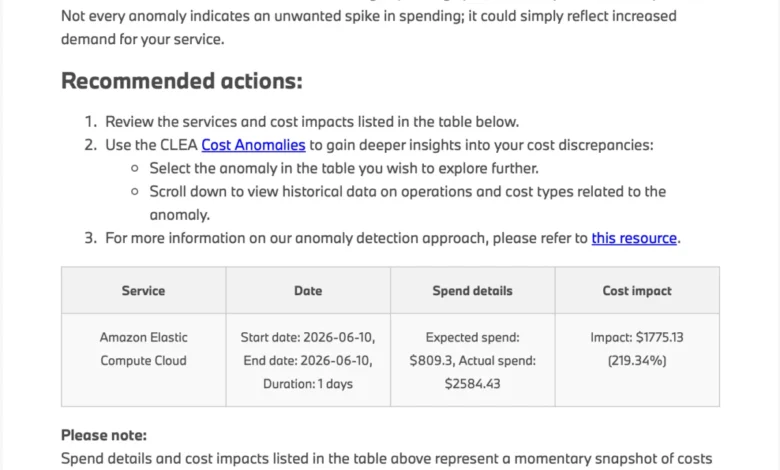
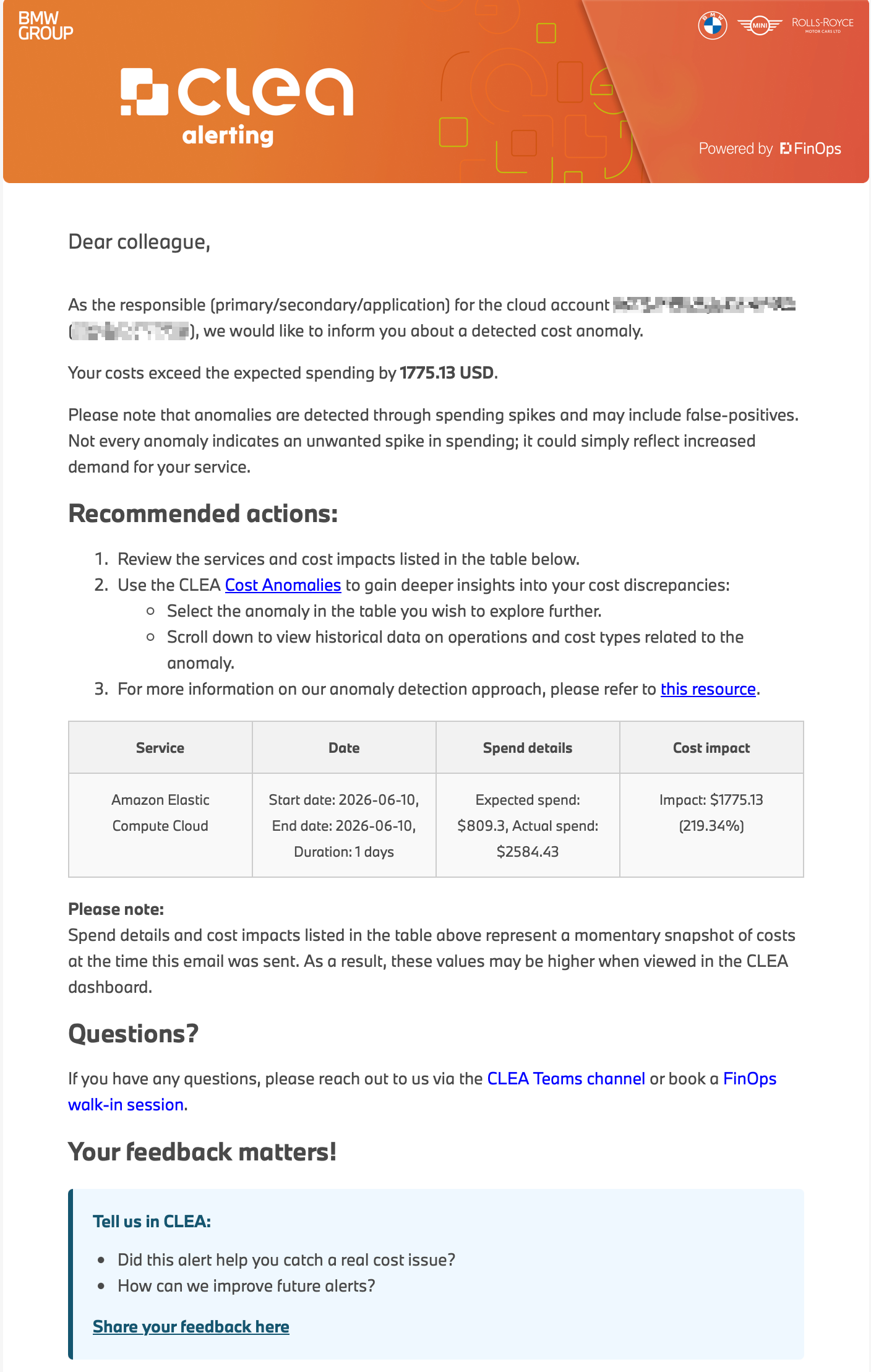
When an alert is triggered, account owners receive a comprehensive email notification complete with structured metadata, detailed financial breakdowns, and a convenient Excel attachment containing the full dataset. Crucially, BMW designed the system to empower self-service root cause analysis, preventing engineering bottlenecks from slowing down remediation.
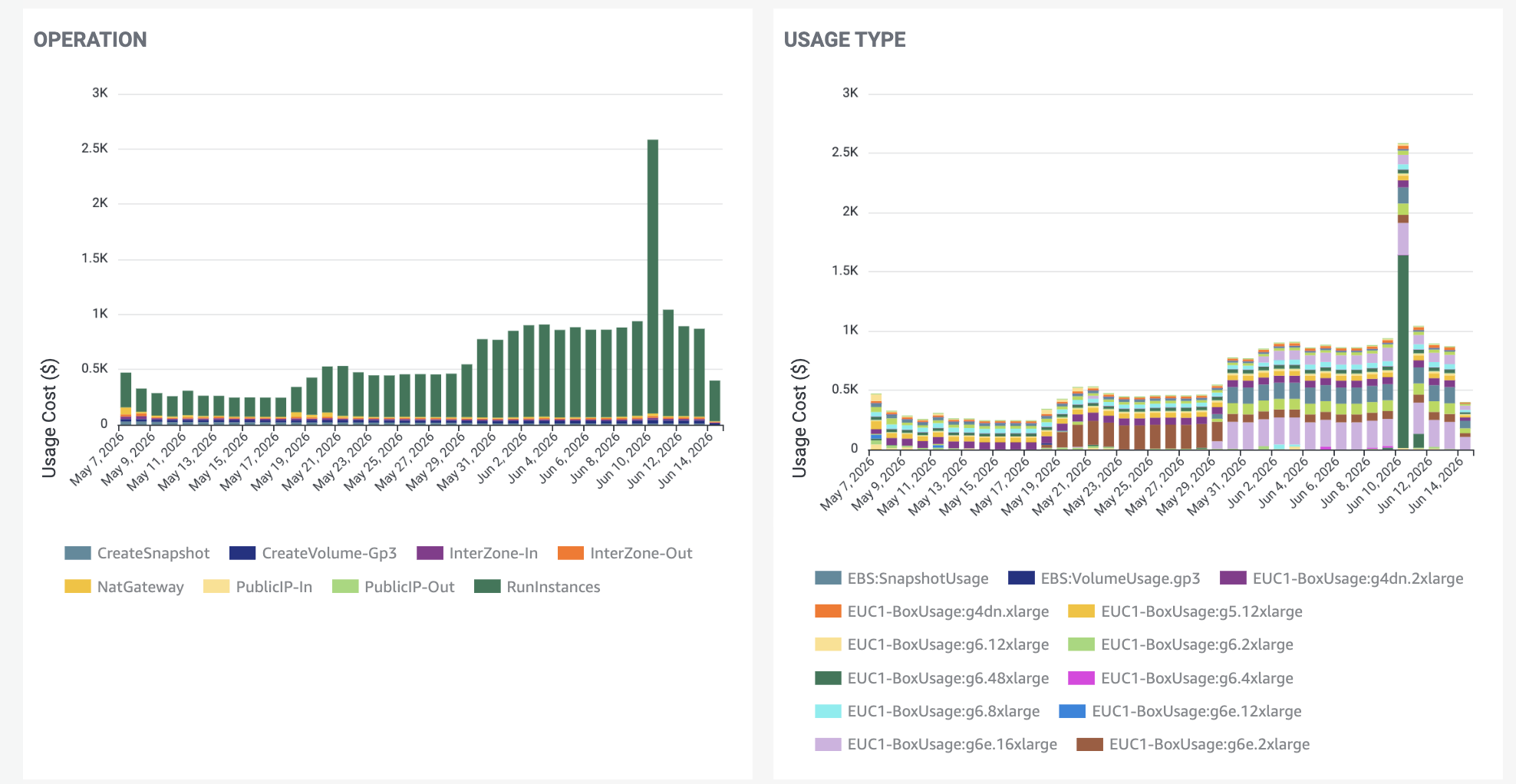
By leveraging an integrated anomaly dashboard built in Amazon QuickSight, account owners can instantly drill down into problematic accounts without involving the central platform team. Utilizing two primary visual dimensions—daily spend by operation and daily spend by usage type—engineers can rapidly isolate the root cause of a financial spike. For instance, analyzing a sudden cost surge typically reveals specific operations like RunInstances driving the anomaly, while usage-type breakdowns immediately pinpoint exact hardware configurations, such as specific GPU instance deployments, responsible for the variance.
Strategic Implications and Future Roadmap
The successful deployment of CLEA highlights a broader operational shift within modern enterprise IT: the democratization of financial accountability. By automating anomaly detection at scale, BMW Group has effectively bridged the traditional communication gap between centralized finance departments and decentralized engineering teams.
Industry analysts note that as multi-cloud environments grow increasingly complex, automated FinOps tools are transitioning from optional optimizations to core enterprise necessities. Systems that successfully combine machine learning forecasting with human feedback loops—such as CLEA’s user-driven calibration buttons embedded within alert emails—represent the gold standard in maintaining fiscal discipline without stifling engineering agility.
Looking ahead, BMW Group and Reply have outlined an ambitious roadmap for the CLEA platform. Planned enhancements include deep integration with existing IT Service Management (ITSM) workflows to deliver incident tickets directly into platforms engineers already monitor daily. Additionally, the team is developing a self-service recommendation portal that will empower account owners to customize their own alert sensitivity thresholds.
Long-term strategic initiatives involve constructing agentic AI endpoints designed to deliver automated root cause explanations paired with proactive remediation advice. Furthermore, upcoming integrations with AWS CloudTrail aim to tie cost anomalies directly to specific user identities and roles, adding granular configuration attribution to the cloud optimization lifecycle. Through continuous iteration and architectural modularity, BMW Group continues to redefine the boundaries of enterprise cloud efficiency.