Managing Large Consumer Groups in Amazon Managed Streaming for Apache Kafka Scaling Challenges and Solutions


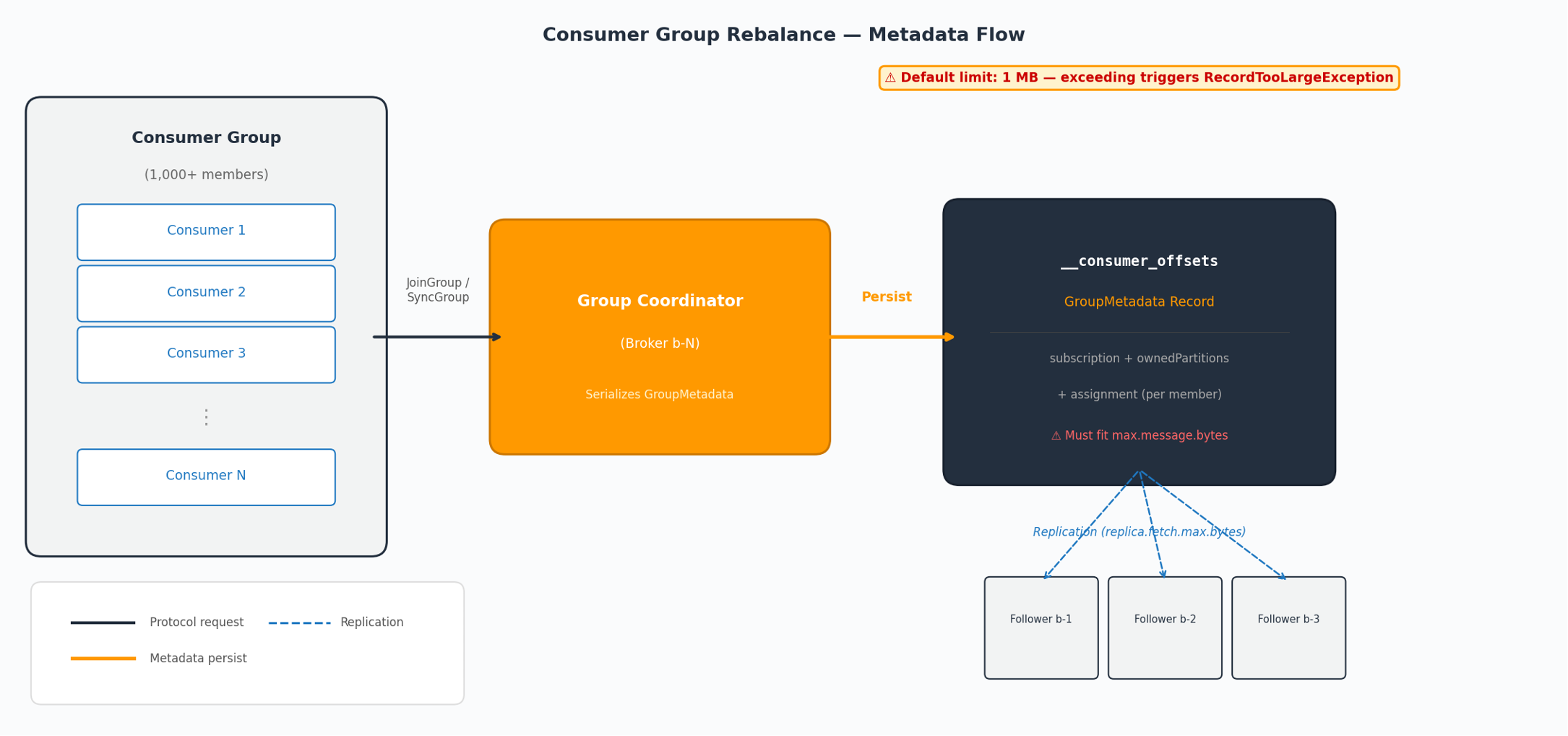
Scaling large consumer groups within Amazon Managed Streaming for Apache Kafka (Amazon MSK) has emerged as a significant architectural hurdle for enterprises managing high-throughput, distributed data streams. As organizations increasingly rely on Kafka to handle massive ingestion volumes, the metadata overhead associated with consumer group rebalances—the process by which Kafka redistributes partition assignments among active consumers—can trigger systemic instability. When the metadata payload for a consumer group exceeds the default 1 MB threshold for the internal __consumer_offsets topic, the system generates a RecordTooLargeException, effectively forcing the group into a perpetual rebalance retry loop that halts data processing.
This issue stems from the fundamental way Kafka manages state. During a rebalance, the Group Coordinator serializes a GroupMetadata record that encapsulates the subscription and assignment status of every member in a group. This record is then persisted to the __consumer_offsets topic and replicated across follower brokers. As the number of consumers grows, the serialized data—which redundantly includes topic names, member IDs, and partition assignments—inflates until it breaches the protocol’s constraints.
The Mechanics of Metadata Inflation
The growth of consumer group metadata is not merely a function of member count; it is a cumulative effect of naming conventions and subscription complexity. The current serialization format requires the broker to store topic names multiple times per member: once within the subscription list, once for owned partitions, and once for the active assignment. When factoring in the overhead of client IDs and approximately 200 bytes of fixed per-member metadata, the payload size scales linearly with the number of participants.
Industry data suggests that for a standard consumer group featuring 1,000 members, each utilizing a 50-byte topic name and a 40-byte client ID, the metadata record approaches 430 KB. As membership climbs to 1,500, the payload reaches roughly 645 KB. Once a group expands to 2,000 members or incorporates complex subscription patterns, the 1 MB limit is frequently exceeded. This creates a "glass ceiling" for developers who rely on auto-scaling mechanisms to handle traffic spikes, as the very act of scaling out can cause the metadata to grow too large, triggering a crash that prevents the cluster from stabilizing.

Remediation and Operational Adjustments
To address these constraints, architects must distinguish between immediate, reactive fixes and long-term, proactive design strategies. The most direct, albeit manual, remediation involves increasing the max.message.bytes limit on the __consumer_offsets topic. By adjusting this configuration, administrators can accommodate larger payloads. However, this is not a unilateral change; it requires a corresponding increase in the replica.fetch.max.bytes broker-level setting to ensure that follower brokers can successfully replicate the larger metadata records. Failure to align these two settings often leads to persistent UnderReplicatedPartitions warnings, which signal that the internal state is not being synchronized across the cluster, potentially risking data loss during a broker failure.
Beyond configuration adjustments, the industry standard for managing high-scale clusters is to move toward decentralized group management. Splitting large consumer groups into smaller, functional cohorts is an effective mitigation strategy. By partitioning the workload—assigning specific group.id labels to subsets of consumers—engineers can keep the metadata footprint of each group well within the default safe zones. While this introduces a layer of operational complexity, requiring teams to monitor multiple groups rather than one, it provides significantly higher reliability during peak loads.
The Role of Infrastructure Design and Capacity Planning
Capacity planning for Amazon MSK must evolve to account for these memory-intensive rebalance events. Larger metadata records place an increased burden on the broker’s heap memory. As records grow, the duration of garbage collection (GC) cycles can increase, potentially triggering session timeouts that result in further rebalances—a cascading failure scenario often observed in under-provisioned environments.
Engineers are advised to align instance types with anticipated group sizes. For groups with fewer than 500 members, standard configurations are generally sufficient. However, for groups exceeding 1,000 members, moving to kafka.m5.2xlarge instances is recommended to provide the necessary heap headroom. Furthermore, proactive monitoring via Amazon CloudWatch is essential. Specifically, tracking HeapMemoryAfterGC serves as a primary indicator of pressure; a sustained value exceeding 80% is typically a signal to initiate vertical scaling of the brokers or to initiate the splitting of the consumer groups.
A New Protocol Paradigm: The KIP-848 Transition
The most significant shift in the landscape of Kafka scaling is the industry-wide adoption of KIP-848, which arrived with the release of Apache Kafka 4.0 in March 2025. KIP-848 fundamentally alters the consumer rebalance protocol by moving the responsibility of partition assignment from the consumer group leader to the broker itself. This "server-side assignment" model eliminates the need for individual consumers to transmit their full subscription and assignment state back and forth during the rebalance handshake.
By centralizing the assignment logic, the metadata payload is drastically reduced. Because the broker now holds the source of truth for assignments, the "wire" overhead that previously contributed to the 1 MB limit is effectively mitigated. This transition is viewed by infrastructure experts as the definitive long-term solution to the RecordTooLargeException. For organizations currently operating on older versions of Kafka, the path forward involves a phased migration: updating cluster versions, testing the protocol shift in non-production environments, and gradually transitioning consumer clients to support the new rebalance mechanism.
Implications for Enterprise Architectures
The shift toward these more robust architectural patterns has profound implications for how organizations approach streaming data. In the early stages of the Kafka ecosystem, developers often treated consumer groups as monolithic entities. Today, the focus has shifted toward granular, elastic, and protocol-aware designs. The transition to KIP-848 and the emphasis on right-sizing partition counts demonstrate a broader trend: as streaming data becomes the backbone of real-time enterprise intelligence, the underlying infrastructure must move away from rigid, legacy limits toward more dynamic, broker-orchestrated models.
For teams currently struggling with the 1 MB metadata limit, the immediate advice from cloud architects is to verify that they are not over-partitioning their topics. Over-partitioning requires more consumers to parallelize the work, which inherently increases group membership and, by extension, metadata size. By aligning the number of partitions with the actual throughput requirements—rather than aiming for an arbitrary maximum—teams can reduce the membership pressure and maintain a more stable, performant streaming architecture.
Ultimately, the management of Amazon MSK consumer groups is a balancing act between operational simplicity and architectural foresight. While increasing max.message.bytes provides a necessary emergency valve for existing workloads, the long-term health of an enterprise streaming platform depends on adopting the modernized protocols of Kafka 4.0 and embracing the distributed, modular design patterns that have become the hallmark of scalable cloud-native data pipelines. By combining proactive monitoring of heap metrics, disciplined naming conventions, and the strategic adoption of KIP-848, organizations can continue to scale their streaming workloads without the constraints of legacy protocol limitations.