The Death Of The Button: Why The Future Of Web Design Is Intent-Driven And Interface-Free

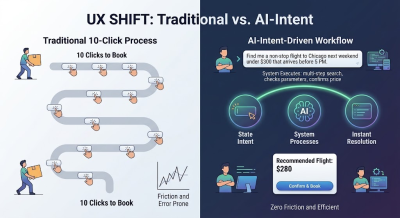
The modern digital landscape is undergoing a profound paradigm shift, moving rapidly away from traditional menus, multi-step forms, and endless clicking toward intuitive experiences shaped entirely around human intent. For decades, software and web design have relied on the point-and-click mechanics pioneered by the Xerox Star and popularised by the original Apple Macintosh. Today, however, advances in artificial intelligence and large language models are fueling a radical philosophy known as intent-driven design. Rather than forcing users to navigate complex visual hierarchies, labyrinthine sales funnels, and cookie pop-ups just to complete basic tasks, emerging platforms are designed to capture high-level human goals and execute the underlying labor silently in the background. This evolution challenges user experience (UX) professionals to fundamentally re-evaluate their roles, shifting their primary focus from designing static, visible interfaces to guiding transparent, intent-driven AI ecosystems.

The historical trajectory of digital interfaces helps contextualize the magnitude of this current transformation. Ever since graphical user interfaces (GUIs) replaced text-based command lines in the late 1970s and 1980s, software has operated as a passive container of data while the human user acted as the manual orchestrator. Booking a flight, purchasing retail goods, or researching health symptoms has historically required navigating dozens of browser tabs, adjusting range sliders, filling out multi-step forms, and managing repetitive software inputs. Digital interactions have long been measured by metrics such as time-on-page and click-through rates, inadvertently incentivizing interfaces that prioritize engagement volume over efficiency.
This model began facing severe philosophical challenges with the advent of human-centered design principles championed by pioneers like Don Norman and Golden Krishna. In his seminal work, The Best Interface Is No Interface, Krishna argued that the ultimate goal of modern technology should not be building prettier buttons or flashier animations, but rather eliminating the interface entirely whenever possible. Over the past several years, this theoretical ideal has transitioned into a commercial reality. The integration of large language models into everyday web platforms has accelerated the shift from command-based interaction to outcome-specification.
Examining current market trends reveals how major platforms are already replacing traditional buttons with intent-driven architectures. Perplexity AI, for instance, has redefined search behavior by moving away from the traditional "ten blue links" directory model established by search engines like Google. Instead of compelling users to open multiple tabs, skim long articles, and manually synthesize information, conversational search platforms process complex queries and deliver aggregated, context-aware answers instantly. Similarly, generative development tools like Vercel v0 allow creators to build functional user interfaces and SaaS dashboard prototypes simply by describing their requirements in natural language, bypassing the traditional need to manually draw rectangles, select hexadecimal color codes, or write custom CSS code in design software like Figma. Productivity applications such as Goblin.tools demonstrate how single-page AI suites can automatically break down overwhelming, multi-step tasks into structured, manageable checklists for neurodivergent users or busy professionals, eliminating the friction of manual project management.
To understand how these modern platforms function, industry analysts point to three core pillars that distinguish intent-driven web design from legacy UX approaches. The first pillar is high-level user input, which replaces micro-actions like dropdowns and toggles with natural language expressions of human goals, supported by ambient context and historical usage patterns. The second pillar is generative UI, a concept highlighted in recent analyses by the Nielsen Norman Group. Unlike traditional static layouts where every visitor encounters the exact same navigation bar and interface elements, generative UI constructs functional layouts dynamically on the fly based on the specific intent of the user in that exact moment. The third pillar is autonomous execution by AI agents. While legacy software relies on constant interruption—such as redundant confirmation pop-ups asking users if they are sure they want to delete a file—intent-driven interfaces prioritize frictionless rollback mechanisms. Drawing on Jakob Nielsen’s usability heuristics for error recovery, modern systems substitute intrusive warning modals with prominent "undo" buttons, simple revision prompts, and transparent audit logs.

Despite the liberating potential of removing interface friction, industry experts warn that stripping away visual controls introduces significant technical and ethical challenges. One major concern highlighted by researchers at the Stanford Human-Computer Interaction Group is the "illusion of control." When software makes automated decisions on behalf of a user based on inferred intent, the experience can quickly become invasive or patronizing if boundaries are not clearly defined. Ethical frameworks from organizations like the Center for Humane Technology emphasize that product designers must guard against manipulative defaults and ensure that high-stakes actions—such as financial transactions, public publishing, or privacy setting alterations—always require explicit human confirmation.
Another critical hurdle is the "black box problem." In a traditional user interface, encountering an unexpected result allows a user to easily diagnose the issue by inspecting filters, checkboxes, or date selections. In contrast, troubleshooting an intent-driven system is inherently more complex. To combat this opacity, guidelines from the Google PAIR (People + AI Research) initiative advocate for transparent feedback loops. Systems must explicitly state their interpretation of a user’s prompt—such as displaying the exact parameters being queried—allowing users to calibrate their trust and correct misinterpretations instantly.
The broader implications of this technological shift extend far beyond aesthetic redesigns; they fundamentally redefine how digital success is measured. For decades, the digital economy has prioritized metrics that encourage users to linger inside applications. The philosophy of intent-driven design turns these traditional business models on their head. The ultimate test of a modern digital product is no longer how visually captivating its interface is, but rather how effectively the software solves a problem and gets out of the user’s way.
As digital systems continue to evolve, UX designers are discovering that their expertise is more critical than ever, albeit applied in new domains. Rather than spending hours perfecting static button states or rigid form validation, modern designers must learn to map and present dynamic, generative UI components that adapt fluidly to changing human needs. By mastering emerging patterns such as ambient feedback, inline prompts, and transparent AI status indicators, creators can ensure that upcoming agent-driven tools remain intuitive, ethical, and deeply human-centered. Ultimately, the web is transitioning into an era where software applications will be valued not for the complexity of their interfaces, but for their ability to render those very interfaces obsolete, paving the way for a future defined by seamless, invisible completion.