The Rise of Privacy-First AI Browsing: Why Data Professionals are Shifting to Brave Leo

Data professionals operate in an environment defined by rapid information intake. The modern analytical workflow involves toggling between dense technical documentation, GitHub repositories, complex model architectures, and sensitive industry reports. As artificial intelligence has become a standard component of this stack, a critical tension has emerged between the utility of AI assistants and the security of proprietary information. While standard browser-integrated AI tools like Google’s Gemini or general-purpose chatbots provide significant productivity gains, they often operate on models that ingest user data for training or human review. For the data science community, this creates a hidden "privacy tax" that may be untenable when dealing with unreleased datasets or intellectual property.
The emergence of Brave Leo, a browser-native AI assistant, marks a significant shift in how privacy-conscious professionals manage their digital workspaces. Unlike traditional third-party extensions or cloud-based AI interfaces, Leo is architected to prioritize local security and ephemeral interaction. As of mid-2026, this technology has moved beyond niche adoption, becoming a standard consideration for researchers and engineers who require high-performance AI without compromising data sovereignty.
The Architectural Evolution of AI Assistants
The history of browser-based AI is relatively short but intense. In early 2023, the industry saw a surge in "chatbot-in-a-tab" applications. By late 2023 and throughout 2024, browser vendors moved to integrate these assistants directly into the Chromium or WebKit engines. However, the data handling protocols remained largely opaque to the average user.
Google’s Gemini, for instance, utilizes a model where conversations may be subject to human review unless users explicitly adjust privacy settings. Similarly, Perplexity AI, while highly effective for research, relies on cloud-based processing where queries and site content are routed to external servers. For a data scientist working on an internal company dashboard or an unreleased neural network architecture, sending that context to a third-party server creates a potential compliance and security vulnerability.
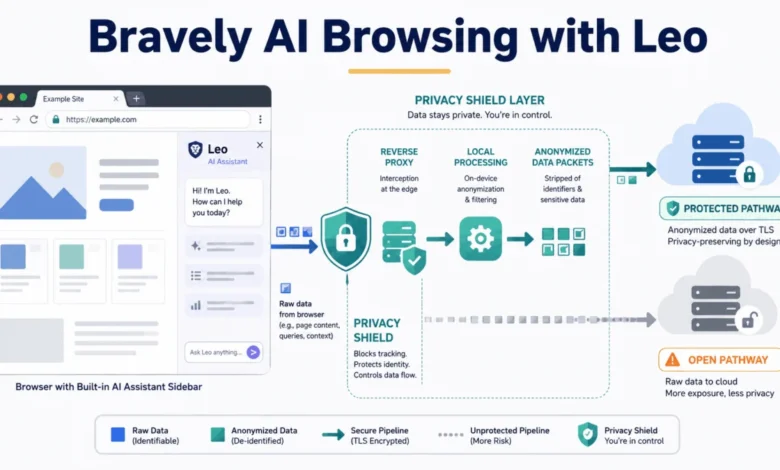
Brave Leo’s architecture addresses this by utilizing a reverse proxy that obscures the user’s IP address and discards conversation logs immediately after the session concludes. This design reflects the growing demand for "privacy-by-default" engineering, where user data is not merely protected by policy, but structurally prevented from being stored or used for model training.
Chronology of Privacy-Focused Browsing
- Q1 2023: The "AI Gold Rush" begins; browser extensions become the primary vehicle for AI interaction, leading to significant data security concerns.
- Q4 2023: Brave introduces Leo, positioning it as a sidebar-based, privacy-first alternative.
- December 2025: Brave introduces "Skills," allowing users to automate repetitive prompt chains, moving Leo from a simple chatbot to a functional workflow tool.
- April 2026: Launch of Brave Ocelot, a local-first summarization model that processes data entirely on the user’s device, eliminating the need for cloud communication.
- May 2026: Early access to Agentic Browsing features is released, enabling autonomous task completion within isolated browser profiles.
Data Security and Institutional Compliance
For professionals working under strict non-disclosure agreements (NDAs) or within sectors like finance, healthcare, and defense, the implications of these architectural choices are significant. A study conducted by industry analysts in early 2026 suggested that nearly 40% of data professionals had been instructed by their IT departments to disable cloud-based AI extensions due to concerns over data leakage.
Leo’s model avoids this by providing a "zero-knowledge" environment. Because no account is required for the free tier and no conversation history is stored by default, it effectively bypasses the common enterprise requirement of "AI-ready" status. Even for Premium subscribers, the integration of a token-based payment system ensures that financial identities are decoupled from the queries made within the browser. This creates a firewall between the user’s personal billing information and their professional research activity.
Technical Deep Dive: The Capability Gap
The primary argument against privacy-focused AI has historically been a lack of performance. Critics often argued that "private" models were less capable than the massive, data-hungry models powering mainstream competitors. However, the integration of models such as Claude Sonnet 4, DeepSeek R1, and Kimi K2.5 into the Brave Premium tier has largely bridged this gap.
For the data professional, these models offer:
- Contextual Awareness: Leo’s ability to read active tabs in real-time eliminates the "copy-paste" workflow, which itself is a common vector for data exposure.
- Multi-Tab Synthesis: By drawing context from multiple tabs simultaneously, the assistant can act as a force multiplier for literature reviews or comparative analyses of API documentation.
- Local Inference: The Ocelot model represents a critical milestone, proving that high-utility summarization does not require an internet connection or a remote server.
Strategic Workflow Implementation
To optimize an AI-driven workflow, experts recommend a segmented approach. Rather than relying on a single tool for every task, data professionals are increasingly utilizing a hybrid strategy:
- Sensitive/Proprietary Tasks: Use Brave Leo. Its privacy-first architecture is the primary choice for reviewing internal datasets, proprietary code, or confidential documentation.
- General Exploratory Research: Use Perplexity or similar tools. When the task involves public-domain data, current events, or tasks requiring deep, citation-heavy web synthesis, the performance advantages of these platforms remain superior.
- Local Development: Use Ocelot or other locally-hosted LLMs for high-frequency, low-latency tasks where internet connectivity or bandwidth might be a constraint.
The Role of "Skills" and Agentic Browsing
The introduction of "Skills" in late 2025 fundamentally altered the value proposition of the browser-based assistant. By allowing users to save and chain prompts, Leo can effectively perform "batch processing" on technical papers. A user can define a skill to automatically extract methodology, dataset limitations, and hardware requirements from any arXiv paper.
Agentic browsing, the most recent development in this space, marks a transition toward automation. By allowing the AI to navigate through a series of webpages to complete a task—such as finding and summarizing a series of technical blog posts related to a specific library update—Leo minimizes the "time-to-insight" for the researcher. Because this occurs within an isolated, private environment, it ensures that the agent’s actions do not leave a footprint on the broader web or the vendor’s analytics servers.
Implications for the Future of Data Science
The broader implication of this shift is a move away from the centralized "all-knowing" chatbot toward specialized, local, and private AI infrastructure. As companies continue to grapple with the risks of AI, tools that prioritize the "local-first" philosophy are likely to see increased adoption.
The requirement for AI to be both highly capable and strictly private is no longer a technical impossibility; it is an architectural choice. As data professionals become more sophisticated in their understanding of how these models function, the preference for tools that respect data sovereignty will likely become the standard for the industry.
Final Assessment of Toolsets
While no tool is perfect, the current landscape requires an objective assessment of trade-offs. Leo’s limitation—namely, its lack of autonomous web-crawling compared to platforms like Perplexity—means it is not a "one-size-fits-all" solution. It is, however, an essential component for any data professional who must balance the need for high-tier intelligence with the mandate to protect proprietary data.
By integrating these tools into a cohesive workflow, professionals can maintain the speed and accuracy that modern AI provides, without the risk of their internal findings becoming training fodder for the next generation of public models. The transition to privacy-first browsing is, ultimately, a maturation of the data professional’s toolkit, acknowledging that in an age of abundant information, the most valuable asset is the integrity of one’s own data.