The evolution of small language models (SLMs) has fundamentally altered the landscape of automated text processing, enabling developers to deploy sophisticated AI capabilities on edge hardware, such as standard consumer laptops. However, the path to efficient production-level inference is often obstructed by sub-optimal software implementation rather than hardware limitations. In this technical analysis, we explore the third and final pillar of SLM optimization: the transition from sequential, per-item inference loops to length-bucketed batching. By reordering data to minimize padding, developers can significantly enhance throughput without sacrificing the integrity of model predictions.
The Bottleneck of Sequential Processing
In the deployment of models like the Qwen2.5-0.5B-Instruct, the most common pitfall for developers is the tendency to process requests one by one. This approach, often referred to as "looping item by item," creates a significant performance bottleneck. When a model operates at a batch size of one, it becomes memory-bandwidth bound. The hardware must repeatedly load the entire set of model weights into cache to process a single sequence, only to discard that state and reload the weights for the next input. During this cycle, the compute-intensive arithmetic units—the core of the GPU or Neural Engine—remain largely idle, waiting for the memory bus to feed them the next set of parameters.
Historical data from various benchmarks indicates that this sequential processing model is the primary source of inefficiency in inference pipelines. Whether utilizing an NVIDIA GPU or the Apple M2 Neural Engine, the physical reality remains consistent: the time taken to stream weights from memory to the compute units far exceeds the time required to perform the actual matrix multiplications. By failing to batch, developers leave the vast majority of their hardware’s potential performance on the table.
The Trade-off: Batching vs. Padding
To overcome the latency of per-item inference, developers typically move toward batching. Batching allows the system to load weights once and perform multiple operations simultaneously. However, a naive implementation of batching introduces a secondary form of waste: padding. Because transformer-based architectures require every input within a batch to share an identical sequence length, shorter sequences must be padded with tokens—often zeros or specific end-of-sequence markers—to match the length of the longest item in that specific batch.
In real-world applications, such as support ticket classification, data is rarely uniform. Ticket lengths typically follow a "long-tail" distribution: most queries are concise, while a small percentage are exceptionally long. If a developer sets the batch size to 32 and includes one outlier of 400 tokens, every other ticket in that batch must be padded to reach 400 tokens. This results in the compute units performing millions of operations on meaningless padding tokens, effectively negating the speed gains achieved through batching.
The Strategy: Length-Bucketed Batching
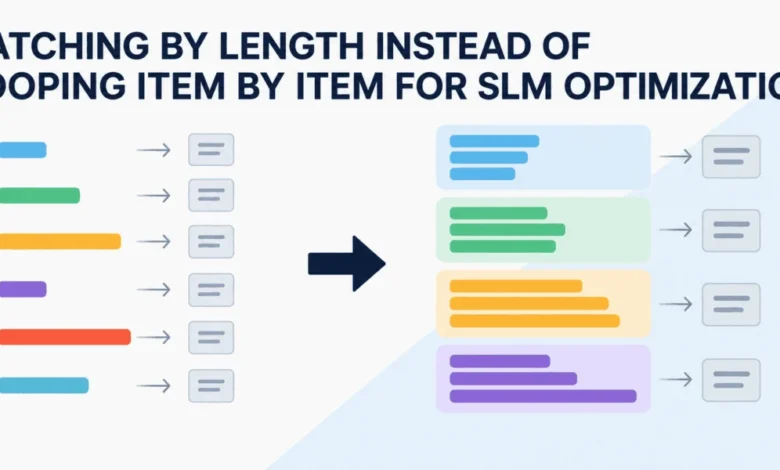
The solution to this dilemma lies in sorting input data by token length prior to batch formation. By grouping sequences of similar length, the developer ensures that the "local maximum" length of each batch is only marginally higher than the length of the shortest item within that same batch.
This technique is mathematically sound and empirically verifiable. In a recent experiment utilizing the Qwen2.5-0.5B-Instruct model, a set of 600 support tickets was processed. Without optimization, the sequential loop took approximately 144 seconds, yielding roughly 4.2 items per second. When the tickets were sorted by length and batched, the execution time dropped to approximately 80 seconds, effectively doubling the throughput. Furthermore, the padding overhead—the percentage of compute cycles wasted on non-data tokens—was reduced to a mere 7.6%.
Chronology of Optimization Efforts
This optimization methodology follows a logical progression of refinement for SLM narrow automation:
- Constraining Output Space: The initial step involved limiting the model’s vocabulary and potential output tokens to specific categories (e.g., "billing," "technical," "account"). By constraining the model to output only one of these three tokens, the need for complex, token-by-token generation is eliminated, allowing for faster classification scores.
- Reusing Prompt Prefixes: The second phase utilized key-value (KV) caching. By identifying that the system prompt or introductory text of a support ticket is identical across all requests, developers can "pre-calculate" the attention states for those tokens, saving significant compute resources during each subsequent forward pass.
- Length-Bucketed Batching: The final stage, discussed here, optimizes the scheduling of these requests. By organizing the incoming stream into buckets of similar lengths, the pipeline minimizes both memory overhead and padding waste.
Implications for Production Environments
For organizations relying on small language models, the shift toward these optimization techniques has profound implications. First, it democratizes access to high-performance AI. When a model can run 7.5 items per second on a MacBook Air, the requirement for expensive, cloud-based GPU clusters for basic automation tasks vanishes. This lowers the total cost of ownership and improves data privacy, as more inference can be performed locally.
Second, the reliability of these optimizations is paramount. Industry standards dictate that any optimization technique must be validated against a "gold standard"—the output of the original, unoptimized, sequential model. In the tests conducted, the batched version achieved perfect parity with the sequential version across all probes. If an optimization changes the resulting classification, it is considered a regression. Therefore, the implementation of length-bucketed batching is not merely a speed improvement; it is a refinement of software engineering practice that demands rigorous verification.
Future Considerations and Caveats
While the gains from length-bucketing are significant, they are not a universal panacea. Developers must exercise caution when combining these techniques. For instance, prefix caching is typically designed for a batch size of one. When applying prefix caching to a batched workflow, the developer must manually expand the key-value tensors to match the batch dimension, which adds complexity to the code. Failure to manage these tensors correctly can lead to corrupted attention states and incorrect model behavior.
Furthermore, the "long-tail" distribution of data is a constant variable. In environments where data length is highly unpredictable or where low-latency requirements necessitate a "first-in, first-out" processing model, the benefits of sorting may be partially offset by the wait time required to fill a batch. Developers must weigh the trade-offs between throughput and latency based on their specific use case.
Conclusion
The optimization of small language models is a discipline of eliminating waste. By moving away from item-by-item loops and adopting strategies like length-bucketed batching, engineers can achieve significant efficiency gains on existing hardware. These techniques, when combined with output space constraints and KV caching, represent a mature approach to deploying SLMs in production. As the AI community continues to prioritize energy efficiency and hardware-agnostic deployment, the focus will increasingly shift from model size to the elegance and efficiency of the inference pipeline. The data is clear: software optimization is the final frontier in making LLM-based automation truly scalable for the modern enterprise.