The Evolution of Intent-Driven Design: Why the Future of the Web Eliminates the Traditional Interface

The digital landscape is undergoing a profound paradigm shift, moving rapidly away from traditional web navigation elements such as static menus, intricate multi-step forms, and endless point-and-click interactions. For decades, software and web design have been anchored in the conventions established by the graphical user interface (GUI) pioneers of the 1970s and 1980s, exemplified by the Xerox Star and the Apple Macintosh. This legacy framework demanded that users act as manual orchestrators of data—adjusting range sliders, closing cookie pop-ups, managing dozens of open browser tabs, and clicking through labyrinthine sales funnels just to execute basic tasks like booking travel or cross-referencing information. Today, however, advances in artificial intelligence and large language models are fueling a new philosophy known as intent-driven design. This emerging approach shifts the digital experience from managing software interfaces to capturing high-level human goals and autonomously executing the underlying labor.

To understand the trajectory of this transformation, it is necessary to examine the historical arc of human-computer interaction (HCI). Since the commercialization of the GUI, software design prioritized visible interfaces, establishing metrics such as time-on-site, click-through rates, and page views per session as the definitive indicators of digital success. Yet, this model routinely forced users to spend more time navigating the software itself than actually achieving their real-world objectives. Over the years, thought leaders in HCI have challenged this friction-heavy paradigm. Notable contributions include Don Norman’s foundational principles of human-centered design and Golden Krishna’s influential thesis, articulated in his book The Best Interface Is No Interface, which argued that the ultimate goal of modern web design should not be to build prettier buttons, but to eliminate the interface entirely.
The movement toward intent-driven design gained significant momentum in the early 2020s, catalyzed by breakthroughs in generative artificial intelligence. As machine learning models evolved from simple pattern-matching algorithms to sophisticated agents capable of reasoning, synthesizing, and executing multi-step workflows, technology companies began reimagining core software architectures. By 2024 and 2025, early commercial applications began demonstrating the viability of screenless, agent-driven workflows. Platforms emerged that could take a natural language prompt—such as finding a specific flight matching strict financial and temporal constraints—and return a single, actionable resolution rather than a page filled with raw search data and filter sidebars.
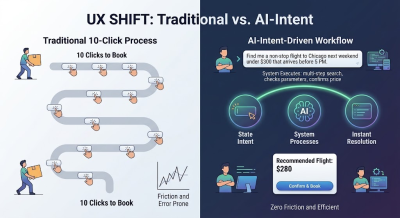
Industry data and usability research underscore the necessity of this shift. According to recent evaluations by the Nielsen Norman Group regarding AI as a new UX paradigm, digital computing is fundamentally transitioning from command-based interaction to outcome-specification. Users no longer wish to operate as manual data-entry clerks for digital systems. Instead, they expect software to interpret context, anticipate requirements, and perform routine execution autonomously. This evolution has manifested across several prominent web platforms that currently serve millions of users daily.
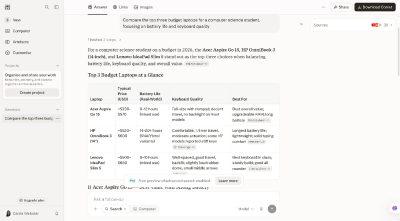
For example, Perplexity AI has redefined online search by replacing the traditional "ten blue links" directory model with synthesized, real-time answers. Rather than forcing users to open multiple tabs, skim long articles, and manually cross-reference sources, Perplexity captures the user’s explicit information intent and delivers a consolidated output complete with citations. Similarly, Vercel v0 has transformed web development and interface design. Instead of requiring designers and developers to manually draw rectangles, select hexadecimal color codes, and write cascading style sheets (CSS) in traditional tools like Figma, v0 allows users to generate fully functional user interface components and SaaS dashboard layouts instantly via conversational text prompts. Another prominent example is Goblin.tools, a suite of AI-driven productivity applications designed to help neurodivergent or overwhelmed users break complex, multi-step real-world projects into manageable, sequential checklists without requiring manual configuration or Kanban board management.
These platforms illustrate the three core pillars that define intent-driven web design: high-level user input, generative user interfaces (UI), and autonomous execution by background AI agents. In traditional UX design, user input relied heavily on micro-actions like clicks, dropdown selections, and toggles. In intent-driven UX, input is captured via natural language, contextual metadata, and behavioral habits. Regarding interface state, traditional websites relied on static layouts where every visitor viewed the same structural elements. Intent-driven systems utilize generative UI, rendering layouts dynamically on the fly to match the user’s immediate operational context. Finally, while traditional software demanded manual execution by the human user—often accompanied by repetitive confirmation pop-ups—intent-driven platforms rely on autonomous AI agents to complete background tasks while prioritizing frictionless rollback mechanisms, such as prominent "Undo" buttons and transparent audit logs, over intrusive warning modals.
Despite the operational efficiency and liberating nature of removing interface friction, this transition introduces complex design and ethical challenges. Industry groups, including the Stanford Human-Computer Interaction (HCI) Group and the Center for Humane Technology, have raised concerns regarding the "illusion of control" and the "black box problem." When software infers and acts upon intent rather than direct point-and-click commands, users risk feeling alienated or manipulated if the automation oversteps boundaries. Furthermore, unexpected system outputs can be difficult to troubleshoot when the underlying logic is hidden from view. To mitigate these risks, design frameworks such as the Google PAIR (People + AI Research) Guidebook advocate for transparent feedback loops, ensuring that systems explicitly state their interpretations—such as confirming search parameters before execution—so users can calibrate trust and correct misinterpretations instantly.
The implications for user experience (UX) professionals are profound. Industry analysts and design leaders emphasize that the role of the UX designer is shifting from crafting static buttons, rigid forms, and visual navigation hierarchies to guiding transparent, intent-driven AI experiences. Designers must learn to map and present dynamic, generative UI components that adapt fluidly to user intent, utilizing ambient feedback, inline prompts, and transparent status indicators. This requires a fundamental re-evaluation of design education and practice, prioritizing ethical guardrails, human oversight for high-stakes decisions—such as financial transactions and privacy modifications—and clear accountability mechanisms.
Ultimately, the philosophical pivot from engagement metrics to seamless completion aligns digital products with the broader "Time Well Spent" movement championed by organizations like the Center for Humane Technology. The primary benchmark of modern digital product success is no longer how long a user stays on a page or how many clicks they generate, but how effectively the software resolves the user’s problem and recedes into the background. As the web continues to evolve beyond menus, forms, and endless clicks toward experiences shaped entirely around human intent, the ultimate measure of design excellence will be found in its ability to make complex interfaces completely obsolete.