The Evolution of Fashion Week Marketing
New York Fashion Week has long served as a battleground for brand visibility. Historically, fashion houses relied on runway shows, exclusive guest lists, and print media to define their seasonal presence. However, the rise of the digital-first economy has forced luxury and retail brands to reconsider how they occupy space—both virtual and physical.
As digital advertising costs continue to rise—with Meta and Google ad spending seeing consistent year-over-year growth—brands have found that consumer attention is becoming increasingly fragmented. Data from industry research firms indicates that the average consumer is exposed to thousands of advertising messages daily, leading to "ad fatigue." Consequently, brands that invest in "physical stunts" or "experiential takeovers" are seeing higher engagement rates. Savage X Fenty’s latest installation is not merely a promotional effort; it is a strategic maneuver designed to break through the noise of the digital feed by rooting the brand in the physical, tactile reality of the city.
A Chronology of the Installation
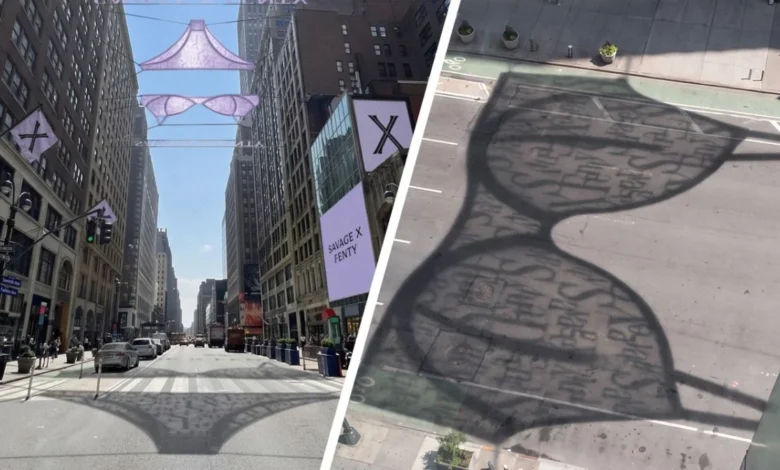
The installation, which occupies the airspace above Seventh Avenue and Fashion Avenue, was strategically timed to coincide with the peak foot traffic of New York Fashion Week. While the brand has maintained a level of mystery regarding the exact logistical planning, the deployment appears to have followed a precise, multi-phase schedule:
- Pre-Event Planning (Early August): Coordination with municipal authorities and urban planning agencies to secure permits for temporary aerial installations within the highly regulated New York City airspace.
- Logistical Assembly (September 5-6): The structural components were transported to the site under the cover of night to minimize disruption to Manhattan’s dense traffic patterns.
- Installation Launch (September 7): The oversized display was raised, coinciding with the official commencement of NYFW events.
- Operational Period (September 7-14): The installation remains active throughout the week, utilizing the sun’s positioning to create dynamic, moving shadows that interact with the city’s grid, specifically aligning with crosswalks to draw the eyes of pedestrians upward.
Design and Technical Execution
The installation is a masterclass in minimalist branding. The set itself is rendered in a neutral tone that emphasizes the architecture of the piece rather than the color of the fabric. Bordered by the recognizable Savage X Fenty logo, the garment features the "Savage" wordmark in a crisp, high-contrast serif font.
The choice of a serif typeface is noteworthy; it evokes a sense of editorial authority and luxury, moving away from the more playful, sans-serif fonts often associated with mass-market lingerie. From a design perspective, the execution relies on "anamorphic" principles—the piece is designed to be viewed from specific angles at street level, ensuring that the proportions remain visually coherent to those walking through the Garment District. The intentional placement ensures that as the sun traverses the sky, the shadow cast by the lingerie shifts across the pavement, creating an ephemeral, ever-changing ad that forces passersby to look up and engage with the environment.
Supporting Data on Experiential Marketing
The shift toward experiential advertising is backed by clear industry trends. According to the EventTrack benchmark report, roughly 74% of consumers report that engaging with branded event marketing makes them more likely to purchase the products being promoted. Furthermore, the "Instagrammability" of such installations serves as a force multiplier. When a physical installation creates a viral moment, the brand gains "earned media"—free publicity generated by social media users sharing images of the site.
For a brand like Savage X Fenty, which built its reputation on inclusivity and disruptive retail models, this installation serves as a physical representation of its digital ethos. By moving from the screen to the skyline, the brand reinforces its presence as a market leader, proving that high-concept design can transcend the limitations of a standard billboard or a sponsored social media post.
Market Implications and Brand Positioning
The implications of this stunt are significant for the retail sector. As the lines between e-commerce and physical retail continue to blur, the ability to create "brand moments" has become as important as the supply chain itself. Industry analysts suggest that Savage X Fenty’s strategy represents a transition toward "architectural branding," where the urban environment becomes an extension of the retail store.
This move also signals a maturation of the Savage X Fenty brand. Having established itself as a disruptor in the lingerie space, the company is now positioning itself as a major cultural force capable of commanding the attention of an entire city. By choosing the Garment District—the traditional heart of the American fashion industry—the brand is making a deliberate statement about its permanence and its commitment to the legacy of fashion, even as it challenges traditional aesthetic norms.
Comparative Analysis: Subvertising and Public Space
The installation also fits into a broader historical context of "subvertising"—a practice where brands or artists reclaim public spaces to challenge societal norms. While Savage X Fenty’s installation is a commercial endeavor, it utilizes the same techniques as subvertising to demand space in a crowded city.
In recent years, other major entities, including Tesla and various tobacco-alternative brands, have used public space to provoke conversation. However, Savage X Fenty’s approach differs by being inherently positive and aesthetically focused rather than combative. By aligning the brand with the "living, breathing" atmosphere of New York City, the company has successfully avoided the backlash often associated with intrusive advertising, instead earning curiosity and admiration from the public.
The Future of Fashion Week Advertising
As New York Fashion Week continues to evolve, the demand for high-impact, low-friction advertising will likely grow. Future iterations of this strategy may involve augmented reality (AR) components, where the physical installation acts as a trigger for mobile devices, allowing users to view the lingerie set in different colors or styles via their smartphone cameras.
For now, the Savage X Fenty installation serves as a benchmark for what is possible when a brand moves beyond the limitations of standard media buys. It demonstrates that the most effective way to reach the modern consumer is not through digital repetition, but through physical, unavoidable, and highly visible creativity. The brand has successfully turned the streets of New York into an extension of its runway, proving that when it comes to capturing the public imagination, the sky is, quite literally, the limit.
This installation underscores a fundamental shift in luxury marketing: the move from being a brand that consumers purchase to a brand that consumers experience. By integrating itself into the fabric of the city, Savage X Fenty has ensured that regardless of whether one is a fashion insider or a casual pedestrian, the brand is impossible to ignore. As the week progresses, it is expected that the installation will continue to drive organic social media engagement, further cementing the brand’s status as a leader in both the lingerie market and the world of high-concept advertising. Through this bold, oversized display, the brand has effectively claimed its place in the skyline, setting a new standard for how fashion houses can engage with the public in the 21st century.