Atelier Manferdini Transforms Virginia Electrical Substation into a Vibrant Urban Landmark with inVisible Facade System

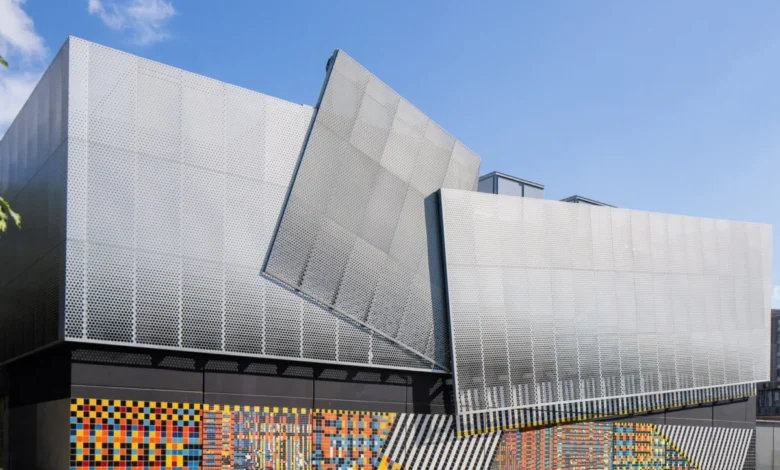
The intersection of utilitarian municipal infrastructure and contemporary architectural design has entered a new phase with the completion of the inVisible project in Crystal City, Northern Virginia. Designed by California-based architecture studio Atelier Manferdini for major energy provider Dominion Energy, this newly minted facade system completely reimagines the outward appearance of an essential electrical substation. Situated just outside the nation’s capital, the project successfully bridges the gap between the hidden, high-voltage machinery humming within and the pedestrian human scale of the surrounding urban landscape.
For decades, critical infrastructure installations have been treated strictly as utilitarian necessities. Municipalities and utility companies historically prioritized function, security, and cost efficiency above all else, leaving neighborhoods burdened with stark, windowless, and uninspired concrete or corrugated metal boxes. The Dominion Energy undertaking in Crystal City represents a paradigm shift in how energy providers approach civic integration. By commissioning a high-concept architectural skin, Dominion Energy and Atelier Manferdini have acknowledged that essential urban infrastructure can—and perhaps should—actively contribute to the visual and cultural fabric of the community it serves.
Architectural Vision and the Human Scale
At the helm of Atelier Manferdini is founder Elena Manferdini, an Italian-born architect and educator at the Southern California Institute of Architecture (SCI-Arc) in Los Angeles, renowned for her exploration of digital patterns and bold color application in building envelopes. When conceptualizing the project, Manferdini and her team focused intensely on the friction between a structure built entirely for the operation of autonomous machines and the human citizens who navigate the city streets daily.
"Critical infrastructure is essential to our cities, yet the Dominion Energy substation is fundamentally designed for machines rather than people," Manferdini explained regarding the design philosophy. "With inVisible, we wanted to explore this dichotomy, transforming a purely functional structure into something meaningful to the surrounding community."
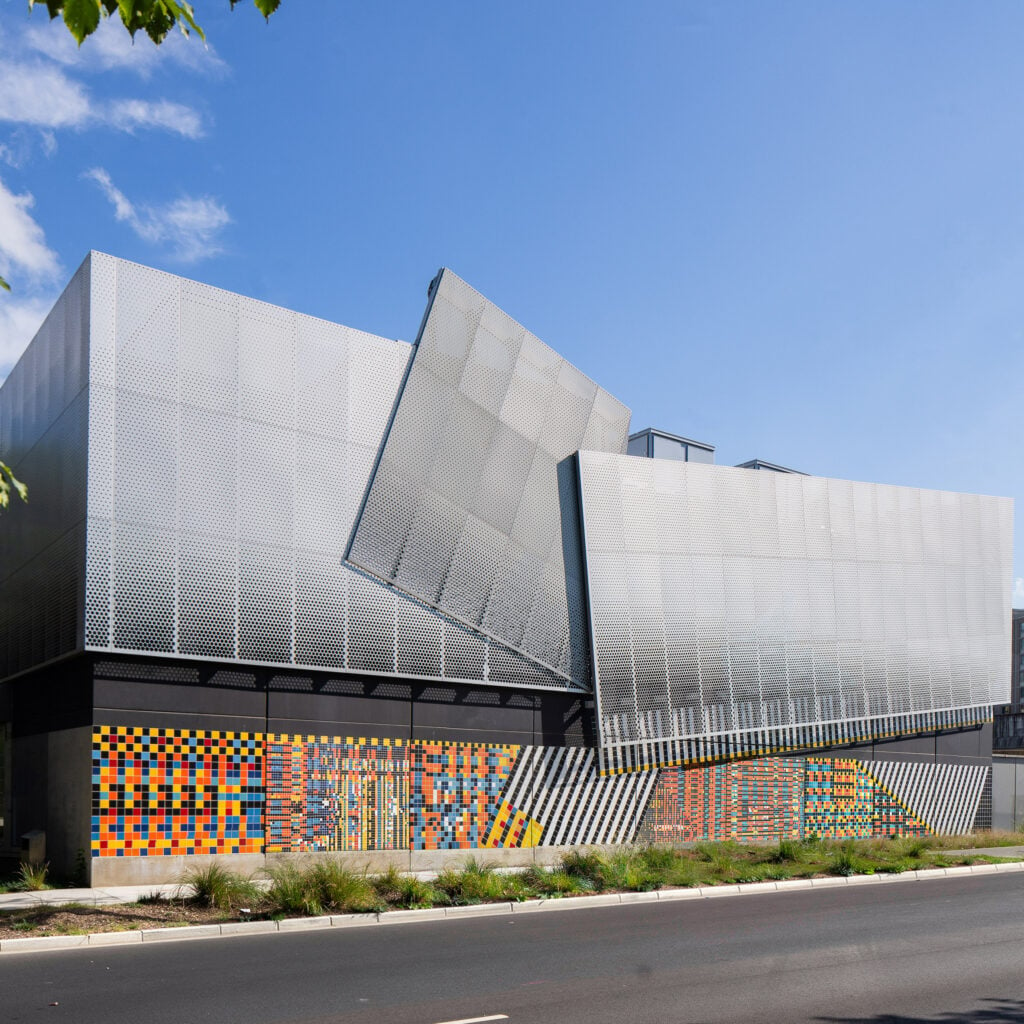
Rather than masking the substation behind traditional landscaping or attempting to pretend the building does not exist, the studio opted for a dynamic, communicative approach. "While the interior responds to the needs of machines, the exterior becomes an opportunity to engage with people through color, pattern, and perception, creating a dialogue between infrastructure and the human scale of the city," she added.
Computational Design and the Mathematics of Electricity
To accurately and creatively represent the invisible flow of electricity, Atelier Manferdini turned to advanced digital design tools. Electrical substations play a vital role in the power grid by stepping electrical voltages up or down to ensure safe, efficient transmission over long distances and local distribution lines. Translating this invisible, high-stakes physical process into a static building facade required a sophisticated computational framework.
The design team utilized Processing, an open-source graphical programming language originally developed at the MIT Media Lab in the early 2000s, which has become a foundational tool for computational designers, digital artists, and architects. By running custom algorithms, the studio generated complex patterns that mirror the erratic, pulsing nature of electrical voltage fluctuations.
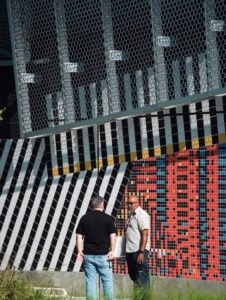
The resulting facade is clearly divided into two distinct yet complementary horizontal bands, creating a unified architectural composition that relies on contrast. The lower portion of the building is anchored by a vibrant, granular ceramic tile system. This colorful band incorporates exactly ten distinct colors and is constructed using tiles of three specific dimensions: two, four, and purposefully incorporated "glitches" within the programmatic generation, recalling the syncopated rhythms of urban life.
Art Historical Precedents and Urban Rhythms
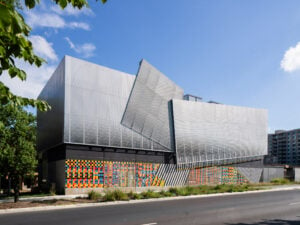
The graphic density and chromatic vibrancy of the lower tile band are not merely random expressions of digital algorithms; they pay direct homage to modern art history. The composition evokes strong parallels to the iconic Boogie Woogie series by modernist painter Piet Mondrian, most notably Broadway Boogie Woogie (1942). Mondrian’s late works were famously inspired by the grid-like layout of Manhattan streets and the syncopated rhythms of jazz music, translating kinetic urban movement into blocks of primary colors.
Atelier Manferdini has effectively updated this mid-century artistic pursuit for the twenty-first century. By substituting jazz rhythms and street grids with electrical voltage metrics and computational algorithms, the tile band grounds the building in a rich tradition of visual abstraction. Passersby walking along the sidewalk experience the granular texture of the tiles up close, interacting with a human-scaled canvas that belies the industrial voltage coursing through the walls behind it.
The Kinetic Aluminium Upper Facade and Play of Light
While the lower band engages the pedestrian eye with color and granular detail, the upper section of the inVisible substation takes on a quieter, monumental, and metallic character. Massive, gridded aluminium panels form an advanced ventilated facade system that wraps around the upper storeys of the structure.
These metal panels are engineered with variable depth, set at precise, calculated distances from the exterior building walls. Where the panels meet, they overlap and stack, creating areas of varying density within the metallic grid. This three-dimensional layering allows natural sunlight to filter through the perforations and gaps in shifting patterns throughout the day.
"The folds catch light and cast shadows, allowing the surface to shift with the time of day and the viewer’s position," the studio noted.
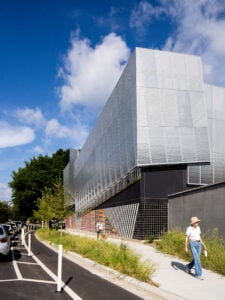
This kinetic quality ensures that the building is never experienced the same way twice. A commuter walking past the substation in the early morning light will witness sharp, linear shadows stretching across the metallic skin, while an afternoon visitor will encounter softer, more diffused reflections.
As daylight fades, the architectural narrative shifts once again. The aluminium panels are integrated with a programmable LED backlighting system. At night, the facade glows from within, turning the industrial utility box into an illuminated urban lantern that signals the perpetual, 24-hour flow of energy powering the Crystal City district.
Broader Urban Trends: Redefining Municipal Infrastructure
The completion of the inVisible substation arrives at a time when cities worldwide are rethinking how industrial and civic utilities are integrated into dense urban environments. As metropolitan areas expand and land values rise, the traditional model of sprawling, fenced-off substations and power plants is increasingly untenable. Furthermore, public expectations regarding urban aesthetics have evolved, with communities demanding that necessary infrastructure respects the visual quality of neighborhoods.
Architectural studios globally are rising to this challenge. Notable international precedents include a major energy facility in Shenzhen, China, designed by architectural firm Schmidt Hammer Lassen. That project successfully shrouded a massive industrial power station in sleek steel lamellas, complete with a rooftop public walkway that reintegrates the industrial footprint back into the public realm. Similarly, in Canada, studio GH3 has gained critical acclaim for treating municipal stormwater facilities as sculptural, landscape-enhancing civic art installations rather than hidden, purely engineering-driven utility works.
By partnering with Atelier Manferdini, Dominion Energy has positioned itself at the forefront of this architectural movement within the United States. The collaboration demonstrates that utility providers can successfully invest in high-design solutions without compromising operational safety, security, or efficiency.
Implications and Future Outlook for Crystal City
Crystal City, located in Arlington County, Virginia, has undergone extensive redevelopment in recent years, marked by high-density mixed-use residential towers, corporate headquarters—including major tech developments—and a rapidly expanding pedestrian population. In an environment experiencing such intense urban densification, the aesthetic quality of every square foot matters immensely.
An electrical substation of this scale could easily have become an eyesore or a psychological barrier within the developing neighborhood. Instead, through thoughtful material selection, algorithmic pattern generation, and a nuanced understanding of scale, Atelier Manferdini has transformed a potential urban dead zone into an engaging point of civic interest.
The success of the inVisible project suggests a promising template for future infrastructure upgrades across the United States. As cities face mounting pressures to upgrade aging electrical grids to accommodate electric vehicles, renewable energy integration, and smart-city technologies, the demand for urban substations will only increase. Projects like the Dominion Energy facility in Crystal City prove that critical engineering infrastructure does not need to be hidden behind gray concrete walls. Instead, with creative architectural intervention, the invisible mechanics of modern civilization can be brought to light, enriching the visual landscape and fostering a deeper connection between citizens and the energy that powers their daily lives.
Related posts: