The rapid maturation of Large Language Models (LLMs) has led to a linguistic inflation in the technology sector, where the term "AI Agent" is increasingly applied to almost any software implementation involving an LLM. From simple automated email responders to complex, multi-step data processing pipelines, the lack of standardized terminology has created significant architectural confusion for developers and business leaders alike. Distinguishing between a rigid AI workflow and a truly autonomous AI agent is no longer a matter of semantics; it is a critical requirement for building scalable, cost-effective, and reliable enterprise systems. This article provides a comprehensive analysis of the technical distinctions between these two paradigms and offers a practical framework for determining which approach is appropriate for specific business use cases.
The Conceptual Divide: Determinism vs. Emergent Behavior
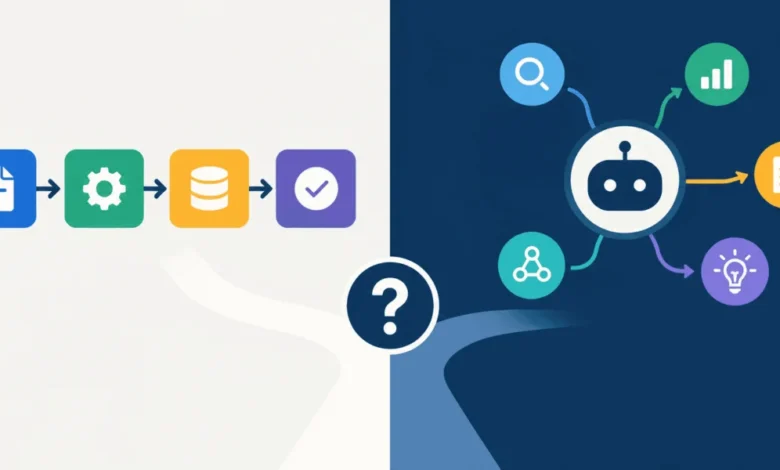
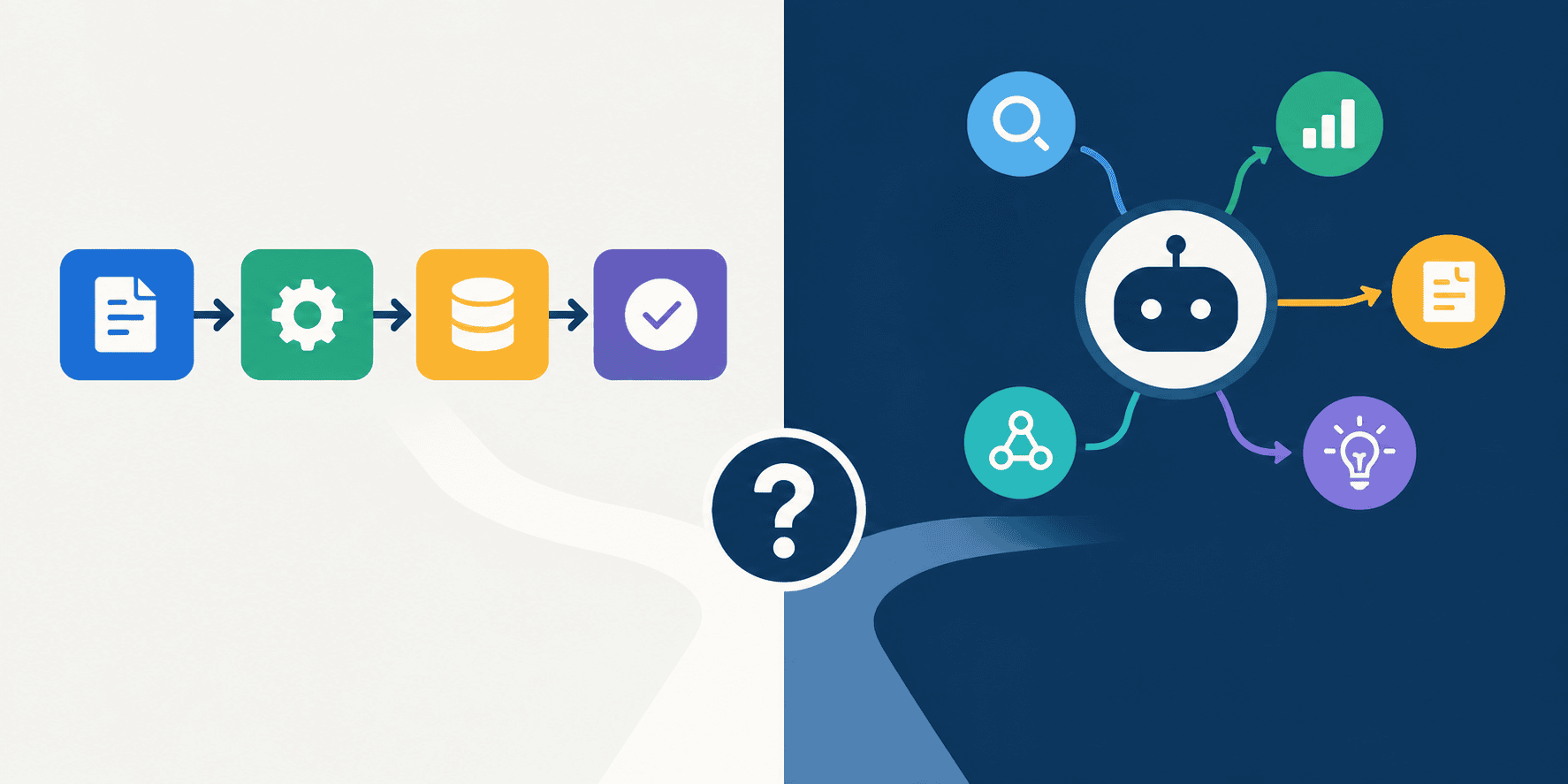
At the core of the current industry debate lies the fundamental question of control. A workflow, often referred to as a pipeline or a chain, operates on a deterministic principle. The architecture is defined at design time, meaning that the developer maps out every possible branch, condition, and exit point before the software is ever deployed. While these systems may integrate sophisticated LLM calls—using the model to summarize, extract, or categorize data—the model serves as a component within a pre-ordained structure. The flow of information is static; the system does not "decide" its next step, but rather follows a path written in code.
Conversely, an AI agent functions through a runtime-driven control loop. In this paradigm, the developer provides the model with a high-level goal and a set of tools, but the model itself determines the sequence of operations. An agent observes its environment, evaluates its current state against the desired outcome, selects a tool, executes it, and analyzes the result to decide whether to continue, backtrack, or terminate. This is the essence of "agentic" behavior: the locus of control shifts from the developer’s hardcoded logic to the model’s reasoning capabilities.
Historical Context and the Rise of Agentic Hype
The evolution of these systems can be traced back to the transition from rule-based automation to probabilistic computing. In the early 2020s, the primary use case for LLMs was content generation or basic classification within existing software stacks. As companies began to integrate these models into their backends, "orchestration frameworks" such as LangChain and LlamaIndex emerged to manage the complexity of chained LLM calls. These frameworks were designed to facilitate workflows.
However, the subsequent push toward "autonomous agents"—systems that can perform multi-step reasoning tasks—has introduced a new layer of complexity. According to recent industry surveys, nearly 65% of enterprise AI initiatives fail to reach production due to "hallucinations" or unpredictable outputs. Technical architects argue that much of this failure stems from applying an agentic architecture to problems that are inherently deterministic. By attempting to force an LLM to "reason" through a process that could have been handled by a simple if-else statement, organizations are inadvertently increasing their technical debt, cloud compute costs, and risk of failure.
The Practical Test: The Whiteboard Methodology
To mitigate the risks associated with premature adoption of complex architectures, engineering teams are increasingly adopting a "Whiteboard Test." The premise is straightforward: if a human engineer can map out the logic of a task on a whiteboard, including all potential failure modes and branching paths, the task should be built as a workflow.
This test serves as a crucial filter. If the logic can be documented in a flow chart, then building an agent is likely an exercise in over-engineering. Workflows are inherently more stable because they provide a verifiable audit trail. In sectors such as fintech, healthcare, and legal services, this transparency is not just preferred—it is a regulatory requirement. When a system makes a decision, the ability to trace that decision back through a pre-defined path is essential for compliance and debugging.
Quantitative and Qualitative Implications
The decision between a workflow and an agent has significant downstream effects on operational efficiency.
- Cost and Token Usage: Agents inherently consume more tokens. Because they are designed to "think" and self-correct, they often make multiple redundant tool calls before arriving at a final answer. For high-volume applications, this can make agentic systems exponentially more expensive than their workflow counterparts.
- Latency: A workflow takes a linear path with a predictable number of API calls. An agent’s path is non-linear and subject to the model’s internal reasoning loop, which can lead to significant, unpredictable latency spikes.
- Reliability and Auditability: Workflows are inherently testable. Unit tests can be written for every node in the graph. Agents are famously difficult to test because their behavior can vary based on small changes in the prompt or the context provided during the run.
When Is an Agent Truly Necessary?
While workflows are superior for routine, process-driven tasks, there are specific scenarios where agents excel. The primary indicator for an agent is "high-input variability." In situations where the problem space is too broad or too complex to define with conditional logic—such as an autonomous security analyst tasked with investigating an active, unknown network threat—the flexibility of an agent is an asset.
In these cases, the model acts as a proxy for a human expert. It must be able to adapt to new information, such as realizing that a database query returned an error and subsequently deciding to check a different log file rather than proceeding with a faulty assumption. This level of dynamic adaptation is the hallmark of a successful agentic deployment.
Strategic Recommendation: Start Constrained
The most robust architectural approach is to begin with a workflow, even when the end goal appears to require an agent. By utilizing LLM-based classification or judgment at specific nodes within a workflow, developers can achieve "intelligent" behavior without sacrificing control.
For example, a customer support system can be structured as a fixed workflow that classifies the user’s issue. The workflow can then trigger specific sub-processes based on that classification. If, after implementing this structure, the team finds that the number of classifications is growing uncontrollably or that the business rules are becoming too complex to maintain in code, then—and only then—should they consider migrating the decision-making logic to an agent.
Conclusion: The Future of AI Architecture
As the industry moves beyond the initial hype cycle, the focus is shifting toward "compound AI systems." These systems treat agents and workflows not as competing choices, but as complementary tools. The most sophisticated enterprise applications are likely to be hybrid in nature: large-scale, deterministic workflows that contain "agentic islands"—specific modules where the task is sufficiently open-ended to warrant the use of autonomous reasoning.
For developers and stakeholders, the imperative is clear: prioritize simplicity. Do not confuse the sophistication of the tool with the quality of the solution. If the process can be charted, it should be coded as a workflow. By maintaining this discipline, organizations can harness the power of LLMs while ensuring their systems remain performant, cost-effective, and, most importantly, reliable in a production environment. Success in the era of AI is not defined by how "autonomous" a system is, but by how effectively it solves the problem at hand while remaining under the architect’s control.