The modern digital product design landscape is characterized by an escalating demand for high-fidelity visual assets, particularly three-dimensional renders, which are increasingly critical for contemporary web interfaces, marketing collateral, and immersive user experiences. Yet, the workflow required to produce these assets has historically remained disjointed, forcing designers to toggle constantly between interface design tools and complex, specialized 3D creation software. Addressing this long-standing friction point in the creative pipeline, a new developer and designer has introduced Depth, a specialized rendering plugin that integrates a lightweight 3D engine directly into Figma. The innovation promises to streamline early-stage design iteration by bridging the gap between raw volumetric models and layout execution, eliminating the need for cumbersome external file conversions during the formative stages of product development.
The Genesis of Depth and the Designer’s Dilemma
The conceptual roots of Depth trace back to a practical challenge encountered during the development of a product website heavily reliant on dynamic 3D assets. While established tools within the enterprise software ecosystem adequately address isolated segments of the digital creation pipeline, the creator identified a distinct void: the absence of a streamlined, localized renderer capable of natively accepting arbitrary 3D models without demanding deep proficiency in professional suites such as Blender, Cinema 4D, or 3ds Max.
In a typical corporate environment, design teams must coordinate closely with dedicated visualization specialists to generate final assets. This multi-layered operational dependency often introduces significant bottlenecks. Bi-weekly leadership reviews frequently necessitate rapid, iterative adjustments to layouts and visual hierarchies between presentation cycles. When a designer possesses the raw 3D geometry but lacks fluency in advanced modeling applications, testing a novel visual hypothesis becomes an arduous multi-step procedure. The process traditionally requires exiting the primary layout environment, configuring a scene in an external utility, exporting a flat image raster, and manually re-importing the asset into the design canvas.

For early-stage ideation, however, production-grade materials and exhaustive physical lighting calculations are rarely necessary. Designers primarily require sufficient structural form and directional illumination to evaluate whether a specific composition functions within the broader context of a web page or user interface. Depth was engineered explicitly to accommodate this intermediate tier of the workflow, allowing practitioners to ingest a model, modify camera angles and lighting parameters, and instantly project the resultant render onto the active canvas.
Technical Architecture and Prototyping Phase
Before committing resources to a fully realized user interface, the project began as a tightly scoped proof of concept (PoC). The primary objective of this initial phase was to evaluate technical feasibility, specifically measuring how efficiently a browser-based 3D engine could operate within the confined architecture of a Figma plugin window. Key performance metrics included real-time scene responsiveness and the ability to encapsulate essential 3D controls without overwhelming users accustomed to standard vector and layout interfaces.
The architecture of Depth is bifurcated into two distinct operational domains communicating in tandem. The plugin window itself is powered by Three.js, a cross-browser JavaScript library and application programming interface used to create and display animated 3D computer graphics. Three.js manages the underlying geometry, spatial camera positioning, material properties, and environmental lighting. Simultaneously, a dedicated background controller synchronizes interactions with the host Figma document.
When a user selects a specific frame, the controller transmits the layer data to the 3D viewport as a portable network graphics (PNG) file. Once the rendering calculations conclude, the output is seamlessly returned to the Figma environment as a standard image layer. To guarantee visual fidelity without disrupting layout compositions, Depth incorporates a 2x export multiplier. This function doubles the pixel dimensions of the exported PNG while preserving the designated bounding box on the canvas, yielding crisper edges and superior resolution on high-density displays.

To optimize performance during active manipulation, Depth employs a dynamic level-of-detail algorithm. When the user actively pans, tilts, or orbits the camera, the application temporarily reduces rendering complexity, accelerating frame rates. Once the camera movement ceases, the software immediately restores high-fidelity shadows, anti-aliasing, and clean edge delineations before finalizing the image injection into Figma. Furthermore, for models utilizing translucent or transparent properties, the renderer intelligently incorporates the underlying scene background into the export calculation, ensuring that complex reflections and refractions remain physically convincing.
Translating the Tool’s Philosophy into Web Experience
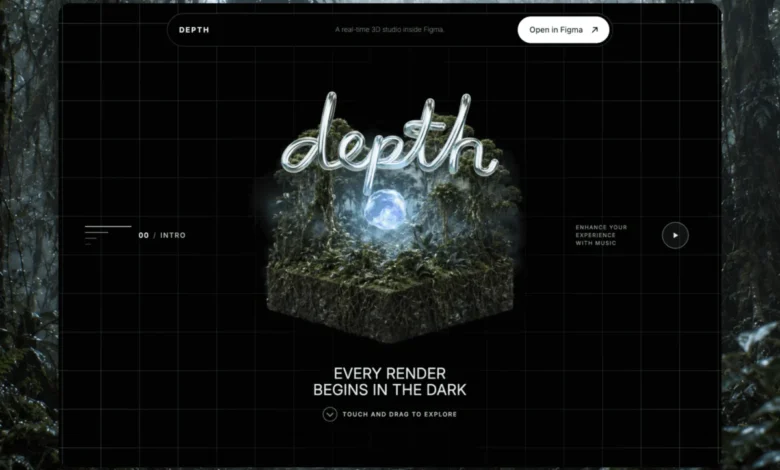
To demonstrate the capabilities of the utility to the broader design community, the creator engineered a dedicated promotional website structured around the chronological progression of a digital render: moving systematically from bare volumetric form to applied material, environmental context, and final catalog integration.
The foundational design of the website adopts a deliberately minimalist aesthetic, beginning in near-total darkness and revealing information iteratively. This progressive disclosure allows visitors to isolate the direct impact of individual design variables. Initially, the project attempted to utilize a fully live, real-time 3D model directly within the browser hero section, allowing visitors to manipulate the geometry natively. However, early technical trials revealed a persistent limitation: while the interactive behavior functioned correctly, real-time web rendering failed to achieve the cinematic surface detail, atmospheric depth, and lighting sophistication desired for the primary brand introduction.
To circumvent the visual constraints of real-time web graphics without sacrificing interactivity, the developer adopted a hybrid technical approach. Utilizing advanced generative video interpolation frameworks, two distinct static frames were synthesized into a continuous 360-degree rotational sequence comprising 240 distinct image frames. This sequence is directly mapped to the horizontal coordinates of the visitor’s cursor. As a user navigates across the viewport, the central island rotates fluidly in response to mouse movement, creating the tactile sensation of a live 3D object while retaining the pristine atmospheric quality of pre-rendered imagery.

Surrounding this central sequence, real-time 3D layers provide immediate spatial depth and motion parallax, while the typography of the brand title is integrated directly into the composition. This synthesis creates a cohesive visual illusion of a unified 3D environment while carefully managing browser performance and loading times through optimized asset delivery strategies.
Granular Control: Form, Material, and Environment
As visitors progress deeper into the web experience, the interface deconstructs the rendering process into dedicated functional chapters. In the material application phase, the underlying geometric form remains entirely static while users experiment with surface attributes. Transitions between distinct material configurations are governed by an opaque Three.js shader that smoothly interpolates color palettes, surface roughness, metallic reflectivity, and microscopic texture details over a controlled duration.
Crucially, the user interface controls respond instantaneously to user input, while the visual surface transition gracefully catches up to the command. Because the engine treats the asset as a single unified mesh during the transition, the geometric boundaries and volumetric depth remain completely stable during user rotation. The system also incorporates intuitive state management: interrupting an ongoing transition with a secondary material choice cleanly reverses or redirects the blending sequence, preventing visual artifacts.
The environmental chapter addresses one of the most persistent hurdles in digital presentation: simulating the complex reflections of a photographic world without introducing literal background imagery that might clutter minimalist interface layouts. Depth resolves this by decoupling the light source from the visible scenery. An invisible High Dynamic Range Imaging (HDRI) map provides comprehensive environmental lighting and accurate surface reflections, while the visible background terrain is abstracted into a sparse field of illuminated points. This stylistic choice preserves the atmospheric mood of natural landscapes while aligning with the overarching graphic language of the digital platform.

Industry Implications and Future Outlook
The introduction of specialized bridging tools like Depth highlights a broader macroeconomic and technological shift within the software tooling sector. As the boundaries separating UI/UX design, 3D visualization, and front-end engineering continue to blur, professionals increasingly demand integrated environments that minimize context switching.
Historically, design operations have suffered from efficiency losses directly attributable to fragmented software ecosystems. By embedding a functional 3D rendering pipeline directly inside a collaborative interface layout tool like Figma, developers and designers can compress feedback loops significantly. Product teams can evaluate spatial design hypotheses, test branding integration, and generate placeholder visual assets within minutes rather than days.
Industry analysts note that as web applications increasingly adopt spatial computing paradigms, WebGL-based utilities and vector-layout integrations will likely become standard expectations rather than experimental novelties. The modular architecture demonstrated by Depth—utilizing lightweight browser graphics libraries combined with asynchronous document controllers—provides a viable blueprint for future enterprise design software extensions.
The Depth plugin is currently accessible to the global design community via the official Figma Community marketplace, alongside an interactive promotional web experience hosted at depth.fyi, offering practitioners a tangible demonstration of how localized rendering engines can reshape the modern digital product development lifecycle.