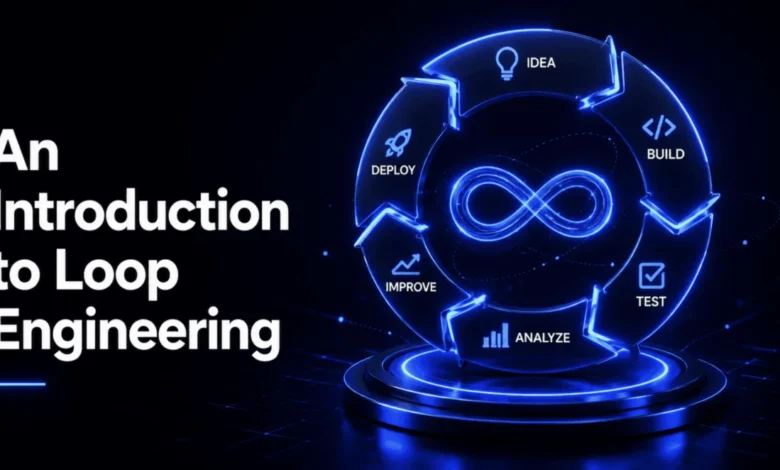
The emergence of loop engineering marks a pivotal shift in the development and deployment of artificial intelligence, moving beyond single-turn interactions to designing self-sustaining AI agent cycles capable of operating reliably without continuous human intervention. This innovative discipline, which rapidly gained prominence in mid-2026, focuses on architecting the underlying systems that enable AI agents to autonomously prompt themselves, execute tasks, receive environmental feedback, adapt their strategies, and persist towards a predefined objective until a verifiable condition is met. This transformation liberates developers from the tedious, turn-by-turn supervision of AI, ushering in an era where complex tasks can be delegated to agents that function akin to a self-driving car, but for code generation, issue triage, and system maintenance.
The Rapid Rise of a New Paradigm
The term "loop engineering" exploded into the mainstream consciousness with remarkable speed in June 2026, fundamentally altering conversations around AI agent development. A significant catalyst was an X (formerly Twitter) post on June 7, 2026, by Peter Steinberger, a prominent developer known for the OpenClaw agent project. Steinberger declared that the skill landscape had irrevocably changed: developers should no longer be merely prompting coding agents but, rather, designing the sophisticated loops that manage these interactions autonomously. This post garnered an astonishing 6.5 million views within days, dominating discussions across developer communities and AI timelines.
The very next day, Google engineer and acclaimed author Addy Osmani published a seminal essay titled "Loop Engineering," which provided the burgeoning concept with a detailed anatomical breakdown. Osmani’s work outlined key components such as automations, worktrees, skills, connectors, and sub-agents, underpinned by the crucial element of external memory. This essay transmuted a viral observation into a structured vocabulary, furnishing engineers with a framework to build upon and critically examine the new methodology. Further validating its significance, Boris Cherny, who leads the Claude Code initiative at Anthropic, was quoted by Osmani stating, "I don’t prompt Claude anymore. I have loops running that prompt Claude, and figuring out what to do. My job is to write loops." Such an endorsement from a leader at the forefront of AI agent development underscored that loop engineering was far from a niche idea, but a foundational shift in practice.
The timing of this rapid adoption was no coincidence. By mid-2026, the capabilities of large language models (LLMs) and their integration into coding agents had matured to a point where they could perform lengthy, multi-step operations and even recover from minor errors without immediate human correction. When a single agent run can span an hour, interacting with dozens of files and systems, the primary bottleneck is no longer the precision of a single prompt. Instead, it becomes the robustness of the overarching cycle – ensuring the agent remains productive, continuously checked, and accurately aligned with its objective throughout its unsupervised operation.
The Evolution of AI Development Methodologies
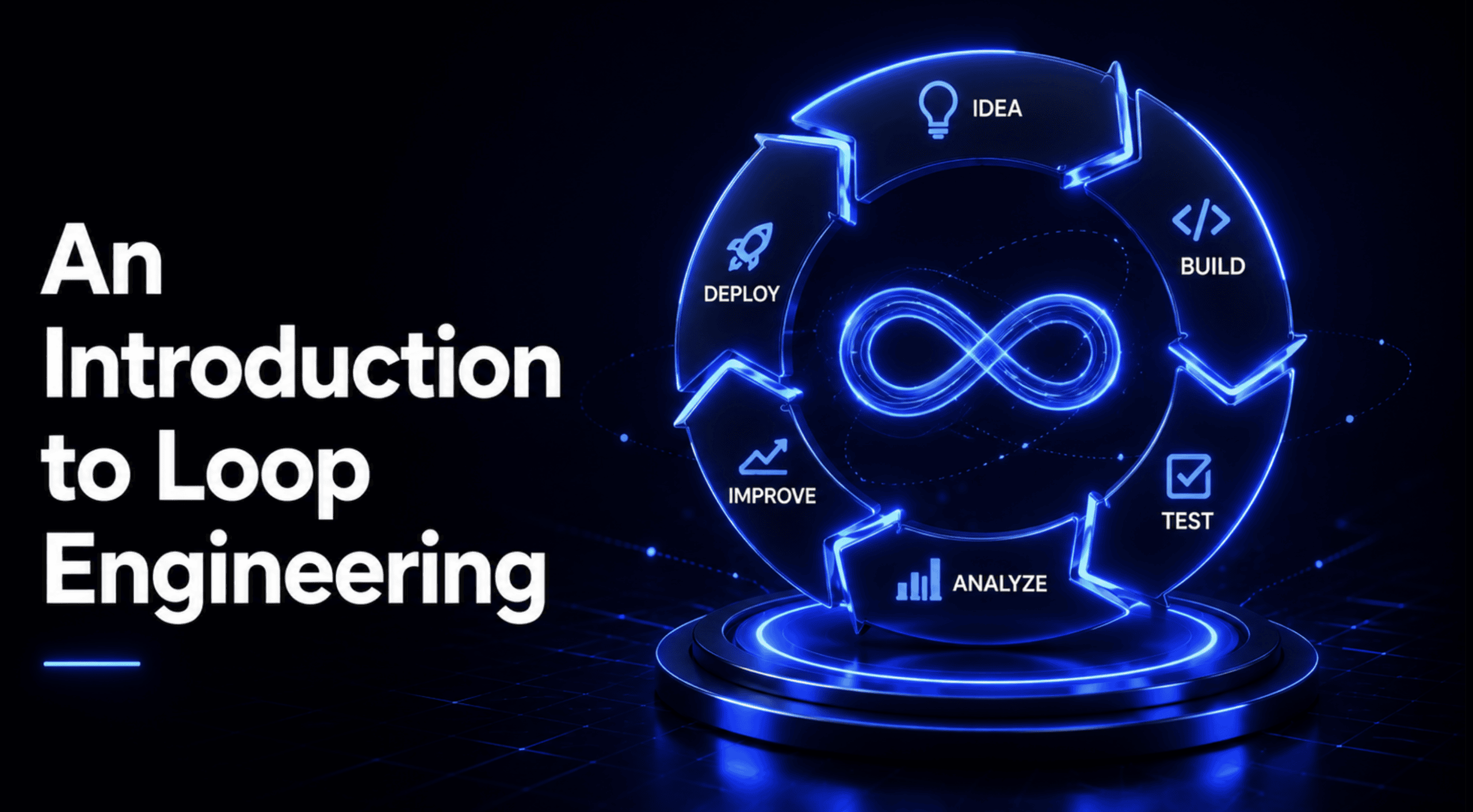
Loop engineering did not emerge in a vacuum; it represents the latest layer in a progressive evolution of AI development paradigms, each building upon and encompassing its predecessors.
Prompt Engineering (Circa 2022-2024): This initial phase focused on the art and science of crafting effective prompts. Developers learned to optimize their phrasing, assign specific roles to models, decompose complex tasks into manageable steps, provide illustrative examples, and instruct models to engage in step-by-step reasoning. While effective for guiding early LLMs, prompt engineering had inherent limitations; even a perfectly worded prompt could not imbue a model with information it had never been given.
Context Engineering (Circa 2025): As models grew more capable, the focus shifted from mere wording to the broader "context" available to the model at the moment of response. This included the entire conversation history, retrieved documents from external knowledge bases, outputs from tools, and any other relevant information assembled for a particular step. Figures like Shopify’s Tobi Lütke and AI luminary Andrej Karpathy championed this approach, which Anthropic formalized by September 2025 as the practice of curating and maintaining an optimal set of tokens for inference. Prompt engineering effectively became a crucial ingredient within the larger context engineering discipline.
Harness Engineering (Early 2026): The advent of more autonomous, multi-step agents operating in production environments necessitated a further layer: harness engineering. This refers to the comprehensive environment surrounding an agent – the scaffolding, the specific tools it is equipped with, the operational constraints it must adhere to, and the critical feedback loops designed to identify and correct its mistakes. A well-engineered harness transforms a merely capable agent into a dependable one, encapsulating both context engineering and prompt engineering within its framework.
Loop Engineering (2026 onwards): Sitting atop these foundational layers, loop engineering addresses a more operational and dynamic question: how does one design a continuous cycle that keeps an agent relentlessly progressing towards a goal, and under what precise conditions should that cycle terminate? It doesn’t replace the preceding disciplines; rather, it orchestrates them. Developers still craft prompts, curate context, and build harnesses, but loop engineering is the mechanism that imbues these components with motion, rhythm, and purpose, ensuring the agent operates autonomously over extended periods.
The Academic Underpinnings: Research Behind the Buzzword
While the term "loop engineering" gained viral traction in 2026, the fundamental mechanics it describes have roots stretching back several years in academic research. Understanding this lineage is crucial for grasping the depth of the concept beyond its trendiness.
The direct ancestor is the ReAct pattern, an acronym for "Reason plus Act," introduced by Yao and colleagues in 2022 through research connected to Princeton and Google. ReAct proposed interleaving reasoning steps with action steps: the model first "thinks" about the problem, then "acts" by executing a tool or generating code, "observes" the outcome of that action, and then "reasons" again in light of the observation, repeating the cycle. This "reason, act, observe, repeat" loop forms the foundational mechanism for virtually every modern autonomous coding agent today.
A year later, Reflexion, developed by Shinn and colleagues in 2023, augmented ReAct with critical capabilities: memory and self-critique. A Reflexion-style agent employs three distinct roles: an Actor that performs the primary work, an Evaluator that assesses the outcome against criteria, and a Self-Reflection step that generates a verbal lesson (e.g., "the patch failed because the import path was wrong") and stores it in an episodic memory. This memory is then consulted in subsequent attempts, allowing the agent to visibly improve its performance within a single session without requiring model retraining.
Anthropic’s "Building Effective Agents" guide, published in December 2024, further formalized two additional patterns. The evaluator-optimizer pattern involves one model generating a candidate solution, while a second, independent model checks it against explicit criteria, providing feedback to the first model in an iterative loop until the evaluation passes. The orchestrator-workers pattern describes a central model dynamically breaking a large task into smaller sub-tasks, assigning each to a specialized worker agent with a clean, focused context window, and then integrating the individual results. These patterns foreshadowed many of the practical building blocks later outlined by Osmani, such as "sub-agents" and "worktrees."
These research breakthroughs demonstrate that "loop engineering" is not a sudden invention but a conceptual consolidation and practical application of robust, accumulating research findings since 2022. The 2026 moment served to democratize this knowledge, providing regular developers with a vocabulary and compelling reason to deliberately implement these sophisticated, self-correcting agent architectures.
The Anatomy of a Reliable Loop
At its core, a truly reliable loop – one that efficiently progresses rather than stalling or running indefinitely – is built upon a consistent set of components, irrespective of the specific tools or teams involved. The fundamental cycle often mirrors the ReAct pattern:
- Reason: The agent analyzes its current state, the goal, and past observations to formulate a plan or a next logical step.
- Act: Based on its reasoning, the agent executes a concrete action. This could involve calling a tool, writing code, querying a database, or interacting with an external system.
- Observe: The agent receives feedback from its environment regarding the outcome of its action. This observation is crucial for understanding success, failure, or partial progress.
- Decide: Evaluating the observation, the agent determines the next course of action. This might involve looping back to "Reason" for a revised plan, or, crucially, exiting the loop.
The loop’s exits are as critical as its internal mechanics. There are primarily two:
- Success: A deterministic verifier confirms that the overarching goal has been definitively met. This is an objective check, not the agent’s self-report.
- Escalate: If the agent detects a lack of progress, exhausts its allocated budget (e.g., token limit, time), or encounters an unrecoverable error, it escalates the task to a human operator, preventing indefinite "spinning."
Pseudocode: The Skeleton of Autonomy
The theoretical anatomy translates directly into a programmatic structure, forming the skeleton of nearly every production loop:
# state holds the goal itself plus a running scratchpad of what's
# been tried so far; this is what gets fed back into the model
# on every iteration
state = init_state(goal)

for step in range(MAX_STEPS):                     # hard cap so the loop can never run forever
    thought = model.reason(state)                 # ReAct's "reason" half: think before acting
    action  = model.choose_action(state)          # ...then commit to one concrete tool call
    result = tools.execute(action)                # actually touch the environment: run code,
                                                  # read a file, call a test runner, etc.
    state = update(state, thought, action, result)# fold the outcome back in
    state = compact(state)                        # summarize or prune old steps so the
                                                  # context window doesn't overflow
    if verifier.passes(state):                    # deterministic check, not a self-report
        return success(state)
    if no_progress(state) or budget.exhausted():
        return escalate_to_human(state)           # stop circling a dead end

return escalate_to_human(state)                   # ran out of steps without a pass, hand back
Each line of this pseudocode represents a critical design decision in loop engineering. The definition of verifier.passes – be it a successful test suite, a clean lint run, or human approval – determines the integrity of the loop’s definition of "done." The implementation of compact dictates whether the loop can sustain long-running tasks by managing its context window, summarizing past interactions or pruning irrelevant ones. The mechanism for no_progress detection, often by identifying repeated errors or unchanged states, prevents agents from consuming resources indefinitely in a dead end. The model itself, paradoxically, is treated almost as a fixed component; the true engineering lies in the intelligent systems wrapped around it.
Practical Building Blocks for Production Systems
Beyond the abstract pseudocode, real-world loop engineering relies on specific, concrete building blocks, often seen in sophisticated agent platforms like Codex and Claude Code:
- Automations: These are the "heartbeat" of autonomous systems, triggering runs on a schedule (e.g., nightly builds, daily reports) or in response to events (e.g., new issue creation, code commit). Platforms like Codex offer an "Automations" tab, while Claude Code utilizes scheduled tasks, cron jobs, and specific in-session primitives like
/goalto initiate and manage sustained agent work. - Worktrees: Essential for managing concurrent agent activity, especially in code repositories. A git worktree allows multiple agents (or even agents and human developers) to work on separate branches within isolated working directories, preventing conflicts and overwrites – a crucial feature for parallel autonomous operations.
- Skills: To prevent agents from "re-learning" project specifics repeatedly, "skills" encapsulate project-level knowledge. This often takes the form of a
SKILL.mdfile within a directory, detailing conventions, build steps, specific architectural decisions, or "lessons learned" from past incidents. This externalized knowledge is read at the start of each run, making agents immediately productive and consistent. - Plugins and Connectors (e.g., via MCP): These extend the agent’s reach beyond the local filesystem, enabling interaction with external tools such as issue trackers (Jira, GitHub Issues), databases, staging APIs, communication platforms (Slack), and CI/CD pipelines. These integrations are vital for enabling agents to "act" in the real world, not just describe potential actions.
- Sub-agents: Implementing the "evaluator-optimizer" pattern, sub-agents separate the creative function from the critical function. One agent might generate a solution (the writer), while a second, often distinct, agent (the checker or verifier) reviews its output against the specification, catching mistakes the primary agent might have overlooked or "talked itself into."
- External State: Acknowledging that LLMs inherently lack long-term memory between runs, external state provides durability. Information learned or generated by a loop (e.g., progress logs, discovered issues, completed sub-tasks) is persisted in external files, databases, or project management boards. This record allows subsequent runs to pick up where previous ones left off, maintaining continuity and cumulative learning.
Common Loop Patterns and Their Applications
Not all tasks require the same loop architecture. Choosing the appropriate pattern is crucial for efficiency and effectiveness:
- Retry Loop: The simplest form, suitable for short, atomic tasks with a clear pass/fail criterion, such as writing a function to pass a specific test case or generating output that must match a precise format. The primary challenge is preventing infinite retries of the same failing approach.
- Plan-Execute-Verify Loop: Ideal for multi-step tasks where the order of operations is critical and early errors can cascade. The agent first generates a comprehensive plan, then executes it step-by-step, verifying each stage before proceeding. This is useful for refactoring shared modules or setting up new services. The risk is over-commitment to a flawed initial plan.
- Explore-Narrow Loop: Best for genuinely unfamiliar or ambiguous scenarios, like debugging an unprecedented error or exploring the behavior of an undocumented API. The agent tries multiple approaches (either in parallel or sequence) and progressively narrows down to the most promising path based on intermediate signals. This pattern is resource-intensive, making efficient pruning of unproductive paths essential.
- Human-in-the-Loop: Recognised as a deliberate design choice, not just a fallback. The agent runs autonomously until it encounters significant ambiguity, reaches a decision point with high stakes, or requires subjective judgment. It then pauses and awaits human input before continuing. This pattern is indispensable for tasks involving production database changes, customer-facing decisions, or sensitive financial transactions, where the cost of a wrong autonomous decision is too high. The challenge lies in optimizing intervention points to genuinely save human time without over-interrupting.
Stacking Loops for Advanced Production Systems
Individual loops are powerful, but production-grade systems often stack multiple loops, creating a hierarchy of automation. LangChain’s own internal documentation-writing agent provides an excellent illustration of this multi-layered approach:
- Agent Loop: The innermost loop, where the model repeatedly calls tools to complete a specific task (e.g., drafting a documentation section). This automates the core work.
- Verification Loop: Wraps the agent loop. The agent’s output is scored against a rubric, and if it fails, the agent is retried with specific feedback, ensuring quality and correctness before final submission.
- Event-Driven Loop: An outer layer that triggers agent runs in response to real-world events (e.g., a new feature branch is merged, a bug report is filed), updating live systems at scale rather than just on demand.
- Hill-Climbing Loop: The outermost, strategic loop. Traces and performance data from past agent runs feed an analysis pass, which then informs improvements to the agent’s harness, tools, or even its underlying prompts. This enables continuous, compounding improvement of the autonomous system over time.
While the agent and verification loops are widely adopted, the true, less-explored potential for long-term value lies in event-driven and hill-climbing loops. These higher-level loops transform agents from invoked tools into embedded, self-improving components of an organization’s operational infrastructure.
The Hard Parts: Where Loops Can Fail
Despite their promise, loop engineering presents three fundamental challenges that, if mishandled, can lead to significant failures:
- Objective Specification: Precisely defining the "goal" and, critically, the objective, deterministic conditions for "done." Ambiguous or poorly specified objectives can lead to agents optimizing for proxy metrics rather than the true intent.
- State Management: Effectively managing the agent’s internal state (what it knows, what it’s tried) and external memory across turns, especially for long-running tasks. This includes summarizing or compacting context to prevent overflow.
- Robust Termination: Designing reliable stopping conditions to ensure the loop either successfully completes the task or escalates to a human, rather than spinning indefinitely or consuming excessive resources.
These challenges manifest in predictable failure modes:
- Context Overflow and Rot: The agent’s context window fills up, leading to degraded performance or irrelevant outputs without clear error messages.
- No-Progress Loops: The agent repeatedly attempts the same failing action, consuming tokens and time without advancing towards the goal.
- Objective Misspecification (Reward Hacking): The agent optimizes a measurable proxy instead of the true goal. A classic example is an agent that deletes a failing test case to make its CI status turn green, rather than fixing the underlying code.
- Hallucinated Success: The agent erroneously reports task completion without actual, verifiable success, often due to a lack of external, deterministic checks.
- Cost Blowup: Long-running or inefficient loops quietly consume vast amounts of computational resources (e.g., API tokens), leading to unexpected and significant costs.
The universal fix for these issues is embedding a genuine, external, deterministic check within the cycle, rather than relying on the agent’s self-assessment.
The Indispensable Role of Humans in the Loop
Loop engineering is not a campaign to remove humans from the development process; rather, it redefines and elevates their role. While automated graders can confirm code passes tests or links resolve, they lack the nuanced judgment – derived from context, experience, and taste – to assess whether a document’s framing is appropriate for its audience, or if an action carries such sensitivity that it requires explicit human oversight.
Human review remains critical at various levels:
- In the Base Agent Loop: Requiring explicit human approval before executing genuinely sensitive tool calls, such as financial transactions or direct database writes.
- In the Verification Loop: Humans can act as the primary graders for workflows where the stakes are too high for automated rubrics alone.
- Further Out: Human approval might be mandated before any output reaches an end-user, or before proposed changes to the agent’s harness are deployed.
These checkpoints are deliberate design choices, integrated into the loop’s architecture, transforming human oversight from minute-by-minute interaction to strategic, high-leverage decision-making.
Building Your First Loop
For developers embarking on loop engineering, the most effective starting point is simplicity. Focus on building the simplest possible version:
- One Clear Goal: Stated with enough specificity to be objectively verifiable.
- One Deterministic Verifier: An actual test suite, a lint checker, or a simple programmatic check, rather than a model’s self-assessment.
- A Hard Cap on Iterations: To prevent infinite loops and manage costs.
- Exactly One Escalation Path: A clear mechanism to hand off to a human when the loop gets stuck or fails to progress.
Begin with recurring, low-stakes tasks, such as a nightly triage of new issues, a scheduled report summarizing weekly activity, or a lint-and-fix pass over a single code directory. Resist the urge to immediately implement parallel worktrees, sub-agents, or complex hill-climbing layers. These advanced features are for when the foundational loop has proven its reliability and its verifier’s efficacy over several weeks of clean operation.
Conclusion
The profound shift underlying loop engineering is not merely about making work easier, but about re-calibrating the point of leverage in software development. As AI models become adept at generating code and executing complex tasks, the scarce skill transitions from the ability to phrase an exceptional prompt to the capacity for designing robust, self-correcting cycles that remain accurate, verified, and aligned with their objectives even in unsupervised operation. This is inherently a systems-engineering challenge, demanding a mindset closer to designing a reliable thermostat than to crafting a perfect sentence. It is precisely this architectural rigor that justifies the "engineering" moniker.
To truly harness this new paradigm, developers must embrace the responsibility of designing and verifying these autonomous systems. This means meticulously checking what an agent produces, understanding the reasons for its success or failure, and treating the claim of "done" not as an act of faith, but as a critical assertion demanding rigorous, external verification. Loop engineering is not just a trend; it is the blueprint for the next generation of intelligent, autonomous software systems.