Monday.com Pioneers Large-Scale AI Teammate Deployment on Amazon Bedrock, Revolutionizing Enterprise Software Development


monday.com, a leading work operating system, has achieved an unprecedented milestone in enterprise AI adoption, integrating agentic AI "Teammates" into its core engineering processes at a scale unmatched by most organizations. Leveraging Amazon Bedrock, these sophisticated AI agents are now deeply embedded within the company’s decade-old, complex codebase, demonstrating significant improvements in developer productivity and operational efficiency. Internal production data from monday.com reveals that nine out of ten builders utilize AI coding tools monthly, a substantial increase from approximately 50% just six months prior. Concurrently, per-engineer Pull Request (PR) throughput has surged by over 50%, highlighting a transformative impact on the software development lifecycle. These figures underscore a paradigm shift in how large-scale enterprise software is built and maintained, moving beyond mere coding assistants to fully autonomous, accountable AI collaborators.
Navigating the Complexities of a Mature Enterprise Environment
The journey to this advanced state was far from a "greenfield" endeavor, a term often used to describe new projects unburdened by legacy systems. monday.com operates a robust platform supporting millions of paying users, underpinned by hundreds of microfrontends and microservices, and managed by hundreds of builders encompassing engineers, product managers, analysts, and product designers. Integrating AI agents into such a critical, high-stakes environment—where every PR directly impacts a system relied upon by millions—presented substantial challenges related to reliability, compliance, and maintaining continuous operation. Unlike straightforward demos, deploying AI agents within an enterprise SaaS context demands meticulous attention to on-call responsibilities, customer impact, and stringent regulatory compliance. This reality necessitated a carefully structured approach to AI engineering, evolving through distinct stages of integration and refinement.
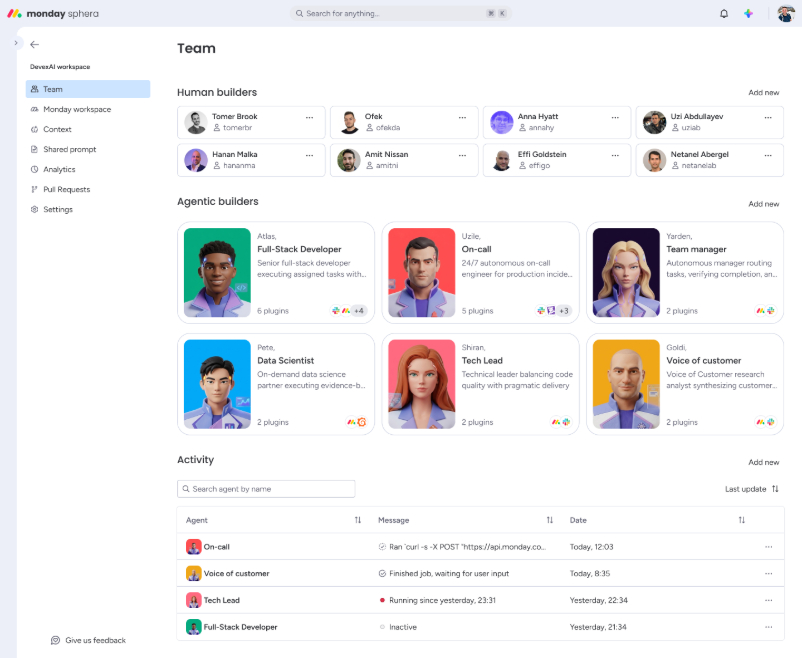
monday.com frames its AI engineering progression through three strategic levels, moving from basic tool integration to highly autonomous agents. This journey emphasizes a crucial philosophy: treating AI agents not as isolated jobs or scripts, but as integral members of development teams. This ethos is embodied in Sphera, monday.com’s internal agent system, which presents a "Teams page" showcasing a blend of human and AI profiles. Each agent, like Atlas—the software engineer at the center of this transformative effort—possesses a defined role, a manager, a scope of work, and a performance score. Atlas, for instance, operates as a Software Engineer, picking up tickets, writing PRs, and shipping features, sharing the same backlog as human teammates. This isn’t merely decorative; it establishes a stable identity for each agent that persists across communication channels like Slack, code repositories like GitHub, and monday.com’s own platform. This seamless integration ensures that agents can be tagged, assigned tasks, code-reviewed, or deactivated just like any human colleague, fostering genuine accountability and allowing them to contribute meaningfully to real-world projects.
The Foundational Architecture: AWS Services and Custom Integration
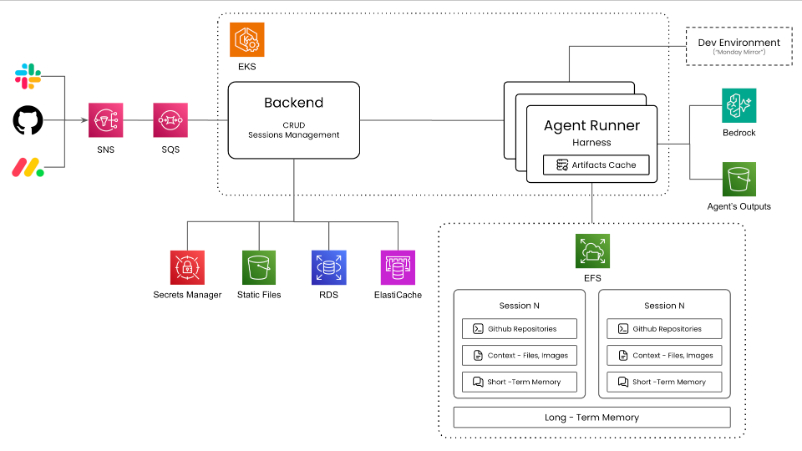
The robust architecture underpinning monday.com’s AI Teammates relies heavily on a suite of Amazon Web Services (AWS), meticulously orchestrated to handle event processing, state management, compute, and model inference. At its core, the system ensures that a monday-built agent is responsive across multiple input channels, including Slack @mentions, monday item assignments, and GitHub PR review requests. Crucially, all these external triggers converge into a single agent session, maintaining consistent memory and workspace across disk, thus eliminating the need for separate agent systems for different event types.
The architecture diagram illustrates a streamlined event path:
- Amazon Simple Notification Service (Amazon SNS): Acts as the initial entry point for all external triggers, fanning out events.
- Amazon Simple Queue Service (Amazon SQS): SNS distributes events to per-team SQS queues, categorized by topic and routing key. This provides essential features like retries, dead-letter queues, back-pressure handling for throttling, durable replay for testing, and concurrent fan-out.
- Amazon Elastic Kubernetes Service (Amazon EKS): The
monday Builders CoWORK, a collection of SQS consumers running on EKS, pulls messages, identifies the relevant agent, and dispatches the task to the appropriate agent runner pod. - Compute and State Management: Each agent runner pod on EKS utilizes:
- Amazon Relational Database Service (Amazon RDS): Likely for persistent configuration, metadata, or broader system data not requiring sub-millisecond access.
- Amazon ElastiCache: Crucial for managing live state, current tasks, run cursors, distributed locks, heartbeats, and agent/human message logs. Its sub-millisecond read capabilities and self-expiring keys make it ideal for transient, high-speed data.
- Amazon Elastic File System (Amazon EFS): Stores active session data and memory. Each session gets a dedicated directory (
/sessions/<session-id>/) containing the checked-out workspace (repos/), encrypted per-session secrets (secrets.json), and a chronological event log (messages/). Additionally, per-agent cross-session memory (/agents/<agent-id>/MEMORY.md) and daily journals (diary/YYYY-MM-DD.md) reside here. EFS provides a real POSIX filesystem, which is critical for tools like Git and npm, and ensures seamless session resumption across different EKS pods. - Amazon Simple Storage Service (Amazon S3): Used for durable records, including final transcripts, snapshots, artifacts, and evaluation data, keyed by session ID, serving as an audit trail.
- AWS Secrets Manager: Manages per-session secrets securely.
- Amazon Bedrock: Serves as the central model fabric, handling all calls to underlying large language models. Beyond just providing tokens, Bedrock offers built-in operational features essential for deploying agents at scale, such as cost management, safety controls, and capacity management, streamlining compliance and security.
monday-agent-sdk: A thin, custom wrapper around the Claude Agent SDK, designed to integrate with monday.com’s internal systems, enforce team boundaries, and manage secret lifecycles.
The choice of EFS for memory and sessions, over alternatives like S3 or DynamoDB, was deliberate. The requirement for a real POSIX filesystem by many development tools (like git and npm) and the need for seamless workspace portability when an agent session resumes on a different EKS pod made EFS an ideal fit. The "daily diary" for agents, stored as a simple markdown file, exemplifies this practical approach, allowing agents like Atlas to recall past lessons and resume work efficiently without complex vector stores or retrieval-augmented generation (RAG) ceremonies.
Five Crucial Retrofits for Enterprise-Scale AI
Integrating AI agents into a mature codebase demanded more than just architectural prowess; it required practical retrofits to address real-world operational challenges. monday.com identified five critical adjustments that transformed the agents from promising prototypes into indispensable teammates:
-
Evals Before Model Upgrades: Initially, the bar for Atlas’s PRs was simply "looks fine." As agent volume grew, this became unsustainable. Two layers of evaluation were introduced:
- Deterministic Metrics: Tracking quantifiable outcomes like PRs merged, revert rates, and zero-touch merge rates per agent.
- LLM-Scored Evals: Each PR was evaluated across five dimensions (Intent & Decision, Execution & Artifact, Completeness & Usefulness, Instruction & Boundary, Efficiency) using an LLM. These evaluations directly fed back into the agent harness. This feedback loop, rather than prompt or model changes, significantly improved agent performance across all dimensions.
-
Memory as a File, Not a Vector Store: Early attempts at agent memory using context-window stuffing and vector retrieval proved ineffective. The breakthrough came with a simple, yet powerful, solution: a per-agent
MEMORY.mdfile for cross-session knowledge and adiary/YYYY-MM-DD.mdfor daily recollections. These plain markdown files, written at session end and read at session start, provided robust, human-readable memory without the overhead or complexity of vector stores or sophisticated RAG. -
Remote Sandbox Before Human Review: Atlas’s initial PRs often passed local tests but failed in CI due to complex, environment-specific dependencies in monday.com’s large codebase. To counter this, each agent session was granted a remote sandbox where every PR was automatically deployed. Tests, checks, and even replayed production traffic ran before any human review was requested. This allowed Atlas to autonomously identify and fix issues, dramatically reducing the burden on human reviewers.
-
PR Guardrails: Automated Review Against monday.com Standards: As agent output increased, human review became a significant bottleneck. monday.com codified its engineering standards into "Guardrails"—automated reviewers that checked for metrics tagging, feature-flag hygiene, Datadog usage, security boundaries, database/microservice conventions, test quality, and documentation. These Guardrails, integrated with internal knowledge bases, provided consistent, automated feedback. Approximately one in five PRs (both agent and human-authored) failed a standard and was bounced back, with human overrides being rare. This system shifted enforcement from human reviewers to automated processes.
-
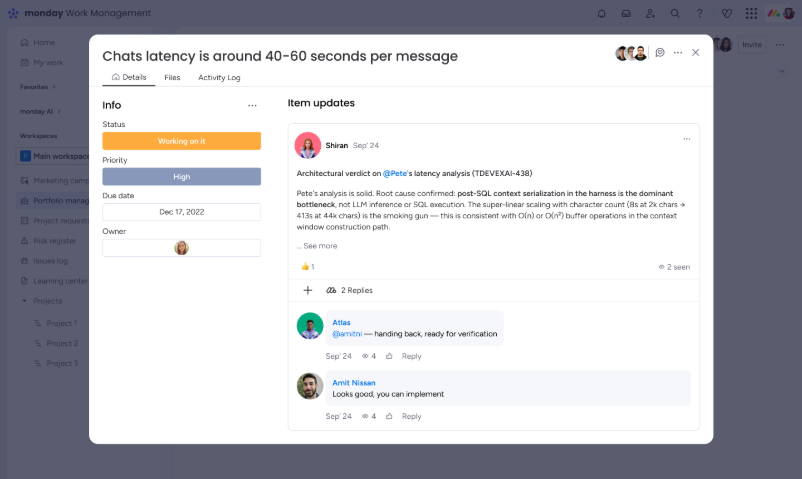
Builders CoWORK: monday Boards as the Shared State Layer: The final significant hurdle was ensuring agents didn’t operate in silos, submitting PRs that no human team owned. The solution was the CoWORK workspace, a user-facing interface built on monday boards. This allowed agent tasks, status, blockers, and handoffs to reside on the same boards as human teams, inherently integrating accountability into existing human workflows. This seamless co-location of human and AI tasks transformed agents into true co-workers.
The Leap to Autonomy: Morphex and Confidence-Scored Merging
By late Q1 2026, the primary bottleneck shifted from code generation to human review, even with Guardrails in place. This necessitated the creation of Morphex, monday.com’s first fully autonomous engineering agent. Morphex operates within the same repository, CI pipeline, Guardrails, and revert protocols as human builders. A remarkable nineteen out of every twenty Morphex PRs merge automatically, not by bypassing review, but by successfully clearing every gate. This means an approved PR ships directly to production without human intervention. Morphex generates more PRs monthly than most individual engineers, and its rejected PRs fail for the same reasons a human engineer’s might: flaky tests, ambiguous specs, or unhandled edge cases.
The key to this high auto-merge rate lies in a rigorous, data-driven confidence scoring system. Across top PR-generating agents, approximately three in ten PRs merge, with about three-quarters of these requiring zero human edits. Crucially, the revert rate remains in the low single digits. The Guardrails system proactively filters out about a quarter of agent PRs that aren’t ready, leaving a pre-filtered, higher-quality population for potential auto-merging. A low revert rate within this pre-filtered group signals the viability of confidence-based auto-merge.
The confidence score is a composite of four real-time signals available when a PR is opened:
- Guardrails Score: A comprehensive assessment from the automated review system.
- Test Run Coverage and Pass Rate: Metrics indicating the robustness of the new code.
- Revert Rate for the Agent (Historical): The agent’s past performance in producing stable code.
- Code Change Impact (Small vs. Large): A heuristic recognizing that smaller, contained changes often carry less risk.
If the combined score surpasses a predefined threshold, the PR merges automatically. If it falls below, the PR is routed to a human reviewer, with the specific failing signal highlighted. This strategic approach represents the transition from Level 2 to Level 3 AI engineering, not by eliminating humans, but by intelligently removing them from scenarios where the system’s signal is sufficiently strong to ensure a positive outcome. monday.com’s immediate goal is to increase the fraction of merged agent PRs that ship without human review, while maintaining or improving the revert rate. This philosophy underscores a core tenet of AI engineering: the goal is not to create perfect agents, but to build robust feedback loops that enable imperfect agents to be safely trusted, thereby saving valuable human time and effort.
Broader Implications and Industry Impact
monday.com’s success in deploying AI Teammates at scale carries profound implications for the future of software development and enterprise AI adoption. It demonstrates that advanced AI agents can move beyond experimental environments and into the demanding realities of production systems, delivering tangible productivity gains. This achievement suggests a future where software engineers increasingly collaborate with AI, offloading routine, repetitive, or well-defined tasks to autonomous agents, allowing human talent to focus on higher-level problem-solving, architectural design, and complex innovation.
The "agent as a teammate" model challenges traditional notions of automation, emphasizing integration, accountability, and shared context. By making agents auditable, reversible, and trustworthy through existing governance structures, monday.com sidesteps the need for entirely new oversight layers. This approach fosters confidence and facilitates wider adoption within organizations that prioritize stability and compliance. The lessons learned, particularly the importance of pragmatic memory solutions (like MEMORY.md), rigorous evaluation frameworks, remote sandboxing, and automated guardrails, provide a valuable playbook for other enterprises embarking on similar AI integration journeys.
Lessons Learned and Future Outlook
Reflecting on their journey, monday.com openly shares three key areas where they would have acted differently:
- Early Evals: Integrating comprehensive evaluation systems from day one would have accelerated Atlas’s performance significantly.
- Pragmatic Memory: Over-investing in complex vector stores was a misstep;
MEMORY.mdon EFS proved to be the more effective and simpler solution. - Integrated Workspaces: Initially, the CoWORK workspace was separate, forcing context-switching for humans. Integrating it directly into monday boards should have been the initial decision.
monday.com is not open-sourcing its monday-agent-sdk due to its bespoke nature, but emphasizes sharing the architecture and operational playbook. The value, they contend, lies not in the wrapper itself, but in the comprehensive harness and integration with monday.com’s core systems. By openly sharing their experiences, monday.com and the Amazon Bedrock team aim to accelerate industry progress in deploying production-grade AI agents. Their pioneering work serves as a powerful testament to the potential of AI to fundamentally reshape how complex software is engineered, making development faster, more efficient, and ultimately, more intelligent.
About the authors
This section was empty in the original article, so it will remain empty here as per instructions.