Maintaining High Availability for Apache HBase on Amazon EMR: A Strategic Operational Framework

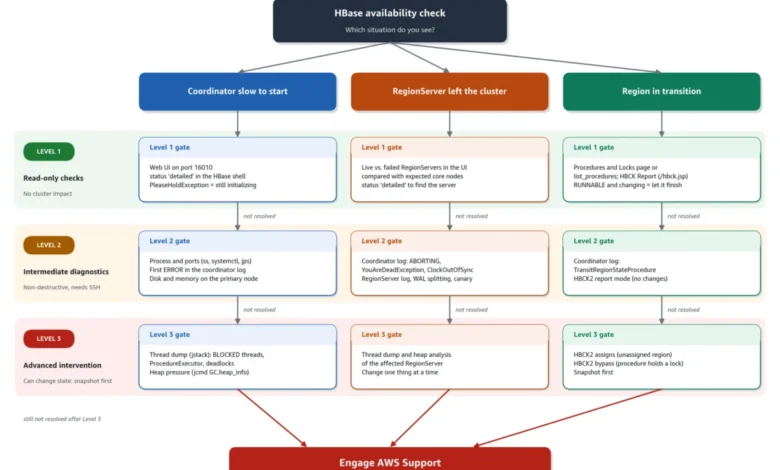
Running Apache HBase on Amazon EMR provides enterprises with a highly scalable, high-performance NoSQL database solution capable of handling petabyte-scale workloads. However, the distributed nature of HBase, which relies on the complex orchestration of the HMaster (coordinator), RegionServers, and the underlying HDFS or Amazon S3 storage layers, necessitates a rigorous operational discipline. When availability incidents occur, they often manifest through specific, predictable signatures in system logs and web interfaces. By adopting a structured, three-tiered troubleshooting methodology, site reliability engineers (SREs) and data administrators can transition from reactive firefighting to systematic, repeatable cluster restoration.
The Anatomy of HBase Cluster Availability
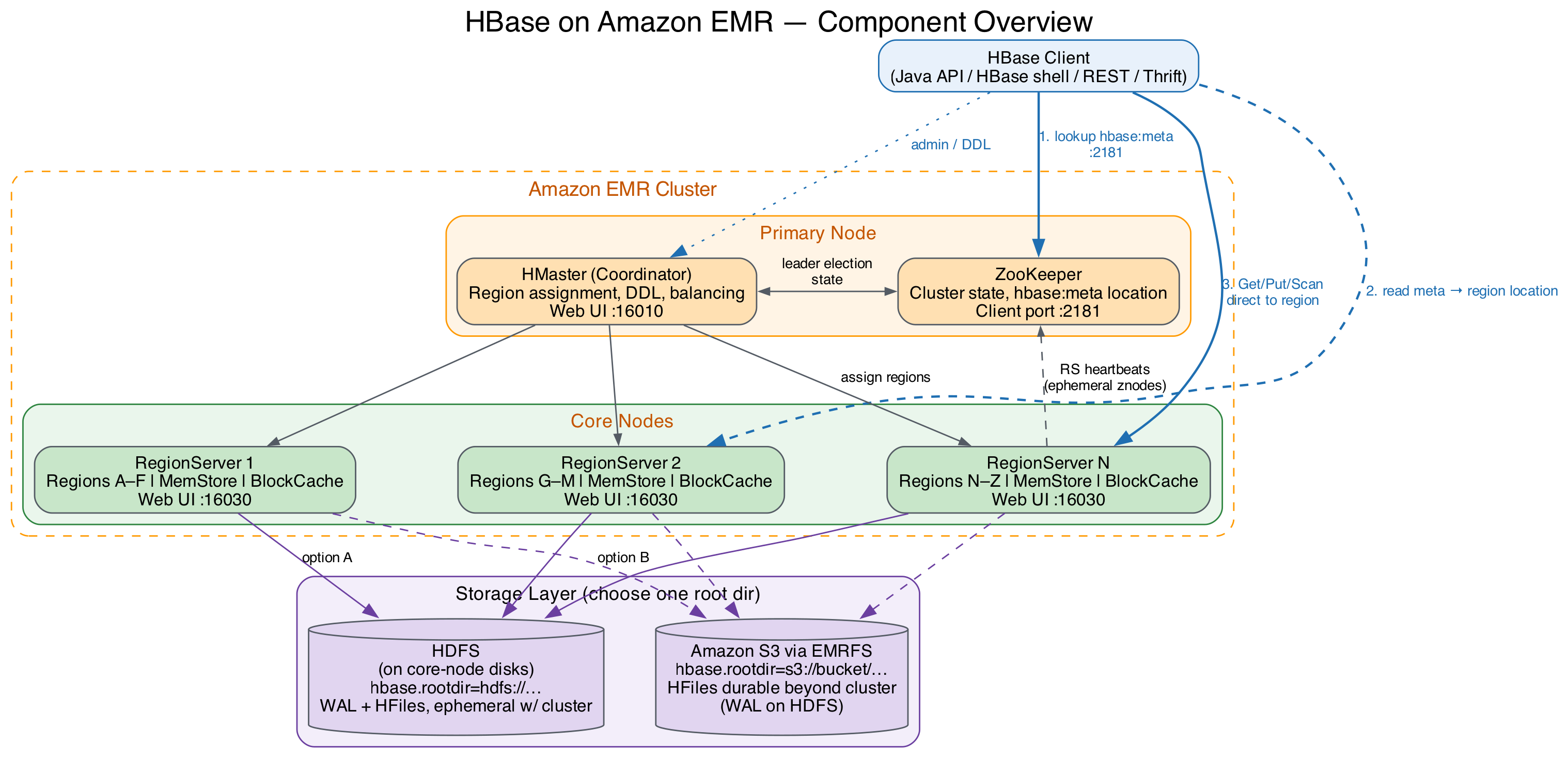
To understand the necessity of this operational framework, one must recognize the dependencies inherent in an EMR-based HBase architecture. The HMaster, residing on the EMR primary node, acts as the cluster’s central nervous system, managing region assignments and monitoring the health of RegionServers. Below it, RegionServers handle the heavy lifting of data storage and retrieval. ZooKeeper provides the coordination layer, ensuring that even if a node fails, the cluster can maintain a consistent view of state.
Availability issues typically fall into three categories: initialization delays, unexpected node departures, and orphaned regions in transition. According to industry benchmarks, the time-to-recovery (TTR) for these clusters is heavily dependent on the operator’s ability to triage the specific component—storage, JVM, or network—before attempting remediation.
Tiered Troubleshooting: A Standardized Approach
The industry-standard approach for managing HBase at scale involves a triage decision tree that moves from non-intrusive observation to surgical intervention. This methodology minimizes the risk of accidental data corruption, which can occur when inexperienced administrators attempt to manually manipulate ZooKeeper znodes or HDFS blocks.
Level 1: Passive Observation (Read-Only)
The primary phase of any diagnostic process involves gathering data without altering the state of the cluster. Operators should first consult the HMaster web UI (typically port 16010) and the RegionServer UI (port 16030). These interfaces provide real-time visibility into the "RIT" (Regions in Transition) count and the current status of the hbase:meta table.
Level 2: Diagnostic Analysis
Once the scope of the issue is confirmed via the UI, the secondary phase focuses on log interrogation. On Amazon EMR, log files are centralized and provide the most accurate forensic evidence of a failure. Key log files for the HMaster are located in /var/log/hbase/hbase-hbase-master-*.log. By searching for specific error signatures—such as SafeModeException or ConnectionLoss—engineers can rapidly differentiate between transient network issues and underlying hardware or configuration failures.
Level 3: Controlled Intervention
The final tier involves active remediation, such as using the HBCK2 (HBase Check) tool to resolve inconsistent regions or adjusting EMRFS retry limits to mitigate Amazon S3 request throttling. This stage is reserved for when the root cause has been definitively identified through log analysis.
Addressing the HMaster Initialization Delay
One of the most critical scenarios for an administrator is an HMaster that remains in a perpetual state of initialization. Because the HMaster coordinates region failover, a stalled initialization prevents the cluster from recovering from existing RegionServer losses.
Analysis of common failure patterns suggests that HMaster startup delays are frequently tied to external dependencies rather than internal HBase code. If the cluster is configured for HDFS storage, the NameNode must exit safe mode before the HMaster can proceed. If the cluster is utilizing Amazon S3, S3 request throttling (HTTP 503 errors) is a frequent bottleneck. Data from EMR performance monitoring indicates that as clusters scale beyond a certain threshold, the default retry strategies for EMRFS may be insufficient. By adjusting the fs.s3.maxRetries property to 30 or implementing an AIMD (Additive-Increase/Multiplicative-Decrease) strategy, organizations can significantly reduce the impact of these temporary throttle events.
The Role of JVM and Garbage Collection
The HBase coordinator is a JVM-based process, making it susceptible to "stop-the-world" garbage collection (GC) pauses. In high-load environments, these pauses can exceed the ZooKeeper session timeout, causing the HMaster to be incorrectly flagged as dead.
Operational telemetry shows that monitoring JvmPauseMonitor logs is essential for diagnosing these events. If the logs show repeated multi-second pauses, the solution is rarely a restart; rather, it requires a tuning of the heap size or a review of the GC configuration. Failing to address these underlying JVM performance issues leads to "flapping," where the HMaster constantly attempts to re-elect itself, leading to sustained cluster instability.
Managing RegionServer Resilience
When a RegionServer disappears, the immediate impact is the unavailability of the data regions it served. However, the secondary impact—the cascading effect of WAL (Write Ahead Log) splitting—can be even more severe. During recovery, the HMaster must split the logs of the departed server to recover uncommitted edits.
If the WAL splitting process is slow, the cluster may appear stalled, leading to further client-side timeouts. SRE teams are advised to use the hbase canary tool to conduct a health check across tables. This tool provides an objective assessment of which regions are genuinely inaccessible, preventing the common mistake of assuming a cluster-wide failure when only a subset of data is affected.
Consistency and the HBCK2 Toolset
In earlier versions of HBase, the hbck tool was often used to perform automated repairs. However, in modern HBase 2.x environments deployed on EMR 6.x and 7.x, manual intervention must be handled with extreme caution. The modern HBCK2 tool is designed for precision, not mass repair.
Experts emphasize that operators should prioritize the "report" mode of HBCK2 over "fix" mode. By identifying the specific missing regions or inconsistent procedures, an operator can apply a surgical fix. The most dangerous action an operator can take is the manual deletion of ZooKeeper znodes. If an administrator deletes the wrong node, the HMaster may lose the state required to rebuild the region map, potentially resulting in irreversible data loss.
Broader Implications and Strategic Best Practices
The evolution of cloud-native data stores like HBase on EMR has fundamentally shifted the responsibilities of the DBA. While traditional on-premises administrators were responsible for physical hardware, the modern cloud administrator must be an expert in distributed systems theory, networking, and API throttling behaviors.
Industry analysis suggests that the most successful organizations treat HBase availability as a continuous process rather than a series of one-off fixes. This involves:
- Automation of Monitoring: Utilizing CloudWatch metrics to trigger alerts before an HMaster reaches a critical state.
- Infrastructure as Code (IaC): Ensuring that configurations for
hbase-site.xmlandemrfs-site.xmlare version-controlled, allowing for rapid rollbacks during troubleshooting. - Capacity Planning: Proactively scaling core nodes to manage compaction pressure and ensure that the HDFS storage layer remains within recommended capacity thresholds.
Conclusion
The operational health of an Apache HBase cluster on Amazon EMR is a reflection of the team’s ability to interpret systemic signals. Whether it is a slow-starting HMaster, a missing RegionServer, or a region stuck in transition, the path to resolution is paved with logs, metrics, and methodical verification. By adhering to the three-tiered diagnostic process—Level 1 for confirmation, Level 2 for evidence, and Level 3 for remediation—organizations can maintain the high availability required for modern, data-intensive applications. As clusters grow in complexity, the ability to distinguish between transient noise and structural failure will remain the defining characteristic of a resilient data infrastructure. With this foundational knowledge, administrators can ensure that their HBase environments remain performant, available, and ready to meet the demands of their business.
Related posts: