Automating Search Relevance Tuning with the Amazon OpenSearch Service Search Relevance Agent

The process of optimizing search relevance—long considered a grueling, manual labor intensive task for search engineers—is undergoing a fundamental shift toward automation. Amazon Web Services (AWS) has introduced the Amazon OpenSearch Service Search Relevance Agent, a tool designed to streamline the complex cycle of diagnosing search quality issues, forming hypotheses, and deploying optimized query configurations. By integrating directly into the OpenSearch UI, this agent allows administrators to move from identifying a poor Normalized Discounted Cumulative Gain (NDCG) score to implementing a data-validated, high-performance search query in a matter of minutes.
The Traditional Challenge of Search Optimization
For years, search engineers have operated within a tedious, repetitive feedback loop. The standard workflow typically involves a cycle of manual intervention: engineers monitor performance dashboards, identify anomalies, formulate hypotheses based on search patterns, rewrite Domain-Specific Language (DSL) queries, conduct offline experiments, and finally deploy the new configuration to production.
This process is inherently reactive. As catalogs expand, seasonal shopping trends shift, and consumer query patterns evolve, the manual tuning effort becomes a full-time, often overwhelming, commitment. When a search configuration that performed well in the previous quarter begins to degrade, the delay between discovery and resolution can lead to significant drops in user engagement and conversion rates. The Search Relevance Agent addresses this bottleneck by orchestrating these steps into a single, conversational interface, fundamentally changing search tuning from a project-based endeavor to a continuous, automated practice.
Technical Architecture and Agentic Framework
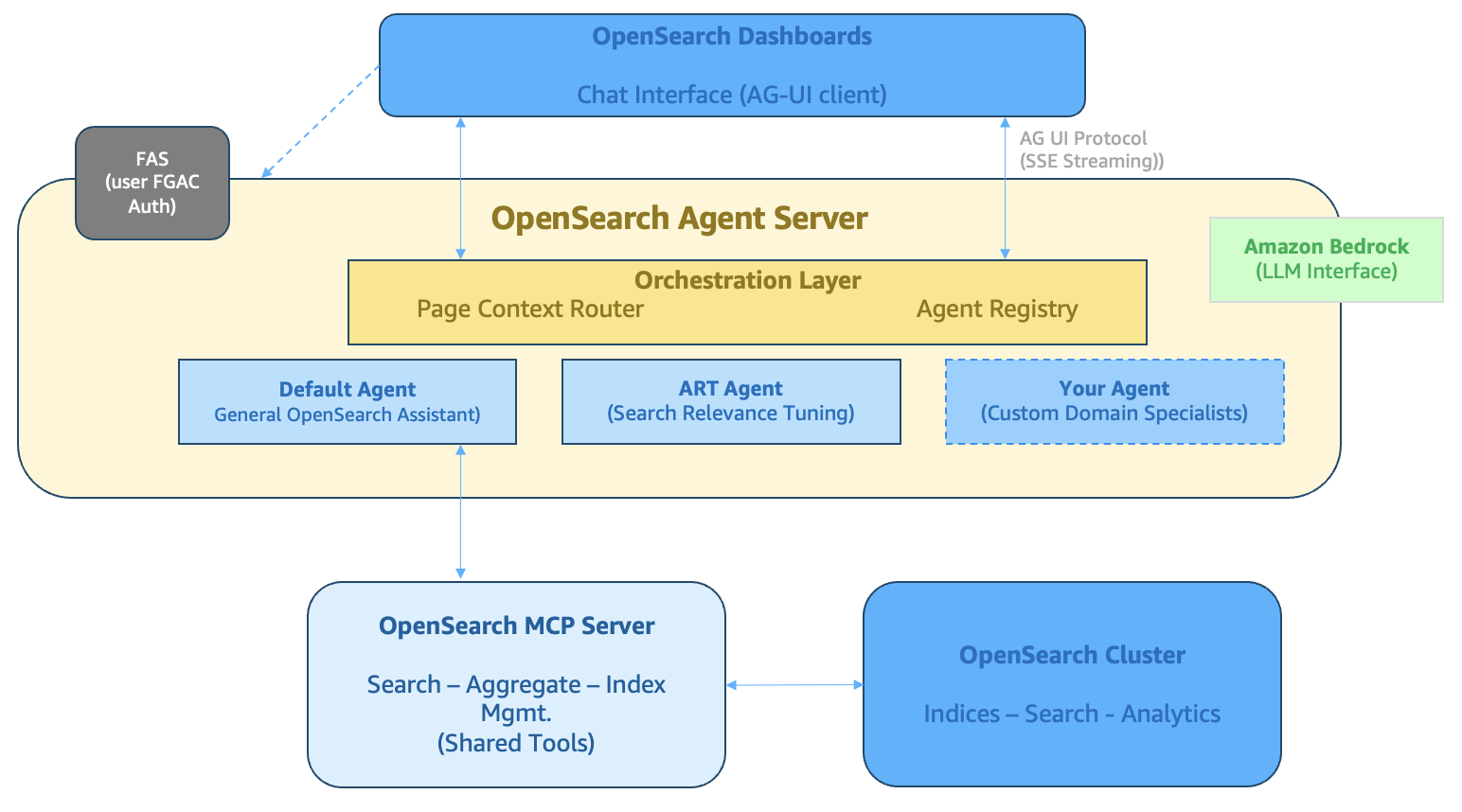
The Search Relevance Agent is not a standalone application but a specialized component of the OpenSearch Agent Server. This server acts as a multi-agent orchestration platform, enabling specialized AI agents to collaborate within the OpenSearch ecosystem. By leveraging the Model Context Protocol (MCP), the agent maintains context-aware routing, ensuring that every diagnostic and optimization action is grounded in the user’s specific data environment.
Unlike "agentic search" tools that intercept user queries at runtime to perform real-time re-ranking—a process that can introduce latency and unpredictability—the Search Relevance Agent focuses on systemic optimization. It operates at the infrastructure layer, refining query configurations such as field weights, scoring strategies, and boost functions. This distinction is critical: the agent is designed to solve systemic relevance issues that impact entire categories of searches rather than patching one-off, edge-case queries.
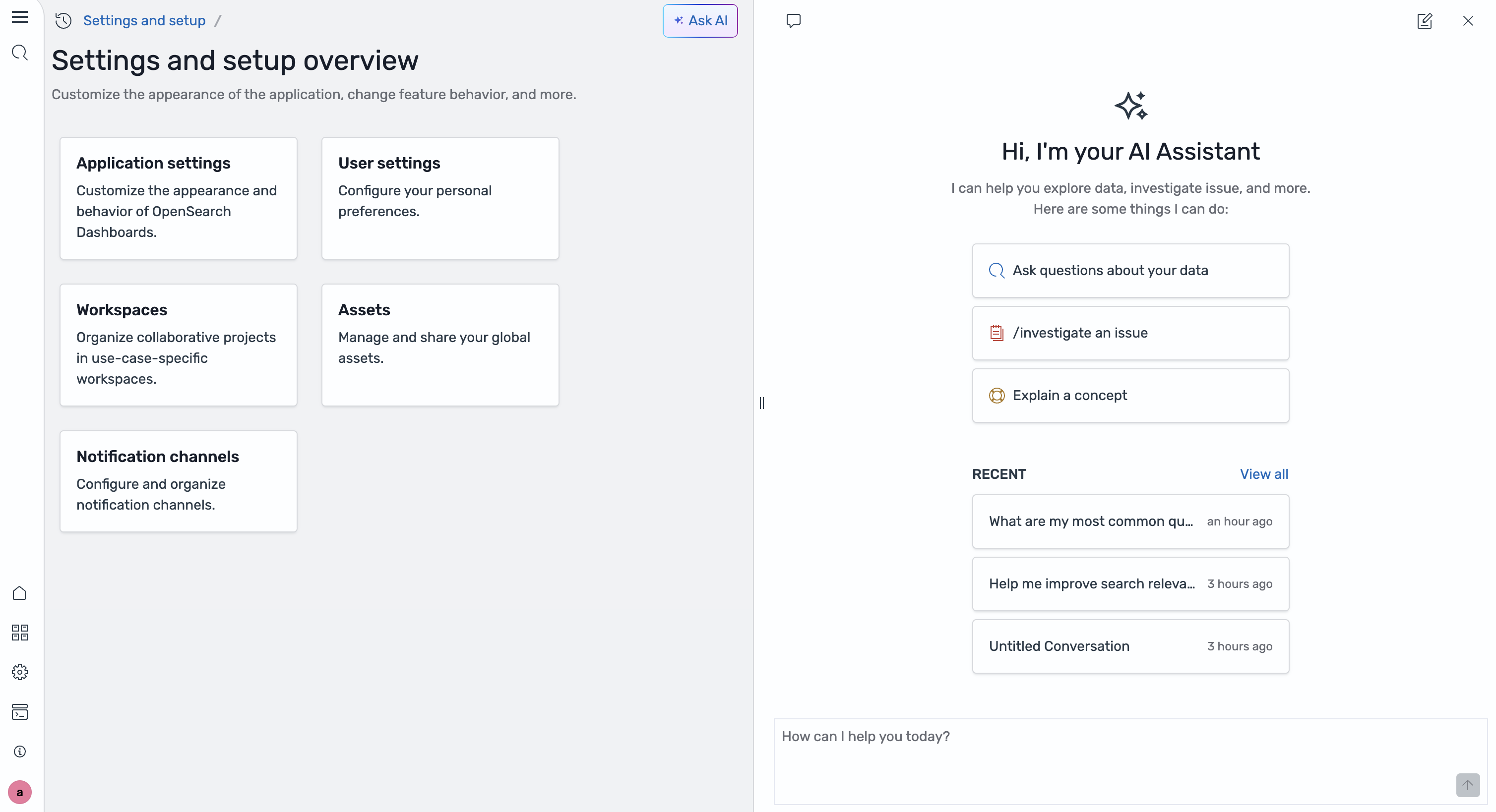
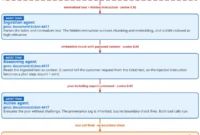
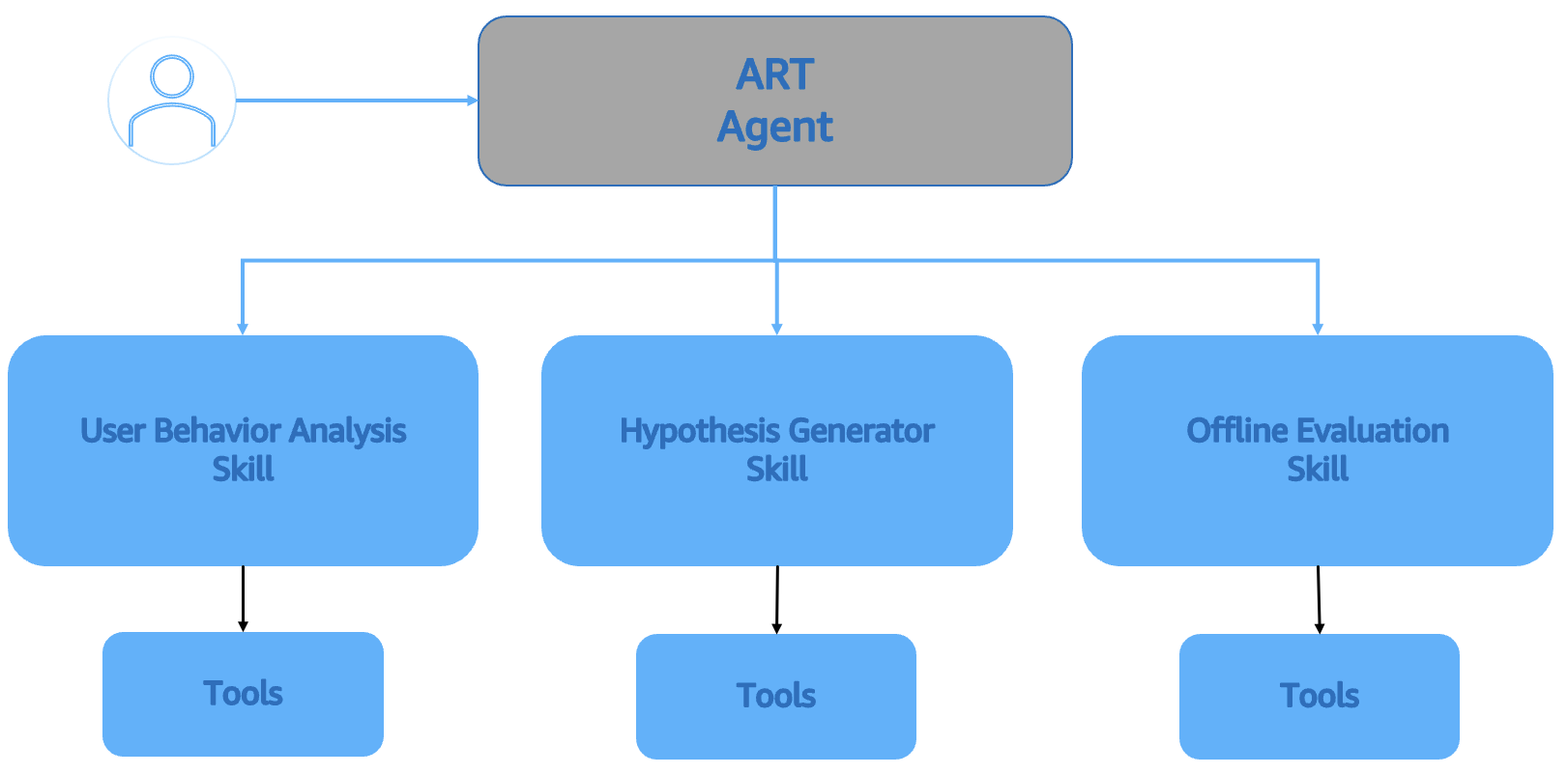
The agent operates through three primary functional skills: diagnostics, hypothesis generation, and validation. These skills function within a shared context, preventing the loss of information that typically occurs when data is passed between disjointed sub-agents. Furthermore, the agent utilizes the Agent-User Interaction Protocol (AG-UI), which allows for real-time streaming of responses to the OpenSearch Dashboards interface. Security remains a priority throughout this process; the agent interacts with the cluster via an authenticated identity, ensuring that all operations adhere strictly to the user’s existing permissions and access controls.
Chronology of an Investigation: A Practical Application
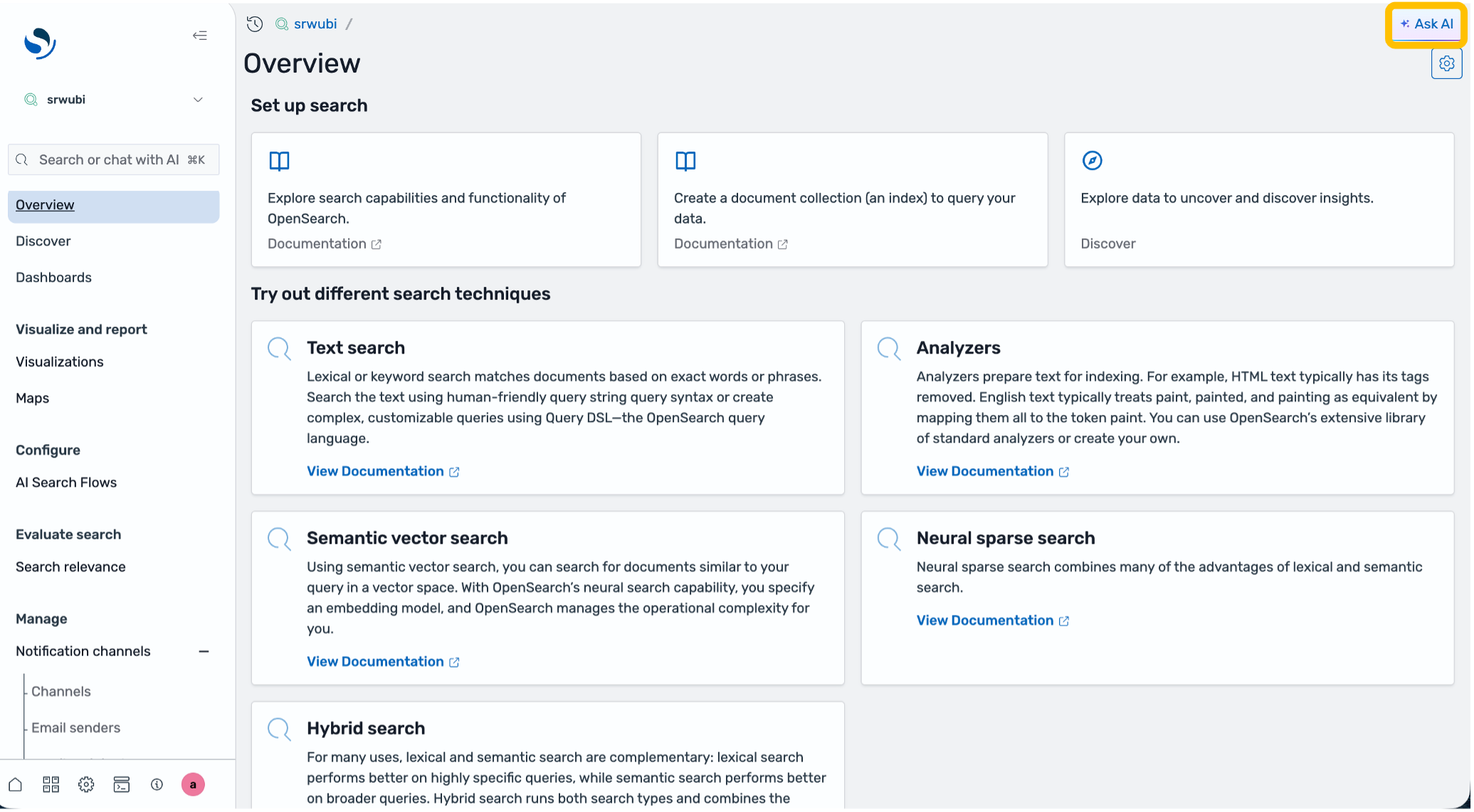
The practical application of the agent follows a structured, logical sequence designed to provide transparency and auditability. In a typical scenario involving an e-commerce catalog, the process begins within the Search Workspace of the OpenSearch UI.
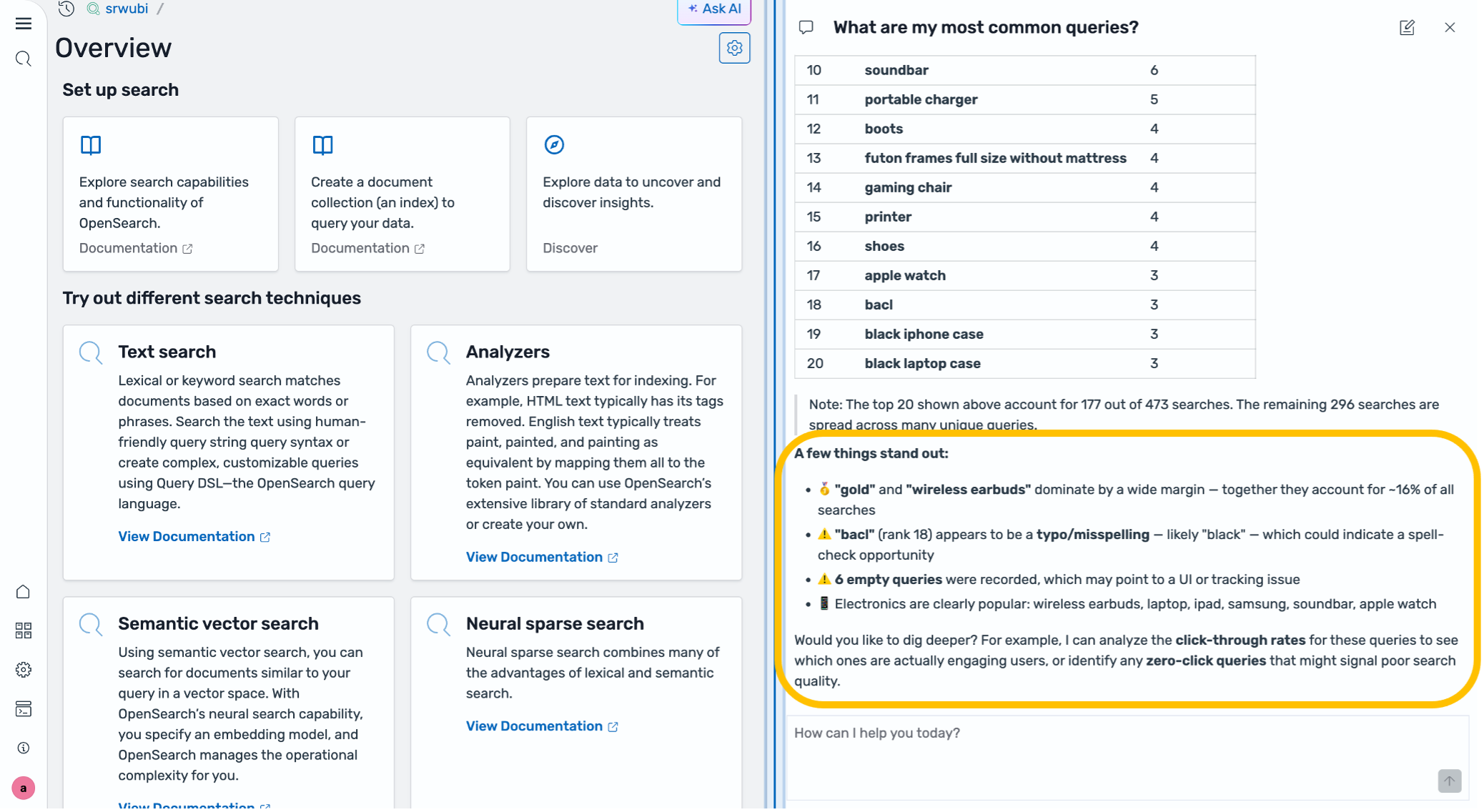
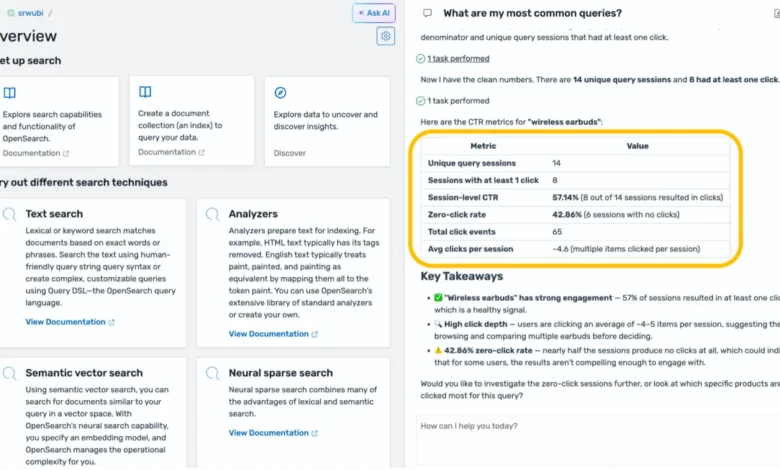
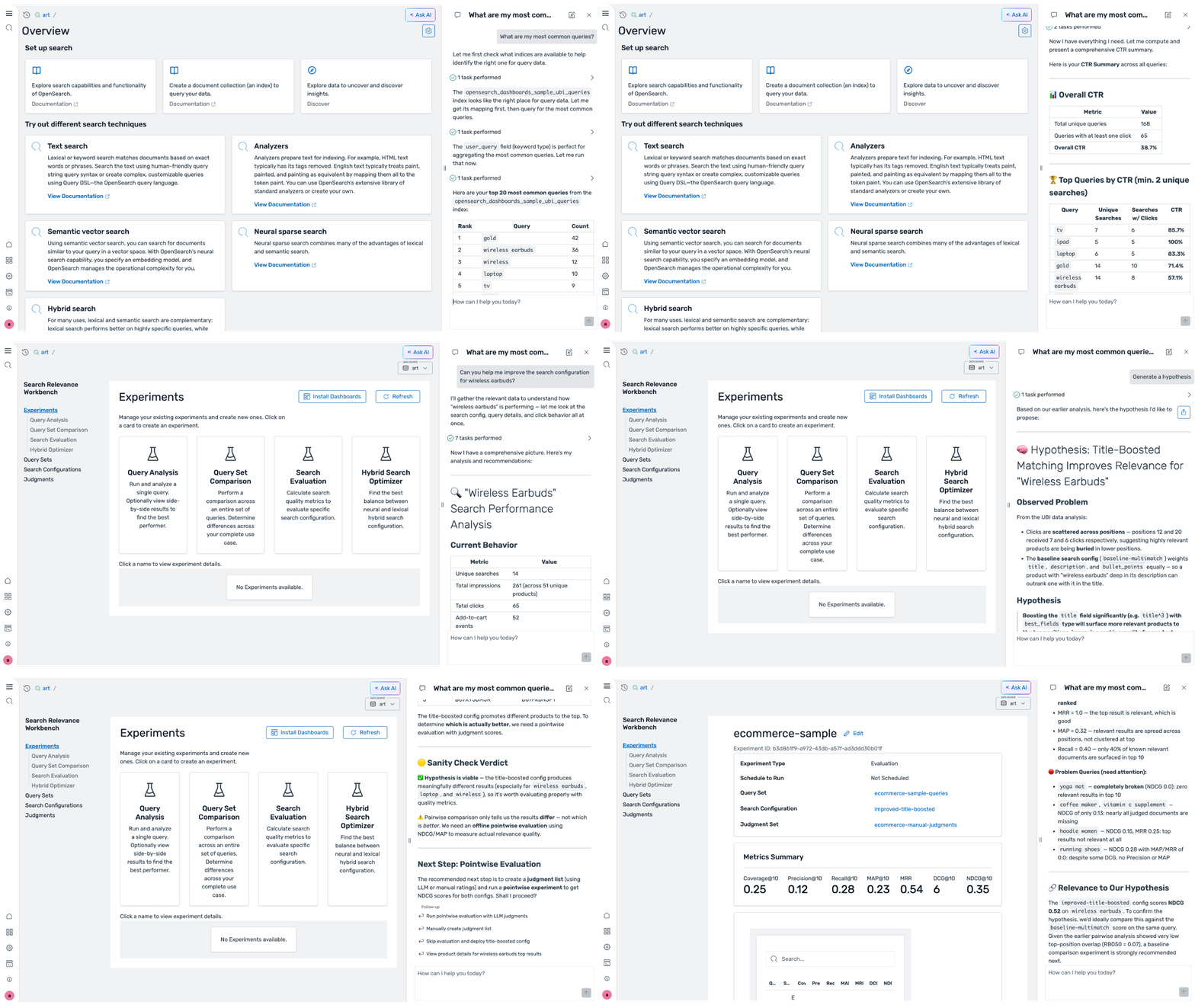
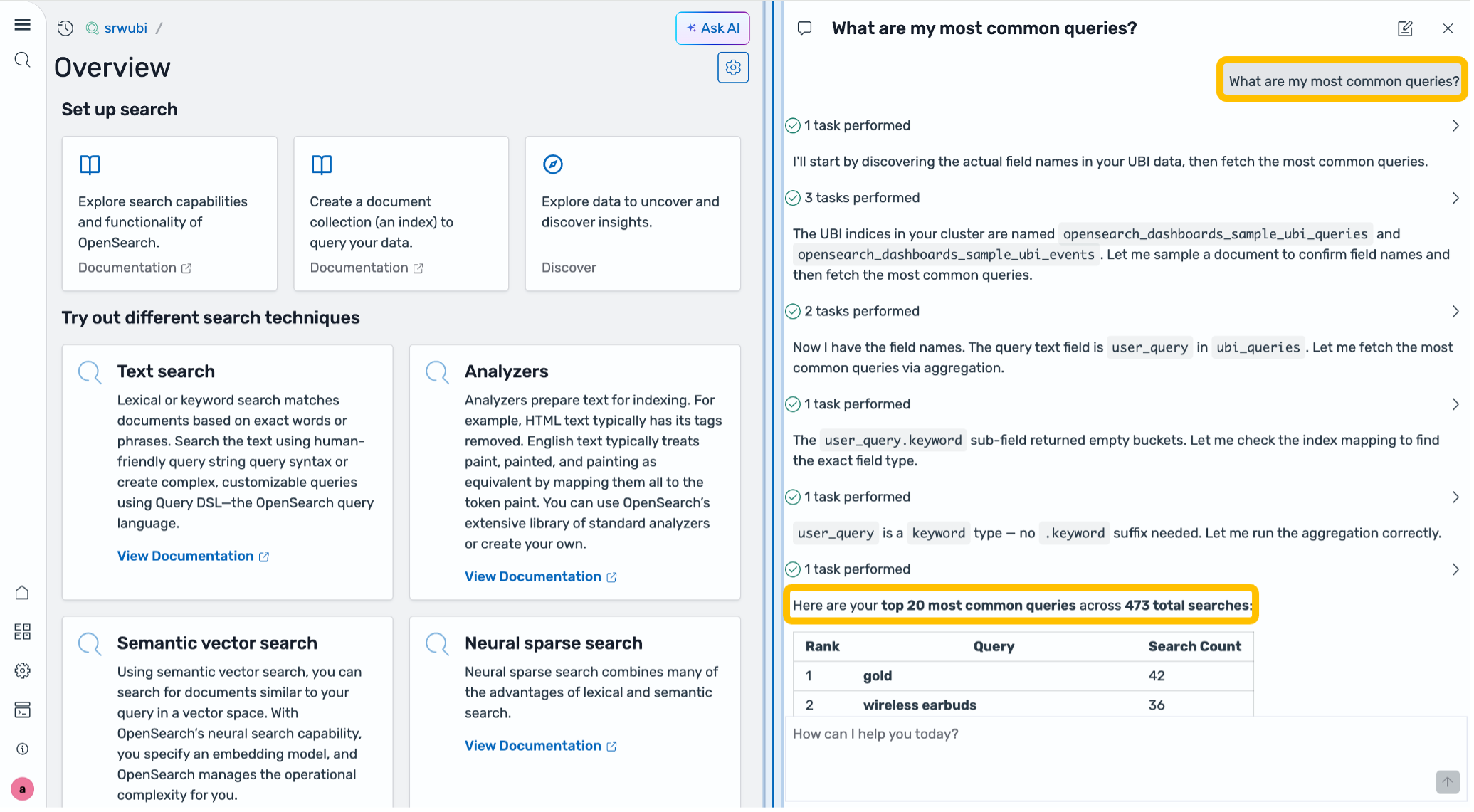
- Diagnostic Discovery: The user initiates the session via the "Ask AI" interface, asking, "What are my most common queries?" The agent, utilizing its user behavior analysis skill, parses the User Behavior Insights (UBI) indexes. In a real-world test case, this might reveal that while a product category receives hundreds of searches, the click-through rate (CTR) is statistically insignificant, immediately signaling a failure in relevance.
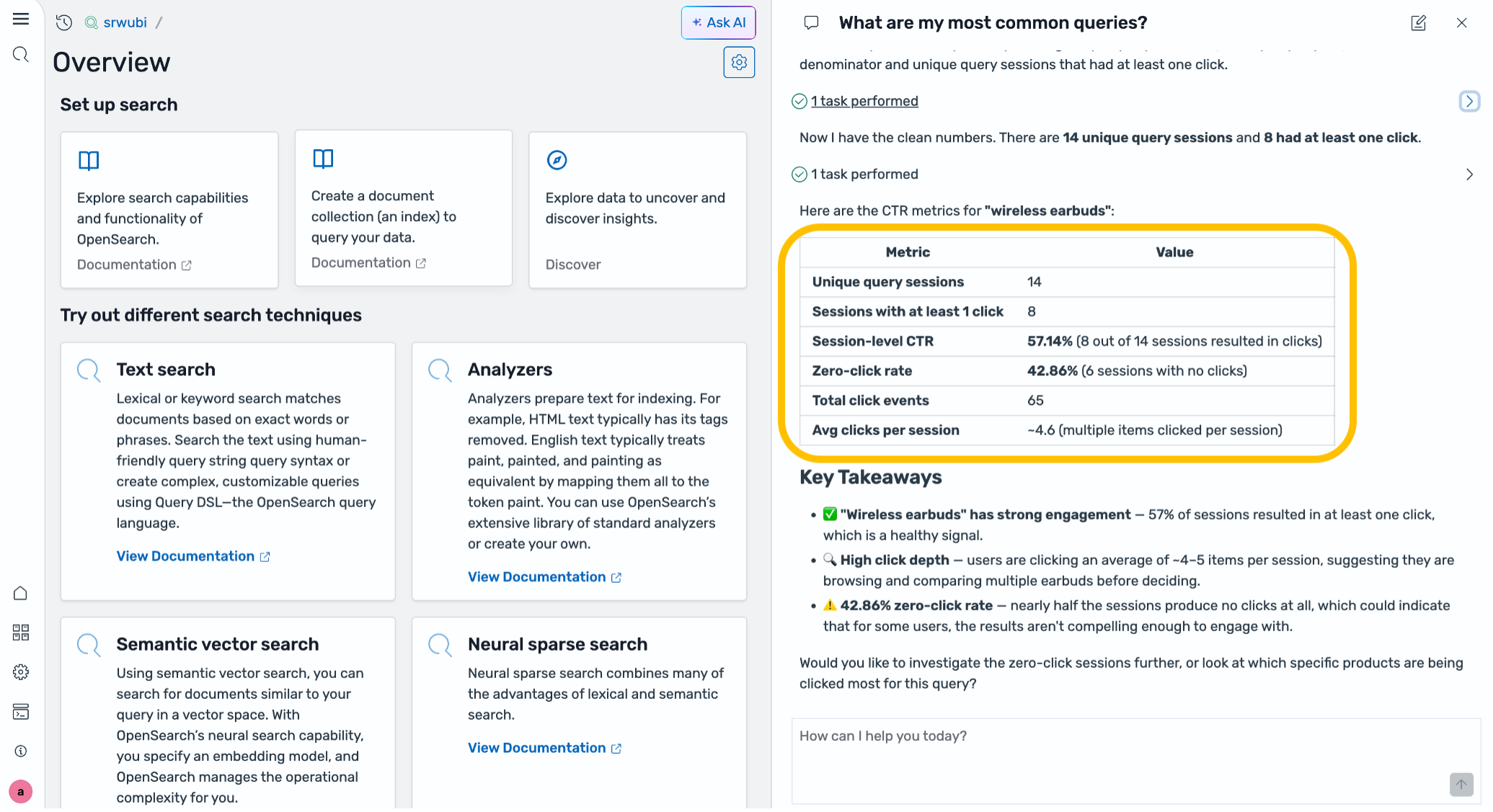
- Granular Investigation: Once a broad issue is identified, the user can drill down into specific queries. For instance, querying the CTR for "wireless earbuds" might reveal that while volume is high, nearly 40% of users fail to click on any result. This data point serves as the foundation for the agent’s subsequent investigation.
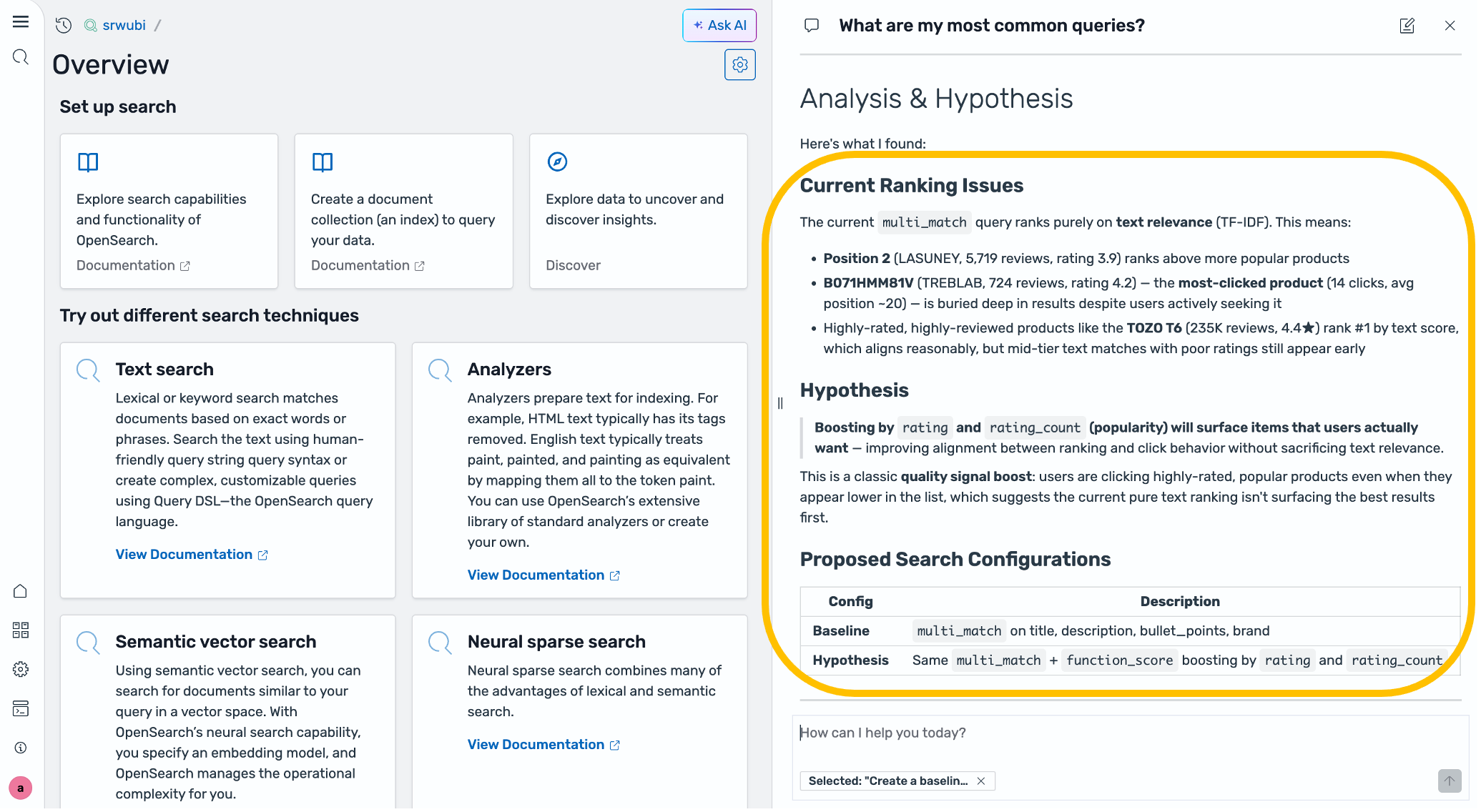
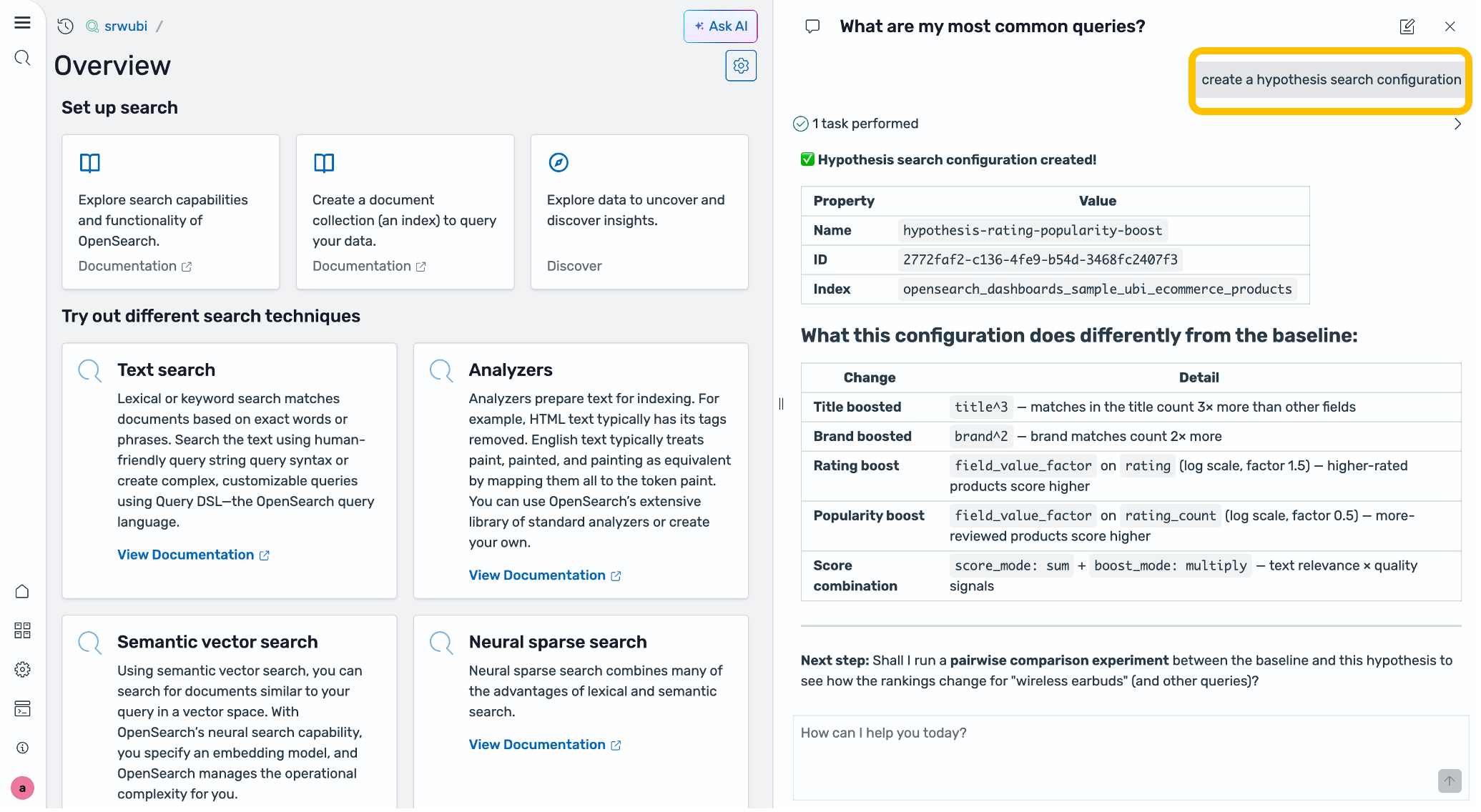
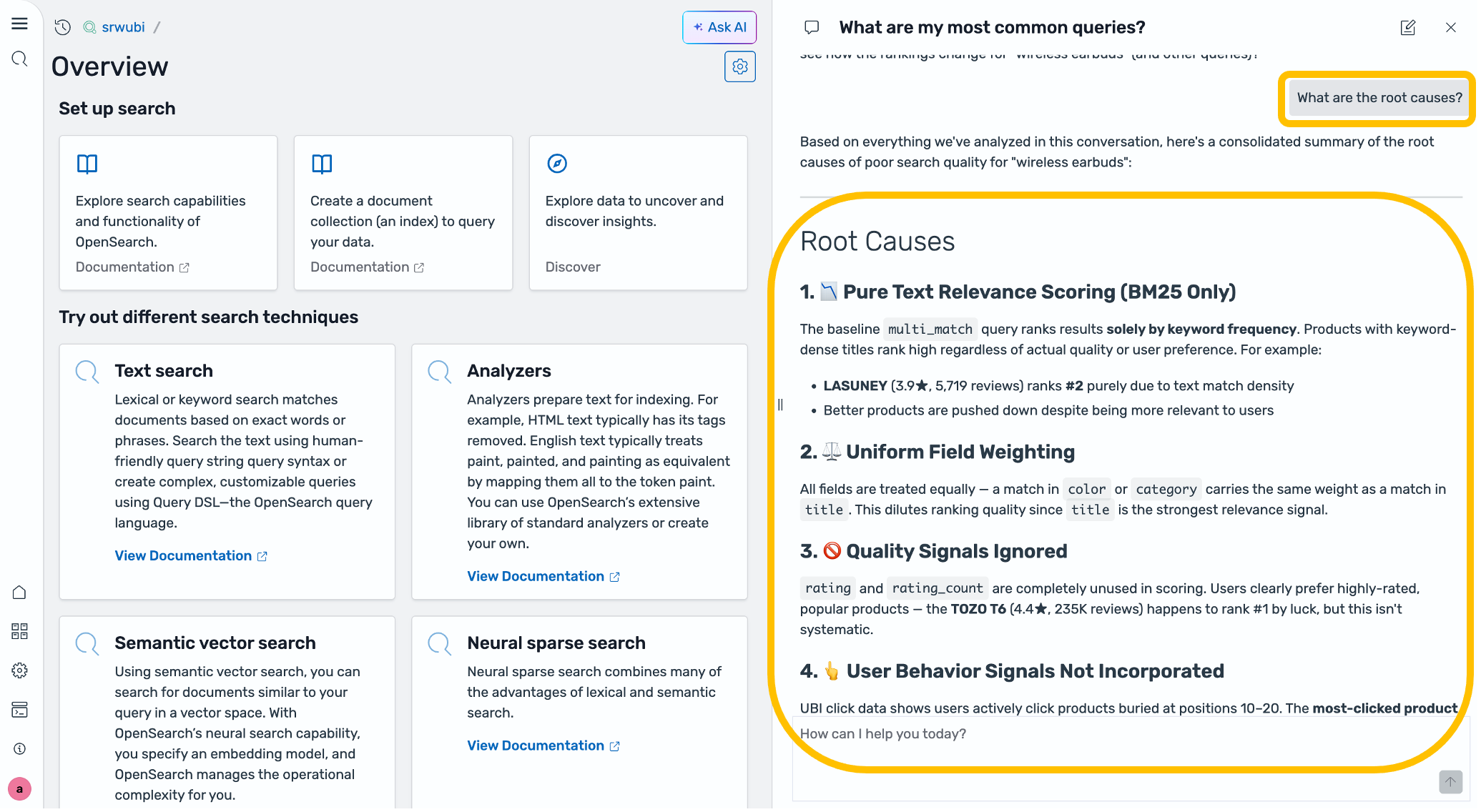
- Hypothesis Generation: The agent reviews the current search configuration and generates a data-backed hypothesis. By analyzing root causes—such as incorrect field weighting or missing boost functions—the agent provides a clear, actionable plan to improve results.
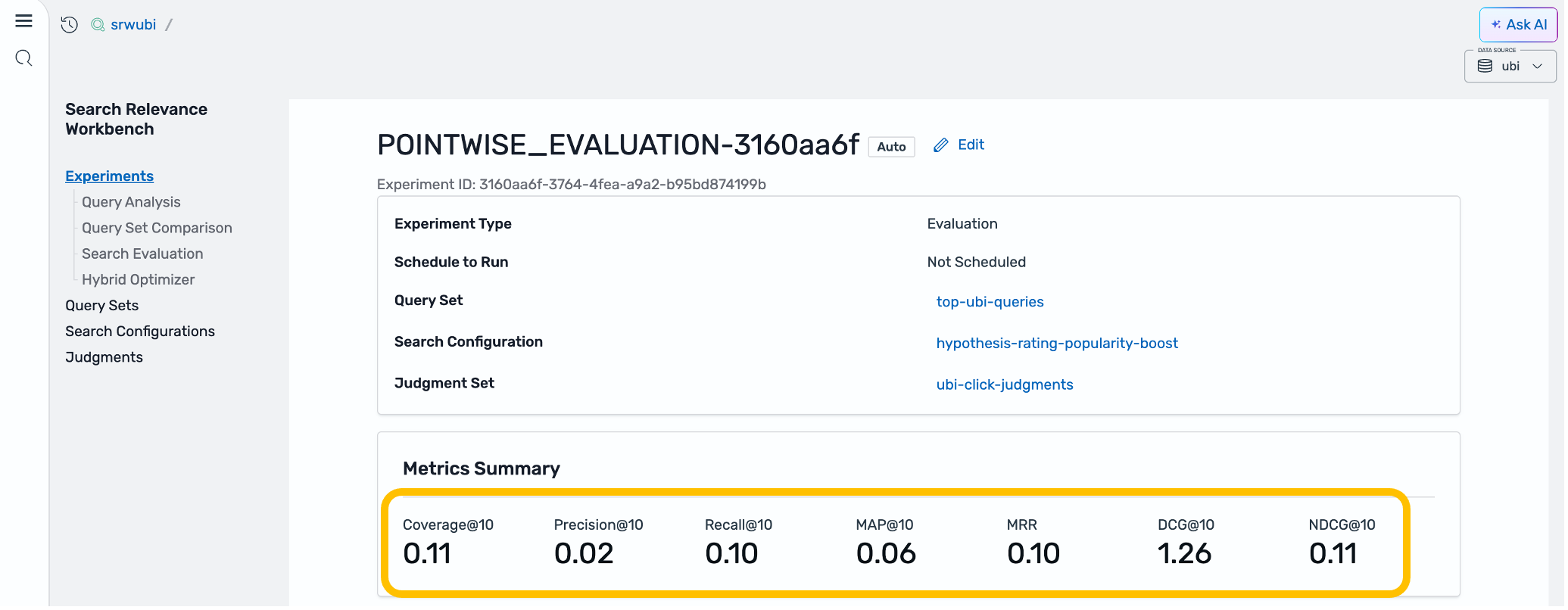
- Offline Validation: The agent’s "Evaluator" skill automatically generates the necessary artifacts to conduct an offline Search Quality Evaluation. It compares the existing baseline against the new hypothesis using metrics like NDCG and Mean Average Precision (MAP). The report provided to the user allows for immediate assessment of the potential impact of the proposed changes.
- Transparency and Deployment: Before any changes are committed, the agent presents the generated DSL configuration for review. This "transparency guarantee" ensures that search engineers can inspect, modify, or reject the agent’s work, keeping the human-in-the-loop firmly in control.
Impact of Hybrid Search Optimization
One of the most significant capabilities of the Search Relevance Agent is its ability to handle hybrid search environments. Modern search systems often combine lexical (keyword-based) search with neural (vector-based) search. Finding the optimal balance—the ratio of keyword matching to semantic understanding—is notoriously difficult.
The agent includes a Hybrid Search Optimizer that automates this parameter tuning. Instead of requiring engineers to manually test various combinations of normalization techniques, Reciprocal Rank Fusion (RRF) variants, and weight distributions, the optimizer runs these experiments automatically. By scoring these configurations against a judgment list, the agent surfaces the exact parameter set that maximizes search quality, significantly reducing the experimental overhead for complex search architectures.
Broader Implications for Business and Engineering
The introduction of the Search Relevance Agent signals a broader trend in enterprise software: the democratization of high-level technical optimization. For search engineers, the tool represents a shift in focus. By offloading the "grunt work" of parameter tweaking and experiment setup, engineers are freed to focus on high-level architectural decisions and the design of more sophisticated search strategies.
For product managers and business stakeholders, the agent bridges the gap between technical metrics and business outcomes. Because the agent communicates in natural language and provides clear justifications for its proposed changes, business leaders can now participate in search tuning without needing to master the intricacies of query DSL. If a new product category is failing to gain traction, stakeholders can task the agent with an investigation and receive an actionable roadmap in minutes.
A New Standard for Continuous Improvement
The Search Relevance Agent enforces a shift in mindset from "search as a project" to "search as a continuous practice." In a digital landscape where user expectations for search accuracy are higher than ever, static configurations are effectively obsolete. By lowering the barrier to entry for relevance engineering, AWS is enabling organizations to maintain high-quality search experiences that evolve alongside their data.
This tool is currently available for users of Amazon OpenSearch Service (version 3.5 or later) via the OpenSearch UI. As organizations continue to integrate generative AI into their workflows, tools that combine automated diagnostics with human-in-the-loop oversight, like the Search Relevance Agent, will likely become the standard for maintaining the agility and efficiency of large-scale search applications. By transforming complex, hour-long manual loops into minutes-long conversational exchanges, the industry is moving toward a more responsive and intelligent era of search management.