Renowned British Architect Norman Foster Unveils His First Mechanical Watch in Collaboration with Lebond

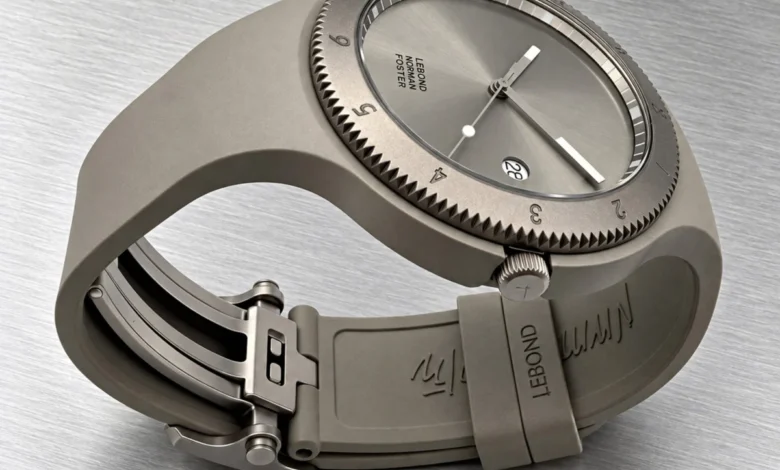
Pritzker Prize-winning architect Lord Norman Foster has officially crossed a new frontier in his illustrious, decades-long design career by unveiling his inaugural mechanical wristwatch. Created in close collaboration with independent watchmaker Lebond, the timepiece represents a masterclass in industrial design, translating the spatial logic, structural integrity, and systemic thinking of large-scale architecture down to a micro-scale wearable object. The collaboration merges Foster’s visionary approach to spatial environments with Lebond’s exacting horological expertise, resulting in a minimalist yet highly functional accessory that rethinks the traditional construction of a wristwatch.
The Genesis of Architectural Horology
For Foster, whose architectural portfolio spans monumental global structures—including the Gherkin in London, the Hearst Tower in New York, Apple Park in California, and the Beijing Capital International Airport—shifting from massive public infrastructure to a 38.5-millimeter watch case was not a conceptual leap, but rather a natural extension of his design philosophy.

"I have never really thought that scale changes the nature of design," Foster noted during the development phase. "Whether it is a city, a building, a chair, or a watch, you are still asking the same questions: how does it work, how is it made, and how do all the parts come together?"
The creative journey began with a rigorous reassessment of standard watch architecture. Historically, wristwatches have relied on a modular construction where a distinct central case houses the movement, to which protruding attachments known as "lugs" are welded or screwed to anchor a separate strap. Foster and the Lebond team chose to dismantle this conventional paradigm. By viewing the case, strap, dial, and internal movement as an integrated, singular system rather than disconnected components, they sought to eliminate the jarring transition points typically found in traditional timepieces.
Engineering and Design Innovations
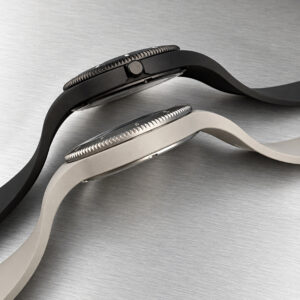
The physical manifestation of this philosophy is the Lebond Norman Foster watch, an exercise in seamless geometry and ergonomic comfort. The timepiece features a Grade 5 titanium case measuring 38.5 millimeters in width, which subtly flares out to 40 millimeters at the exact junction where it meets the integrated strap. This deliberate widening creates a continuous, uninterrupted profile that wraps fluidly around the wrist.
Crucially, Foster discarded conventional watch lugs entirely. By engineering a design where the strap wraps directly around the titanium housing, the watch achieves a streamlined silhouette that sits flush against the skin, dramatically enhancing everyday wearability.
Beyond its sleek exterior, the watch carries subtle nods to aviation design—a lifelong passion for Foster, who is an accomplished pilot. This aerospace influence is visible in the distinctive rotor and a highly practical 12-hour bidirectional rotating bezel. The bezel mechanism allows the wearer to easily track a second time zone using the main hour hand, catering to the globetrotting lifestyle of modern professionals and frequent international travelers.
Protected by a domed sapphire crystal outfitted with an anti-reflective coating, the dial balances legibility with understated elegance. The entire assembly is engineered to be water-resistant up to 50 meters, ensuring durability across varied environments.
Launch Editions and Modular Customization
At launch, the Lebond Norman Foster collection is available in two distinct variations tailored to different aesthetic preferences:
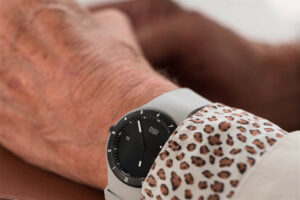
- Natural Titanium Edition: This version showcases a micro-sandblasted titanium case paired with a sophisticated brushed-metal dial, complemented by a minimalist grey rubber strap.
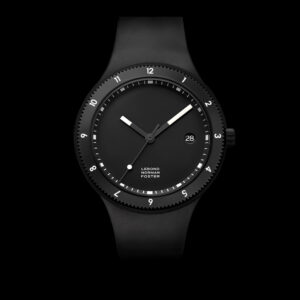
- Black Edition: This variant features a matte black DLC-coated (Diamond-Like Carbon) titanium case, matched with a deep black lacquered dial and hands, alongside a black rubber strap.
True to Foster’s ethos of user-centric design, the timepiece is built for personalization. Recognizing that a watch is an intensely personal object worn across diverse facets of daily life, the designers engineered a proprietary, user-friendly attachment mechanism. This system allows wearers to effortlessly swap cases, components, and straps at will, encouraging owners to curate their own color combinations and material pairings.
"I proposed a watch that could move naturally between very different situations, working in the studio, being on a building site, travelling, or going somewhere formal," Foster explained. "It should not feel precious or limited to one particular setting." Lebond has confirmed that additional interchangeable versions and material iterations will be introduced to the market over time.
Chronology and Design Methodology

The development of the Lebond Norman Foster watch followed a rigorous, iterative process mirroring the architectural drafting room.
- Conceptualization Phase: The partnership commenced with foundational discussions focused on questioning the obvious constraints of traditional horology, breaking down the watch into elemental systems.
- Prototyping and Refinement: The design underwent extensive prototyping cycles. Through continuous digital modeling, physical mock-ups, and structural adjustments, the team refined the contours until the transition between the titanium case and the strap appeared inevitable and organic.
- Milestone Timing: The launch arrives at a notable juncture in Foster’s career. Last year, the architectural community celebrated Lord Foster’s 90th birthday, prompting retrospectives of his twelve most defining structural projects. Furthermore, the unveiling precedes his upcoming keynote address at the prestigious Dezeen Awards, cementing his status as one of the most enduring and influential creative minds of the modern era.
Broader Industry Implications and Market Analysis
The entry of Norman Foster into the luxury independent watch market highlights a growing convergence between high architecture and micro-mechanical design. In recent years, consumers have increasingly gravitated toward cross-disciplinary collaborations, where the aesthetic vocabulary of modernist architecture and industrial design infuses traditional luxury goods with fresh perspectives.
By partnering with an independent watchmaker like Lebond, Foster has bypassed the rigid conventions of heritage Swiss houses, offering a product that champions material innovation—such as lightweight Grade 5 titanium—and functional modularity. Analysts suggest that this approach appeals strongly to contemporary collectors who prioritize architectural purity, tactile ergonomics, and personal customizability over ostentatious branding.
As the lines between structural engineering, fashion, and wearable technology continue to blur, the Lebond Norman Foster watch stands as a testament to the power of fundamental design thinking. By applying the exactitude of city-planning and skyscraper construction to a 40-millimeter wrist accessory, Foster has proven that good design truly transcends scale.
Related posts: