Speculative Decoding Explained: How This Breakthrough Enables 3x Faster Large Language Model Inference

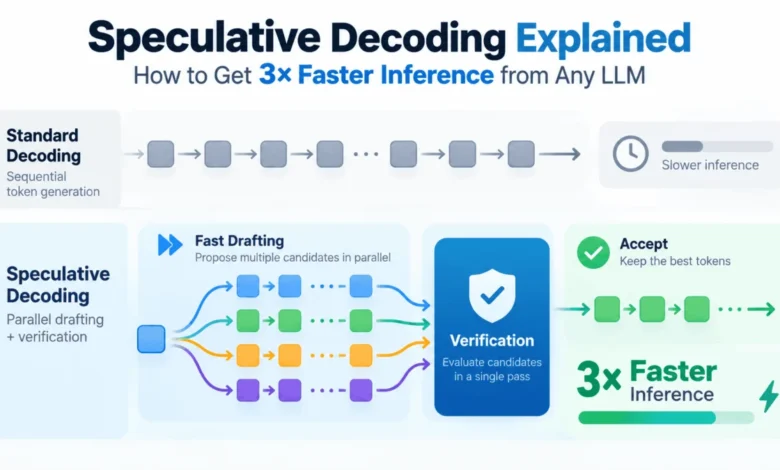
The deployment of Large Language Models (LLMs) has revolutionized artificial intelligence, yet these systems remain shackled by a fundamental technical constraint: the autoregressive nature of token generation. Because LLMs produce text one token at a time, the process is inherently sequential, leading to significant latency in real-time applications such as conversational agents, coding assistants, and interactive creative tools. Speculative decoding has emerged as the industry’s most promising solution to this bottleneck, offering a method to accelerate inference speeds by two to three times without compromising output quality or requiring model retraining. By decoupling the generation of candidate sequences from the verification of those sequences, developers are effectively bypassing the memory-bandwidth limitations that have historically hampered hardware performance.
The Autoregressive Bottleneck and Memory Constraints
To understand the necessity of speculative decoding, one must first analyze the current standard of LLM inference. Modern models are massive, with parameters often reaching into the hundreds of billions. During the generation phase, the entire weight matrix of the model must be loaded into the GPU’s VRAM and transferred to the compute units for every single token produced.
This process renders the hardware "memory-bandwidth bound." In practical terms, the GPU’s high-speed compute cores—the components responsible for the actual mathematical operations—spend the vast majority of their time idling, waiting for the model parameters to be fetched from memory. Because each token relies on the output of the previous one, the system cannot parallelize the generation of a full sentence. This serial dependency means that even the most powerful hardware, such as the NVIDIA H100, is constrained by the speed at which data can be moved across the bus, rather than the raw FLOPS (floating-point operations per second) of the chip itself.
The Evolution of Speculative Decoding: A Chronology
The academic roots of speculative decoding can be traced back to early 2023, when researchers began exploring how to optimize the "wait time" of large models. By late 2023 and early 2024, the technique matured from theoretical research papers into a production-ready paradigm.
The initial breakthrough was defined by the "two-model" architecture. In this setup, a smaller, "draft" model—often a distilled version of the target model or a much smaller architecture like a 1-billion parameter variant—is tasked with predicting the next several tokens. These predictions are generated at high speed. The target model then consumes these candidate tokens in a single, massive parallel operation. If the target model finds the draft’s predictions acceptable, it confirms them instantly. If it disagrees, it replaces the incorrect tokens and resumes from the point of divergence.
This approach represented a paradigm shift. For years, the industry focused on model compression, such as quantization and pruning, to improve speed. While effective, these methods often led to a slight degradation in model intelligence. Speculative decoding changed the conversation by providing a mathematical guarantee: the statistical distribution of the output remains identical to that of the target model acting alone, as if no draft model were involved.
Technical Mechanics: How Parallel Verification Works
The speculative loop functions through a refined sequence of operations:
- The Drafting Phase: The draft model predicts a sequence of $N$ tokens (typically 4 to 8).
- The Verification Phase: The target model receives this sequence. Because of the parallel architecture of modern GPUs, the target model can evaluate the probability distribution of all $N$ tokens simultaneously.
- The Acceptance Criterion: The target model compares its own internal probability distribution against the draft’s. If the target model determines that the draft’s candidate aligns with its own logic, the token is accepted.
- Correction: If a token is rejected, the target model samples a new token based on its own distribution and discards the remainder of the draft sequence.
This mechanism allows the system to utilize the full throughput of the GPU. By loading the target model’s weights only once per speculative step, the ratio of "compute-to-memory-transfer" is drastically improved. The GPU performs a larger batch of operations per memory load, effectively turning a memory-bound task into a compute-bound one, where the hardware can finally operate closer to its theoretical peak capacity.
Beyond Two-Model Architectures: Medusa and Eagle
As the technology gained traction, researchers identified that maintaining two separate models—a draft and a target—introduced unnecessary operational complexity. This led to the development of "single-model" speculative decoding strategies.
Medusa, introduced by researchers in early 2024, represents a significant evolution. Instead of using an external model, Medusa adds extra "heads" to the final layer of the target model. These heads are trained to predict the next few tokens in the sequence simultaneously. Since these heads are integrated into the base model, there is no need to load an additional model into memory.
Similarly, the Eagle (Extrapolation Algorithm for Greater Language-model Efficiency) framework utilizes the internal hidden states of the target model to generate candidates. By leveraging the deep contextual understanding already present in the target model’s hidden layers, Eagle often achieves higher acceptance rates than traditional draft models, particularly in complex domains where the context of the conversation shifts rapidly.
Implications for Production Environments
For infrastructure engineers and AI practitioners, the implications of these developments are twofold. First, speculative decoding is becoming a standard feature in high-performance inference engines. Frameworks like vLLM and Hugging Face’s Text Generation Inference have integrated these methods, allowing developers to enable them via simple configuration flags.
However, industry experts advise caution regarding the "cost" of speculation. In scenarios with high concurrent request volume—where multiple users are hitting a server at once—speculative decoding can be counterproductive. The resources required to generate draft tokens can consume compute cycles that would be better spent serving additional users. Therefore, speculative decoding is currently best suited for latency-sensitive, low-to-medium concurrency environments, such as dedicated coding assistants or specialized enterprise applications.
Future Outlook and Economic Impact
The adoption of these techniques is fundamentally altering the economics of AI deployment. By doubling or tripling inference speed, organizations can effectively reduce the cost-per-token of their AI services without compromising the quality of the outputs. As models continue to grow in size—approaching the trillion-parameter threshold—the reliance on memory-bandwidth becomes even more acute.
Future developments are expected to focus on "adaptive speculation," where the system dynamically decides whether to engage the draft model based on the complexity of the prompt. If a prompt is simple or repetitive, the system might use a smaller draft sequence; for highly complex reasoning tasks, it might opt for a more conservative verification strategy.
Ultimately, speculative decoding serves as a bridge between the current hardware limitations and the next generation of AI capabilities. It demonstrates that efficiency is not always about building faster chips or smaller models, but about smarter orchestration of the existing computational stack. As this technology matures, the "one-token-at-a-time" paradigm will likely be relegated to a historical footnote in the rapid development of large language models, clearing the way for a future of instantaneous, high-fidelity AI interactions. The transition from serial processing to parallel verification marks a pivotal moment in the deployment of generative AI, ensuring that the technology remains scalable as it integrates into the fabric of global digital infrastructure.