Scaling Distributed Deep Learning on Amazon EKS: Overcoming Checkpoint Bottlenecks and Worker Faults with NVIDIA Resiliency Extension

The modern landscape of large-scale artificial intelligence development is defined by massive distributed training workloads that span dozens, or even hundreds, of specialized computing nodes for days or weeks at a time. Within these expansive clusters, distributed training jobs face severe operational challenges that can derail engineering timelines and inflate cloud infrastructure expenses. As large language models (LLMs) and foundational architectures scale into the hundreds of billions of parameters, infrastructure reliability transitions from a secondary operational concern to a primary engineering hurdle. Network partitions, ephemeral memory errors, transient software exceptions, and underlying hardware infrastructure events inevitably disrupt active workers during protracted training runs.
When a single Graphics Processing Unit (GPU) faults within a distributed training topology, it rarely remains an isolated incident. Instead, it triggers a cascading sequence of failures. Timeouts from foundational communication layers, such as the NVIDIA Collective Communication Library (NCCL), rapidly propagate to otherwise healthy worker nodes. Kubernetes pods frequently crash and restart out of synchronization, leaving expensive, high-performance GPU clusters idling while making zero meaningful training progress. Furthermore, traditional synchronous checkpointing systems introduce an additional layer of latency: every time the cluster saves model states, it blocks all ranks on Input/Output (I/O) operations. At cluster scales utilizing cutting-edge hardware, this blocking behavior can consume up to 40 percent of total wall-clock time, severely degrading overall hardware utilization and cost-efficiency.
To address these compounding inefficiencies, engineering teams are increasingly turning to advanced software stacks that bridge high-performance cloud infrastructure with application-level fault resilience. A prominent implementation of this methodology involves integrating the NVIDIA Resiliency Extension (NVRx) into PyTorch Fully Sharded Data Parallel (FSDP) training workloads hosted on Amazon Elastic Kubernetes Service (Amazon EKS). By pairing asynchronous checkpointing, in-process fault recovery, and automated job-level restarts with a meticulously optimized Kubernetes foundation, organizations can maintain exceptionally high compute efficiency even in the presence of inevitable hardware and software disruptions.
Anatomy of Distributed Training Failures and Inefficiencies
To fully appreciate the innovations in distributed fault tolerance, one must examine the specific mechanisms that cause multi-node training jobs to stall or fail. Training large models across multiple nodes typically relies on synchronous stochastic gradient descent frameworks. In these architectures, every worker must complete its forward and backward passes and exchange gradients before the global optimizer can execute a parameter update. If a single worker slows down due to thermal throttling, memory swapping, or network jitter, all other workers must wait. If that worker crashes entirely, the entire distributed communication ring breaks down.
Historically, distributed Kubernetes environments handled worker crashes through native orchestration mechanics. When a pod experiences an unrecoverable error or fails a liveness probe, the Kubernetes control plane tears down the pod and attempts to reschedule a replacement. However, in the context of distributed machine learning, this default behavior is remarkably inefficient. The surviving workers, still operating within the active NCCL process group, wait for messages from the dead worker until an NCCL timeout threshold is reached—often taking several minutes. Once the timeout occurs, the surviving pods crash as well, leading to cascading restarts, out-of-sync initialization phases, and prolonged periods of cluster inactivity known as CrashLoopBackOff states.
Simultaneously, the mechanics of model checkpointing introduce severe performance taxes. Saving the state of a multi-billion-parameter model requires serializing model weights, optimizer states, and gradient buffers across all participating ranks. In a traditional synchronous checkpointing regime, every rank halts training computations to write its data to shared network storage. Because network filesystems face bandwidth constraints when bombarded by simultaneous write requests from dozens of high-performance nodes, the system experiences severe I/O serialization. As cluster sizes grow, the time spent waiting for synchronous checkpoint writes to complete scales upward, robbing engineering teams of valuable compute cycles for which they are paying premium cloud rates.

The Technological Architecture: Combining NVRx and Amazon EKS
Mitigating these systemic inefficiencies requires a dual-pronged architectural approach: optimizing the write and recovery pathways at the application level while providing a resilient, high-bandwidth infrastructure foundation at the orchestration level. The integration of the NVIDIA Resiliency Extension with Amazon EKS achieves this balance by dividing responsibilities between application-level primitives and cloud-native infrastructure orchestration.
The NVIDIA Resiliency Extension operates as a pip-installable Python package that introduces fault-tolerance primitives directly into standard PyTorch training scripts without requiring custom model kernels, proprietary PyTorch forks, or manual recompilation. Designed for modular adoption, NVRx provides three distinct layers of resilience: asynchronous checkpointing, in-process restart capabilities, and an in-job restart launcher known as ft_launcher.
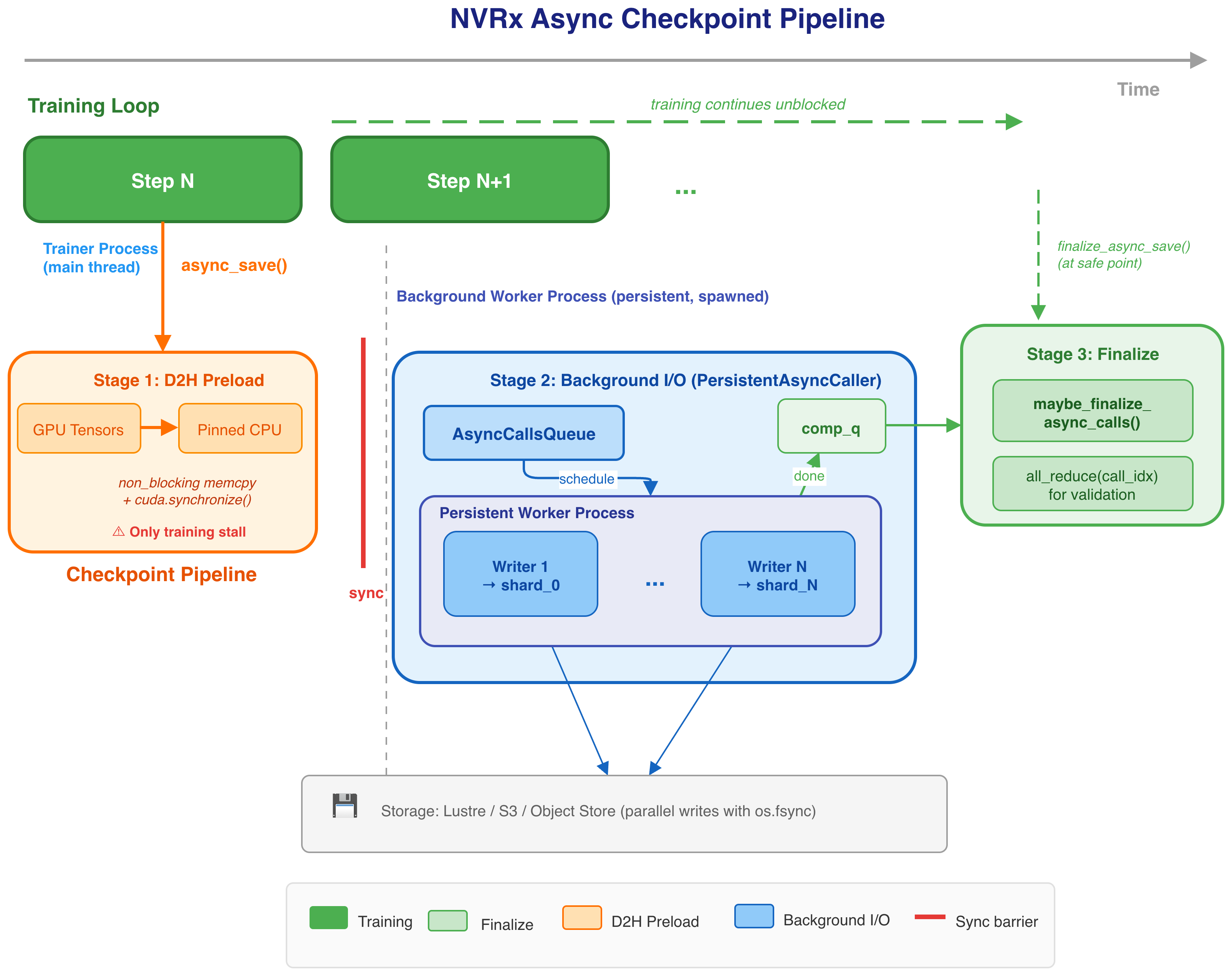
Asynchronous checkpointing, exposed through the TorchAsyncCheckpoint class, fundamentally alters the write path. Instead of forcing training loops to halt during serialization, async_save() immediately hands the model’s state dictionary off to a background operating system process while allowing the main training thread to proceed directly to the next forward and backward pass. When paired with PyTorch FSDP’s LOCAL_STATE_DICT configuration, each individual rank writes its own model shard directly to shared storage without requiring costly all-gather operations or creating a centralized rank-zero serialization bottleneck.
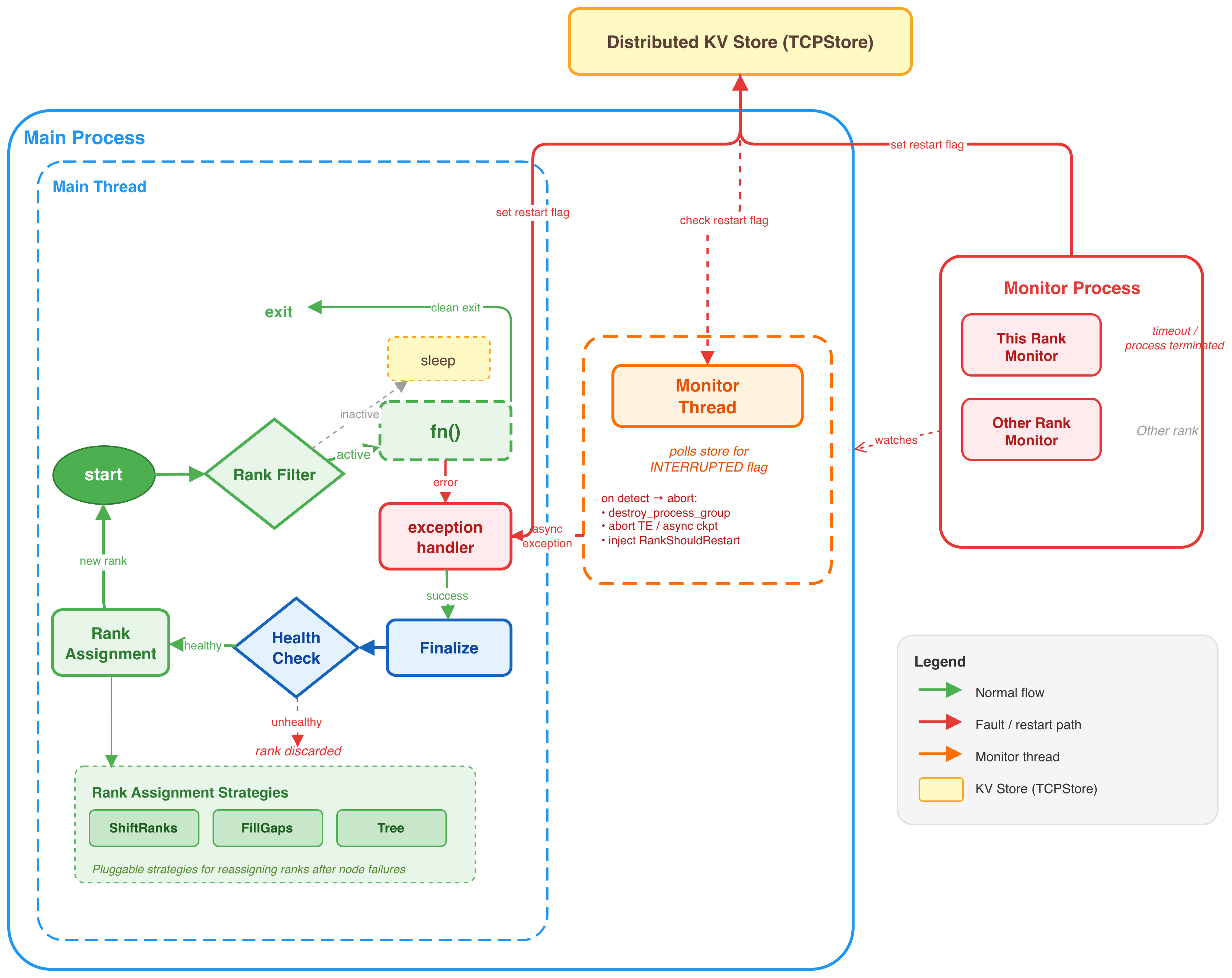
For handling transient software errors and soft faults, NVRx introduces in-process restart capabilities via inprocess.Wrapper. When an unhandled exception or an NCCL communication hang occurs, the wrapper intercepts the failure before it can destroy the underlying Python process. It aborts the active distributed process group, executes localized health checks across the GPU, NVLink, and Network Interface Card (NIC) subsystems, re-establishes rendezvous protocols among surviving workers, and cleanly re-enters the training function from the most recent valid checkpoint. Crucially, the Python interpreter, CUDA memory allocator, and outer-scope objects survive the intervention, avoiding the heavy latency associated with full container teardowns.
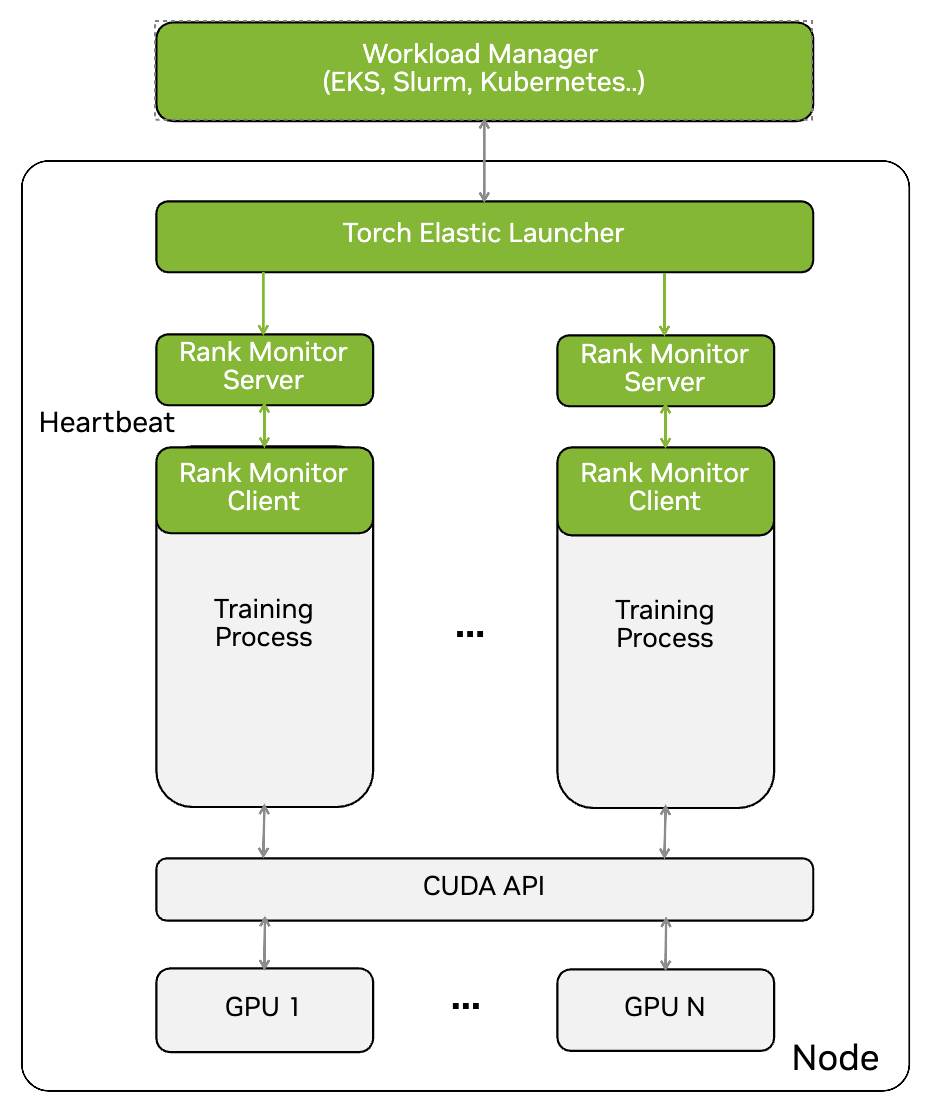
For hard faults that bypass in-process interception—such as operating system-level hangs, Out-Of-Memory (OOM) kills, or SIGKILL signals—the architecture relies on the ft_launcher binary. Replacing traditional launchers like torchrun, ft_launcher works in tandem with a per-rank RankMonitorClient that continuously transmits heartbeat signals to a monitor server. If a worker fails to report within a user-defined timeout window, the launcher reclaims allocated GPU memory, terminates lingering worker processes, re-configures the communication topology, and respawns fresh workers within the exact same Kubernetes job context.
Infrastructure Foundations on Amazon Elastic Kubernetes Service
The operational success of this resilience framework depends heavily on the underlying cloud infrastructure. Amazon EKS provides a fully managed Kubernetes control plane that simplifies cluster management, automated upgrades, and API server availability. For high-performance multi-node deep learning workloads, engineers deploy self-managed node groups utilizing Amazon EC2 p5.48xlarge instances. Each p5 instance is equipped with eight NVIDIA H100 Tensor Core GPUs boasting 80 gigabytes of high-speed memory, alongside 32 Elastic Fabric Adapter (EFA) network interfaces designed for ultra-low latency, high-throughput inter-node communication.
Within the EKS environment, training jobs are orchestrated as Kubernetes Jobs backed by headless Kubernetes Services. This configuration allows worker pods to discover one another dynamically via internal DNS resolution rather than relying on hardcoded IP addresses, ensuring that replacement pods can seamlessly rejoin an active job after a recovery event. Furthermore, resource allocation is managed via specialized device plugins—specifically the NVIDIA device plugin and the EFA device plugin—which expose GPUs and network adapters as extended Kubernetes resources, enabling the scheduler to place workloads with strict node affinity and tolerations.
For persistent storage and rapid recovery read operations, the architecture integrates Amazon FSx for Lustre configured with high-performance scratch storage tiers. Mounted directly into every training pod via the FSx CSI driver, the shared Lustre filesystem serves as the destination for both synchronous and asynchronous checkpoint writes. During a recovery event, surviving or respawned workers read their checkpoint states directly from this shared filesystem. By deploying Amazon FSx for Lustre within the same Availability Zone as the GPU compute nodes, system architects minimize network read latency during recovery phases, a critical optimization given that checkpoint loading times often dictate total recovery duration at scale.
Empirical Benchmarks and Performance Analysis
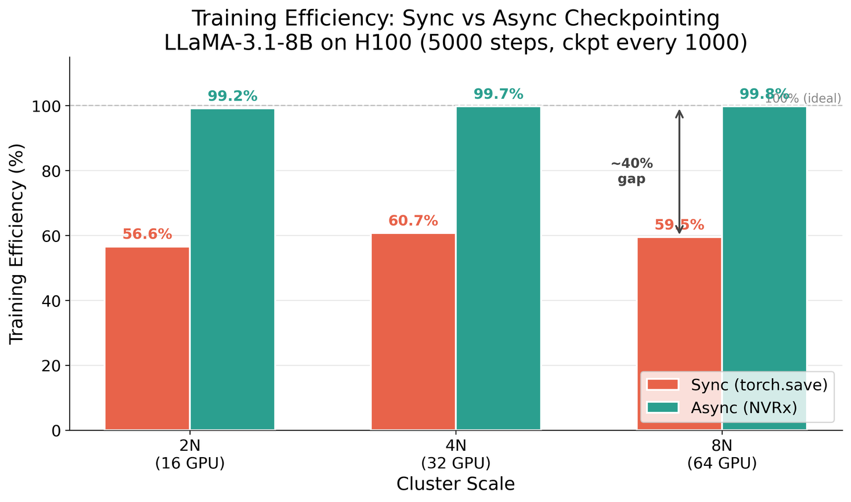
Comprehensive empirical evaluations conducted on LLaMA-3.1-8B models trained using PyTorch FSDP illustrate the profound performance advantages delivered by this integrated resilience framework. Benchmarks comparing synchronous checkpointing against NVRx asynchronous checkpointing across cluster sizes ranging from 2 nodes (16 H100 GPUs) to 8 nodes (64 H100 GPUs) reveal stark efficiency divergences.
When executing traditional synchronous checkpointing every 1,000 steps, training efficiency remains depressed between 57 and 61 percent across all tested node counts, with approximately 40 percent of total wall-clock time lost to blocking I/O operations. This bottleneck persists because Lustre write latency remains relatively constant regardless of whether data is aggregated from 16 or 64 GPUs. In contrast, asynchronous checkpointing maintains an exceptional training efficiency of over 99 percent across all scales—recording 99.2 percent efficiency at 2-node scale and climbing to 99.8 percent at 8-node scale. By decoupling the write path from the active training loop, asynchronous checkpointing completely masks serialization latency.
When evaluating checkpoint frequency variations at an 8-node scale, the operational benefits of async checkpointing become even more pronounced. At an interval of every 1,000 steps, async checkpointing achieves 99.8 percent efficiency compared to synchronous checkpointing’s 60.3 percent. When checkpoint frequency is aggressively increased to every 100 steps—a practice highly desirable for minimizing lost work during unexpected interruptions—synchronous training efficiency plummets to 14.7 percent. Meanwhile, asynchronous checkpointing degrades gracefully to 29.6 percent efficiency, proving roughly twice as fast because partial overlap continues to shield the compute engines from complete serialization stalls.
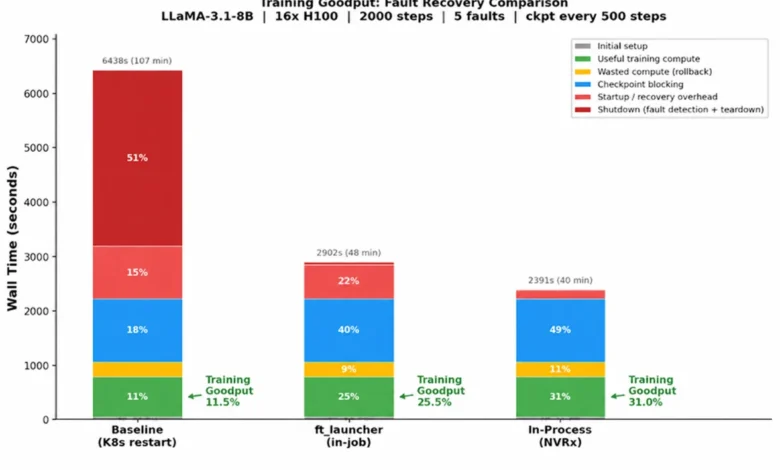
In fault recovery benchmarks involving the injection of deterministic software exceptions and network hangs into 16-GPU training runs, the superiority of NVRx recovery mechanisms over native orchestration becomes undeniable. Standard Kubernetes pod restarts consumed an average of 270 seconds per fault, leading to catastrophic cascade failures, NCCL timeout loops, and an overall training goodput of just 11.5 percent. Conversely, utilizing NVRx in-job restart via ft_launcher reduced recovery time to 17 seconds per fault, elevating training goodput to 25.5 percent. Most impressively, employing NVRx in-process restart compressed recovery windows to approximately 10 seconds with zero container restarts, achieving a training goodput of 31 percent and an infrastructure goodput of 87 percent.
Broader Implications for Enterprise Artificial Intelligence
The successful deployment of NVIDIA Resiliency Extension primitives atop Amazon EKS infrastructure signals a maturing operational maturity model for enterprise generative artificial intelligence initiatives. As organizations transition foundational model training from experimental laboratories into continuous production pipelines, mitigating infrastructure fragility is paramount.
The empirical data demonstrates that failure to address checkpoint blocking and recovery latency results in massive financial waste. In clusters operating hundreds of high-end GPUs where hardware faults occur multiple times a day, traditional recovery mechanisms can easily consume more than half of the total available compute time in administrative overhead and idle waiting states. By slashing recovery times from several minutes down to mere seconds and eliminating checkpoint blocking penalties, engineering teams can adopt aggressive, high-frequency checkpointing strategies without sacrificing hardware utilization.
Ultimately, this architectural pattern decouples the statistical inevitability of hardware faults from the economic viability of large-scale training. Organizations leveraging asynchronous checkpointing and multi-layered fault recovery can maximize data protection, safeguard capital investments in premium silicon, and accelerate time-to-market for state-of-the-art artificial intelligence models. As distributed training clusters continue to expand in geographical distribution and GPU density, adopting application-aware resilience layers will transition from an advanced optimization technique to an indispensable standard operating procedure across the cloud-native ecosystem.