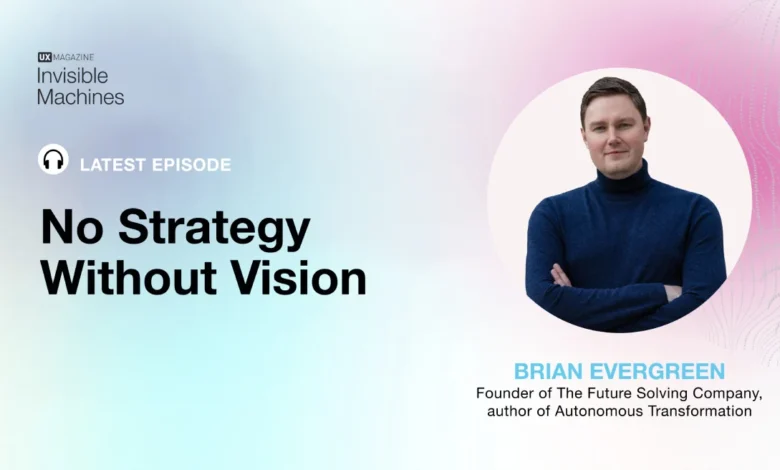
Brian Evergreen on why agentic AI rewards vision-first strategy and why your RFP is built for a world that no longer exists

The modern enterprise is currently caught in a cycle of technological procurement that is fundamentally ill-suited for the era of agentic artificial intelligence. As organizations rush to integrate advanced AI systems, they are increasingly relying on traditional Request for Proposal (RFP) processes, vendor feature matrices, and bottom-up use-case experimentation. However, according to Brian Evergreen, founder of The Future Solving Company and author of Autonomous Transformation, these established methods are failing because they attempt to apply 20th-century procurement logic to a 21st-century paradigm shift. The core issue, Evergreen argues, is that current AI strategies are often hollow, focusing on technical literacy and vendor selection while neglecting the essential, prerequisite work of defining a clear, long-term vision.
The Procurement Trap: A Chronology of Obsolescence
The evolution of corporate technology adoption has long followed a predictable path: identify a business problem, survey the market for vendors, compare features, and execute a pilot program. In the early 2000s, this model served organizations well when purchasing standardized software, such as Customer Relationship Management (CRM) or Enterprise Resource Planning (ERP) systems. These were "known quantities"—tools designed to optimize existing processes.
However, the advent of agentic AI—systems capable of autonomous decision-making, task execution, and cross-functional coordination—has rendered this linear procurement model obsolete. The transition from generative AI, which creates content, to agentic AI, which performs work, represents a fundamental shift in how value is generated. Between 2022 and 2024, corporate spending on AI shifted from exploratory "chatbots" to deep system integration. Despite this, the procurement cycles remain tethered to old methodologies. Companies continue to treat AI as a commodity to be purchased rather than a capability to be designed. By the time a six-month RFP process concludes, the AI landscape has often shifted, with new model updates rendering previous feature checklists irrelevant.
Data-Driven Reality vs. The Myth of the Checklist
Supporting data from recent industry reports suggests that the "feature-first" approach is yielding diminishing returns. According to various enterprise research firms, over 70% of AI pilot programs fail to scale into production. This statistic is rarely a failure of the technology itself, but rather a failure of integration and alignment. When companies treat AI innovation like a science fair—where the primary objective is to select the vendor that checks the most boxes on a spreadsheet—they lose sight of the organizational architecture required to support such tools.
The reliance on these checklists is, in essence, a mechanism to reduce the anxiety of uncertainty. By demanding standardized, comparable metrics, procurement teams attempt to force a nascent, rapidly evolving technology into a predictable, low-risk bucket. Evergreen posits that this is a category error. Because there is no historical dataset for a market structure that does not yet exist, attempting to "buy" the future through an RFP is a structural impossibility. The most critical capabilities of an agentic system—such as context awareness, data sovereignty, and cross-silo orchestration—are often not even included in standard vendor evaluation forms because they are not yet standardized features.
The Vision-First Imperative: Lessons from History
Evergreen’s central thesis—that there can be no strategy without vision—finds historical resonance in the strategies employed by high-performing research organizations. The 1952 Bell Labs initiative serves as a poignant case study. Faced with the aging of their foundational patents and the stagnation of the telephone network, leadership at Bell Labs initiated a "rebuild from scratch" exercise. They forced researchers to assume the current infrastructure was completely destroyed and tasked them with recreating a functional network using only contemporary science and economics.
This approach stands in stark contrast to the modern corporate tendency to "optimize the org chart." By assuming the existing constraints are destiny, companies limit their potential to mere incremental improvement. The Bell Labs example demonstrates that breakthrough innovation is not a stochastic event that occurs during calendar-blocked "innovation hours," but a deliberate, top-down mandate to solve for a desired future.
In contrast, the decline of Blockbuster provides a cautionary tale. While the company successfully piloted streaming-based services, it failed to integrate this technology into its core business model because it viewed the innovation as a threat to its existing, high-margin, late-fee-based revenue stream. The technology was not the missing link; the strategic alignment was. As Robb Wilson, CEO of OneReach.ai and host of the Invisible Machines podcast, notes, the issue for many large firms is not an absence of planning, but a highly evolved, rigid plan for buying solutions that support the status quo, even when that status quo is being disrupted.
The Shift from Problem Solving to Future Solving
The distinction between "problem solving" and "future solving" is the conceptual bedrock of Evergreen’s framework. Problem solving is inherently reactive and subtractive; it seeks to eliminate waste and refine existing workflows. Future solving, conversely, is an exercise in imagination and construction. It asks: "What do we want to exist that does not exist today?" and "What must become true for that to be possible?"
This shift has profound implications for corporate governance. For instance, Morgan Stanley’s early efforts to develop a governed knowledge layer illustrate the practical application of this philosophy. Rather than simply dumping PDFs into a large language model—a common, low-value "use case"—the firm invested in creating a system defined by accountability, data freshness, and ownership. This required not just software, but a complete reassessment of how knowledge is treated within the firm.
The failure to define this "future state" leads to what Evergreen calls "motion without architecture." When organizations encourage mass literacy in AI tools without providing a clear, visceral vision of the desired outcome, they create a chaotic environment where disparate teams pursue conflicting objectives. Without a "north star," the friction inherent in organizational change becomes insurmountable. Friction is not merely an obstacle to be avoided; it is a feature of any significant transformation. However, friction is only worth overcoming if the direction is clear and the promise of the outcome is tangible.
Broader Implications and Institutional Change
The implications for the C-suite are significant. If organizations do not take the time to author their own future, platform companies and external vendors will do it for them by default. This transition moves the conversation from "which vendor has the best features" to "how do we design our organization to function with agentic systems?"
The collapse of traditional interfaces is likely on the horizon. Just as the concept of a "login" or a "save icon" has shifted in meaning over the decades, the way humans interact with enterprise software will fundamentally change. The future of the enterprise is not a collection of fragmented apps, but a cohesive, intent-driven experience where the underlying logistics are invisible to the user. Achieving this requires a level of authorship that cannot be outsourced to a vendor.
For leaders, the mandate is clear: pause the procurement sprint. Before issuing the next RFP, organizations must engage in the difficult, necessary work of defining their own future. This requires moving beyond the "science fair" mentality of checking boxes and instead building a roadmap of the necessary conditions—data contracts, policy frameworks, and incentive structures—that must be true to realize a truly autonomous, high-performing organization. In an era where software capabilities change mid-flight, the only sustainable competitive advantage is a coherent, visceral, and clearly articulated vision of the future. Those who fail to define this vision will find themselves managing a collection of powerful tools, but lacking the architecture to ensure they are used for anything other than sustaining a world that is already disappearing.