Governing AI Agent Access with Okta Cross App Access and Amazon Bedrock AgentCore Part 1

The rapid proliferation of generative artificial intelligence across enterprise environments has introduced a complex identity and access management challenge. As autonomous AI agents increasingly handle routine operational workflows—such as updating customer records, modifying support tickets, and querying internal databases—they frequently operate on behalf of authenticated human users. Traditional identity models relying on per-application OAuth consent or shared service accounts often fail to definitively answer a critical security question: which specific AI agent is acting for which user within a given application, and how can administrators promptly revoke that authority if necessary.
To address these vulnerabilities, organizations are turning to robust delegation frameworks. By combining Okta Cross App Access (XAA) with Amazon Bedrock AgentCore, security teams can establish a centralized governance and execution plane. This multi-layered architecture ensures that an agent’s access privileges are dynamically evaluated, strictly scoped, and immediately revoked when administrative parameters change.
The Architectural Paradigm: Governance Meets Execution
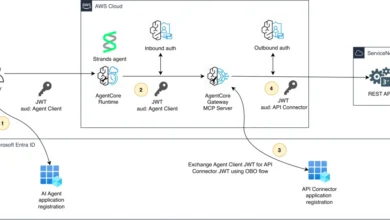
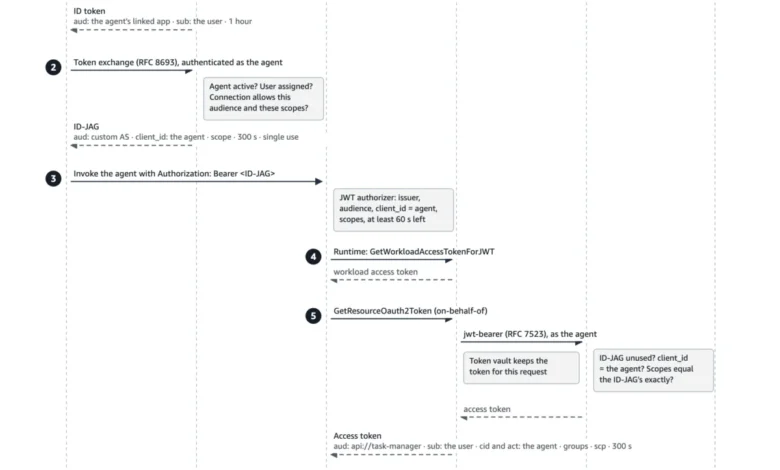
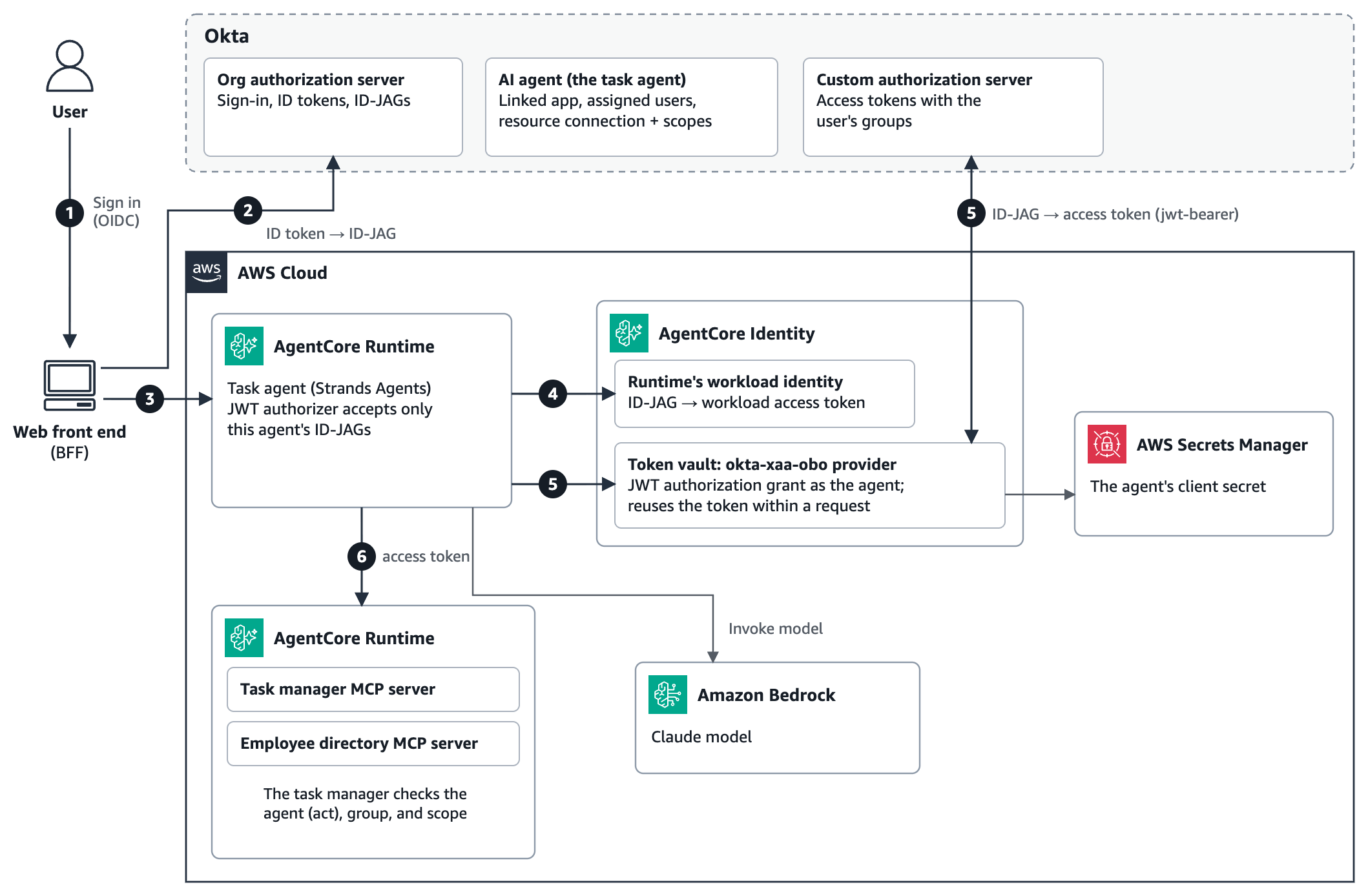
At the core of this security model is a clear operational separation between governance and execution. Okta acts as the central governance plane, determining which AI agent is authorized to act on behalf of a specific user against a designated target resource. Meanwhile, Amazon Bedrock AgentCore functions as the execution plane, managing the agent’s underlying credentials, translating authorization decisions into resource-accepted tokens, and encapsulating dual identities within a secure token vault.
The operational workflow relies on a sophisticated three-token delegation chain. When a user interacts with an application, the request carries an ID token establishing the user’s identity, an Identity Assertion JWT Authorization Grant (ID-JAG) representing Okta’s explicit delegation decision, and an access token accepted by the downstream resource or Model Context Protocol (MCP) server.
In testing environments, this infrastructure demonstrates remarkable agility. When an administrator revokes a user’s assignment to an agent, Okta successfully refuses subsequent requests within approximately one second. Furthermore, any access tokens already issued expire within a maximum window of five minutes, significantly reducing the window of exposure during security incidents.
Prerequisites and Implementation Roadmap
Deploying this architecture requires a well-configured cloud and identity ecosystem. Administrators typically require an AWS account provisioned with access to Amazon Bedrock AgentCore and foundation models such as Anthropic Claude, operating within regions like US West (Oregon). On the identity side, an Okta organization utilizing Cross App Access for AI agents and API Access Management custom authorization servers is essential.
Development teams utilize Python 3.11, the AWS Command Line Interface (CLI) version 2, boto3, the AgentCore CLI, and the AgentCore Python SDK to construct the task agent. Because the architecture involves cross-service credentials—such as client secrets stored securely in AWS Secrets Manager—organizations must enforce stringent Identity and Access Management (IAM) policies. These policies scope down the agent’s runtime role exclusively to its designated workload identity, credential provider, and associated secrets.
Step-by-Step Registration and Credential Management
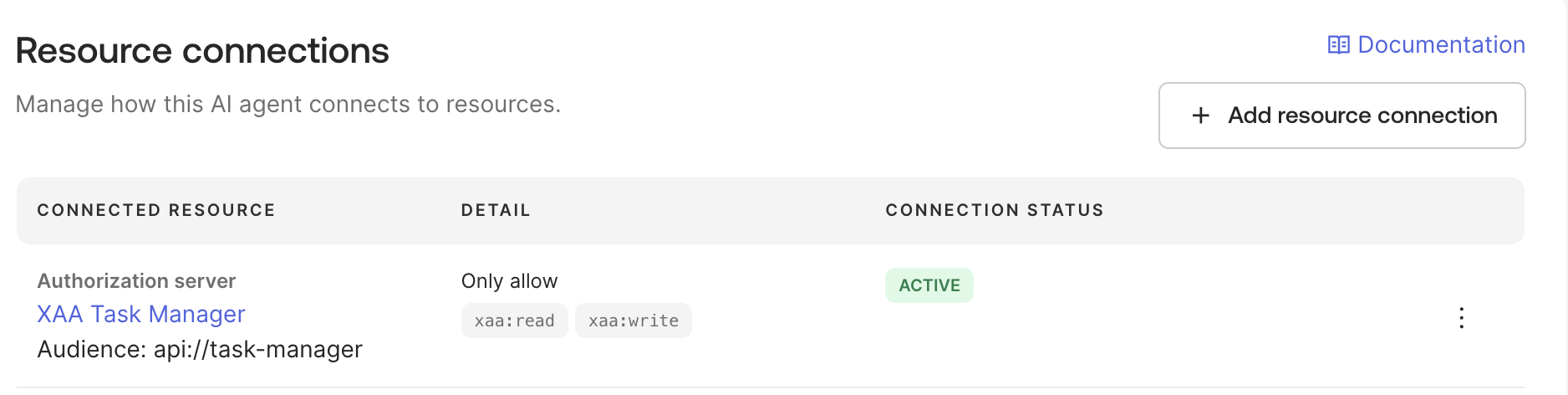
The implementation process begins by registering the AI agent within the Okta Admin Console. Administrators configure an authorization server for the target resource, establish the agent application, and define a resource connection limited to precise operational scopes, such as read and write permissions.
Once registered, the application requests an ID-JAG by authenticating as the agent against Okta’s token endpoint. To maintain security best practices, the agent’s client secret is stored securely in AWS Secrets Manager rather than embedded in source code.
Within the execution environment, Amazon Bedrock AgentCore Identity manages three critical components:
- Workload Identity: Associates the agent’s execution on AWS with the signed-in user for each specific request.
- OAuth2 Credential Provider: Stores the agent’s Okta client credentials and defines the JWT authorization grant configuration.
- Token Vault: Securely caches obtained access tokens for the duration of the request lifecycle, minimizing redundant token exchange overhead.
Performance Metrics and Latency Analysis
Rigorous testing of the integrated architecture provides clear visibility into operational performance. While end-to-end task execution typically spans approximately 30 seconds—largely driven by underlying foundation model inference and tool execution times—the security infrastructure introduces minimal latency.
Empirical benchmarks indicate that the sign-in workflow via the authorization code flow takes approximately 1,205 milliseconds. Exchanging an ID token for an ID-JAG at Okta’s authorization server adds roughly 216 milliseconds. Retrieving the workload access token takes about 135 milliseconds, while finalizing the resource OAuth2 token via AgentCore Identity consumes roughly 508 milliseconds. Subsequent calls within the same request lifecycle benefit significantly from the token vault, returning cached credentials in mere milliseconds without triggering repeated token exchanges.
Enforcing Granular Authority in Downstream Tools
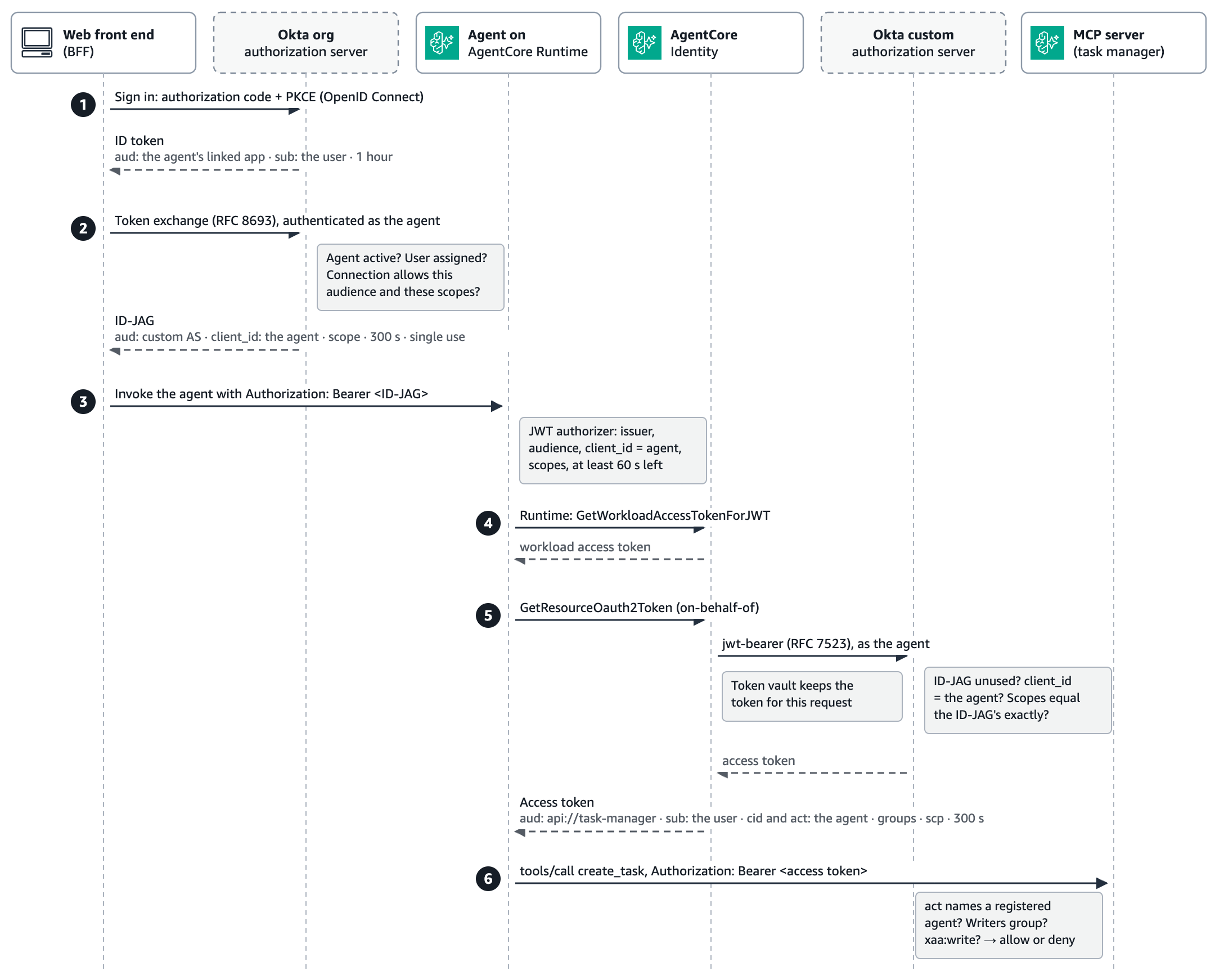
A vital aspect of this security architecture is the enforcement of per-user authority at the resource level—specifically within Model Context Protocol (MCP) servers. Because resource connections often assign broad baseline scopes to all users of an agent, granular access control must rely on claims such as user group memberships.
For instance, testing scenarios involving multiple users demonstrated that individuals assigned to specific reader groups could list project tasks but were strictly blocked from executing write operations. Users lacking appropriate group claims or explicit scope authorizations faced immediate rejection. Furthermore, the runtime’s custom JWT authorizer acts as an initial gatekeeper, rejecting malformed tokens, mismatched client identifiers, and expired credentials before execution reaches the agent code.
Comparative Analysis: Cross App Access Versus Plain Token Exchange
To evaluate the efficacy of Cross App Access, security researchers compared its behavior against traditional RFC 8693 plain token exchange implementations. The findings highlight significant security advantages for XAA.
While plain token exchange successfully propagates user identity downstream, it frequently leads to privilege inflation, where restricted users inadvertently inherit broader functional scopes during the exchange process. Additionally, plain token exchange mechanisms often fail to incorporate the agent identifier (act claim) into the resulting token, obscuring audit trails.
In contrast, Okta Cross App Access enforces strict adherence to administrator-approved scopes, prevents unauthorized privilege escalation, and embeds explicit agent attribution within every log event. If an administrator deletes an agent’s resource connection or revokes a user assignment, XAA immediately halts unauthorized transactions, whereas traditional token exchanges may continue processing stale credentials until expiration.
Broader Industry Implications and Enterprise Applications
The deployment of governed AI agents is particularly critical in highly regulated industries such as media and entertainment, financial services, healthcare, and the public sector. In media organizations, for example, autonomous agents frequently interact with production tracking systems, asset metadata repositories, and localization pipelines. Because access rights frequently vary by title, geographical territory, and contractual release windows, establishing deterministic boundaries around agent autonomy is a mandatory prerequisite for production deployment.
By decoupling identity governance from workload execution, enterprises can safely harness the productivity benefits of generative AI without compromising compliance mandates or audit readiness. The seamless integration between Okta and Amazon Bedrock AgentCore establishes a repeatable, scalable blueprint for zero-trust AI architecture across modern cloud environments.