The rapid proliferation of large language models (LLMs) has transitioned from a research curiosity to a core industrial utility. While the initial challenge of training capable models—such as the Llama, Mistral, and GPT-4 architectures—has been largely addressed, the focus of the artificial intelligence sector has shifted toward the "production gap." This gap represents the chasm between a model performing well in a controlled benchmark and a model functioning reliably, affordably, and at scale within a live commercial application. As request queues lengthen and context windows expand, infrastructure costs often balloon, rendering many naive deployments economically unsustainable. Inference optimization has consequently emerged as a specialized engineering discipline, aiming to maximize throughput and minimize latency without altering the fundamental weights of the pre-trained model.
The Physics of Inference: Prefill and Decode
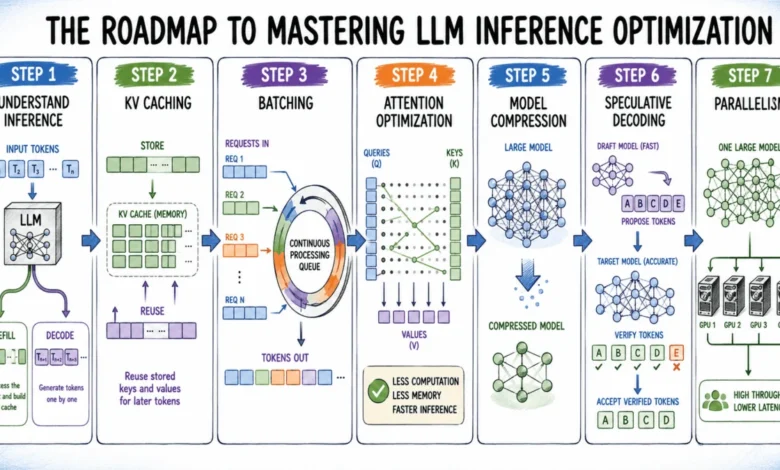
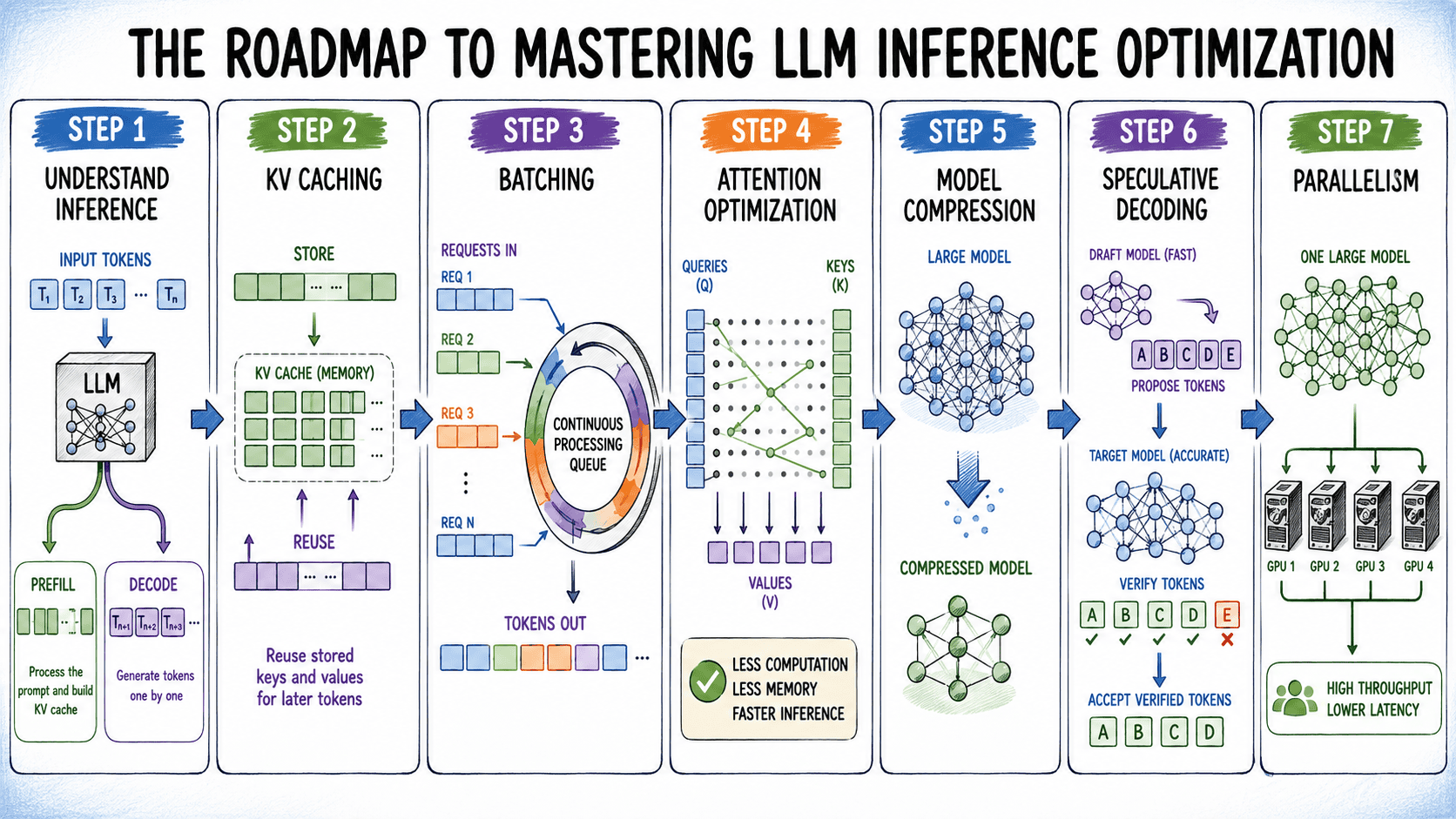
To understand how to optimize LLM performance, one must first deconstruct the two-phase inference process. Every forward pass through a decoder-only architecture is bifurcated into the prefill phase and the decode phase, each exhibiting distinct computational bottlenecks.
During the prefill phase, the model ingests the entirety of the input prompt. Because the input tokens are known simultaneously, the GPU can process these in parallel, effectively saturating its compute cores. This phase is characterized as "compute-bound." The performance of this stage directly dictates the "Time-to-First-Token" (TTFT), a critical metric for user experience in conversational interfaces.
Conversely, the decode phase occurs after the first token is generated. Because LLMs are autoregressive, each subsequent token depends on the preceding ones, necessitating a sequential generation process. In this stage, the bottleneck shifts from compute to memory bandwidth. The GPU spends a disproportionate amount of time fetching model parameters and historical context from memory rather than performing floating-point operations. Consequently, raw GPU power is often less important during the decode phase than memory speed. Engineers optimizing for high-throughput applications must prioritize reducing memory traffic, as this is the primary lever for increasing tokens-per-second (TPS).
The Evolution of KV Cache Management
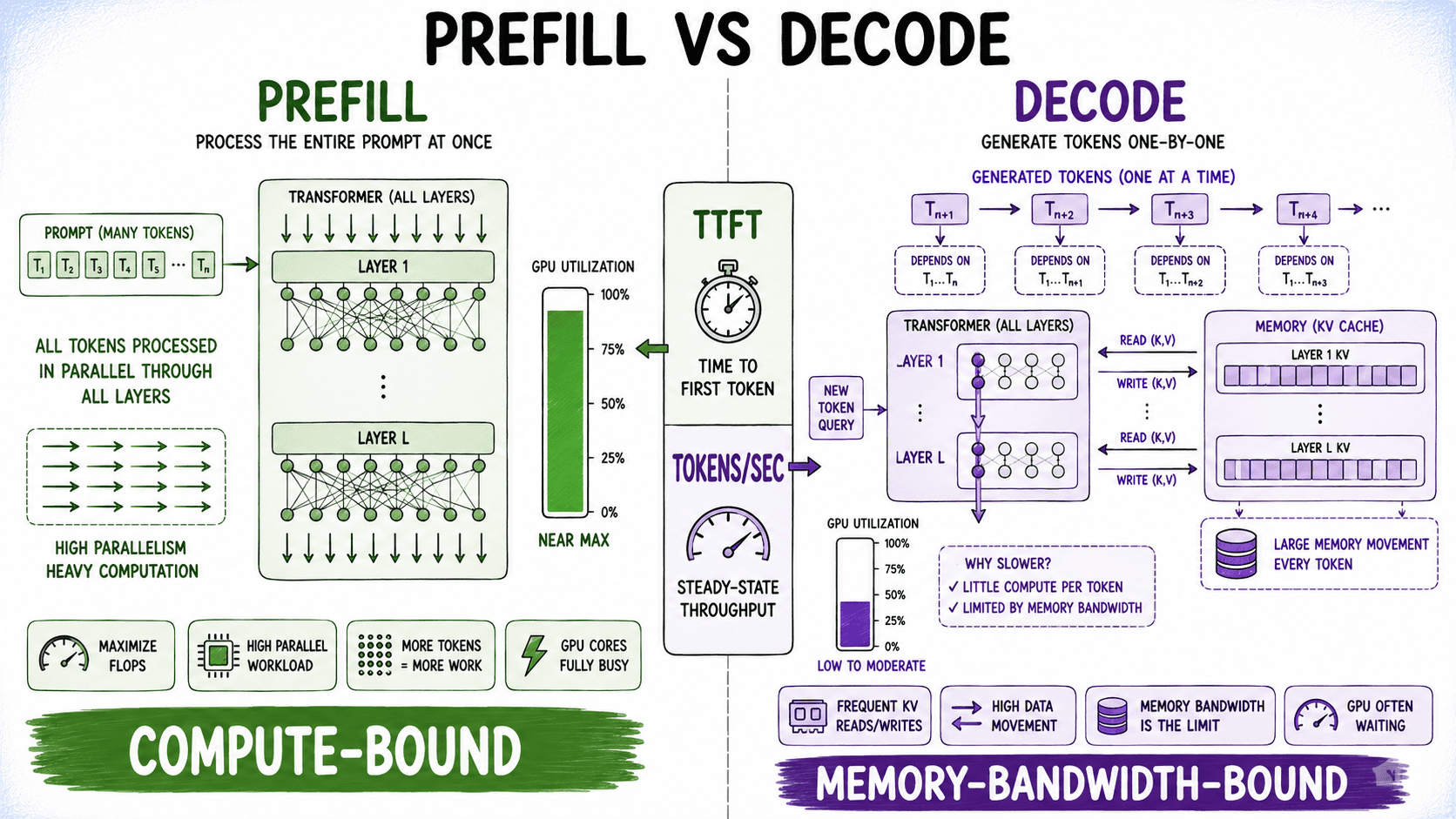
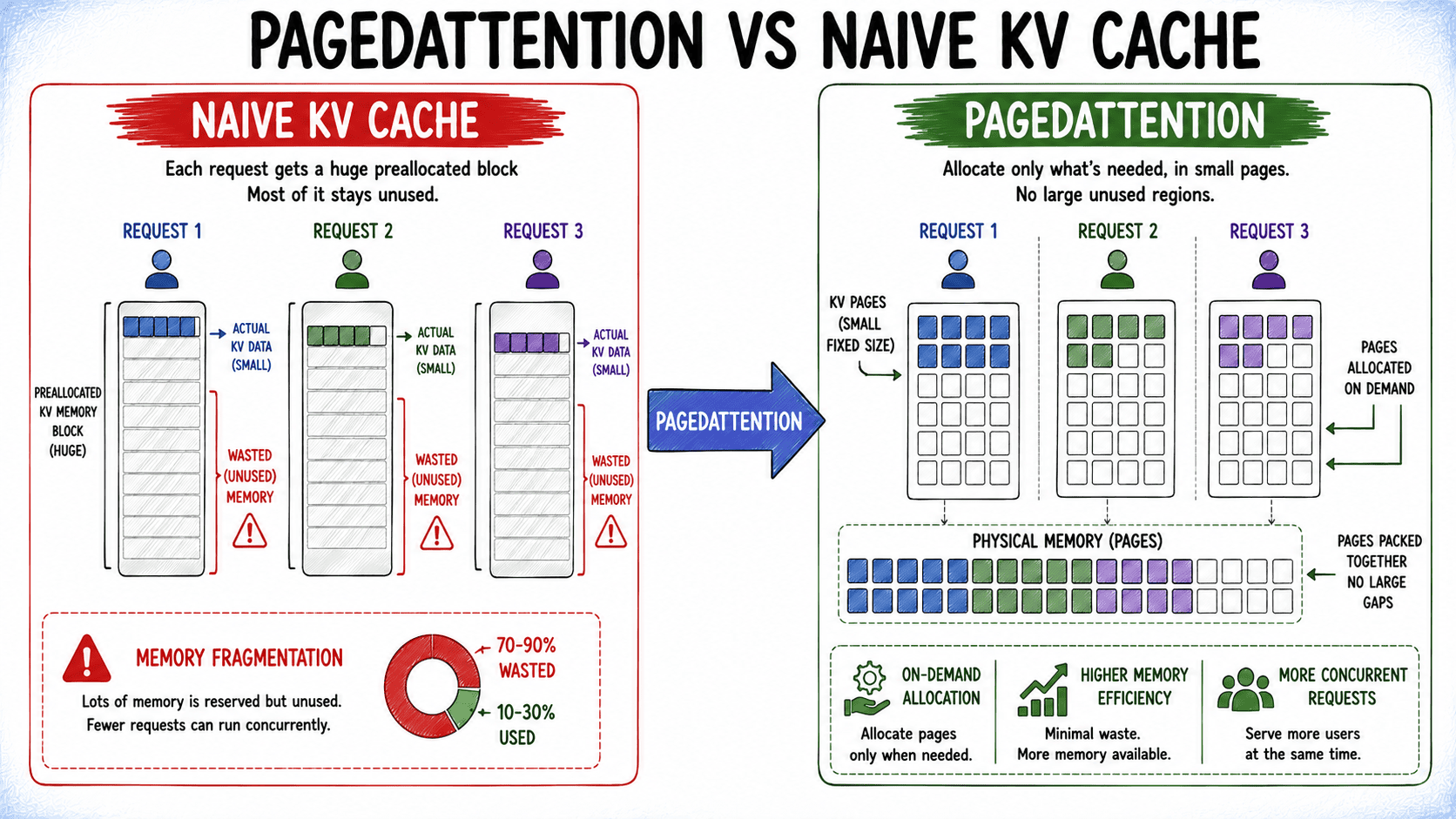
A central challenge in minimizing memory-related bottlenecks is the management of the Key-Value (KV) cache. By storing the intermediate tensors of previous tokens, the model avoids redundant recomputations. However, as sequence lengths grow, the KV cache footprint expands linearly, eventually consuming the entirety of available VRAM.
Historical approaches to this problem involved static memory allocation, where developers pre-reserved space for the maximum possible sequence length. This resulted in significant memory fragmentation, as most requests never reached the maximum threshold. The industry standard has shifted toward PagedAttention, a memory management innovation inspired by virtual memory paging in operating systems. By partitioning the KV cache into non-contiguous blocks, systems can allocate memory on-demand, reducing waste and enabling significantly larger batch sizes.
Furthermore, the rise of "Prefix Caching" has allowed developers to reuse computation for static prompts, such as system instructions or lengthy reference documents in Retrieval-Augmented Generation (RAG) pipelines. By caching the hidden states of these prefixes, systems can bypass thousands of operations per request, drastically lowering operational costs.
The Shift Toward Continuous Batching
The history of batching in machine learning has seen three distinct eras. Early implementations relied on "static batching," where the system waited for a fixed number of requests to arrive before initiating a batch. This approach was highly inefficient, as it was constrained by the longest-running request in the group, forcing faster requests to wait idly.
"Dynamic batching" improved upon this by introducing timeout mechanisms, but it still suffered from the "blocking" problem—if one request took longer to generate, the entire batch was held up. The current state-of-the-art is "continuous batching" (also known as in-flight batching). In this paradigm, the inference engine removes a request from the batch the moment it completes and immediately inserts a new one. This ensures the GPU is kept at near-maximum utilization, regardless of the variance in output lengths. Today, production-grade runtimes like vLLM and NVIDIA’s TensorRT-LLM utilize continuous batching as the bedrock of their scheduling logic, allowing for orders-of-magnitude improvements in throughput.
Architectural Innovations: Attention and Compression
Beyond scheduling and memory, optimizations at the model architecture level have significantly reduced the computational burden. Standard Multi-Head Attention (MHA) is computationally expensive, but variants such as Multi-Query Attention (MQA) and Grouped-Query Attention (GQA) have emerged as preferred alternatives. By forcing multiple query heads to share a single set of key and value heads, these methods reduce memory bandwidth requirements during the decode phase with only negligible impacts on model accuracy.
Complementing these are "drop-in" performance boosters like FlashAttention. Unlike architectural changes, FlashAttention focuses on the input/output (I/O) efficiency of the GPU. By fusing attention operations and utilizing the GPU’s high-speed SRAM, it minimizes the need for frequent writes to slower global memory.
For deployments where memory is the ultimate constraint, model compression remains the most effective lever. Quantization—the process of reducing numerical precision from 16-bit to 8-bit or 4-bit—has become standard practice. Data indicates that moving from FP16 to INT4 can reduce the memory footprint by 75% while maintaining near-original model quality. Combined with structured sparsity—where specific weight patterns are zeroed out to leverage hardware acceleration—quantization allows large models to run on consumer-grade hardware that would otherwise be insufficient.
Addressing Latency: Speculative Decoding
For latency-sensitive applications, such as real-time customer service agents, the autoregressive nature of LLMs presents a hard wall. Speculative decoding attempts to bypass this by utilizing a "draft model." In this workflow, a smaller, lightweight model generates a draft sequence of tokens at high speed. A larger, more accurate "verification model" then evaluates these tokens in parallel. If the draft matches the target, the system accepts multiple tokens in a single iteration. This methodology has been widely adopted for interactive applications where the cost of a slightly less accurate draft is outweighed by the massive reduction in end-to-end latency.
The Broader Implications for Infrastructure
The cumulative effect of these optimizations is profound. As of late 2024, industry leaders have reported that sophisticated inference optimization can reduce total cost of ownership (TCO) by up to 80% compared to baseline implementations. This shift is reshaping the economics of AI; as the "cost per 1,000 tokens" continues to fall, developers are increasingly able to move away from rigid, small-scale deployments toward robust, multi-tenant architectures.
However, these gains come with increased technical complexity. Organizations must now account for the trade-offs between precision, latency, and throughput when selecting a stack. The "disaggregation" of prefill and decode hardware—where separate compute clusters handle the input-heavy and output-heavy phases of a request—is the next frontier in large-scale infrastructure.
As the field matures, the standard for a "production-ready" LLM is no longer merely the quality of its output, but the efficiency of its delivery. For businesses operating at scale, the ability to implement these optimization strategies is no longer optional; it is the fundamental requirement for surviving in an increasingly competitive AI ecosystem. Future developments are expected to focus on hardware-software co-design, where future silicon is specifically engineered to handle the unique memory-bandwidth requirements of the decode-heavy transformer architecture.